








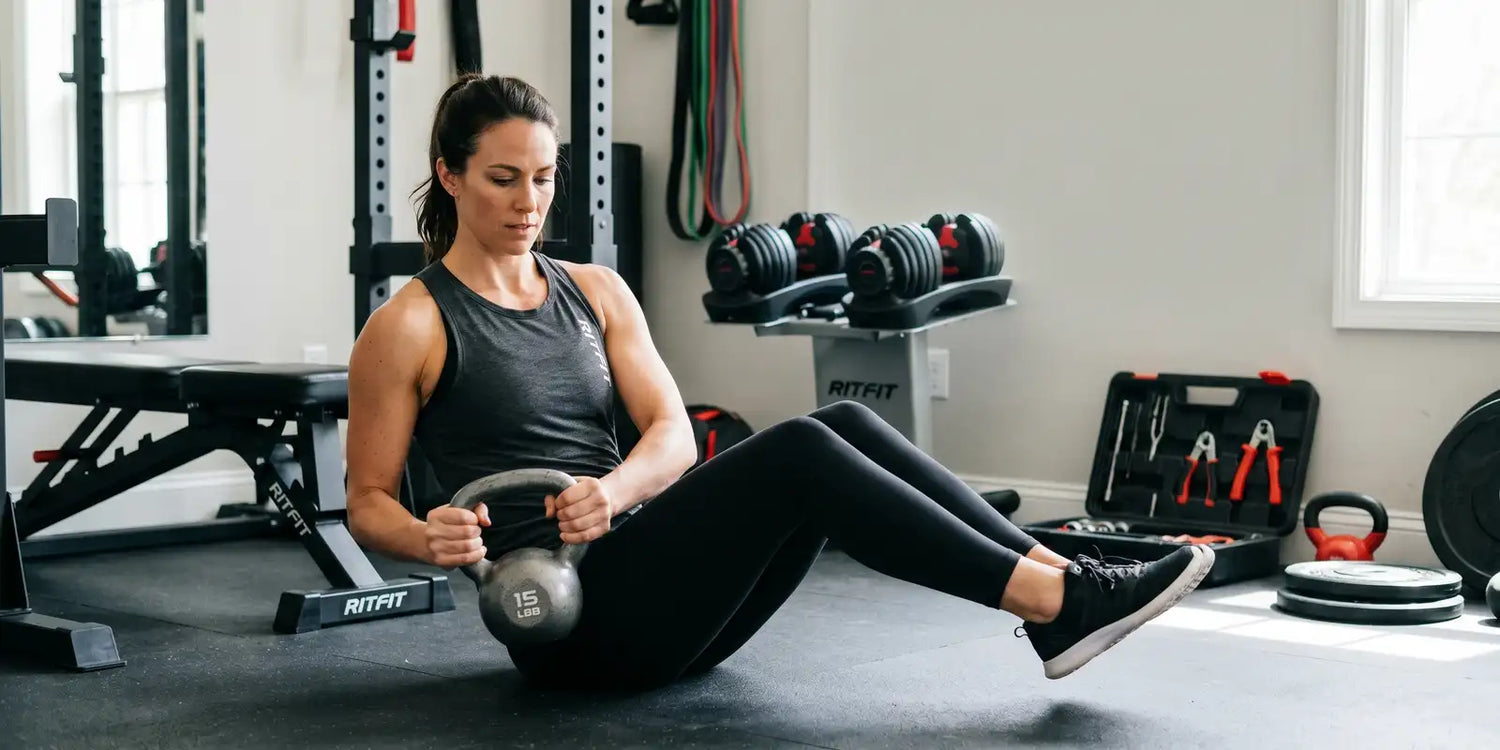
The Russian twist is a seated rotational core exercise that builds your obliques and trunk stability. This guide explains what it is, the muscles it works, how to do it with correct form, and how to scale it safely.
It suits beginners and intermediate lifters training at home or in the gym. You will also learn common mistakes to avoid and when to stop if your lower back complains.
Table of Contents
Key Takeaways
- What it is: A seated twist where you lean back and rotate your torso side to side to train rotational core strength.
- Muscles worked: Mainly the internal and external obliques, with support from the rectus abdominis, transverse abdominis, and hip flexors.
- Form first: Keep your chest tall and rotate from the trunk, not just by swinging your arms.
- Start light: Begin with body weight and feet down, then progress to lifted feet or added load.
- Stop signal: Sharp or pinching lower back pain means stop and switch to a gentler core move.
What Is a Russian Twist?
A Russian twist is a seated rotational core exercise in which you lean your torso back to about a 45 degree angle, brace your midsection, and rotate from side to side. It targets the obliques and trains the trunk to resist and produce rotation.
The movement can be done with body weight alone or with a weight held at your chest for added resistance. It is popular in core circuits, metcon core circuits, and athletic conditioning because it mimics the twisting demands of sport and daily life.
- Movement type: Anti-rotation and rotation control, not a forward crunch.
- Equipment: Optional medicine ball, dumbbell, weight plate, or kettlebell.
What Muscles Does the Russian Twist Work?
The Russian twist mainly works the internal and external obliques, the muscles along the sides of your trunk that drive rotation. It also recruits the rectus abdominis and transverse abdominis to stabilize the spine, while the hip flexors hold your torso in the leaned-back position.
EMG research on related braced core exercises confirms that the internal oblique, external oblique, and transverse abdominis are strongly recruited during controlled trunk work, not just the surface "six-pack" muscle.[3]
- Primary movers: Internal and external obliques.
- Stabilizers: Rectus abdominis, transverse abdominis, and spinal erectors.
- Assisting: Hip flexors hold the trunk angle throughout each set.
One EMG study of sprinters found that a rotational sit-up twist loaded the abdominals without the significant side-to-side imbalance seen in unilateral side bridges, suggesting twist drills train the trunk fairly evenly.[2] Pair this work with a bench ab workout to round out your midsection training.
How Do You Do a Russian Twist Step by Step?
You do a Russian twist by sitting on the floor with knees bent, leaning back to engage your core, lifting your chest, and rotating your torso side to side under control. Move from the trunk and exhale as you twist, keeping the spine tall rather than rounded.
Breathing matters more than most people expect. One study found that performing a curl-up with a strong exhale significantly increased oblique activity compared with a slow or held breath, so exhale firmly as you rotate to each side.[1]
- Step 1: Sit with knees bent and heels lightly planted on the floor.
- Step 2: Lean back to roughly a 45 degree torso angle and brace your abs.
- Step 3: Clasp your hands or hold a weight at lower chest level.
- Step 4: Exhale and rotate your torso to one side, keeping arms in line with the trunk.
- Step 5: Inhale back to center, then exhale and rotate to the other side.
The short clip below from the American College of Sports Medicine demonstrates the setup, torso angle, and controlled rotation clearly.
How Many Reps, Sets, and Weight Should a Beginner Start With?
Beginners should start with 3 sets of 10 to 15 controlled twists per side using body weight and feet on the floor. Add a light 5 to 10 lb weight only once your form stays clean and your back feels strong.
What Variations and Progressions Can You Use?
You can scale the Russian twist by changing your base of support, adding load, or shifting the angle. Progress from feet down, to feet elevated, to holding a weight, so the demand rises as your core control improves.
- Feet down (beginner): Heels planted for the most stability and easiest entry point.
- Feet elevated: Lift your heels off the floor to challenge balance and the hip flexors.
- Weighted twist: Hold a medicine ball, dumbbell, or plate to increase rotational load.
- Decline bench twist: Anchor your feet on a decline bench for a longer range of motion.
Russian twists also fit naturally into timed formats such as Tabata-style intervals and bodyweight core training sessions.
What Are the Most Common Russian Twist Mistakes?
The most common Russian twist mistake is swinging the arms while the trunk stays still, which removes the core from the movement. Other frequent errors include rounding the spine, rushing the tempo, and loading too much weight before form is solid.
- Arms-only swinging: Rotate from the trunk so the obliques drive each rep, not the shoulders.
- Rounded back: Keep the chest tall and spine long to protect the lower back.
- Rushing reps: Slow, deliberate twists keep tension on the core throughout.
- Too much weight: Heavy load early turns the move into momentum tossing rather than core work.
Building deep core control first, similar to the bracing focus in deep core engagement work, makes these fixes much easier to apply.
When Should You Add Weight, Substitute, or Stop?
Add weight only when you can complete all reps with a tall spine and controlled tempo, with no back discomfort. If a twist aggravates your back, substitute a gentler core move, and stop entirely if you feel sharp or pinching pain.
- When to add load: Once bodyweight sets feel easy and form holds, add 5 lb at a time.
- Substitutions: Try dead bugs, side planks, or pallof presses for lower-back-friendly rotation control.
- Frequency: Train rotational core work 2 to 3 times per week with rest between sessions.
- Stop signal: Sharp, shooting, or pinching pain means stop and reassess before continuing.
For a broader conditioning plan that includes core drills, see this core conditioning routine.
Sample Russian Twist Core Circuit
A simple core circuit lets you place the Russian twist alongside complementary movements for balanced trunk training. Run the circuit below for 2 to 3 rounds with short rest between exercises.
| Exercise | Reps or Time | Focus |
|---|---|---|
| Russian Twist | 10 to 15 per side | Rotational obliques |
| Plank | 30 to 45 seconds | Anti-extension core |
| Dead Bug | 8 to 10 per side | Deep core control |
| Side Plank | 20 to 30 seconds per side | Lateral obliques |
FAQs About Russian Twists
What is a Russian twist exercise?
A Russian twist is a seated rotational core exercise where you lean back at about a 45 degree angle, brace your trunk, and rotate your torso side to side. It primarily trains the obliques along with the rectus abdominis and deep core, and it can be done with body weight or by holding a weight for added resistance.
What muscles does the Russian twist work?
The Russian twist mainly targets the internal and external obliques, which drive the rotation. It also recruits the rectus abdominis and transverse abdominis to stabilize the trunk, while the hip flexors and spinal stabilizers keep your torso held in the leaned-back position throughout each controlled twist.
How many Russian twists should a beginner do?
Most beginners start with 3 sets of 10 to 15 controlled twists per side, performed with body weight and feet kept on the floor. Once that feels easy with no back strain, you can lift your feet, slow the tempo, or add a light weight to make the movement more challenging over time.
Are Russian twists bad for your lower back?
Russian twists are not inherently bad, but rounding the spine, rushing the rotation, or using too much weight can strain the lower back. Keep your chest tall and rotate from the trunk rather than just swinging the arms. If you feel sharp or pinching back pain, stop the exercise and choose a gentler core movement instead.
Do you need weights to do a Russian twist?
No. You do not need weights to do a Russian twist. The bodyweight version with hands clasped is effective for beginners and for learning correct form. Adding a medicine ball, dumbbell, or weight plate is simply a progression once you can control the movement and want to increase the demand on your core.
Conclusion
The Russian twist is a simple, scalable way to build rotational core strength using little or no equipment. Focus on a tall spine, controlled rotation from the trunk, and a firm exhale on each twist.
Start with body weight and feet down, then progress to lifted feet or light load as your control improves. If your lower back protests, switch to a gentler core move and build up gradually.
Disclaimer
This article is for general educational purposes only and does not replace personalized medical or fitness advice. Consult a qualified healthcare or training professional before starting new exercises, especially if you have a back condition or injury.
References
1. Kim SH, Park SY. Effect of hip position and breathing pattern on abdominal muscle activation during curl-up variations. Journal of Exercise Rehabilitation. 2018;14(3):445-450. https://pmc.ncbi.nlm.nih.gov/articles/PMC6028217/
2. Kawama R, Ike A, Soma A, Hojo T, Wakahara T. Side-To-Side Difference in Electromyographic Activity of Abdominal Muscles during Asymmetric Exercises. Journal of Sports Science & Medicine. 2022;21(4):493-503. https://pmc.ncbi.nlm.nih.gov/articles/PMC9741726/
3. Dolenec A, Svetina M, Strojnik V. Electromyographic Comparison of an Abdominal Rise on a Ball with a Traditional Crunch. Sensors (Basel). 2022;22(5). https://pmc.ncbi.nlm.nih.gov/articles/PMC8915105/





