








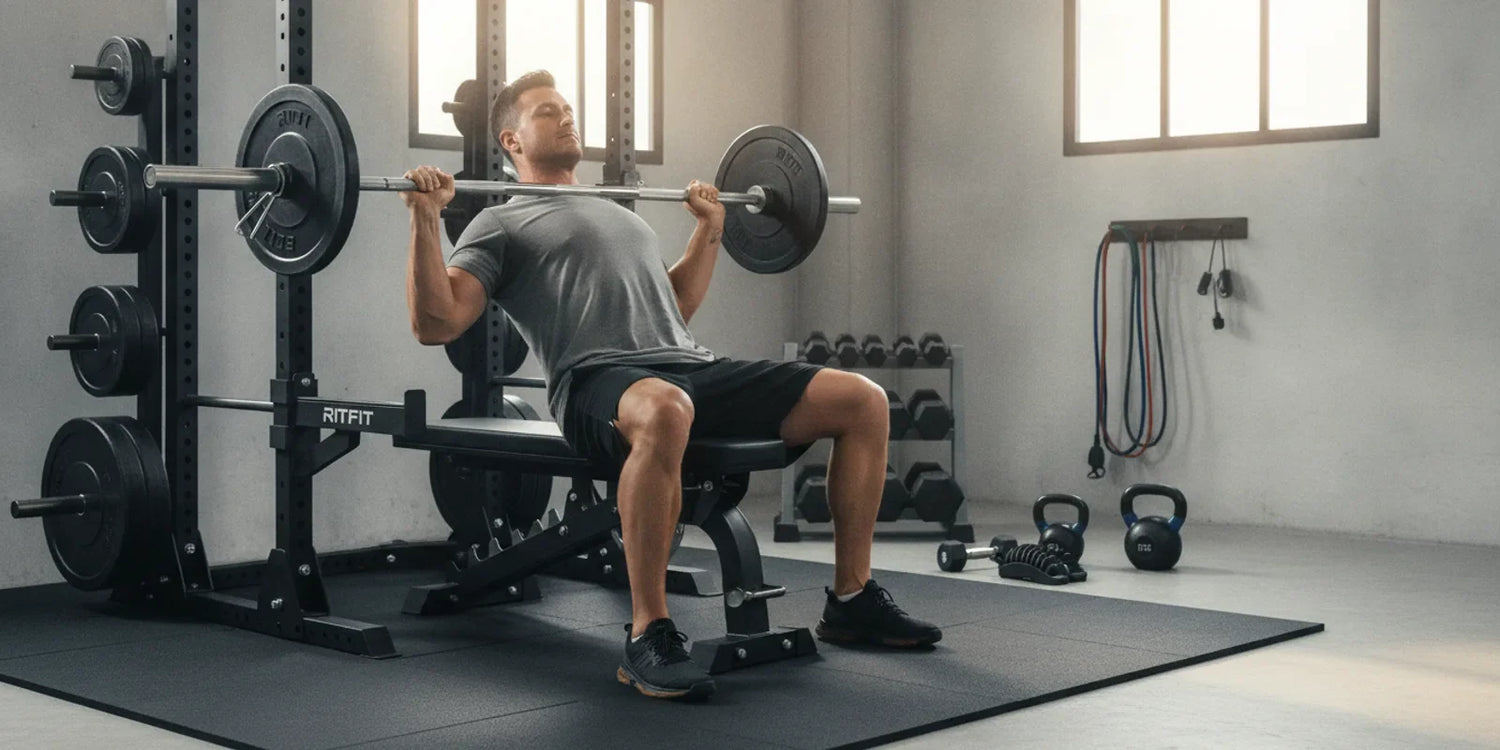
Determining what percentage of body weight should you be able to bench press provides an objective benchmark for upper-body pressing strength. Target strength standards vary significantly based on your biological sex, lifting experience, and individual body proportions.
This comprehensive guide breaks down evidence-based bodyweight ratios across five distinct skill levels and outlines methods to safely build upper-body power.
Quick Answer: Most intermediate male lifters can bench press approximately 1.15 to 1.25 times their body weight, while intermediate female lifters typically target 0.65 to 0.75 times body weight. Beginners generally start around 0.50 times body weight for men and 0.35 to 0.50 times for women before steadily building upper-body pressing capacity.
Key Takeaways
- Intermediate Bench Ratios: Men typically press 1.15 to 1.25 times body weight while women press 0.65 to 0.75 times body weight.
- Bodyweight Milestone: Benching 1.0 times your body weight represents a solid intermediate benchmark for men and an advanced milestone for women.
- Allometric Scaling Effect: Lighter lifters naturally exhibit higher strength-to-weight percentages because muscular force scales with cross-sectional area rather than total mass.
- Submaximal Testing Safety: Calculating one-rep maximums using 3-to-5 repetition sets reduces joint strain and injury risk during ratio evaluations.
- Consistent Frequency: Pressing two to three sessions weekly with progressive overload provides optimal neuromuscular stimulation for steady ratio improvement.
What Percentage of Body Weight Should You Bench Press on Average?
Recreational lifters should generally aim to bench press between 0.50 and 1.50 times their total body weight depending on their current experience level. Untrained individuals typically start around 0.50 times body weight, while competitive strength athletes regularly exceed 1.50 times body weight.
Establishing a personalized baseline helps lifters set realistic milestones without falling into unrealistic expectations. Utilizing heavy-duty weight benches paired with calibrated free weights ensures a stable foundation for consistent progress.
- Beginner Baseline: Lifting 0.50 to 0.75 times body weight develops initial neuromuscular coordination.
- Intermediate Target: Achieving 1.00 to 1.25 times body weight reflects dedicated multi-year resistance training.
- Advanced Achievement: Reaching 1.50 times body weight or higher demands specialized powerlifting programming.
For more detailed baseline guidelines, explore our in-depth analysis on how much should I be able to bench across various training backgrounds.
What Are the Bench Press Bodyweight Standards by Experience Level?
Bench press strength standards scale systematically across five developmental tiers ranging from untrained beginners to elite competitive powerlifters. Research indicates that upper-body pressing capacity strongly correlates with structured resistance training experience over time[1].
| Experience Level | Male Ratio (% BW) | Female Ratio (% BW) | Primary Characteristics |
|---|---|---|---|
| Untrained | 0.50x (50%) | 0.35x (35%) | No prior structured resistance training experience |
| Novice | 0.75x (75%) | 0.50x (50%) | Under six months of consistent pressing technique |
| Intermediate | 1.15x (115%) | 0.70x (70%) | One to two years of progressive overload training |
| Advanced | 1.50x (150%) | 0.90x (90%) | Multiple years of dedicated strength and hypertrophy focus |
| Elite | 1.80x+ (180%+) | 1.15x+ (115%+) | Competitive powerlifting and national-level strength athletes |
Standards derived from community strength databases and clinical exercise science cohorts.
Progressing between tiers requires loading gradual increments using precision weight plates. Loading progressive resistance methodically allows connective tissues and stabilizing musculature to adapt alongside prime movers.
How Do Gender and Anthropometry Affect Bench Press Ratios?
Biological sex and upper-body skeletal anthropometry substantially dictate relative bench press leverage and absolute force production capacity. Men naturally possess greater upper-body muscle mass and broader clavicles, whereas women exhibit distinct neuromuscular recovery profiles[2].
Individual limb lengths also heavily influence bar path mechanics and range of motion. Lifters with shorter humerus bones enjoy mechanical leverage advantages over long-limbed individuals when pressing on a robust RitFit 1300lb Adjustable Weight Bench.
"Women lift about 67% as much as men in the squat, 56% in the bench, and 71% in the deadlift, on average. However, those gaps are larger when looking at less successful lifters and smaller when looking at more successful lifters, a 90th percentile woman has about 63% as much relative bench press strength as a 90th percentile man."
, Greg Nuckols, MA, Strength Researcher and Coach, holder of multiple powerlifting world records, Stronger By Science
Why Do Lighter Lifters Bench a Higher Percentage of Body Weight?
Lighter athletes achieve higher bodyweight bench press ratios because muscular strength scales with cross-sectional area rather than volumetric body mass. The square-cube mathematical law explains why relative strength diminishes as absolute body mass increases[3].
A 150-pound lifter benching 225 pounds achieves a 1.50x ratio, whereas a 250-pound lifter pressing 325 pounds hits a 1.30x ratio despite moving 100 pounds more. Heavy lifters should evaluate both absolute poundage and relative percentages when selecting matching barbells and weight plates for progression.
- Cross-Sectional Force: Muscle contractile strength increases proportionally to two-dimensional muscle cross-section.
- Volumetric Mass: Body weight increases proportionally to three-dimensional physical volume.
Understanding allometric scaling prevents heavy lifters from becoming discouraged when comparing bodyweight percentages with lighter training partners.
How Do You Safely Test and Increase Your Bench Press Ratio?
Testing your bench press ratio safely involves calculating a predicted one-rep maximum from a controlled multi-rep set rather than attempting a dangerous true single. Performing three to five strict repetitions to technical fatigue yields accurate max estimates while protecting vulnerable shoulder joints.
To continually drive ratio adaptations, train compound pressing movements across varying incline angles on a RitFit Gator Adjustable Weight Bench. Maintaining strict scapular retraction, driving with the legs, and controlling the eccentric tempo guarantees long-term progression.
FAQs About Bench Press Bodyweight Ratios
What percentage of my body weight should I be able to bench press?
An intermediate male lifter can generally bench press approximately 1.15 to 1.25 times his body weight, while an intermediate female lifter typically benches around 0.65 to 0.75 times her body weight. Beginners start around 0.50 to 0.75 times body weight for men and 0.35 to 0.50 times for women. These target ratios shift with training age, sex, and individual anthropometric proportions.
Is benching your own body weight considered good?
Benching 1.0 times your body weight is a respected milestone representing solid upper body pressing power. For men, pressing 100 percent of body weight marks a smooth transition between novice and intermediate strength. For women, a 1.0 times bodyweight bench press is an advanced achievement attained after dedicated strength training.
Why do lighter lifters bench a higher percentage of their body weight?
Strength scales with muscle cross-sectional area rather than body mass due to the allometric scaling principle. Muscle force increases with area while total body mass increases with volume, making lighter athletes naturally achieve higher strength-to-weight ratios than heavier lifters despite lower absolute loads.
How do you safely determine your one-rep max bench press?
Lifters can safely estimate a one-rep max by performing a submaximal three to five repetition set to near failure and applying standard predictive formulas. Always use reliable safety spotter arms on a sturdy power rack or recruit a dedicated spotter before attempting heavy testing sets.
How many times per week should you bench press to improve your ratio?
Training the bench press two to three times weekly provides the optimal balance of neuromuscular stimulation and muscle recovery. Incorporating diverse variations such as close-grip presses, paused reps, and incline work will consistently drive progressive overload and strength ratio gains.
Conclusion
Assessing what percentage of body weight should you be able to bench press provides an objective framework for tracking upper-body pressing development. Target benchmarks transition from 0.50 times body weight for novices up to 1.50 times body weight for advanced athletes.
Start by determining your baseline ratio with safe submaximal testing, maintain progressive overload, and review the RitFit discount guide to outfit your training space with professional strength equipment.
Disclaimer
This article provides general strength training information and does not constitute personalized medical or fitness advice. Consult a qualified medical practitioner or certified strength coach before starting new heavy lifting protocols.
References
1. Ferland PM, Pollock A, Swope R, et al. The Relationship Between Physical Characteristics and Maximal Strength in Men Practicing the Back Squat, the Bench Press and the Deadlift. Int J Exerc Sci. 2020;13(4):281-297. doi:10.70252/AJSZ9846. PMCID: PMC7039481
2. Ferland PM, Laurier A, Comtois AS. Relationships Between Anthropometry and Maximal Strength in Male Classic Powerlifters. Int J Exerc Sci. 2020;13(4):1512-1531. doi:10.70252/WKTF5547. PMCID: PMC7745913
3. García-Ramos A, Janicijevic D, Jukic I. Concentric-Only Versus Touch-and-Go Bench Press One-Repetition Maximum in Men and Women. Sports Health. 2021;13(4):373-379. doi:10.1177/1941738120977861. PMCID: PMC8645326





