








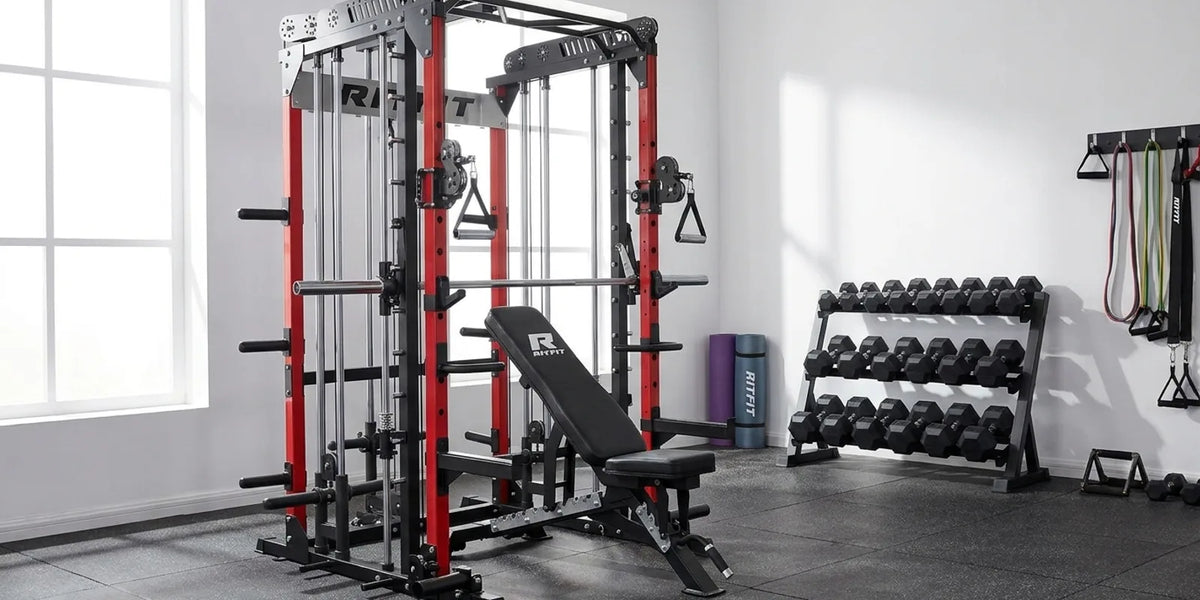
The wide grip bench press smith machine combination loads your chest in a stretched position while the fixed rails keep every rep on the same near-vertical path. Solo lifters get the wide-grip stretch without balancing a free bar or hunting for a spotter.
This guide covers exact grip width, bar landing, shoulder setup, hook height, and load rules, plus honest shoulder limits and the mechanics that separate wide grip from standard and close grip.
Quick Answer: The wide grip bench press works on a Smith machine because the press path stays nearly vertical and the fixed rails hold it there. Set the hooks just below chest height, place your hands about 1.5 to 1.7 times shoulder width, and press with less weight than your standard-grip bench press.
Key Takeaways
- Fixed Path Fit: The wide-grip press travels on a near-vertical path, so fixed Smith machine rails guide it without fighting the movement.
- Grip Setup: A wide grip sits well outside your standard bench grip, hands around 1.5 to 1.7 times shoulder width with wrists stacked over the forearms.
- Chest Stretch, Shoulder Cost: Wide grip loads the chest in its most stretched position but raises shoulder stress, so mobility limits decide how wide you should go.
- Solo Safety: Hook catches set just below chest height replace a spotter and let you bail out of any failed rep.
- Load And Progression: Begin lighter than your standard-grip bench press, own the groove, then add weight in small steps.
Can You Do Wide-Grip Bench Press on a Smith Machine?
Yes, the wide-grip bench press works on a Smith machine because the press path stays nearly vertical and the fixed rails hold that path for every rep.
The rails absorb the outward push that a wide grip creates instead of your stabilizers fighting it. A 2023 force and EMG study measured an 81 cm wide grip pushing outward with lateral force around 30 percent of vertical force, the pectoralis-to-triceps activity ratio barely changing with hand width, and trained lifters averaging 81.3 kg on wide-grip 10-RM sets versus 65.9 kg with narrow grip[1].
On a free bar the wide grip tilts the force vector sideways, and balancing that load is where solo lifters run into trouble. Guided rails remove the balance demand and let you push the wide groove with full attention on your chest.
- Path Match: The wide-grip press travels up and down in nearly one line, so guided rails do not distort the movement.
- Solo Bailout: Hook catches set just below the chest catch the bar on any failed rep and replace a spotter.
- Frame Fit: Competition-maximum 81 cm index-finger spacing fits inside standard Smith machine uprights, so hand width never collides with the frame.
Fixed-path pressing carries its own pros and risks, so read the full Smith machine bench press pros and risks breakdown before you load the bar. The wide variation adds chest stretch on top of that foundation.
"Few pieces of equipment in the home exercise industry are as comprehensive and versatile as this all-in-one gym system. The robust system provides a natural, centered bar path for compound lifts like squats, presses, and rows, and incorporates a dual cable crossover station with a full rack of precision-engineered attachments."
Tom Eskey, CF-L1, CPT, Garage Gym Revisited, RitFit M1 Multi-functional Smith Machine Review
Set a Wide Grip Wider Than Your Standard Grip
A wide grip places your hands roughly 1.5 to 1.7 times your shoulder width, clearly wider than the standard bench grip most lifters use. A 2020 biomechanical analysis set the wide condition at 1.7 times acromial width, about 71 cm between the hands, versus 1.4 times and 56 cm for a medium grip[2]. Competitive bench press rules cap index fingers at 81 cm, which is the practical ceiling for any wide setup.
Where the Bar Lands and How Your Wrists Sit
- Measure First: Acromial width means the distance between the bony points on top of your shoulders, so measure once and multiply before you grab the bar.
- Wider Than Standard: A standard bench grip sits a bit outside shoulder width, so the wide setup should add roughly one to two palm widths per side.
- Wrist Stack: Keep each wrist directly over its forearm so the bar loads bone structure rather than a bent wrist at the bottom.
- Bar Landing: A wider grip brings the bar down slightly lower on the chest, around the lower-mid chest line, with the forearms vertical at the bottom.
The wide hand spacing also shortens the range of motion slightly and opens the shoulder angle at the bottom, which is exactly the stretch the wide grip is chosen for. Set the grip before your first working set and keep it identical across sets so the groove stays measurable.
Watch the grip width taught rep by rep in this wide-grip bench press walkthrough before your first working set.
How to Set Up Wide-Grip Bench Press on a Smith Machine
The full wide-grip Smith machine setup takes five steps, from bench placement to lockout, and every step protects either your shoulders or your safety margin. Work through them in order on your first sessions even if the movement already feels familiar.
- Step 1: Center the bench: Roll the flat bench so your eyes finish just under the bar path, which sets the line the bar travels on every rep.
- Step 2: Set the hooks low: Choose the catch height that sits just below your chest with the arms extended, so a failed rep lands on the catches instead of on you.
- Step 3: Build your base: Plant your feet, pull your shoulder blades back and down into solid scapular retraction, and keep a light natural arch through your upper back.
- Step 4: Take the wide grip: Place your hands at 1.5 to 1.7 times shoulder width, stack the wrists, and rotate the bar to clear the hooks.
- Step 5: Lower and press: Bring the bar to your lower-mid chest with a slow eccentric phase and moderate elbow flare, pause briefly, then press to lockout without bouncing.
Lifters who are new to fixed-path pressing should own the standard groove first, and the Smith machine bench press guide walks through that baseline setup. Widen the grip only after the standard path feels automatic under load.
The upper-body pressing footage below shows how a wide pressing session flows inside a real Smith machine workout.
Wide Grip vs Standard Grip vs Close Grip
Wide grip emphasizes chest stretch and shoulder horizontal abduction, standard grip balances chest and triceps, and close grip shifts the work to the triceps. The three grips share one bar path but change the joint moments enough to train your upper body differently.
In a 2021 EMG study of 28 men, wider grip raised biceps brachii activity, wide grip lowered triceps activation versus medium and narrow grips, and narrow grip produced the lowest 6-RM loads[3]. That matches what lifters feel at the bar: wide grip stretches the chest and steals triceps leverage, while close grip does the opposite.
Wide grip also shortens the range of motion slightly and works the sternal pectoralis major hardest in the stretched position near the bottom. Grip-width work ties the sticking region just off the chest to greater horizontal shoulder moments with wide and medium grips, so the bottom is where the wide setup earns its stress.
| Grip | Hand Placement | Primary Emphasis | Shoulder Stress |
|---|---|---|---|
| Wide | About 1.5-1.7x shoulder width | Chest stretch, mid-chest focus | Highest of the three |
| Standard | About 1.4x shoulder width | Balanced chest and triceps | Moderate |
| Close | Inside shoulder width | Triceps and lockout strength | Lower on shoulders, more elbow load |
Grip widths follow the measured conditions in the references, and shoulder stress reflects the joint moment changes they describe.
Lifters often describe the stretched wide position as hitting the mid-chest line harder, and that feel comes from loading the pecs at a larger shoulder horizontal abduction angle rather than from a proven inner-chest isolation effect. Pick wide grip for chest stretch and mid-chest focus, not because it is universally better than the other two.
Want the opposite bias? The close-grip bench press guide covers the triceps-dominant variation with its own grip and elbow rules.
Choose the Right Weight for Wide-Grip Pressing
Your first wide-grip sessions should use 10 to 20 percent less weight than your standard-grip Smith machine bench press, then rebuild the load as the groove feels controlled. The wider hand position shifts more stress toward the chest and shoulders, so the conservative start protects joints that have not been loaded at this angle before.
- Warm-Up Sets: Empty bar for 10 to 15 reps, then two or three progressive jumps before the working weight.
- Working Reps: 6 to 10 reps per set suits wide-grip pressing, with 2 to 3 minutes of rest between heavy sets.
- Load Tolerance: Pinching at the bottom means the weight or the grip is too aggressive, so trim both before continuing.
- Hook Check: Confirm the catches sit below chest height before every working set, because wide-grip bails are harder to save mid-rep.
Load capacity varies with grip width and training experience rather than dropping automatically, so treat the lighter start as groove building and not a permanent ceiling. The wide position can move serious weight once the elbows and shoulders own the path, and the fixed rails let you push close to that limit without a spotter.
Does the RitFit M3 PRO Smith Machine Work for Wide-Grip Bench Press?
Yes, the RitFit M3 PRO Smith Machine supports wide-grip bench pressing with a fixed bar path, adjustable hook positions, and room inside the frame for a flat bench. The guided bar keeps every rep on the same vertical line, so the wide grip changes your leverage rather than the bar path. Solo lifters get the full wide-grip setup without a spotter because the hook catches cover every height the bench needs.
For a garage gym that trains chest, back, and legs in one footprint, the machine's bench pressing role is simple to judge: load it like a rack, press inside the Smith path, and let the catches handle the risk. One frame covers wide, standard, and close-grip pressing plus the cable work that follows.
Stability under heavy pressing is the durability question that matters here, and M3 family owners describe the frame as solid under daily training. Versatility comes from the same station handling all three pressing variations plus rows, pulldowns, and accessory work.
Choose the RitFit M3 PRO for Wide-Grip Pressing
Three checks decide whether this machine matches your wide-grip goals, and each one maps to something you can verify before ordering.
- Bench Clearance: Upright spacing must fit your flat bench with the bar landing on your lower-mid chest line.
- Hook Density: Closely spaced catch positions let solo lifters set the safety line just below chest height.
- Frame Stability: Heavy-gauge uprights keep the guided bar quiet and steady when the wide grip pushes outward.
Shoppers comparing machines for bench pressing can compare footprints and hook layouts in the best Smith machine for bench press at home guide before deciding.
"This machine is fabulously sturdy and gives the opportunity to do a complete body workout in one place!"
Charla W. Verified Buyer, M3 Power Rack Cable Crossover Smith Machine
Shoulder Risks and Common Mistakes for Wide-Grip Pressing
Wide grip raises horizontal shoulder moments more than medium or narrow grip, so lifters with limited shoulder mobility should widen gradually and stop at the first sharp pain. The most common mistakes are gripping too wide, flaring the elbows hard, bouncing the bar, and setting the hooks too high.
- Grip Too Wide: Going past your mobility pinches the shoulder at the bottom, so back the hands in until the descent stays pain-free.
- Elbow Flare: Wild flaring stacks stress on the shoulder capsule and lengthens the moment arm at the shoulder, so keep a moderate flare with vertical forearms.
- Bar Bounce: Bouncing off the chest turns a strength rep into a tendon rep, so touch lightly and pause briefly.
- Hooks Too High: Catches above chest height block the descent, so set them one notch below your lowest bar position.
- Stop Signals: Sharp front-shoulder pain, pinching, or numbness means end the set, unload, and reassess grip width before the next session.
Shoulder mobility earns you the right to go wider over weeks, not in one session, and thoracic spine work helps the upper back hold the arch.
When Should You Stop the Wide-Grip Bench Press?
Sharp front-shoulder pain, pinching, or numbness ends the set immediately and pauses the exercise until the cause is clear. A history of shoulder injury means clearing the wide setup with a physician or physical therapist before loading it.
Program Wide-Grip Bench Press Sets, Reps, and Alternatives
Two to four sets of 6 to 10 reps, once or twice a week, fit most lifters who want chest emphasis without overloading the shoulders. Add weight only when every rep of the final set moves at the same speed, and swap in alternatives whenever the shoulders need a break.
- Substitute Movements: Dumbbell bench press, machine chest press, and close-grip Smith press cover the same slot when the shoulders need a change.
- Deload Weeks: Every 4 to 6 weeks, cut the working weight and keep the technique so the wider shoulder angle stays healthy.
If your home gym still needs a machine that handles pressing and everything after it, the M1 Multi-Functional Home Gym Smith Machine keeps the whole push day in one footprint. Browse the full Smith machine collection to compare footprints and hook layouts before you commit.
How Often Should You Train It and When Do You Add Weight?
Run wide-grip pressing once or twice per week inside a push day, leaving at least 72 hours before the next heavy chest session. Add 2.5 to 5 lb per side only when every rep of the final set moves at the same bar speed.
FAQs About Wide-Grip Bench Press on a Smith Machine
Can you do a wide-grip bench press on a Smith machine?
Yes, the wide-grip bench press works on a Smith machine because the press path stays nearly vertical and the fixed rails keep it there. Set the hook catches just below your chest height so the bar can be re-racked safely even when you train alone without a spotter.
How wide should your grip be for a wide-grip bench press?
A practical wide grip sits around 1.5 to 1.7 times your shoulder width, which research placed near 71 cm between the hands, with competition rules capping index fingers at 81 cm. Start slightly wider than your standard grip and keep your wrists stacked directly over your forearms.
Is wide-grip bench press harder on the shoulders?
Yes, a wider grip increases horizontal shoulder moments and shoulder stress compared with medium or narrow grips. Lifters with limited shoulder mobility should widen gradually, keep the elbows moderately flared, and stop the set immediately if sharp shoulder pain appears.
What muscles does the wide-grip Smith machine bench press work?
The wide-grip Smith machine bench press trains the sternal pectoralis major through a deep stretch, with the front deltoids assisting and the biceps acting as stabilizers. Triceps involvement drops compared with close grip, where elbow extension dominates the lift instead.
How much weight should you use for wide-grip bench press on a Smith machine?
Start with roughly 10 to 20 percent less than your standard-grip Smith machine bench press load for the first sessions. The wider hand position shifts more stress to the chest and shoulders, so rebuild the load gradually once the movement feels controlled.
Should the bar touch your chest with a wide grip?
Lower the bar to around your lower-mid chest where your forearms stay vertical, then press back up without bouncing. If reaching your chest forces your shoulders to roll forward or causes pain, shorten the range of motion and work on shoulder mobility first.
Is wide grip better than standard grip on a Smith machine?
Neither grip is universally better. Wide grip emphasizes chest stretch and shoulder horizontal abduction, standard grip balances chest and triceps, and close grip shifts work to the triceps, so rotate them based on your goal and how your shoulders feel.
Conclusion
The wide grip bench press earns its place on a Smith machine when you want chest stretch without a spotter. Set the grip wide but inside your mobility, keep the hooks below chest height, and progress the load slowly.
New lifters should own the standard groove first, then widen over time. When you are ready to build out the rest of the home gym, check the RitFit discount guide for current savings.
Disclaimer
This article provides general training information and is not medical advice or a diagnosis of shoulder conditions. Stop any exercise that causes sharp pain, and consult a qualified physician or physical therapist before starting a new strength program.
References
1. Tanimoto M, Arakawa H, Sato M, Nagano A. Lateral Force and EMG Activity in Wide- and Narrow-Grip Bench Press in Various Conditions. Sports (Basel). 2023;11(8). doi:10.3390/sports11080154. PMCID: PMC10458411
2. Larsen S, Gomo O, van den Tillaar R. A Biomechanical Analysis of Wide, Medium, and Narrow Grip Width Effects on Kinematics, Horizontal Kinetics, and Muscle Activity on the Sticking Region in Recreationally Trained Males During 1-RM Bench Pressing. Front Sports Act Living. 2020;2:637066. doi:10.3389/fspor.2020.637066. PMCID: PMC7862765
3. Saeterbakken AH, Stien N, Pedersen H, Solstad TEJ, Cumming KT, Andersen V. The Effect of Grip Width on Muscle Strength and Electromyographic Activity in Bench Press among Novice- and Resistance-Trained Men. Int J Environ Res Public Health. 2021;18(12). doi:10.3390/ijerph18126444. PMCID: PMC8296276





