Choosing a workout bench comes down to one decision before anything else: do you need a fixed flat bench, or an adjustable bench that also inclines and declines? Get that right and the rest is just checking specs.
This guide walks through the main bench types, the specs that actually matter, how to fit one in your space, and the buying mistakes that quietly waste money.
Quick Answer: The best workout bench for most home gyms is an adjustable flat-incline or FID bench, because it covers flat pressing plus incline, shoulder, and decline work on one frame. Choose a dedicated flat bench only if you almost exclusively barbell bench press and want maximum stability.
Key Takeaways
- Start with bench type: Decide flat, adjustable, or FID before comparing brands or prices.
- Adjustable wins for most: One adjustable bench replaces several stations in a home gym.
- Specs over features: Prioritize weight capacity, pad width, pad gap, pad height, and frame gauge.
- Measure first: Check floor footprint and rack fit before you buy, not after.
- Use the full range: Rotate flat, incline, and decline angles instead of pressing only flat.
What Are the Main Workout Bench Types?
The four main workout bench types are the flat bench, the adjustable incline bench, the FID bench, and the Olympic bench. They differ mainly in how the backrest moves and how many exercises each can support.
- Flat bench: A fixed horizontal pad with no moving parts, making it the most stable platform for barbell bench pressing.
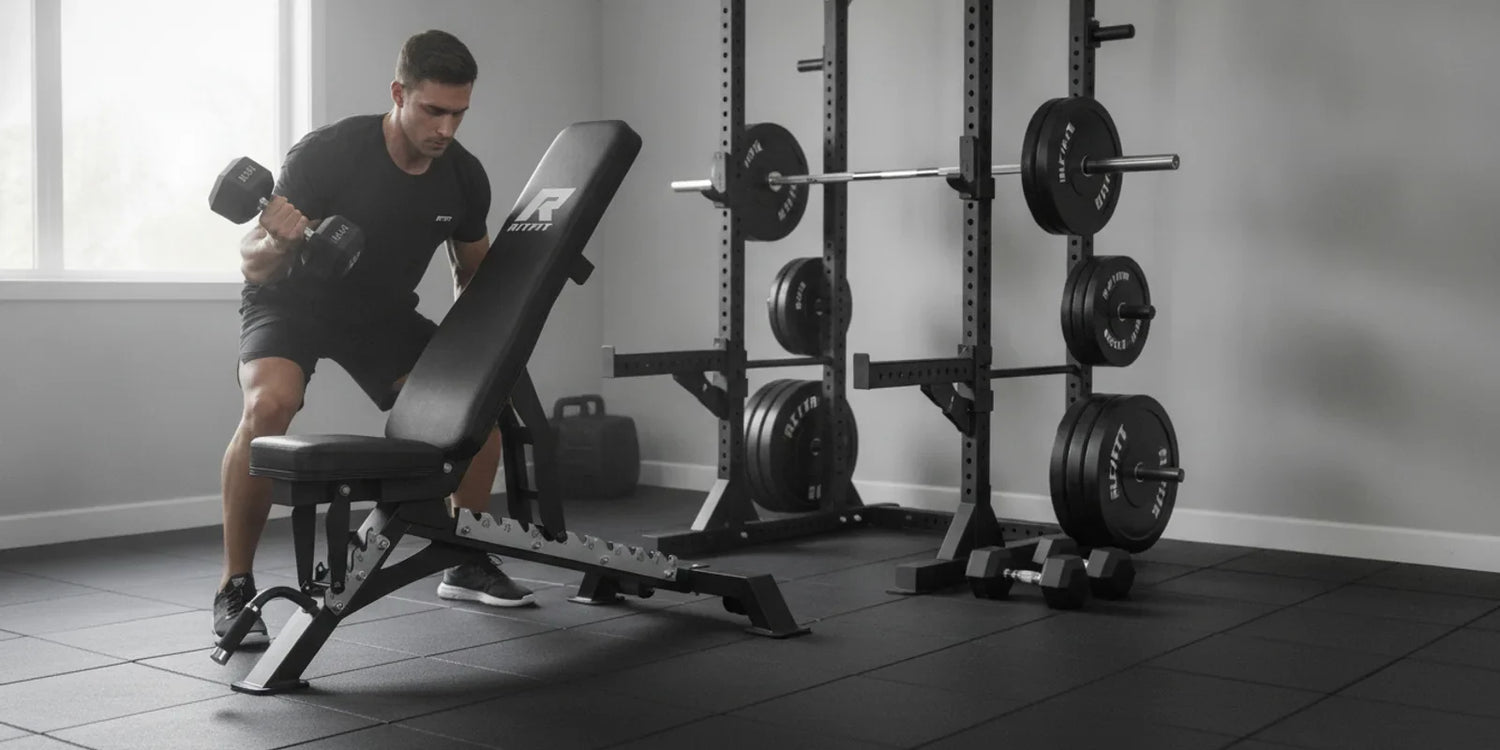
- Adjustable bench: A movable backrest that travels from flat through incline angles, usually up to about 85 degrees for seated work.
- FID bench: An adjustable bench that adds a decline position, typically around minus 15 to minus 30 degrees, covering the widest exercise range.
- Olympic bench: A flat or adjustable pad paired with fixed barbell uprights, built for self-spotted pressing without a separate rack.
If you are still mapping out routines, the bench workout guide shows what each type lets you train. For broader sessions, see full-body workouts with a home workout bench, or start with a versatile model like the RitFit 1300 lb Adjustable Weight Bench.
Which Workout Bench Is Right for You?
The right workout bench is the one that matches your main training goal and your available space. Match your dominant lift and footprint to a bench type using the matrix below.
| Your Priority | Best Bench Type | Why It Fits |
|---|---|---|
| Barbell bench press only | Flat bench | Most stable, simplest, lowest cost for one job |
| General strength and bodybuilding | Adjustable or FID | Covers incline press, shoulder work, and dumbbell variety |
| Full exercise library | FID bench | Adds decline for chest and core, most versatile |
| Pressing without a spotter | Olympic bench | Fixed uprights allow safer self-spotted pressing |
| Tight floor space | Foldable adjustable | Folds or stands upright to free the room when stored |
Bench selection by training goal and space, within the RitFit bench line.
For example, a lifter doing hip thrusts and step-ups should see leg workouts at home with a bench to confirm an adjustable model fits those movements.
Which Specs Actually Matter When Buying a Bench?
The specs that matter most when buying a bench are weight capacity, pad width, pad gap, pad height, and frame gauge. These determine stability, comfort, and safety far more than cosmetic features.
- Weight capacity: Aim for 700 lb or more so the rated load comfortably covers your body weight plus the bar and plates.
- Pad width: Look for 11 to 12 inches, wide enough to support your shoulders without limiting arm movement.
- Pad gap: Keep the gap between seat and back pad small so you do not sink in during incline or decline work.
- Pad height: Around 17 to 17.5 inches suits bench pressing, letting most lifters plant their feet flat on the floor.
- Frame gauge: Choose 11 to 12 gauge steel, since lower gauge numbers mean thicker, more rigid tubing.
Matching these specs to your lifts pays off across accessory moves too, like the core work in this bench ab workout.
How do you measure your space and check rack fit?
Measure the bench footprint plus walking clearance, then confirm the bench length and pad height work under your rack uprights and J-cups.
What Incline Angle Should You Use?
An incline between 30 and 45 degrees emphasizes the upper chest while keeping the shoulders from taking over the movement. Steeper angles gradually turn an incline press into a shoulder press.
In one chest-exercise study, an adjustable-backrest weight bench was used with loads at 15 and 30 percent of body weight, and the authors recommended starting light and with supervision[1]. A study comparing bench angles found that a flat bench produces the highest activation in the sternocostal head of the pectoralis major, while inclining toward roughly 44 degrees produces the greatest activation in the clavicular, or upper-chest, portion[2].
"Set your incline bench between 30 and 45 degrees. Most commercial gym benches have preset angles, use the second or third setting from flat, not the steepest option. If the incline feels entirely like a shoulder press, the bench angle is probably too high."
Brad Schoenfeld, PhD, Exercise Science Researcher, CUNY Lehman College
This is exactly why an adjustable bench earns its place. It lets you train angles a flat bench cannot reach.
What Mistakes Should You Avoid When Choosing a Bench?
The most common mistake when choosing a bench is buying on price and looks instead of capacity, stability, and fit. A wobbly or undersized bench limits training and feels unsafe under load.
- Ignoring weight capacity: A low rating that barely clears your bodyweight leaves no margin for the bar, plates, and momentum.
- Overlooking the pad gap: A large seat-to-back gap lets you sink in awkwardly during incline and decline pressing.
- Skipping the space check: Buying before measuring often leaves no clearance to load plates or walk around the bench.
- Forgetting rack fit: A bench that sits too tall or too long will not position correctly under your rack uprights.
- Pressing only flat: Owning an adjustable bench but never inclining wastes the versatility you paid for.
If wobble or noise appears at heavy loads, stop the set and recheck the bench placement and locking pins before continuing.
Is an Adjustable Bench Worth the Extra Cost?
For most home-gym owners an adjustable bench is worth the extra cost, because it does everything a flat bench does and adds incline, decline, and seated work. The added versatility usually outweighs the slight loss of fixed-flat stability.
That versatility supports varied training methods too. A randomized crossover study found that velocity-based bench pressing let lifters complete more repetitions and reach a higher volume load at failure than a tempo-based approach[3].
- Buy adjustable or FID if: You use dumbbells, follow structured programs, or want one bench for many muscle groups.
- Buy a dedicated flat bench if: You almost exclusively barbell bench press and already own a second bench for angled work.
For ideas on putting that range to use, the best bench workout routines cover flat and incline programming.
What Long-Term Value Should You Plan For?
Long-term bench value comes from storage, durability, and the ability to add attachments later. A well-built bench should still serve you as your training and equipment grow.
- Storage footprint: Foldable or upright-standing models can cut stored floor space substantially in a small room.
- Frame durability: A thicker-gauge steel frame and quality welds resist play and last through years of heavy use.
- Attachment ports: Some adjustable benches accept leg developers, preacher pads, or wheels for added exercises.
- Pairing potential: A solid bench complements racks and dumbbells, like the hamstring drills in this hamstring workouts with a workout bench guide.
Once your bench is set, conditioning work fits in easily, as shown in these metcon workouts.
FAQs About Workout Benches
What is the difference between a flat, adjustable, and FID bench?
A flat bench has a fixed horizontal pad and is the most stable choice for barbell pressing.
An adjustable bench moves the backrest from flat through incline angles, usually up to about 85 degrees.
An FID bench adds a decline position, typically around minus 15 to minus 30 degrees, making it the most versatile option for a home gym.
Is an adjustable bench worth the extra cost over a flat bench?
For most home-gym owners, yes.
An adjustable bench does everything a flat bench does, then adds incline pressing, seated shoulder work, chest-supported rows, and angled dumbbell movements.
Only buy a dedicated flat bench if you almost exclusively barbell bench press and want maximum pressing stability for that single job.
What specs matter most when choosing a workout bench?
Prioritize weight capacity, ideally 700 pounds or more, a pad width of at least 11 to 12 inches, and a sturdy 11 to 12 gauge steel frame. Pad height near 17 to 17.5 inches suits bench pressing, and a small pad gap matters so you do not sink in during decline or incline work.
What incline angle should I set my bench to for upper chest?
An incline between 30 and 45 degrees emphasizes the upper chest while keeping the shoulders from taking over.
On a preset adjustable bench, that usually means the second or third notch from flat.
If the press feels entirely like a shoulder movement, the angle is too steep and should be lowered.
How do I make sure a bench fits my space and rack?
Measure the floor footprint plus clearance to walk around it, then check the bench length against your rack so you can position it under the bar. Confirm pad height works with your rack J-cups and that the bench can be removed or folded for storage if floor space is limited in your home gym.
Conclusion
Choosing the right workout bench starts with type, then specs, then space. For most lifters an adjustable or FID bench delivers the best mix of versatility and value, while a flat bench suits pure pressing.
Measure your space, confirm rack fit, and browse the RitFit benches collection to match a model to your goals, then build your routine around it. To add accessory variety, try this bench dips workout.
Disclaimer
This article is for general informational purposes only and does not replace professional fitness or medical guidance. Consult a qualified trainer or healthcare provider before starting new equipment or training, especially if you have existing injuries or conditions.
References
1. Schütz P, Zimmer P, Zeidler F, et al. Chest Exercises: Movement and Loading of Shoulder, Elbow and Wrist Joints. Sports (Basel). 2022;10(2). doi:10.3390/sports10020019. PMCID: PMC8877248
2. Chaves SFN, Rocha-Júnior VA, Encarnação IGA, et al. Effects of Horizontal and Incline Bench Press on Neuromuscular Adaptations in Untrained Young Men. Int J Exerc Sci. 2020;13(6):859-872. doi:10.70252/FDNB1158. PMCID: PMC7449336
3. Fitas A, Miras-Moreno S, Oliveira JH, et al. Bench-Press Performed With a Velocity- and Tempo-Based Approach: Are There Differences in Volume Load, Time Under Tension, and Metabolic Demands? Sports Health. 2026:19417381261416535. doi:10.1177/19417381261416535. PMCID: PMC12900656