








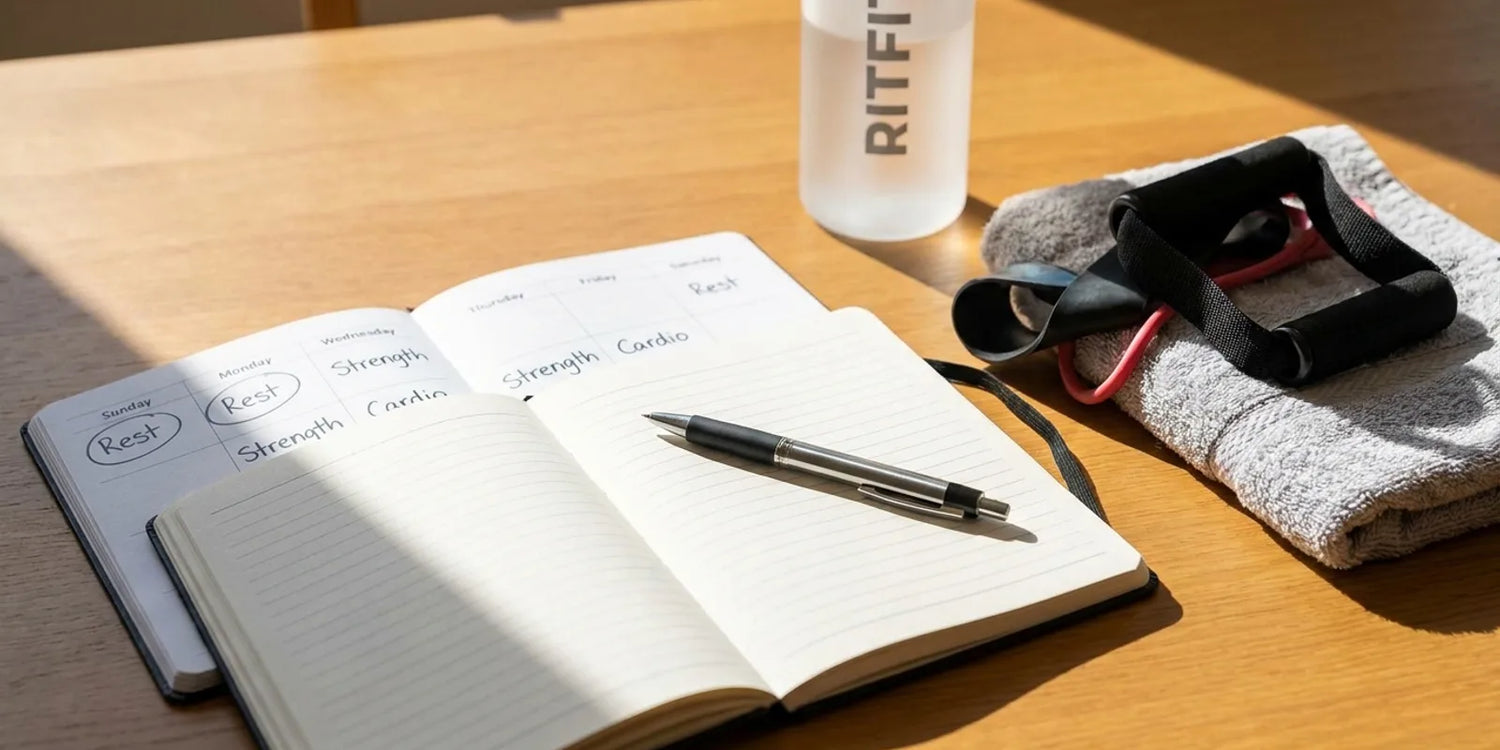
A workout split for women that rests on Sunday and Monday keeps your training days compact and your recovery deliberate, so you build strength without burning out. This guide gives you a complete weekly schedule, sample upper and lower body sessions, and clear rules for when to push and when to rest.
It is written for beginners and busy women who want a simple plan that fits a real week. Follow the schedule as written, warm up before each session, and stop any exercise if you feel sharp pain.
Quick Answer: A workout split for women that rests on Sunday and Monday trains Tuesday through Saturday, giving every muscle group at least 48 hours of recovery between sessions, and a four day upper lower split or a three day full body split both fit this schedule well. Two back to back rest days keep you fresh and consistent.
Key Takeaways
- Two rest days in a row: Resting on Sunday and Monday gives every muscle group at least 48 hours of recovery before your next session.
- Best splits for women: A four day upper lower split trains every muscle twice a week and fits a Sunday and Monday off schedule well.
- Training frequency: Novices can train the whole body two to three days a week, while advanced lifters can train four to six days.
- Signs you need rest: A drop in strength, lingering fatigue, or persistent soreness means you should take an extra rest day.
- Rest day habits: Light walks and mobility work on Sunday and Monday support recovery better than full rest or intense cardio.
Why Do Rest Days Matter for Strength and Muscle?
Rest days are when your muscles actually rebuild and grow stronger, because training breaks muscle fibers down and recovery rebuilds them. Skipping rest leaves you fatigued and stalls the progress that your hard sessions are meant to create.
- Adaptation happens during recovery: The stress of lifting is only useful if your body has time to rebuild stronger tissue afterward.
- Performance stays high: A well rested muscle group produces more force, so each training session is higher quality.
- Injury risk drops: Persistent fatigue makes form break down, which is the most common cause of training injuries.
Blocking out two rest days, such as Sunday and Monday, removes the guesswork from recovery. That consistent structure is one reason a 4 Day Split Workout Routine is so easy to stick to week after week.
How Many Days a Week Should Women Train?
A 2025 review of resistance training in women recommends novice athletes train the whole body two to three days per week and advanced lifters four to six days per week [1]. Training each muscle group twice weekly is the practical sweet spot that most schedules and recovery needs support.
- Beginners: Three days a week on a full body split builds a strong base without overloading your schedule.
- Intermediate lifters: Four days on an upper lower split trains every muscle twice while leaving time to recover.
- Advanced lifters: Five to six days works only when recovery habits like sleep and food are consistent.
The number of sessions matters less than training each muscle group twice in the week, which is exactly what a 4 Day Workout Split Muscle Twice A Week plan delivers.
What Does a Sunday and Monday Off Workout Split Look Like?
A Sunday and Monday off split trains Tuesday through Saturday, so you get two rest days in a row before the week starts again. The most practical version is a four day upper lower split, because each muscle group is still trained twice a week.
| Day | Focus | Example Movements |
|---|---|---|
| Tuesday | Upper body A | Bench press, row, lateral raise, tricep pressdown |
| Wednesday | Lower body A | Back squat, hip thrust, leg press, calf raise |
| Thursday | Rest or mobility | Light walk, stretching, foam rolling |
| Friday | Upper body B | Overhead press, lat pulldown, face pull, bicep curl |
| Saturday | Lower body B | Romanian deadlift, lunge, leg curl, glute bridge |
| Sunday | Rest | Full recovery day |
| Monday | Rest | Full recovery day |
This schedule keeps two full rest days while training each muscle group twice per week.
A meta-analysis of weekly training frequency found no significant strength advantage from more training days when total volume was equal, though upper body gains trended higher with more frequent sessions [2]. A 12 week trial in previously untrained women found an upper lower split produced similar strength and muscle gains to full body training when each muscle group was trained twice a week [3].
You can move the rest days to any two days that fit your life, as long as you keep a day of recovery between lower body sessions. Many women prefer training midweek and using the weekend for recovery and family time.
What Should an Upper Body Day Look Like?
An upper body day pairs a horizontal pressing and pulling pattern with a vertical press and pull, so every upper body muscle gets work in one efficient session. Aim for three to four sets of 8 to 12 reps per exercise with 60 to 90 seconds of rest.
- Bench press or chest press: 3-4 sets of 8-12 reps for the chest and front shoulders.
- Barbell or dumbbell row: 3-4 sets of 8-12 reps for the back.
- Overhead press: 3 sets of 8-10 reps for the shoulders.
- Lat pulldown or pull up: 3 sets of 8-12 reps for the lats.
- Accessory work: Lateral raise, bicep curl, and tricep pressdown for 2-3 sets of 10-15 reps.
For more pressing patterns and back work, see the Chest And Back Workout For Women Gym guide and the Bench Workout breakdown. You can swap the bench press for Dips Workout variations when you want a change.
What Should a Lower Body Day Look Like?
A lower body day pairs a squat pattern with a hip hinge, so the quads, glutes, and hamstrings all get trained in one session. Alternate one squat dominant day with one hinge dominant day to manage fatigue across the week.
- Squat pattern: Back squat or goblet squat, 3-4 sets of 8-12 reps for the quads and glutes.
- Hip hinge: Romanian deadlift or hip thrust, 3-4 sets of 10-12 reps for the hamstrings and glutes.
- Single leg work: Reverse lunge or step up, 3 sets of 8-10 reps per leg.
- Finisher: Leg curl and calf raise, 2-3 sets of 12-15 reps.
How Do You Choose Your Weight and Know When to Add More?
Choose a weight you can lift for the target reps with good form, leaving one to two reps in the tank on your first sets. Add weight only when you can complete all sets and reps with clean technique on two consecutive sessions.
- Start light: Pick a weight that lets you finish every set with a rep or two to spare.
- Add in small jumps: Increase by the smallest increment you have when you hit the top of the rep range.
- Track your numbers: Write down weights and reps each week so progress is obvious.
- Progress slowly: Jumping weight too fast breaks form and leads to injury.
At home, a set of Adjustable Dumbbells makes small weight jumps easy without filling a room with plates.
How Do You Know When You Need an Extra Rest Day?
You need an extra rest day when your strength drops noticeably, fatigue lingers into the next day, or soreness keeps you from training well. Taking one planned rest day protects the quality of the sessions that actually build progress.
- Strength drop: If your usual weights feel much heavier, your body is signaling that it needs more recovery.
- Lingering fatigue: Heavy tiredness that does not lift with sleep means you are pushing past your recovery capacity.
- Persistent soreness: Soreness that lasts more than a few days is a cue to back off.
- Poor sleep: A rough week of sleep is a good reason to take an unplanned rest day.
"When people start to see a drop off of 10% or so of their grip output, you really should skip the gym that day."
Jeff Cavaliere, MSPT, CSCS, Physical Therapist and Strength Coach, former Head Physical Therapist for the NY Mets, Athlean-X
What Can You Do With Limited Equipment or No Gym?
With dumbbells and a flat bench you can run almost every part of this split, and bodyweight substitutes work for a full body day when you have no equipment at all. Swap barbell movements for dumbbell or bodyweight versions rather than skipping the session.
- Barbell squat: Use a goblet squat or split squat with a dumbbell.
- Bench press: Use a floor press or push up with a weight vest.
- Barbell row: Use a one arm dumbbell row or band row.
- Hip thrust: Load with a dumbbell across your hips at home.
For a home lower body setup, the Full Leg Workout Package combines leg press, hack squat, and calf raise in one machine. Newer lifters can follow the Bench Workout Guide to learn pressing form step by step.
Common Workout Split Mistakes to Avoid
The most common mistake is training every day with no scheduled rest, which leads to burnout and stalled progress. Other mistakes include training each muscle only once a week, skipping warm ups, and adding weight faster than your form allows.
- No scheduled rest: Rest days are part of the plan, not a sign of weakness.
- One session per muscle: Training a muscle once a week is too little volume for most women.
- Skipping warm ups: Five minutes of light cardio and dynamic mobility protects every session.
- Changing plans too often: Run the same split for at least eight weeks before you decide it is not working.
Progress is built over months, not weeks. Staying consistent is easier when you train for a purpose, which is what Celebrate Women S Strength Pink Fitness Equipment is all about.
FAQs About Workout Splits for Women
Is it okay to take two rest days in a row such as Sunday and Monday?
Yes.
Training Tuesday through Saturday and resting on Sunday and Monday gives every muscle group at least 48 hours of recovery between sessions, which research supports for strength gains.
A two day break also helps beginners adapt and keeps the week consistent, so you are more likely to stick with the plan.
What is the best workout split for women?
For most women, a four day upper lower split is a strong choice because every muscle group gets trained twice while still leaving time to recover. Beginners can start with a three day full body split, and more advanced lifters can add a fifth day once the current plan stops producing progress.
How many days a week should women lift weights?
A 2025 review of resistance training in women recommends novice athletes train the whole body two to three days per week and advanced lifters four to six days per week. Training each muscle group twice weekly is a practical target that balances training volume with the recovery your body needs between sessions.
Do women need more rest than men?
Evidence suggests women generally recover from resistance training faster than men, so they do not need longer rest periods.
Rest one to two minutes between assistance exercises and two to three minutes between heavy compound lifts.
Use how your body feels to fine tune the timing.
What should you do on rest days?
Rest days should keep you moving lightly without loading your muscles.
A short walk, gentle mobility work, or light stretching supports blood flow and reduces stiffness.
Avoid intense cardio or heavy lifting on Sunday and Monday, and prioritize sleep and protein so your body can adapt from the week.
How do you know when you need an extra rest day?
Signs that you need more rest include a noticeable drop in strength or grip output, heavy fatigue that lingers, poor sleep, and soreness that persists for days.
Taking one rest day to recover beats several weeks of sluggish training.
If you feel sharp joint or muscle pain, stop and rest.
Conclusion
A workout split for women that rests on Sunday and Monday trains Tuesday through Saturday, so every muscle group recovers for at least 48 hours between sessions. A four day upper lower split fits this schedule best for most women, while a three day full body split works well for beginners.
Pick one split, run it consistently for at least eight weeks, and add weight only when your form holds. If you are unsure where to start, visit RitFit Sales to see home gym options that fit your space and budget.
Disclaimer
This article provides general fitness information and is not a substitute for professional medical advice, especially during pregnancy, after injury, or when recovering from illness. Consult a qualified professional before starting a new training program if you have any health concerns.
References
1. Kraemer WJ, Fragala MS, Ratamess NA. Evolution of resistance training in women: History and mechanisms for health and performance. Sports Med Health Sci. 2025;7(5):351-365. doi:10.1016/j.smhs.2025.01.005. PMCID: PMC12421175
2. Ralston GW, Kilgore L, Wyatt FB, Buchan D, Baker JS. Weekly Training Frequency Effects on Strength Gain: A Meta-Analysis. Sports Med Open. 2018;4(1):36. doi:10.1186/s40798-018-0149-9. PMCID: PMC6081873
3. Pedersen H, Fimland MS, Schoenfeld BJ, et al. A randomized trial on the efficacy of split-body versus full-body resistance training in non-resistance trained women. BMC Sports Sci Med Rehabil. 2022;14(1):87. doi:10.1186/s13102-022-00481-7. PMCID: PMC9107721





