








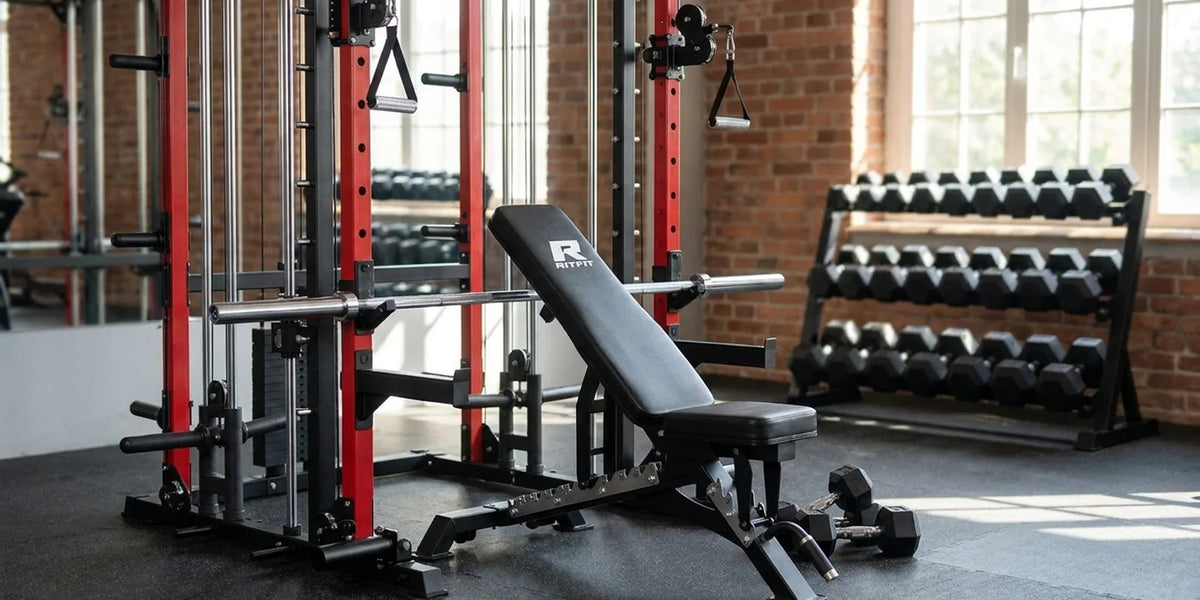
The smith machine wrist curl works, and the guided bar makes it easier to isolate the forearms than a free barbell. Sit on the floor, set the bar low, and move only the wrists.
This guide covers bar height, forearm support, wrist flexion and reverse wrist extension, light loads with high reps, grip width, and the pain signals that mean stop. Forearm training is low risk, but wrist and elbow pain deserves real caution.
Quick Answer: Smith machine wrist curls are done seated on the floor or on a bench with your forearms supported and the bar set at the lowest hooks. You curl from the wrists only with a light load for high reps, and the guided bar stays fixed so the forearms isolate.
Key Takeaways
- Fixed path: The guided bar cannot swing forward or back, so the wrist joint isolates flexion and extension without balancing the load.
- Setup: Sit on the floor or a bench with the forearms supported and the bar at the lowest hooks you can reach.
- Load: A light load for 15 to 25 controlled reps beats a heavy bar for a joint this small.
- Wrist vs elbow: Wrist curls bend the wrist joint only, reverse curls bend the elbow and train the brachioradialis and extensors.
- Stop signals: Sharp wrist or inner elbow pain ends the set immediately.
Can You Do Wrist Curls on a Smith Machine?
The Smith machine wrist curl works, and the setup takes about a minute once the hooks sit at the right height. One major exercise library lists the seated Smith machine wrist curl as a standard forearm movement. The fixed bar path removes the balancing act of a free barbell.
- What you need: A Smith machine, the empty bar, and optionally a flat bench.
- Where it fits: The last 10 minutes of an arm day or any upper body session.
- Who it suits: Any lifter who wants forearm work without buying a separate curl bar.
Forearm training on the machine pairs naturally with the rest of a home gym plan, and our smith machine forearm exercises guide rounds out the movement menu.
Why Do Wrist Curls on a Smith Machine?
The guided bar stays on the uprights and cannot swing forward or back, so the wrist joint isolates flexion without balancing the load. The hooks also let you start and finish each set at a safe low height without a spotter.
A free barbell rolls in the fingers during wrist curls, and many lifters lose the feel of the wrist joint while the forearms chase balance. The Smith machine bar rides a fixed vertical path, so the wrist does all of the bending.
- Fixed path: The bar tracks straight up and down, so the wrist flexors do the bending and nothing else.
- Low hooks: Unrack and rack at knee height or lower with a simple wrist flick.
- Small jumps: Thin plates add tiny load increases that suit a small joint.
The setup works on any guided bar machine, from a multifunctional Smith machine to a full cage. If you are still shopping, the Smith machine collection shows every current model.
"The smith machine is great because it's going to take a lot of the pressure out of your shoulders because it's supporting itself and you can do a little bit more weight on here."
Scott Herman, YouTube Creator, ScottHermanFitness, How To: Smith Machine- Bench Press (YouTube)
Set the Smith Machine Bar Low for Wrist Curls
The bar sits at the lowest hooks you can reach, roughly mid thigh when you sit on the floor with the forearms on the thighs. Set the safety stops one notch below the working height so a dropped bar lands softly.
Bar Height and Hook Position
Start on the lowest hook pair and raise it only until the wrists hang just below the bar at the bottom of the stretch. The hooks or safety tabs should catch the bar the moment your grip opens.
Forearm Support: Thighs or Flat Bench
Sit on the floor in front of the rack and lay the forearms across the thighs with the wrists just past the knees, or lay them on a flat bench rolled into the rack. Either way the forearms stay glued down for the whole set.
Grip Width
Take a grip slightly wider than the thighs, about shoulder width, with both hands even on the bar. A symmetric grip keeps both wrists working through the same range.
Curl From the Wrists Only Step by Step
Every rep comes from the wrist joint, and the forearms stay locked on the thighs or bench through the whole set. The movement has two halves, wrist flexion with palms up and wrist extension with palms down.
Wrist flexors produce lower maximum voluntary torque at 30 degrees of wrist extension than at 0 degrees neutral or 30 degrees flexion, so the bottom stretch will feel like the weakest point[1]. That is normal for the joint and not a reason to cut the range.
Wrist Curl: Flexion Only
- Step 1: Sit on the floor in front of the rack and rest the forearms on the thighs with the wrists just past the knees.
- Step 2: Take a palms up grip on the bar slightly wider than the thighs.
- Step 3: Unrack and let the wrists extend so the bar rolls down toward the fingertips.
- Step 4: Curl the hands up by flexing the wrists only, squeeze the forearms at the top, and lower for 2 to 3 seconds through the eccentric phase.
Reverse Wrist Curl: Wrist Extension
Use the same seat and support with a palms down grip and bend the wrists upward until the forearms contract, then lower for 2 to 3 seconds. This trains the wrist extensors on the top of the forearm.
Watch a wrist curl set from the front to see how little the forearms move while the wrists do the work.
What Muscles Do Smith Machine Wrist Curls Work?
Smith machine wrist curls train the wrist flexors on the front of the forearm, led by the flexor carpi ulnaris and flexor digitorum superficialis. The same flexor-pronator mass steadies the inside of the elbow during heavy lifting.
Different forearm exercises recruit different forearm muscles, and one 2023 EMG study of 10 healthy men recorded peak activation of 40.3% of maximum voluntary contraction in the flexor carpi ulnaris during ulnar deviation and 63.8% in the flexor digitorum superficialis during forearm pronation[2]. Wrist curls load flexion directly, so the flexor carpi radialis and ulnaris lead each rep while the finger flexors hold the bar.
Grip work and direct wrist work overlap more than most lifters expect, and our look at handgrip training and forearm size shows where the two meet.
Wrist Curls vs Reverse Curls on a Smith Machine
A wrist curl moves the wrist joint only with the forearms locked in place, while a reverse curl is an elbow movement driven by the brachioradialis, forearm extensors, and biceps. Both belong on arm day, but they build different parts of the arm.
The wrist curl is the forearm specialist on the palm side of the forearm. The reverse curl favors the elbow flexors and the top of the forearm, which is why the two feel like different exercises even on the same bar.
| Point of difference | Wrist Curl | Reverse Curl on the Smith Machine |
|---|---|---|
| Joint that moves | Wrist only | Elbow |
| Forearms | Locked on thighs or bench | Curl toward the upper arms |
| Primary muscles | Wrist flexors (flexor carpi ulnaris, flexor digitorum superficialis) | Brachioradialis, wrist extensors, biceps |
| Training focus | Wrist flexion detail and grip support | Elbow strength and forearm thickness |
Table scope covers joint mechanics only, loading and frequency recommendations sit in the programming section.
Choose Light Loads and High Reps for Wrist Curls
The empty Smith machine bar is heavy enough for most first sets, and 15 to 25 controlled reps with a light load suits the wrist joint. Small muscles and small joints respond to volume and control, not to max singles.
- Sets and reps: 2 to 4 sets of 15 to 25 reps per direction.
- Rest: 45 to 60 seconds between sets.
- Tempo: A 1 second squeeze at the top and a 2 to 3 second lowering phase.
- Load test: If the forearms lift off the support, the weight is too heavy.
Keep the load honest and chase clean reps instead of bar weight, and the forearms will tell you when the work is done.
Try Wrist Curl Variations and Alternatives
The seated version is the default, and standing behind-the-back wrist curls plus dumbbell or cable wrist curls cover the rest of the forearm menu. All of the variations keep the movement at the wrist joint.
- Seated wrist curl, palms up: The standard wrist flexion version described above.
- Reverse wrist curl, palms down: The same seat with wrist extension for the top of the forearm.
- Standing behind-the-back wrist curl: Stand in the rack with the bar behind the thighs and curl from the wrists.
- Dumbbell wrist curl: The honest alternative when the Smith bar is in use.
- Cable wrist curl: Constant tension from a low pulley with a straight handle.
Forearm work pairs well with arm training, for example our Smith machine biceps exercises roundup, and a rack like the M3 power rack with Smith machine adds cable wrist curls through its pulleys.
Train Wrist Curls Twice a Week and Add Weight Slowly
Two or three wrist curl sessions per week with at least one rest day between them suit most lifters. Forearm muscles recover quickly, but the wrists and elbow tendons appreciate the downtime.
Treat wrist curls as a finisher at the end of arm day and keep one or two reps in reserve on every set. Progress by adding reps first, then sets, then the smallest plate available.
When to Increase the Weight
Add load only when every rep of two straight sessions stays smooth through the full range with a 1 second squeeze at the top. The smallest jump on the bar is often enough for a joint this small.
For a full forearm session built around high rep finishers, try the forearm crusher workout.
Avoid These Mistakes and Stop for Sharp Pain
The most common mistakes are lifting the forearms off the support, swinging with the arms, and loading too heavy, and sharp wrist or inner elbow pain ends the set immediately. Fix the setup before adding reps.
- Forearms come loose: If the forearms lift, the elbows start doing the curl.
- Arm swing: The wrist should bend alone, if the bar moves with the arms the load is too heavy.
- Half reps: Stopping short cuts the range and shortchanges the forearm.
- Rushing the lowering phase: A 2 to 3 second lowering builds more control than dropping the bar.
Dull muscle burn during the set is normal, but sharp wrist pain, tingling, or swelling means stop and rest until the area feels normal again. A small 2018 controlled study of tennis elbow patients found wrist eccentric control exercise improved pain and grip strength within the group[3], a rehabilitation context that is not a training plan.
If elbow or wrist pain keeps coming back, see a qualified professional before training through it.
Which RitFit Smith Machine Fits Wrist Curl Training?
Any RitFit guided bar machine handles wrist curls, and the right pick is the model that fits your space and the rest of your training plan. The same low hook setup works across the lineup.
The RitFit P9 Multi-Functional Modular Power Cage with 3D Smith Machine and Adjustable Dual Cable System pairs the guided bar with a dual cable system, so one footprint covers wrist curls, cable wrist work, and the big compound lifts. The same wrist curl setup works on any guided bar model, including the RitFit M1 Smith machine and the Buffalo Wild Smith machine.
Does the RitFit P9 Smith Machine Work for Wrist Curls?
Yes, the RitFit P9 runs its bar on guide rods with adjustable hooks, so the low hook positions make a floor or bench wrist curl setup straightforward. The cage uprights leave plenty of room to roll in a flat bench.
FAQs About Smith Machine Wrist Curls
Can you do wrist curls on a Smith machine?
Yes. Sit on the floor in front of the rack with your forearms resting on your thighs, set the bar low on the guide rods, and curl from the wrists only. The guided bar stays fixed and does not swing forward or back, so your wrists can focus on flexion and extension.
What is the difference between a wrist curl and a reverse curl on a Smith machine?
A wrist curl moves only the wrist joint, with the forearms locked in place, so the forearm wrist flexors do the work. A reverse curl is an elbow movement, the forearms curl toward the upper arms, and the brachioradialis, forearm extensors, and biceps drive the reps.
How much weight should you use for Smith machine wrist curls?
Start with the empty bar or the lightest plates you own, because the wrist joint is small and the bar alone can feel heavy. Most lifters work with light loads for 15 to 25 controlled reps, and add weight only when every rep stays smooth through the full range.
How often should you do wrist curls on a Smith machine?
Train wrist curls two or three times per week and leave at least one rest day between sessions. Forearm muscles recover quickly but the wrists and elbow tendons appreciate downtime. Treat wrist curls as a finisher at the end of arm day and keep one or two sets short of failure.
Do Smith machine wrist curls build forearm size?
Yes, wrist curls are a direct forearm mass builder when you train them with enough hard sets over time. The wrist flexors respond to progressive overload like any other muscle, so gradually add reps, sets, or load while keeping the movement strict and pain free.
Should your forearms rest on your thighs or on a bench for Smith machine wrist curls?
Both setups work. Resting your forearms on your thighs while sitting on the floor is the simplest setup and keeps the bar at a natural low height. A flat bench raises your forearms and lets taller users reach a comfortable bar position without hunching over the guide rods.
When should you stop doing wrist curls because of pain?
Stop the set if you feel sharp pain in the wrist or on the inside of the elbow, and skip wrist curls until the area feels normal again. Dull muscle burn in the forearms is fine, but joint pain, tingling, or swelling is a signal to rest and seek professional advice.
Conclusion
The smith machine wrist curl delivers real forearm training from one machine, low hooks, supported forearms, and movement at the wrist joint only. Keep the load light, the reps high, and the pain signal at zero.
Start with two sets of 15 reps at the end of your next arm day and add reps before weight. Check the RitFit discount guide before adding any machine or attachment to the home gym.
Disclaimer
This article is general fitness information and is not medical advice. Stop any exercise that causes sharp pain, and talk to a qualified professional before starting a new training program if you have a wrist or elbow injury.
References
1. Behrens M, Husmann F, Mau-Moeller A, Schlegel J, Reuter EM, Zschorlich VR. Neuromuscular Properties of the Human Wrist Flexors as a Function of the Wrist Joint Angle. Front Bioeng Biotechnol. 2019;7:181. doi:10.3389/fbioe.2019.00181. PMCID: PMC6713036
2. Fukunaga T, Fedge C, Tyler T, et al. Flexor-Pronator Mass Training Exercises Selectively Activate Forearm Musculature. Int J Sports Phys Ther. 2023;18(1):208-214. doi:10.26603/001c.68073. PMCID: PMC9897040
3. Lee JH, Kim TH, Lim KB. Effects of eccentric control exercise for wrist extensor and shoulder stabilization exercise on the pain and functions of tennis elbow. J Phys Ther Sci. 2018;30(4):590-594. doi:10.1589/jpts.30.590. PMCID: PMC5909009





