A benching workout is a pressing session built around the bench press, and the sets and reps you choose decide whether it builds strength, muscle size, or endurance. This guide answers how many sets and reps for bench press directly, then walks through the rest of the session.
It is written for beginner to intermediate lifters who already know how to press and now want exact numbers for sets, reps, frequency, and progression. Form is summarized briefly here and linked out in depth.
Quick Answer: Bench press sets and reps land at 3 to 5 sets of 5 to 12 reps. Pick the goal row: 1 to 5 reps at 80 to 95 percent of one rep max for strength, 6 to 12 reps at 65 to 80 percent for muscle size, and 12 to 15 reps at 50 to 65 percent for endurance.
Key Takeaways
- Sets and reps decide the outcome: Bench press work lands at 3 to 5 sets of 5 to 12 reps, using 1 to 5 reps for strength, 6 to 12 reps for size, and 12 to 15 reps for endurance.
- Benching is the bench press: In gym language, benching means performing the bench press, either as a single lift or as a full pressing session.
- Build a session, not a single lift: Pair a main press with incline work and two or three accessories for balanced chest development.
- Bench two to three times weekly: Spreading volume across sessions tends to beat a single heavy day for both strength and size.
- Respect pain signals: Sharp shoulder, elbow, or wrist pain means stop the set, not push through it.
What Does Benching Mean in the Gym?
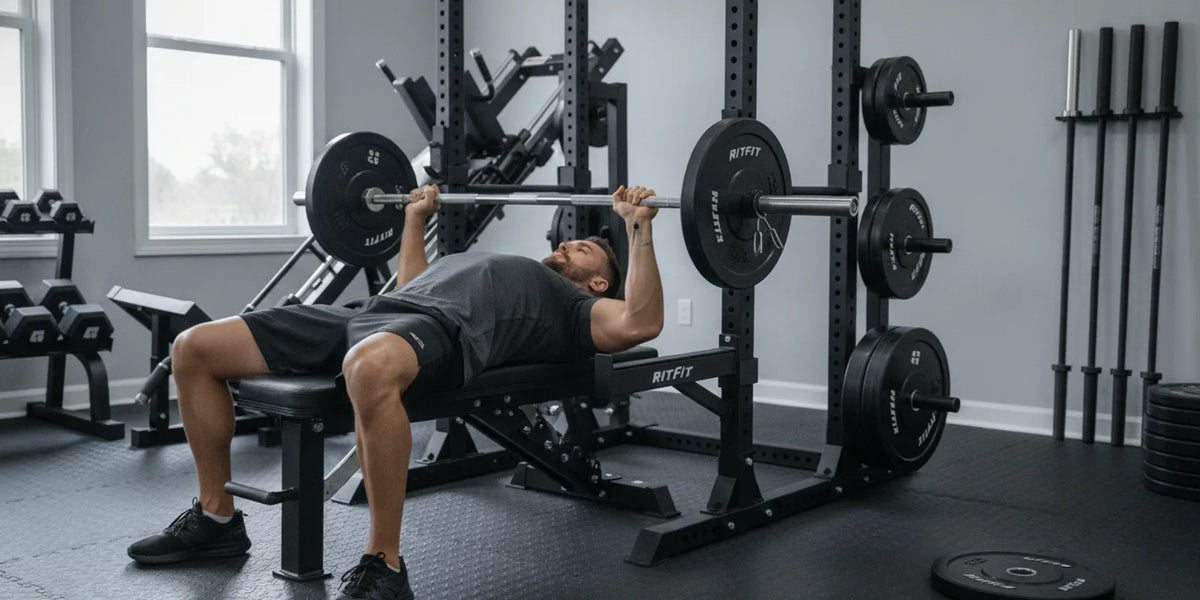
Benching is gym shorthand for performing the bench press, and in a training program it means a pressing session built on that movement. The word covers the single lift, whichever bench press variation you choose, and the whole bench day that follows it.
- As a lift: Benching usually means the flat bench press on a barbell, and it also covers dumbbell and machine versions of the same pressing pattern.
- As a session: A benching workout or bench day is the complete session, with a main press, incline work, and accessory movements.
- As a verb: Saying you are benching today simply means the bench press sits on today's plan.
If the movement is new to you, perfect your bench press form before adding load, then use the rest of this guide for the numbers.
What a Real Benching Workout Includes
A complete benching workout includes one main pressing movement plus accessory exercises that train the chest, shoulders, and triceps from different angles. The flat press alone leaves gaps that incline work and isolation movements fill in.
- Main press: Flat barbell or dumbbell bench press as the strength anchor of the session.
- Incline press: Targets the upper chest that the flat press underloads.
- Accessories: Dips, flyes, and close grip pressing to add volume and address weak points.
Think of the press as the foundation and accessories as the finish work. Treat this complete bench workout guide as your reference for the wider template.
How Many Sets and Reps Should You Do for Bench Press?
Most lifters do best with 3 to 5 sets of 5 to 12 reps per bench press movement, adjusted for the goal of the training block. Strength phases sit at the low end of that rep range with long rest, muscle size work adds reps at moderate loads, and endurance work finishes with lighter weight and shorter rest. The table below maps sets, reps, intensity, and rest to each goal.
| Goal | Sets | Reps | Intensity | Rest |
|---|---|---|---|---|
| Maximal strength | 3 to 5 | 1 to 5 | 80 to 95 percent 1RM | 3 to 5 minutes |
| Muscle size | 3 to 4 | 6 to 12 | 65 to 80 percent 1RM | 1 to 2 minutes |
| Muscular endurance | 2 to 3 | 12 to 15 | 50 to 65 percent 1RM | 45 to 90 seconds |
Loading zones follow common coaching guidelines, so adjust them to your experience and recovery.
The best sets and reps for bench press are the ones you can repeat every week with clean technique, so treat the table as a starting point rather than a number to chase. Run one goal per block for about four to eight weeks and let progressive overload come from added load or added reps.
If you are asking how many reps on bench press to perform, the answer comes from the goal row you pick rather than from one universal figure. Beginners often want to know how many reps for bench press to start with, and the practical answer is the lighter end of the muscle size row, where technique still holds up.
Bench press reps per set drive the training effect, while bench press sets control how much total volume you accumulate across the week. Most of the confusion around how many sets and reps for bench press comes from mixing strength and size goals inside one session, which leaves every working set somewhere in the middle.
"If I did 75 pounds on my bench press and I did it eight times, you can just run an estimate to say, okay, you're probably going to be able to bench about 95 pounds for one rep max."
Andy Galpin, PhD, Professor of Exercise Science and Human Performance, Parker University, Huberman Lab
How Do You Build the Session Around the Main Lift?
You build a benching workout by leading with the heaviest pressing movement while you are fresh, then layering lighter accessory work after. Order matters because the main lift demands the most coordination and force.
The Main Press: Flat Barbell or Dumbbell
The main press is your strength anchor, performed first for 3 to 5 sets when your nervous system is fresh. A study found that muscle activity in the pectoralis major, anterior deltoid, and triceps changes as load climbs from 70 to 100 percent of your one rep max, and at the top of that range the anterior deltoid takes over as the prime mover[1].
The video below walks beginners through the full setup and pressing checklist step by step.
Incline Work for the Upper Chest
Incline pressing shifts emphasis to the upper, clavicular portion of the chest that flat pressing tends to underload. A study found that upper pectoralis major activity peaks at a bench inclination of 30 degrees, and that angles steeper than 45 degrees raise anterior deltoid activity instead[2].
- Angle: Set the bench to roughly 30 degrees for upper chest focus.
- Load: Expect to press less than on flat, so adjust the weight down.
For angle specifics, see our guide on the best incline angle for your bench press and how to incline bench press for the upper chest.
Accessory Movements: Dips, Flyes, and Close Grip
Accessories add chest and triceps volume after the main lifts without taxing your nervous system as heavily. A study found that the standard bar produced greater pectoralis major activity than a cambered bar at 90 percent of 1RM, which is why grip and tool choice change which muscles do the most work[3].
- Dips: Lean forward to bias the chest, stay more upright for triceps.
- Flyes: Keep loads light and chase a controlled stretch, not maximal weight.
- Close grip press: Shifts work toward the triceps and inner chest.
To see how pressing patterns compare, read chest press vs shoulder press before slotting accessories in.
How Do You Choose Your Starting Weight?
You choose your starting bench weight by picking a load you can press for 8 to 10 controlled reps with two reps left in reserve. Starting conservative protects your shoulders and lets you groove the movement before chasing numbers.
- Absolute beginners: Start with the empty barbell, about 45 pounds, or light dumbbells.
- Returning lifters: Begin near 60 percent of your old working weight and rebuild.
- Reserve check: If you cannot pause and reset at the top, the weight is too heavy.
Train on a sturdy, adjustable platform so you can move between flat and incline safely. Browse adjustable weight benches to match the angles your program needs.
How Often Should You Bench Each Week?
Most lifters benefit from benching two to three times per week rather than a single heavy session. Spreading the volume out gives more practice with the lift and supports both strength and size better than one heavy day.
Direct weekly volume matters more than any single session, and a practical target for chest growth is 10 or more working sets per week. Lighter weeks still build muscle at much lower volume, so a busy schedule does not erase progress.
- Beginners: Two sessions weekly is plenty while you learn the movement.
- Intermediate: Three sessions let you vary heavy, moderate, and lighter days.
- Low time budget: Meaningful gains are still possible at four or fewer sets per week.
"10+ sets per muscle per week elicited greater hypertrophy than fewer than 10 sets. Thus, this would be a good starting point."
Brad Schoenfeld, PhD, Exercise Science Researcher, CUNY Lehman College
When and How Much Weight Should You Add?
You should add weight once you can complete all your target reps with clean form and a rep or two still in reserve. Progress comes from small, repeatable jumps rather than big ego leaps.
- Upper body increments: Add about 2.5 to 5 pounds to the bar at a time.
- Reps before load: Add a rep per set first, then bump weight once you top your range.
- Stall fix: If you miss reps two sessions in a row, hold the weight or back off slightly.
Pair pressing days with pulling work so your shoulders stay balanced as loads climb. A simple split like an chest with back training session keeps progression sustainable.
What Can You Swap When Equipment or Shoulders Are Limited?
You can swap the barbell bench press for dumbbells, push-ups, dips, or a machine when equipment or shoulders are limited. These options build the chest effectively while letting you control range of motion and joint stress.
- Only dumbbells: Dumbbell presses allow a longer range of motion and let each arm work independently.
- No free weights: Push-ups and dips load the chest with bodyweight progressions.
- Cranky shoulders: A guided machine reduces the stabilizing demand of a free bar.
A fixed pressing path can be gentler on irritable shoulders, such as the RitFit Gorilla 2-in-1 Chest and Shoulder Press Machine. You can also add core work on the bench on lighter days.
What Are the Common Mistakes and When Should You Stop a Set?
The most common benching mistakes are flaring the elbows, bouncing the bar, and skipping leg drive, while the clearest stop signal is sharp joint pain. Knowing the difference between fatigue and pain keeps training productive.
- Elbow flare: Keep elbows around 45 to 75 degrees, not pinned at 90.
- Bouncing: Lower under control and touch the chest without rebounding.
- Stop the set: End it for sharp or pinching pain in the shoulder, elbow, or wrist.
Normal muscle burn and fatigue are fine to train through, but joint pain is not. Reduce the load, fix your setup, and explore more bench workout routines if a movement keeps aggravating you.
What Does a Sample 4-Week Benching Plan Look Like?
A sample 4-week benching plan rotates rep ranges and slowly adds load while keeping two pressing days per week. This structure balances progress with recovery for most beginner to intermediate lifters.
| Week | Day 1 Main Press | Day 2 Main Press |
|---|---|---|
| Week 1 | 4 sets of 8 | 3 sets of 10 incline |
| Week 2 | 4 sets of 6 | 3 sets of 10 incline |
| Week 3 | 5 sets of 5 | 4 sets of 8 incline |
| Week 4 | 3 sets of 8 deload | 3 sets of 8 incline |
Add accessories like dips and flyes after the main press, and adjust loads to your reserve.
Repeat the cycle with slightly heavier starting loads if recovery feels solid. Treat week four as a planned deload to absorb the work and arrive fresh.
FAQs About Benching Workouts
How much should I bench press as a beginner?
Start lighter than you think you need. Many beginners begin with just the empty barbell, which weighs about 45 pounds, and add small increments once their form is solid. Choose a weight you can press for 8 to 10 controlled reps with two reps left in the tank, then progress gradually from there.
How many days a week should I do a benching workout?
For most lifters, pressing two to three times per week works better than once, because it spreads volume out and gives more practice with the movement. Beginners can start with two sessions weekly, keeping total weekly chest volume around ten or more working sets and adjusting based on recovery and soreness.
What is the best rep range for the bench press?
It depends on your goal. For maximal strength, work in the 1 to 5 rep range with heavier loads. For muscle size, the 6 to 12 range tends to work well. For endurance and joint friendly volume, 12 to 15 reps with lighter weight is useful. Most programs blend these ranges across the week.
Can I build a chest without a barbell?
Yes. Dumbbell presses, incline dumbbell presses, push-ups, dips, and chest press machines all build the pectorals effectively. Dumbbells allow a longer range of motion and let each arm work independently, which is helpful if you train at home or want to reduce shoulder strain from a fixed barbell path.
When should I stop a bench press set because of pain?
Stop immediately if you feel sharp or pinching pain in the shoulder, elbow, or wrist, as opposed to normal muscle fatigue or burn. Pain in the front of the shoulder during pressing often signals form or mobility issues. Reduce the weight, fix your setup, and consult a professional if pain persists.
How many sets and reps should I do for bench press?
Most lifters should do 3 to 5 sets of 5 to 12 reps per bench press movement. For strength, use 3 to 5 sets of 1 to 5 reps at 80 to 95 percent of one rep max. For muscle size, use 3 to 4 sets of 6 to 12 reps at 65 to 80 percent. For endurance, use 2 to 3 sets of 12 to 15 reps with lighter loads and shorter rest.
What does benching mean in the gym?
Benching is gym slang for performing the bench press. It can describe the single lift, the full press, or a complete chest session built around that movement, which is why lifters say they are benching on a pressing day. In program terms, a benching workout pairs the main press with incline and accessory work, then repeats it two or three times each week.
Conclusion
A productive benching workout is a structured session, not just the flat press, and the sets and reps you pick decide the result. Anchor it with a main press, add incline and accessory work, and load the bar for a rep range that matches your goal.
Start with two sessions a week, progress in 2.5 to 5 pound jumps, and stop any set that turns into joint pain. Follow the 4-week plan above, then check the RitFit discount guide before you upgrade your setup.
Disclaimer
This article is for general educational purposes only and is not medical or professional training advice. Consult a qualified healthcare provider or certified coach before starting any new exercise program, especially if you have existing injuries or conditions.
References
1. Król H, Gołaś A. Effect of Barbell Weight on the Structure of the Flat Bench Press. J Strength Cond Res. 2017;31(5):1321-1337. doi:10.1519/JSC.0000000000001816. PMCID: PMC5400411
2. Rodríguez-Ridao D, Antequera-Vique JA, Martín-Fuentes I, Muyor JM. Effect of Five Bench Inclinations on the Electromyographic Activity of the Pectoralis Major, Anterior Deltoid, and Triceps Brachii during the Bench Press Exercise. Int J Environ Res Public Health. 2020;17(19). doi:10.3390/ijerph17197339. PMCID: PMC7579505
3. Krzysztofik M, Golas A, Wilk M, Stastny P, Lockie RG, Zajac A. A Comparison of Muscle Activity Between the Cambered and Standard Bar During the Bench Press Exercise. Front Physiol. 2020;11:875. doi:10.3389/fphys.2020.00875. PMCID: PMC7378805
Save on your next RitFit order
Tap the button to copy your code, then paste it at checkout.