








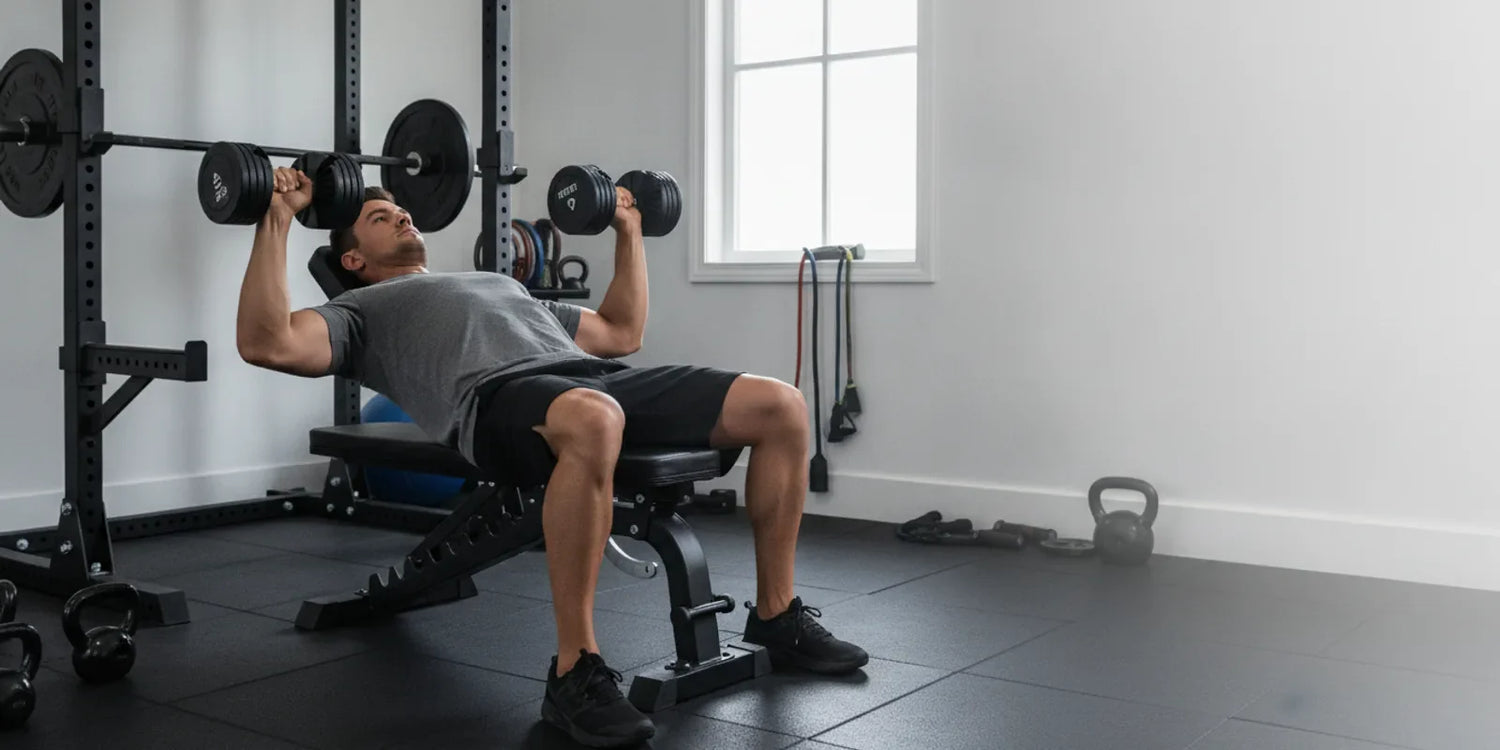
A bench workout turns a single bench and a pair of dumbbells into a complete full-body training system. This guide gives you a ready-to-run three-day plan, not just a list of moves.
You will learn how to structure your week, choose starting weights, apply progressive overload, and know exactly when to add load or stop a set for safety.
Quick Answer: A bench workout with an adjustable bench and dumbbells can train your entire body in three weekly sessions. Split the week into push, pull and core, and lower-body focus days, choose loads where the last reps feel hard but controlled, and progress reps before weight.
Key Takeaways
- Full-body capable: A bench plus dumbbells covers pressing, rowing, hip extension, single-leg, and core work without machines.
- Three days is the sweet spot: Two to three full-body sessions per week balance stimulus and recovery for most home lifters.
- Start with control: Pick a load where the last two to three reps feel hard while form stays clean.
- Progress with double progression: Add reps first, then add weight and rebuild reps from the lower end.
- Stop on sharp pain: End any set if the weight is uncontrolled or you feel joint pain rather than muscle fatigue.
Why a Bench and Dumbbells Are a Complete System
A bench and dumbbells form a complete full-body system because they cover every major movement pattern, including horizontal pressing, rowing, hip extension, single-leg work, and core stability. One stable platform plus adjustable load reaches the chest, back, shoulders, arms, glutes, and legs.
A study comparing the barbell bench press and dumbbell flyes in resistance-trained males examined how each movement loads the pectoralis major and anterior deltoid, showing that both pressing and isolation work have a place in a bench-based plan.[1]
- Pressing: Flat, incline, and decline angles train the chest, shoulders, and triceps.
- Pulling and lower body: Single-arm rows hit the back, while split squats and hip thrusts load the legs and glutes.
- Core control: Every press forces you to brace your trunk, so a bench workout quietly builds midsection stability.
If you want the full movement catalog, see our companion guide to 12 weight bench exercises for a full-body home workout, then use this article to program them. Most of this work happens on a quality RitFit adjustable weight bench.
What Does the 3-Day Full-Body Bench Split Look Like?
The three-day full-body bench split divides the week into a push day, a pull and core day, and a lower-body day, with at least one rest day between sessions. This structure trains every muscle group two to three times weekly while leaving room to recover.
Run the days in order with a rest day between each. Choose one swap per slot if an exercise bothers a joint, and keep total hard sets per muscle moderate so you can recover and progress.
Day 1 - Push Focus
Day 1 trains the chest, shoulders, and triceps with dumbbell bench press, incline press, and bench dips for three to four sets each in the 8 to 12 rep range.
Day 2 - Pull and Core
Day 2 builds the back and trunk through single-arm dumbbell rows and chest-supported rows, finishing with bench core work like decline sit-ups, drawing on our bench ab workout ideas.
Day 3 - Lower Body and Posterior Chain
Day 3 loads the legs and glutes with Bulgarian split squats, step-ups, and bench-supported hip thrusts, expanded in our leg workouts at home with a bench and hamstring workouts with a bench guides.
How Do You Choose Your Starting Weight?
You choose your starting weight by picking a load where the last two to three reps of your target range feel genuinely hard while your form stays clean. If you can easily beat the top of the range it is too light, and if you cannot reach the bottom with control it is too heavy.
- Test conservatively: Begin lighter on new movements and add load only once the pattern feels stable.
- Match the rep range: Aim for 8 to 12 reps on presses and rows, and 10 to 15 on single-leg and glute work.
- Use small increments: A bench workout progresses best in the smallest load steps you can control, so keep notes on each session.
Adjustable dumbbells make small jumps easy, and a sturdy bench keeps every angle secure as loads climb.
Should You Add Weight or Add Reps to Keep Progressing?
You should add reps first, then add weight once you hit the top of your range across all sets. This double-progression method applies progressive overload steadily while keeping technique solid.
A ten-week training study found that improved strength shifted the sticking region in chest-press exercises, and that gains from one chest-press variation transferred to the untrained barbell bench press.[2]
- Phase one: Build reps from the bottom of your range to the top while the weight stays fixed.
- Phase two: Increase the load by the smallest available increment and rebuild reps from the lower end.
For a structured weekly template, our bench workout routines guide shows how to schedule this progression across training blocks.
How Do You Dial In Bench Angle for Each Goal?
You dial in bench angle by matching the incline to the region you want to emphasize. Flat pressing trains the mid chest, a slight incline shifts work to the upper chest, and a decline targets the lower chest.
One coaching guide suggests setting an adjustable bench to about a 30-degree incline to put more emphasis on the upper chest during pressing.
Equipment choice also changes the stimulus. An EMG study comparing standard and cambered bars during the bench press found the standard bar produced higher pectoralis major and triceps activity at 90% 1RM, while the cambered bar activated the anterior deltoid more.[3]
What Are the Most Common Bench Workout Mistakes?
The most common bench workout mistakes are using too much weight too soon, bouncing the dumbbells off the chest, and flaring the elbows wide. Each one trades clean tension for momentum and raises injury risk.
- Rushing the load: Chasing heavy weight before the movement is grooved breaks form and stalls progress.
- Bouncing the reps: Using momentum off the chest removes tension and makes the top of the rep carry the load.
- Ignoring the lower body: Skipping split squats and hip thrusts leaves a bench program upper-heavy and unbalanced.
Pair your pressing with controlled triceps work like the variations in our bench dips and triceps work guide to keep the whole pushing chain strong. For balanced full-body sessions, our full-body workouts with a home workout bench walkthrough adds structure.
When Should You Add Load and When Should You Stop?
You should add load once you complete the top of your rep range across all sets with clean technique. You should stop a set when form breaks down, the weight feels uncontrolled, or you feel sharp joint pain rather than normal muscle fatigue.
- Green light to progress: All working sets reach the top of the range and the last reps still look controlled.
- Red light to stop: Sharp front-shoulder pain during pressing signals an angle or grip issue, so reduce load and fix setup first.
Progress again only once the movement feels pain-free, since consistent pain-free training is what drives long-term strength.
"What I advise in most cases is, instead of looking for a spotter to take you through those areas of a lift that are more difficult, think of other ways you can improve your ability to complete that lift, if strength is your goal."
Jeff Cavaliere, MSPT, CSCS, Physical Therapist and Strength Coach, former Head Physical Therapist for the NY Mets, Men's Health
FAQs About Bench Workouts
Can I get a full-body workout with just a bench and dumbbells?
Yes, a bench and dumbbells cover every major movement pattern, including pressing, rowing, hip extension, single-leg work, and core. By rotating flat, incline, and decline angles across a three-day full-body split, you can train your chest, back, shoulders, arms, glutes, and legs without any large machines.
How many days per week should I do a bench workout?
For most home lifters, two to three full-body bench sessions per week works well, with at least one rest day between them. Beginners can start with two sessions to learn the movements and recover fully, while more experienced lifters can run three days and split the work into push, pull, and lower-body focuses.
How do I choose the right starting weight for bench exercises?
Pick a weight where the last two to three reps of your target range feel genuinely hard but your form stays clean. If you can easily beat the top of the range, the load is too light, and if you cannot reach the bottom with control, it is too heavy.
Should I add weight or add reps to keep progressing?
Add reps first until you comfortably hit the top of your target range across all sets, then increase the load slightly and rebuild your reps from the lower end. This double-progression approach lets you apply progressive overload steadily while keeping technique solid, which matters more than chasing heavy weight too soon.
What bench angle should I use for the upper chest?
Setting an adjustable bench to about a 30-degree incline shifts more emphasis onto the upper chest during pressing, according to coaching guidance. Flat pressing trains the mid chest, and a slight decline targets the lower chest, so rotating angles across your week gives balanced development.
When should I stop a bench set or modify the exercise?
Stop the set if your form breaks down, you cannot control the weight, or you feel sharp pain in the shoulder joint rather than normal muscle fatigue. Pressing discomfort in the front of the shoulder often signals an angle or grip issue, so reduce the load, fix your setup, and progress again only once the movement feels pain-free.
Conclusion
A smart bench workout is less about owning machines and more about programming a bench and dumbbells across a balanced week. Run the three-day push, pull, and lower-body split, start with controlled loads, and progress reps before weight.
Build your setup around a stable platform from our adjustable weight benches collection, then train consistently and stop any set that turns from fatigue into joint pain. For a deeper budget guide, browse our RitFit sales page.
Disclaimer
This article is for general educational purposes and does not replace personalized medical or fitness advice. Consult a qualified healthcare or training professional before starting a new program, especially if you have an injury or health condition.
References
1. Solstad TE, Andersen V, Shaw M, Hoel EM, Vonheim A, Saeterbakken AH. A Comparison of Muscle Activation between Barbell Bench Press and Dumbbell Flyes in Resistance-Trained Males. J Sports Sci Med. 2020;19(4):645-651. PMCID: PMC7675616
2. Saeterbakken AH, Andersen V, van den Tillaar R, et al. The effects of ten weeks resistance training on sticking region in chest-press exercises. PLoS One. 2020;15(7):e0235555. doi:10.1371/journal.pone.0235555. PMCID: PMC7347144
3. Krzysztofik M, Golas A, Wilk M, Stastny P, Lockie RG, Zajac A. A Comparison of Muscle Activity between the Cambered and Standard Bar During the Bench Press Exercise. Front Physiol. 2020;11:875. doi:10.3389/fphys.2020.00875. PMCID: PMC7378805





