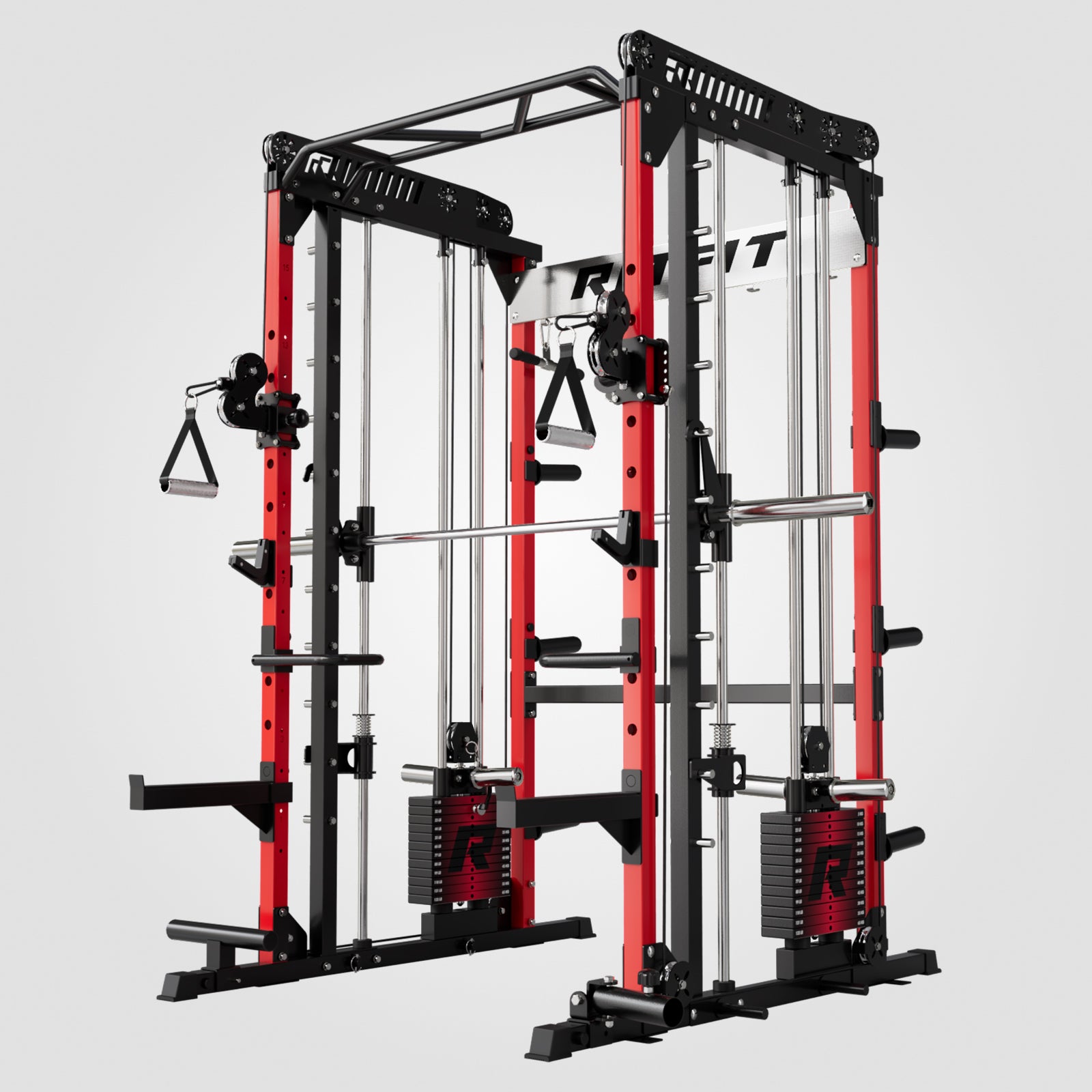
The best 3x3 smith machine for a home gym in 2026 is the RitFit M3 PRO, combining a Smith machine, power rack, and 16-pulley cable crossover in a 21.5 sqft footprint on uniform 3x3, 11-gauge steel. For a garage or basement with limited floor and ceiling space, it delivers commercial-grade strength you can measure first.
This guide covers the M3 PRO footprint, working clearance, ceiling height, the RitFit 3x3 lineup, and spotter-free safety. You will know exactly how much space the M3 PRO needs before the boxes arrive.
Quick Answer: Best 3x3 smith machine for a home gym: the RitFit M3 PRO, a 2,500 lb rated frame that fits a Smith machine, power rack, and 16-pulley cable crossover in a 21.5 sqft footprint with 180 lb stacks per side. Measure your floor space and ceiling height first, then buy with confidence.
Key Takeaways
- Uniform 3x3 steel: The M3 PRO uses 75x75x3mm (3x3, 11-gauge) steel on the front, middle, and rear posts, so the frame stays rigid under a 2,500 lb rated load.
- Measured footprint: RitFit lists the M3 PRO base at 21.5 sqft, but the outer rectangle spans about 86.5 in by 60.4 in, so plan the full working area before you order.
- Low-ceiling fit: At 84 in tall with the highest upright hole at 78 in, a 96 in ceiling leaves 12 in above the pull-up bar, so measure your own joists and lights first.
- Spotter-free safety: The 650 lb rated safety arms extend 560 mm, and the guided 2.2 m Smith bar lets one person fail presses and squats safely.
- Three stations in one: A Smith machine, power rack, and 16-pulley cable crossover share the same 21.5 sqft base, replacing several separate machines.
What Does 3x3, 11-Gauge Steel Mean for a Smith Machine?
A 3x3, 11-gauge smith machine uses square tubing that measures 3 inches by 3 inches on every upright with an 11-gauge wall, so the frame resists flex and twisting under heavy loads. The M3 PRO builds this uniform 75x75x3mm A36/Q235 steel into the front, middle, and rear posts to keep the bar path stable.
- Uniform uprights: Every vertical post shares the same 3x3 profile, so load spreads across the frame instead of concentrating on a weaker corner.
- Thicker wall: An 11-gauge wall outlasts the 14-gauge steel on lighter racks and reduces sway when you rack heavy squats or drop the bar on the safety arms.
- Frame rating: RitFit rates the M3 PRO frame at 2,500 lb with a total steel mass of about 1,093 lb, so the structure stays rigid through years of daily use.
The uniform column is why one 3x3 station can carry a full RitFit M3 PRO 3x3 Power Rack with Cable Crossover without flex.
How Much Floor Space Does the M3 PRO Really Need?
RitFit lists the M3 PRO at a 21.5 sqft base footprint, but the full frame spans about 86.5 in long by 60.4 in wide, which is a 36.3 sqft outer rectangle. Plan the working area around that outer rectangle, not the advertised footprint, before you order.
- Bench clearance: Reserve about 4 ft behind the bench for chest presses and rows, so the station needs roughly 10 ft of usable floor length.
- Plate-loading side: Leave at least 12 in on the plate side of each loaded bar so you can load and unload plates without hitting a wall.
- Cable travel: The high and low pulleys pull forward and overhead, so keep open space behind the frame for flyes and pulldowns.
- Walkways: Keep a 24 in path on at least one side so everyone in the household can pass safely.
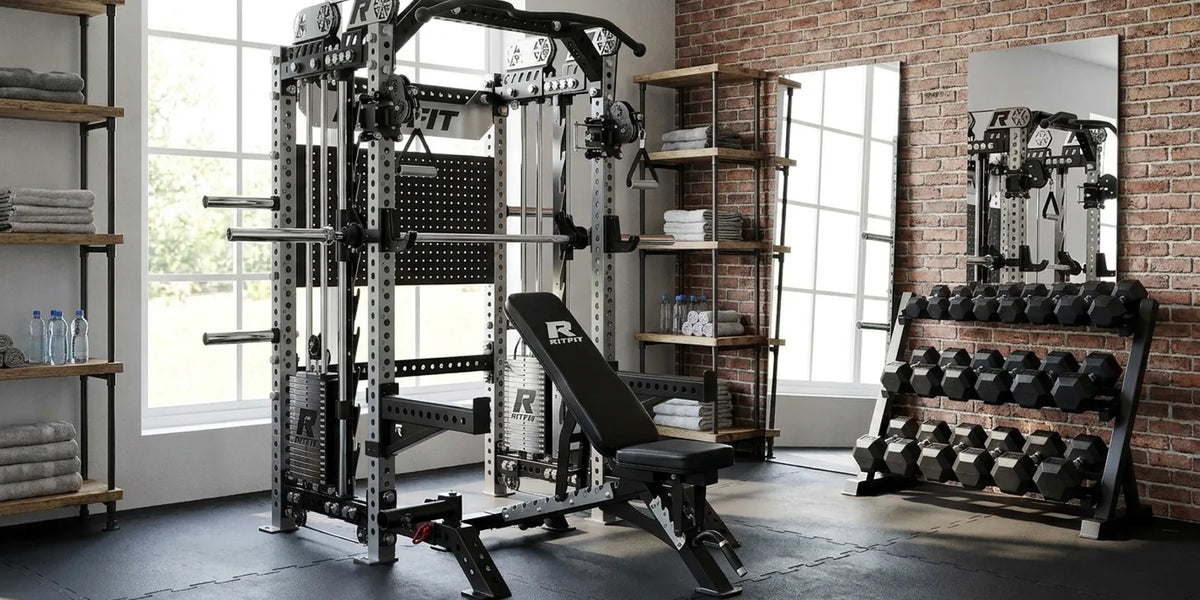
A one-car garage of about 12 ft by 20 ft gives the M3 PRO room for the base plus its working clearance. Compare the RitFit Smith Machine collection to see how each compact station's listed dimensions compare.
Will an 84-Inch M3 PRO Fit a Low-Ceiling Garage or Basement?
RitFit lists the M3 PRO at 84 in (2,134 mm) tall including the pull-up bar, so a 96 in ceiling leaves about 12 in of headroom. Measure the joists, lights, and doorways first, because the pull-up bar needs several extra inches for pull-ups and overhead work.
- Ceiling clearance: Take the floor-to-joist height and subtract the 84 in frame plus your raised-arm reach before you commit.
- Highest hole: The highest upright hole sits at 78 in (1,980 mm), which supports press and squat lockouts for users up to about 6 ft 5 in.
- User range: The guided bar and adjustable J-hooks suit the full household height range of 4'9" to 6'5" (145-195 cm).
- Delivery route: Check doorways and hallways on the path into the room, because the station arrives in multiple boxes.
If your ceiling is under 90 in, measure twice before ordering. The M3 PRO Home Gym Smith Machine page lists the complete dimensions for your tape measure.
M1 PRO vs M2 vs M3 PRO: Which Fits a Small Space?
The RitFit 3x3 lineup offers three versions that all fit compact rooms, so the choice comes down to frame strength and weight stack. The M3 PRO pairs the thickest 3x3 steel with 180 lb stacks per side, while the M1 PRO and M2 use lighter steel with smaller or similar footprints.
| Model | Upright Steel | Frame Rating | Base Footprint | Loading |
|---|---|---|---|---|
| RitFit M1 PRO | 2 in x 2 in, 14 gauge | 1,600 lb | 20.9 sqft | Plate loaded, optional stack |
| RitFit M2 | 2.36 in x 2.36 in, 14 gauge | 2,000 lb | 22.8 sqft | Plate loaded, optional 286 lb stack |
| RitFit M3 PRO | 3 in x 3 in, 11 gauge Q235 | 2,500 lb | 21.5 sqft | 180 lb stacks per side |
Source: RitFit product listings. Base footprints are the listed values; always verify working clearance against your own floor plan.
- M3 PRO for most households: The 2,500 lb frame and 180 lb stacks per side suit families that train heavy across several members.
- M1 PRO for tighter budgets: A 20.9 sqft footprint and 1,600 lb rating handle moderate workloads for less money.
- M2 as the middle option: A 2.36 in column at 2,000 lb adds an optional 286 lb stack inside a 22.8 sqft base.
Read the full breakdown in the RitFit M3 PRO vs M2 vs M1 PRO article, and compare the RitFit M1 PRO and RitFit M1 with cable crossover for value alternatives.
What Can You Train on a Compact 3x3 Smith Station?
A compact 3x3 Smith station covers presses, squats, pulls, and cable isolation work, because the guided bar and built-in stacks replace several machines in one footprint. Research on time-efficient training notes that machines can save time for less experienced lifters and that progressive overload stays central to strength gains[1].
- Smith bench press: The full-length 2.2 m Olympic Smith bar tracks a straight line, so you can press and set the safety arms for failure-safe reps.
- Back squat and split squat: Load the bar, set the safeties, and work quads and glutes without a spotter.
- Lat pulldown and rows: The 180 lb stack per side at a 2:1 ratio feeds the high and low pulleys.
- Cable flye and pull-through: The 16 pulleys with 29 trolley positions set angles for chest, shoulder, and glute work.
- Pull-ups and barbell work: The 84 in frame carries a pull-up bar and J-hooks for bodyweight and accessory lifts.
A full movement menu matters most when space is tight, because one station replaces several machines. Learn the technique from the smith machine benefits for your home gym article and the how to do a smith machine bench press guide.
How Do Safety Arms and a Guided Bar Path Support Spotter-Free Training?
The M3 PRO lets one person train heavy without a spotter, because the safety arms are rated at 650 lb and extend 560 mm to catch a failed press or squat. Reviews of resistance training injuries identify improper technique and excessive loading as common contributing factors, and a guided bar path helps you avoid both when you train alone[2].
- Set the safeties: Place the 650 lb rated arms just below your lockout height so the bar stops cleanly if you fail a rep.
- Quick rack positions: Use the 35 upright holes with 2 in spacing to rack and unrack the bar at the right height for each movement.
- Kids at home: A US emergency department study found mechanical home exercise equipment injuries are common and unsupervised children are at higher risk, so keep the room locked when it is not in use[3].
"The smith machine is great because it's going to take a lot of the pressure out of your shoulders because it's supporting itself and you can do a little bit more weight on here. So it can help you break some barriers too, and also if you don't have a spotter you can utilize the tabs, put that right here so if you drop it it'll just bounce and then you won't hurt yourself."
Jeff Cavaliere, MSPT, CSCS, Physical Therapist and Strength Coach, former Head Physical Therapist for the NY Mets, Athlean-X
Space-Saving Setup Tips and Common Mistakes
The most common mistake is ordering off the listed footprint and ignoring the bench, plates, and cable travel, which makes a real garage gym fail. Measure the full working rectangle and the ceiling before the boxes arrive.
- Measure, then buy: Tape out the 86.5 in by 60.4 in rectangle on the floor and walk through a bench press to confirm the fit.
- Add headroom: Keep 6 to 12 in above the pull-up bar for chin-ups and overhead presses.
- Level the floor: Use the frame feet and a level to stop rocking on garage concrete.
- Plan the route: Clear doorways and hallways from the front door to the room, because a full rack ships in multiple boxes.
Take the tape measure to the room, not just to the product page. If you want more options that share a compact base, browse the RitFit M1 Multi-Functional Smith Machine, the RitFit M1 Home Gym Package, and the RitFit BPC06 All-in-One.
Is the RitFit M3 PRO Worth It for a Small Home Gym?
The RitFit M3 PRO is worth the price for households that train often, because one 21.5 sqft station replaces a Smith machine, a power rack, and a cable crossover. If you only need guided bar work, a lighter model costs less, but the 2,500 lb frame and 180 lb stacks per side justify the upgrade for heavier, more frequent training.
- What you get: Three stations, a 2,500 lb rated frame, 16 pulleys, and 180 lb stacks per side in one measured footprint.
- vs a family gym membership: A household membership adds up over a year, while the M3 PRO stays in your garage with no commute and no queue.
- Longevity: The 3x3, 11-gauge frame is built to hold up through years of daily use, which protects your investment.
Match the M3 PRO against your floor plan and your training frequency, then decide with the numbers in hand. The RitFit M3 PRO Limited Edition adds a color option for the same frame.
FAQs About 3x3 Smith Machines
Is a 3x3 smith machine frame stronger than a 2x2 frame?
A 3x3, 11-gauge frame uses thicker steel on the front, middle, and rear posts than a 2x2 or 2x3 frame, which reduces flex under heavy loads, and the M3 PRO carries a 2,500 lb frame rating with 650 lb rated safety arms. For most home lifters, the practical benefit is stability and a longer usable service life.
How much floor space does the RitFit M3 PRO really need?
RitFit lists a 21.5 sqft base footprint, but the outer rectangle measures about 36.3 sqft, so you should also reserve room for a bench, plate loading, cable travel, and safe walking clearance around the frame. Plan the full working area, not just the listed footprint, before ordering.
Will the M3 PRO fit under a low basement ceiling?
The M3 PRO frame is listed at 84 inches tall, and the pull-up bar reaches about 83 inches, so an 84 inch ceiling leaves little or no practical headroom. Measure joists, lights, and doors carefully, because most users need several extra inches of clearance above the bar for pull-ups and overhead work.
Can I train heavy without a spotter on the M3 PRO?
Yes, the M3 PRO includes safety arms rated at 650 pounds that extend 560 mm, so you can set safeties and fail safely on presses and squats. The true 2.2 m Olympic Smith bar keeps the bar path guided, and the quick rack positions give you controlled racking between sets.
Is the RitFit M3 PRO worth the price for a home gym?
The M3 PRO is worth it for frequent lifters who want a Smith machine, power rack, and selectorized cables in one permanent station, and it lists a 2,500 lb frame with 180 lb weight stacks per side. Buyers who only need guided bar training can spend less on a simpler model.
What is the difference between the M1 PRO, M2, and M3 PRO?
The M1 PRO uses 2 by 2 inch, 14 gauge steel with a 1,600 lb rating and a 20.9 sqft footprint, while the M2 uses 2.36 inch steel with a 2,000 lb rating and 22.8 sqft. The M3 PRO uses 3 by 3 inch, 11 gauge steel, a 2,500 lb rating, and a 21.5 sqft footprint.
Conclusion
For a garage or basement gym with real space limits, the RitFit M3 PRO is the best 3x3 smith machine for a home gym because it combines a 3x3, 11-gauge frame, a guided Smith bar, and cable stacks in one 21.5 sqft footprint. Order only after you tape out the working rectangle and confirm your ceiling height, then set the safety arms and train with confidence.
Start with a free home gym quote and see current packages and financing options on the RitFit sales page.
Disclaimer
This guide is for general information only and is not medical, training, or safety advice, so follow the manufacturer's assembly and usage instructions and inspect the frame and safety arms before every session. Consult a physician before starting a new program and keep children away from equipment that is not in active use, because unsupervised access to home exercise machines carries real risk.
References
1. Iversen VM, Norum M, Schoenfeld BJ, Fimland MS. No Time to Lift? Designing Time-Efficient Training Programs for Strength and Hypertrophy: A Narrative Review. Sports Med. 2021;51(10):2079-2095. doi:10.1007/s40279-021-01490-1. PMCID: PMC8449772
2. Kawa O, Zywiec W, Czyzewski B, et al. Most Common Injuries in Resistance Training: Mechanisms, Therapeutic Interventions, and Preventive Strategies. Cureus. 2025;17(10):e94035. doi:10.7759/cureus.94035. PMCID: PMC12591260
3. Graves JM, Iyer KR, Willis MM, Ebel BE, Rivara FP, Vavilala MS. Emergency department-reported injuries associated with mechanical home exercise equipment in the USA. Inj Prev. 2014;20(4):281-5. doi:10.1136/injuryprev-2013-040833. PMCID: PMC4306571