








Inner chest exercises do not build a separate inner chest muscle, because the pectoralis major is a single muscle that pulls your arm across your body. What you can train is horizontal adduction and a hard squeeze at the end of the range.
This guide separates what is trainable from what is not, then gives you the exercises, grip, and range of motion choices that create a stronger mid chest contraction. It also covers swaps for a garage gym with only dumbbells, a bench, or a cable machine.
Quick Answer: The best inner chest exercises are the ones that load horizontal adduction and hold a hard squeeze, such as the dumbbell squeeze press, cable crossover, pec deck, machine chest press, and diamond push-up. None of them isolate the inner chest, because the pectoralis major is one muscle.
Key Takeaways
- One muscle, not three: The pectoralis major is a single muscle, so no inner chest exercise can switch on only the fibers closest to your sternum.
- What you can train: Horizontal adduction and the squeeze at the end of the range are the two things that make the middle of the chest read as fuller.
- Best pick: The cable crossover and the dumbbell squeeze press hold the strongest end range contraction of the exercises covered here.
- Grip width is not the lever: In 20 physically active adults, every bench press and seated chest press grip tested produced similar muscle activity at 60% of 1RM.[3]
- Programming beats novelty: One or two squeeze exercises, two chest sessions per week, and a slow three second lowering phase do more than chasing a new angle.
What Does the Inner Chest Actually Mean?
The inner chest is not a separate muscle but the part of the pectoralis major closest to your sternum. Push-ups and presses involve shoulder horizontal adduction, and the pectoralis major is the primary acting muscle.[1]
Most lifters who search for inner chest exercises are really describing a look: a fuller middle chest with a visible line between the two sides. That look comes from overall pectoralis major development plus a strong squeeze, not from a hidden set of medial fibers you have been ignoring.
- The clavicular head: The upper portion of the pectoralis major, trained by incline pressing and pressing angles that bring the arm up and across.
- The sternocostal head: The larger lower portion, trained by flat and decline pressing plus any movement that finishes with your arm across your body.
- The sternum line: The groove between the two sides is where the muscle attaches, so it becomes more visible as the muscle grows, not as a separate training target.
Treat the inner chest as a sensation and a finishing position rather than a muscle group. Every inner chest exercise below is chosen because it makes that finishing position easy to load and easy to repeat.
Why You Cannot Isolate Your Inner Chest
No inner chest exercise can switch on only the medial fibers, because the pectoralis major contracts as one unit. A study of bench press variations in competitive athletes found that changing the variation changes muscle activity and performance, but no single setup isolates a region of the chest.[2]
What changes between exercises is how much tension the muscle sees at a short length, where the hands finish, and how stable your shoulder stays. Those three variables decide how much squeeze you feel, which is why the honest answer is selection and execution rather than a secret angle.
- Regional activation is not regional growth: Feeling a movement in the middle of your chest does not mean only the middle of the chest is working.
- Hand position shifts emphasis, not territory: Close and wide positions change elbow and shoulder demands more than they change inner chest muscle activity.
- End range is the real target: The squeeze you feel when your arms finish across your body is the closest thing to an inner chest contraction you can train.
- The upside: Because the whole muscle responds, heavy pressing that grows your chest overall also fills in the middle over time.
This is also why most lifters plateau. They rotate through new inner chest workouts every few weeks instead of adding load and reps to a squeeze movement they already know how to feel.
What Are the Best Inner Chest Exercises to Add to Your Workout?
The best inner chest exercises combine horizontal adduction with a hard squeeze at the end of the range. If you want to know how to train the inner chest, stop hunting for a new angle and start loading that finishing position on purpose.
Dumbbell squeeze press for a hard mid chest contraction
Press two dumbbells together and keep that pressure through the whole rep, which keeps tension on the chest and takes the guesswork out of the squeeze. Use a weight you can control for ten to fifteen reps rather than the heaviest pair on the rack.
- Set up: Lie on a bench or on the floor with the dumbbells touching over your chest.
- Execution: Press up while squeezing the dumbbells together, pause for one second at the top, and lower over three seconds.
- Why it works: The pressing force you create inward keeps the pectoralis major working even when the elbows are locked.
Pair it with the dumbbell work in these best dumbbell chest exercises to build more muscle when you want a full dumbbell chest session.
"Arrived today and took less than an hour to put together. Very good directions! Will be breaking it in tomorrow."
Diane L. Verified Buyer, RitFit Gorilla 2-in-1 Chest and Shoulder Press Machine
Cable crossover for end range tension
The cable crossover holds tension where free weights let it drop off, which makes it the best exercise for inner chest squeeze. Set the pulleys at chest height, finish with your hands crossing slightly past each other, and hold the finish for one second.
- Standing crossover: Best for a symmetric squeeze, three sets of twelve to fifteen reps.
- Angle changes: High to low targets the lower chest, low to high brings in the upper chest, and the middle path is the closest to a pure inner chest contraction.
Any of the cable machines in the cable machine lineup can run this movement, and a home unit like the RitFit M3 Power Rack Cable Crossover Smith Machine covers crossover work and pressing on one frame.
Single-arm cable fly for end range tension
The single-arm cable fly trains one side at a time, which suits a lifter whose weaker side lags or whose shoulder dislikes both arms moving at once. Keep the elbow angle almost fixed and drive the upper arm across your body until your hand passes your midline.
- When to use it: Best when one side feels weaker, or when a shoulder is unhappy with both arms moving together.
- Reps: Three sets of twelve to fifteen reps per side, starting each set with the weaker side.
Machine chest press for a repeatable squeeze
A machine chest press fixes the path so the squeeze is repeatable even when you are tired, which matters more than raw activation numbers. Use a neutral grip and squeeze the handles together at the end of every rep.
- Seated press: Adjust the seat so the handles line up with the middle of your chest.
- Execution: Press out and slightly inward, then control the return for three seconds.
- Machine quality: A stable frame with a smooth cable path lets you hold the squeeze instead of fighting the machine.
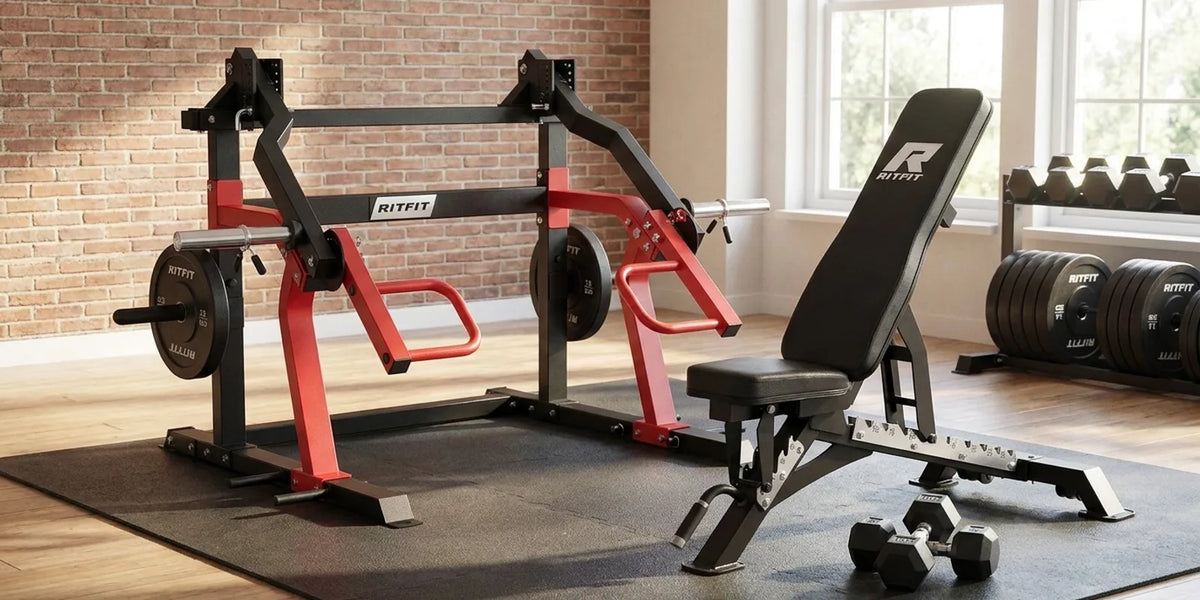
The RitFit Gorilla 2 in 1 Chest and Shoulder Press Machine is built for exactly this pattern, with a fixed pressing path you can load for the squeeze and a shoulder press station for the rest of your session.
Pec deck for a repeatable squeeze
The pec deck takes your arms further across your body than a press, so it finishes closer to a true inner chest contraction. Keep a slight elbow bend so the chest stays loaded rather than the elbow joint.
- Execution: Drive with the upper arm rather than the hands, and hold the squeeze for one second.
- Range: Stop before your shoulders roll forward, then return under control.
Diamond push-ups when you have no equipment
Diamond push-ups are the strongest bodyweight option here, and they are worth keeping in any inner chest workout. In 20 young men doing 6 repetitions of each hand position, diamond push-ups produced the highest relative pectoralis major activation of the standard, diamond, and wide variations tested.
- Hands: Index fingers and thumbs together under your sternum.
- Elbows: Keep them close to your ribs rather than flared out.
- Progression: Raise your feet on a bench when three sets of fifteen reps feels easy.
Put the pieces together and a simple inner pec exercises block looks like this: a squeeze press, one crossover variation, a machine press or pec deck, and diamond push-ups as a finisher. That is enough variety to train the squeeze without turning chest day into a checklist.
"We have to train adduction. This is not an optional exercise if you want your biggest chest. I don't like the unsupported dumbbell flyes -- it actually creates a lot of instability at the shoulder."
Jeff Cavaliere, MSPT, CSCS, Physical Therapist and Strength Coach, Creator of ATHLEAN-X, Athlean-X, Jeff Cavaliere Chest Cable Crossover (Generation Iron)
How Should You Set Grip Width and Range of Motion?
Grip width changes how your shoulders feel far more than how much inner chest you build. In 20 physically active adults doing eight repetitions at 60% of 1RM, a neutral grip seated chest press produced around 30% MVIC in the clavicular portion of the pectoralis major, compared with around 25% for a prone grip bench press at 150% of biacromial width.
Anterior deltoid activity stayed near 24% MVIC across every variation, while triceps activity was higher around 16% MVIC with a narrow grip at 50% of biacromial width than around 12% at the wider position. The authors concluded that all exercises and grips produced similar muscle activity.[3]
That conclusion is the useful part for anyone chasing inner chest muscle exercises, because the press you can load hardest and control best is the better pick.
- Grip width: Narrow and shoulder width grips change elbow and shoulder demands, not how much of the inner chest you hit.
- Finish position: Let your arms travel across your body at the end of a fly, because that last portion of the range is the closest thing to an inner chest contraction.
- Range of motion: Stop the stretch where your shoulder still feels stable, then spend the saved effort on a slower, tighter finish.
- Tempo: Lower for three seconds and hold the squeeze for one second to keep tension on the chest through the whole rep.
Here is how to target inner chest fibers in practice: keep the elbow angle almost fixed, drive from the upper arm, and treat the last few degrees of the movement as the rep that counts. Swap to a neutral grip if a straight bar grip irritates your shoulder, because both options load the chest similarly.
How Often Should You Train Your Inner Chest?
Two chest sessions per week is enough for most lifters, with one or two squeeze exercises in each. A ten week targeted resistance training block changed neuromuscular patterning of the pectoralis major during the bench press, which is the practical argument for repeating the same movements long enough to adapt instead of rotating them weekly.[4]
What separates good inner chest workouts from forgettable ones is scheduling, not exercise choice. Three or four squeeze movements in one session add fatigue that the middle of your chest cannot use, while the same two movements spread across two sessions give you twice as many quality reps.
Choosing a starting weight and adding load
Start with a load you can control for twelve clean reps and finish the set knowing you had two or three reps left in reserve. Add a small amount of weight or one rep per set every week or two, and only after you can hold the one second squeeze on every rep.
- Starting point: Twelve to fifteen reps for squeeze movements, and eight to twelve for the machine chest press.
- When to add weight: Once you hit the top of the rep range with the squeeze intact on all sets.
- When to hold steady: If the squeeze disappears in the last two reps, the load is already ahead of the target.
- Weekly volume: Roughly six to ten hard sets per week for the chest is a reasonable working range for most lifters.
Build the rest of the session around that plan with this 30 minute chest and tricep workout, and check the shoulder balance advice in how many shoulder exercises per workout so chest volume does not crowd out your shoulders.
How many inner chest exercises belong in one chest workout
One or two is enough. Because the inner chest is the same muscle you already train with every press, a squeeze movement at the end of the session is a finisher rather than a separate workout block.
Which Inner Chest Exercises Should You Swap In and Out?
Swap the exercise, not the intent, so every session still ends with a hard mid chest squeeze. The list below keeps the same finishing position while matching whatever equipment you actually own.
Dumbbell only swaps and bench swaps
- No cable machine: Dumbbell squeeze press on a bench or floor, holding the dumbbells together for every rep.
- Bench and dumbbells: Add a neutral grip press and a slow fly with a soft elbow bend, stopping where the shoulder feels stable.
- Bar only: Close grip bench press with your elbows tucked, finishing each rep with an extra squeeze rather than a lockout pause.
A full dumbbell plan is in these dumbbell chest exercises with a bench, and the fixed path option is covered in these Smith machine chest workouts for muscle growth.
Cable machine and home gym swaps
- Cable available: Standing crossover, single arm fly, and a low to high fly for the upper chest.
- Machines available: Seated chest press with a neutral grip, then pec deck to push the arms further across the body.
- Bodyweight only: Diamond push-ups, then feet elevated diamond push-ups once three sets of fifteen reps feels easy.
Most exercises for inner pecs overlap heavily, so pick by equipment rather than by novelty. The best inner chest exercise is the squeeze movement you can load and repeat for months, because the middle of the chest fills in from total chest work rather than a secret angle.
If you are still unsure how to target inner chest, remember that an inner pectoral workout should feel like a controlled squeeze rather than a heavy press. Rotate between these best dumbbell exercises for the upper chest and a chest and back pairing like this Arnold chest and back workout to keep the whole chest growing.
When Should You Stop an Inner Chest Exercise?
Stop the set when the squeeze disappears or when you feel sharp pain at the front of the shoulder. A dull stretch at the end of the range is normal, but pain that shows up at the same point on every rep is a signal to change the exercise rather than push through it.
Shoulder position is the usual culprit, because fly style movements put the joint under load at its longest length. Switching to a neutral grip press or a machine path removes most of that demand while keeping the squeeze you came for.
- Sharp shoulder pain: End the set, reduce the range, and try a neutral grip before returning to the movement.
- Clicking with pain: Stop the exercise for the day and pick a pressing variation instead.
- Elbow pain: Reduce the load and stop locking out hard at the end of the range.
- Numbness or tingling: Stop training that movement and get it looked at by a professional.
- Losing the squeeze: Drop the weight rather than grinding out reps with no tension on the chest.
Common mistakes that kill the inner chest squeeze
Squeeze problems usually come from setup rather than effort, and most of them are fixable in one session. Check these before you add any weight.
- Flaring the elbows: Wide elbows shift load to the front of the shoulder and away from the chest.
- Cutting the range short: Stopping before your arms cross your body removes the part of the rep you came for.
- Rushing the lowering phase: Dropping the weight fast wastes the tension that builds the squeeze.
- Chasing new angles: Rotating exercises weekly removes the repeated practice that makes a movement feel reliable.
FAQs About Best Inner Chest Exercises
What does it mean to target the inner chest?
It means training the horizontal adduction and the squeeze at the end of the range, not a hidden muscle. The pectoralis major is one muscle, so there are no inside chest exercises that switch on only the fibers nearest your sternum. Cable and machine work simply make that end range contraction easier to feel and repeat.
What are the best inner chest exercises for a home gym?
A dumbbell squeeze press, a cable crossover, and a pec deck cover the range well. With dumbbells and a bench only, press the dumbbells together hard through the whole rep and finish with diamond push-ups. If you own a cable machine, chest height crossovers are the best exercise for inner pecs, since they keep tension on the finish.
How many inner chest exercises should you do in one workout?
One or two is plenty. The inner pec muscle is the same muscle you already train with every press, so adding three or four squeeze movements mostly adds fatigue without adding growth. Pick one squeeze exercise after your main press and run it for three sets of ten to fifteen controlled reps with a one second hold at the finish.
How well do close-grip push-ups work the inner pecs?
Very well for a bodyweight option. In 20 young men doing 6 repetitions of each hand position, diamond push-ups produced the highest relative pectoralis major activation of the standard, diamond, and wide variations tested. Keep your elbows close and squeeze your hands together at the top of every rep for the strongest contraction.
How do you target inner chest fibers with dumbbells only?
Press the dumbbells together and keep that pressure for the full rep. A squeeze press on the floor or on a bench keeps tension on the chest without loading the shoulder at a long stretch, which is the position that most often causes discomfort. Finish each set with a slow three second lowering phase.
How long does it take to build a fuller inner chest?
Expect months rather than weeks. The middle of the chest fills in as the whole pectoralis major grows, so progress follows your pressing strength and weekly volume. Add a little load or one rep every week or two, keep chest work at two sessions per week, and track your reps in every chest workout instead of chasing a pump.
Conclusion
There is no separate inner chest muscle to isolate, so the best inner chest exercises load horizontal adduction and hold a squeeze you can feel. The dumbbell squeeze press, cable crossover, pec deck, machine press, and diamond push-up all finish with your arms across your body, the position that trains the middle of the chest hardest.
Pick one or two of them, run them twice a week, and add weight only when the squeeze survives every rep. New to chest training? Start with the beginner path in the RitFit discount guide and use a load you can control.
Disclaimer
This article is general fitness education and is not medical advice, diagnosis, or treatment for any shoulder, elbow, or chest condition. Anyone with existing pain, an injury history, or a recent procedure should clear pressing and fly movements with a qualified physician or physical therapist before starting.
References
1. Intziegianni K, Katsamis E, Michaelides M, Parpa K. Electromyographic Activation of the Pectoralis Major and Triceps Brachii Muscles During Standard, Diamond, and Wide Hand Position Push-Ups. Muscles. 2026;5(1). doi:10.3390/muscles5010018. PMCID: PMC13029269
2. Saeterbakken AH, Mo DA, Scott S, Andersen V. The Effects of Bench Press Variations in Competitive Athletes on Muscle Activity and Performance. J Hum Kinet. 2017;57:61-71. doi:10.1515/hukin-2017-0047. PMCID: PMC5504579
3. Muyor JM, Rodriguez-Ridao D, Oliva-Lozano JM. Comparison of Muscle Activity between the Horizontal Bench Press and the Seated Chest Press Exercises Using Several Grips. J Hum Kinet. 2023;87:23-34. doi:10.5114/jhk/161468. PMCID: PMC10203828
4. Stronska-Garbien K, Golas A, Roczniok R, Terbalyan A, Drozd M. Neuromuscular Repatterning of the Pectoralis Major During the Bench Press Exercise Following a 10-week Targeted Resistance Training Intervention. J Musculoskelet Neuronal Interact. 2024;24(3):276-283. PMCID: PMC11367169





