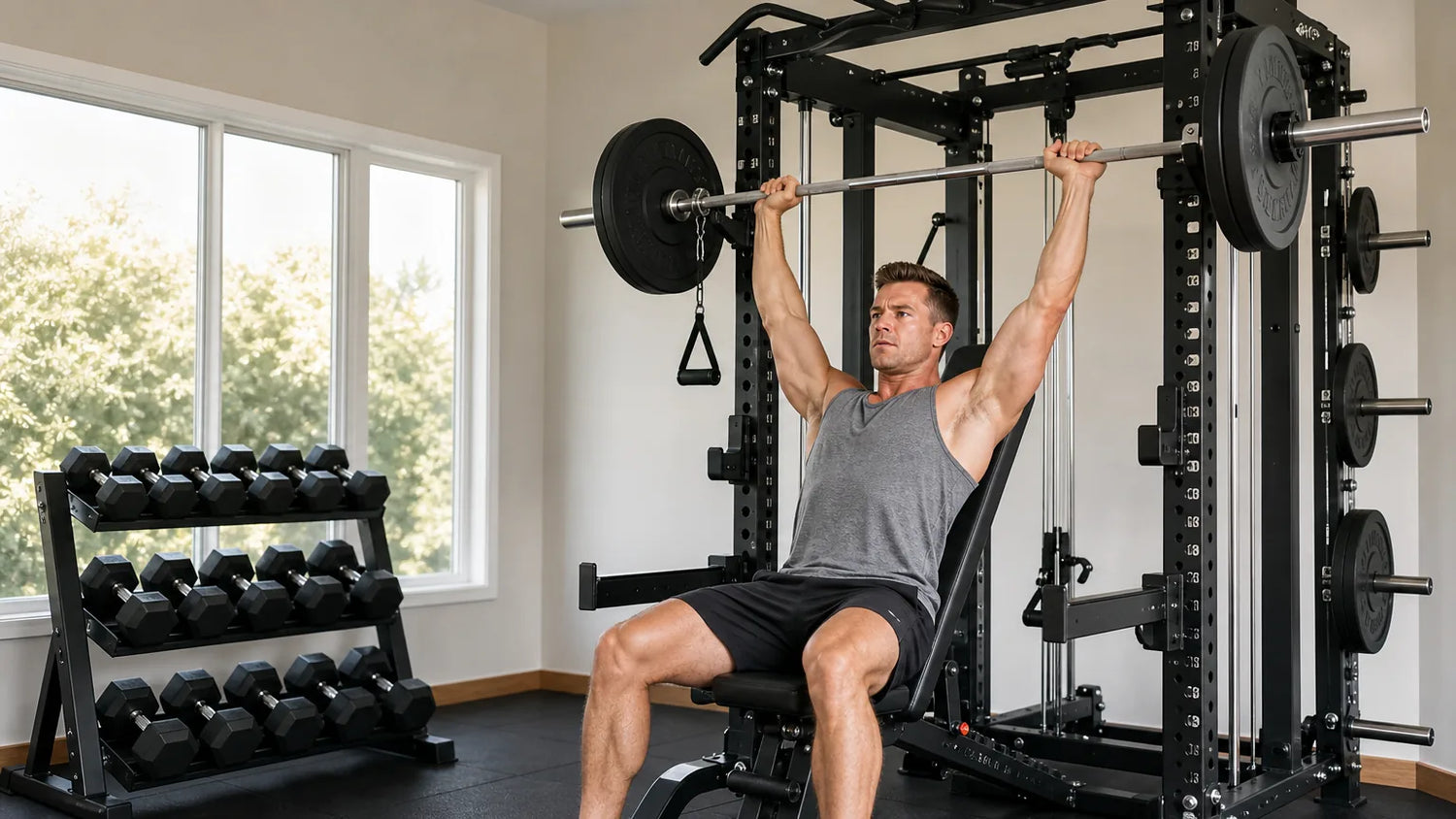
The best overall shoulder exercise is the overhead press, the one movement that builds real deltoid mass and pressing strength at the same time. This guide explains why it wins and how to make it work for you.
You will learn which press variation fits your body and equipment, how to program it, and why lateral raises still belong in your routine for full shoulder width.
Quick Answer: The overhead press is the best overall shoulder exercise because EMG testing shows it produces the highest anterior deltoid activation and strong medial deltoid activity, while letting you load heavy for progressive overload. Add lateral raises to finish the side delts and build full shoulder width.
Key Takeaways
- Single best pick: The overhead press builds front and side deltoids and lets you overload heavy, making it the top overall shoulder exercise.
- Activation edge: In one EMG trial the shoulder press hit the highest anterior deltoid activity of the movements tested.
- Pick your variation: Barbell, seated dumbbell, and machine presses each suit different lifters, mobility levels, and spaces.
- Add width separately: Lateral raises target the side delt that presses alone cannot fully develop.
- Form first: Straight wrists, controlled range, and a solid overhead lockout keep pressing safe and effective.
Why the Overhead Press Wins for Shoulders
The overhead press wins because it trains the largest share of the deltoid while allowing heavy, progressive loading. No isolation move matches that combination of muscle recruitment and strength potential.
The three deltoid heads and their jobs
Your deltoid has three heads that each contribute to shoulder shape and function.
- Anterior (front) delt: Drives pressing overhead and in front of the body, and it is the primary mover in any shoulder press.
- Medial (side) delt: Lifts the arm out to the side and is the main driver of shoulder width and that rounded look.
- Posterior (rear) delt: Pulls the arm back and stabilizes the shoulder, and it gets less work during pressing than the other heads.
What the activation data shows
The shoulder press recruits the front and side delts more than most other upper body pressing options. In resistance trained men, the shoulder press produced the highest anterior deltoid activation, 33.3% MVIC, significantly higher than bench press, lateral raise, and dumbbell fly[1].
That heavy front and side delt involvement, paired with room to add weight over time, is why a proper overhead press beats single joint shoulder work for overall development. Beginners can start light and build up gradually.
Which Shoulder Press Variation Is Best for You?
The best shoulder press variation depends on your mobility, your goal, and your equipment, not on one universal ranking. All three main versions build the front and side delts effectively when performed well.
Overhead press variations provide different stimuli to the shoulder muscles, and pressing a free barbell generally excites the deltoids more than a machine that stabilizes the load path for you[2]. Use the matrix below to match a version to your situation.
| Variation | Heads trained | Overload potential | Mobility needed | Best for |
|---|---|---|---|---|
| Barbell standing overhead press | Front and side | Very high | More | Strength and mass foundation |
| Seated dumbbell shoulder press | Front and side | High | Moderate | Mass, natural wrist path, full range |
| Machine shoulder press | Front and side | High | Low | Beginners, small space, guided path |
Barbell standing overhead press
The standing barbell press is the top choice for building raw pressing strength and total shoulder mass. It demands good shoulder and thoracic mobility and a braced core, so it rewards lifters who can hold a solid position overhead.
Seated dumbbell shoulder press
The seated dumbbell press lets each arm move on its natural path and often feels friendlier on the wrists and shoulders. A more stable implement can recruit the prime mover more, since the anterior deltoid showed greater activation pressing a dumbbell, 63.3% MVIC, than a less stable kettlebell, 57.9% MVIC[3].
Machine shoulder press
The machine shoulder press guides the bar path, which lowers the mobility and balance demand and suits beginners or tight spaces. The RitFit Gorilla 2-in-1 chest and shoulder press machine covers both presses in one footprint.
How Should You Program the Overhead Press?
Program the overhead press with a weight you control for clean reps, a moderate set and rep target, and steady weekly progression. Consistency and good form beat chasing maximum loads every session.
Choosing your starting weight
Pick a load that lets you complete every rep with straight wrists and no lower back arching. Starting lighter and adding weight over weeks builds a stronger, safer pressing pattern than grinding heavy from day one.
Sets, reps and frequency
A practical starting point is 3 to 4 sets of 6 to 12 reps, training shoulders 2 to 3 times per week with pressing and side delt work spread across sessions. This pairs well with a full shoulder workout with dumbbells.
When to add weight and how to progress
Add a small amount of weight once you can complete all prescribed reps with good form for two sessions in a row. Range of motion matters as much as load, and the initial to mid portion of the press is a high value part of the movement to train hard.
Why Do You Still Need Lateral Raises?
You still need lateral raises because the press alone does not fully develop the side delt that creates shoulder width. Pressing builds mass and strength, while raises isolate the medial head for that rounded, capped look.
The data supports pairing them, since for the medial deltoid the lateral raise, 30.3% MVIC, and shoulder press, 27.9% MVIC, both showed significantly higher activity than bench press and dumbbell fly[1]. Presses cover a lot of the side delt, but dedicated raises push it further.
- Press for the base: Overhead pressing builds front and side delt mass plus the strength to load progressively.
- Raise for the width: Lateral raises hammer the medial head with lighter, higher rep sets that presses cannot replicate.
- Do not skip the rear: Add rear delt work so your shoulders stay balanced and healthy, not front dominant.
Cable raises keep tension smooth across the range, and a pair of cable machine handles makes them easy to set up at home. See how the movements differ in our guide on chest press vs shoulder press.
What Are the Most Common Shoulder Press Mistakes?
The most common shoulder press mistakes are poor wrist and bar position, excessive lower back arch, and pressing through pain. Fixing these protects your shoulders and makes every rep more productive.
- Bent wrists: Let the bar sit deep in the palm with straight wrists so force transfers cleanly and joints stay protected.
- Overarching the back: Brace your core and squeeze your glutes so the press does not turn into a standing incline movement.
- Behind the neck pressing: Skip behind the neck versions, which raise shoulder impingement risk for most lifters.
- Pressing through pain: Stop the set if you feel sharp pain or pinching, and reset your form before continuing.
The video below walks through proper setup, grip, and lockout so you can self check your technique. Building strong supporting muscles helps too, as covered in our notes on grip and hand strength work.
Knowing when to stop a set is a skill, and the standing press even doubles as core training, which links to broader exercise for balance work.
How Do You Build a Shoulder Setup at Home?
You can build a complete shoulder setup at home with a small mix of adjustable load and pressing options. You do not need a commercial gym to train the best overall shoulder exercise effectively.
- Adjustable load: A set of dumbbells or plates covers pressing, raises, and progression as you get stronger.
- A pressing station: A bench or machine lets you press seated for extra overload and a supported torso.
- Cable access: Cables or bands add smooth tension lateral raises for side delt width.
Start simple, add equipment as your training grows, and explore related bench shoulder exercises and a broader full-body training guide to round out your program.
"If you're going to do a shoulder press, if you want to do a half rep, do it from here to here, the initial portion to the mid portion is the most important portion of a movement. The majority of literature shows that if you just do a half repetition in the lengthened portion, it's as effective as doing the full range of motion."
Brad Schoenfeld, PhD, Exercise Science Researcher, CUNY Lehman College
FAQs About the Best Overall Shoulder Exercise
What is the single best overall shoulder exercise?
The overhead shoulder press is the best overall shoulder exercise. EMG research found it produces the highest anterior deltoid activation and among the highest medial deltoid activation of common movements, and it lets you load heavy for progressive overload. Add lateral raises to fully develop the side delts and shoulder width.
Does the shoulder press work all three deltoid heads?
The shoulder press strongly trains the front and side deltoids and involves the rear deltoids to a lesser degree. It is excellent for overall mass, but the rear and side heads still benefit from dedicated work like lateral raises and rear delt movements to build balanced, rounded shoulders and avoid front dominant imbalances.
Should you do the overhead press standing or seated?
Standing presses are easier on the lower back and train more core stability, while seated presses let you use more weight and place more overload directly on the delts. Beginners and those with back concerns often start seated or with a machine, then progress. Both build shoulder mass effectively when performed with good form.
How often should you train the shoulder press?
Training shoulders two to three times per week works well for most lifters, keeping total weekly sets in a moderate range spread across sessions. Pair pressing with lateral raises, use a mix of rep ranges, and prioritize good technique and gradual weight increases over chasing maximum loads every session.
Is the overhead press bad for your shoulders?
No. The overhead press is generally safe for healthy shoulders when done with a full grip, straight wrists, controlled range, and a proper overhead lockout. Avoid behind the neck pressing and stop the set if you feel sharp pain or pinching. If you have an existing shoulder condition, consult a qualified professional first.
Conclusion
The overhead press is the best overall shoulder exercise because it builds the front and side delts while letting you load heavy and progress over time. Choose the variation that fits your mobility and space, then keep your form tight.
Start pressing today, add lateral raises for width, and browse our exercise weights to load your first working sets.
Disclaimer
This article is for general educational purposes only and does not replace professional medical or fitness advice. Consult a qualified professional before starting a new program, especially if you have an existing shoulder condition or injury.
Save on your next RitFit order
Tap the button to copy your code, then paste it at checkout.
References
1. Campos YAC, Vianna JM, Guimaraes MP, et al. Different Shoulder Exercises Affect the Activation of Deltoid Portions in Resistance-Trained Individuals. J Hum Kinet. 2020;75:5-14. doi:10.2478/hukin-2020-0033 PMC7706677.
2. Coratella G, Tornatore G, Longo S, et al. Front vs Back and Barbell vs Machine Overhead Press: An Electromyographic Analysis and Implications for Resistance Training. Int J Environ Res Public Health. 2022;19(15):9484. doi:10.3390/ijerph19159484 PMC9354811.
3. Williams MR, Hendricks DS, Dannen MJ, et al. Stability of Resistance Training Implement alters EMG Activity during the Overhead Press. Int J Exerc Sci. 2018;11(1):1044-1053. PMC6033506.