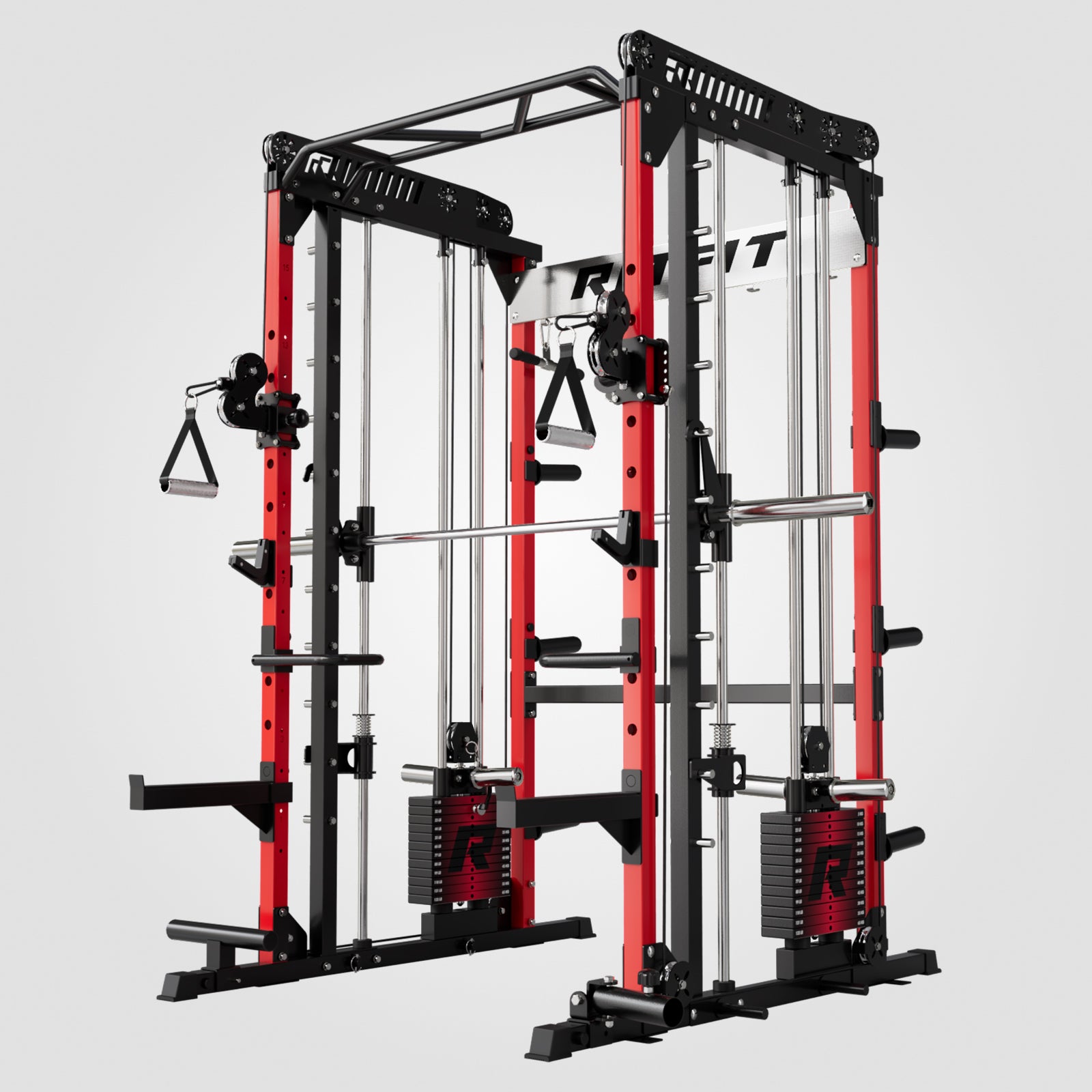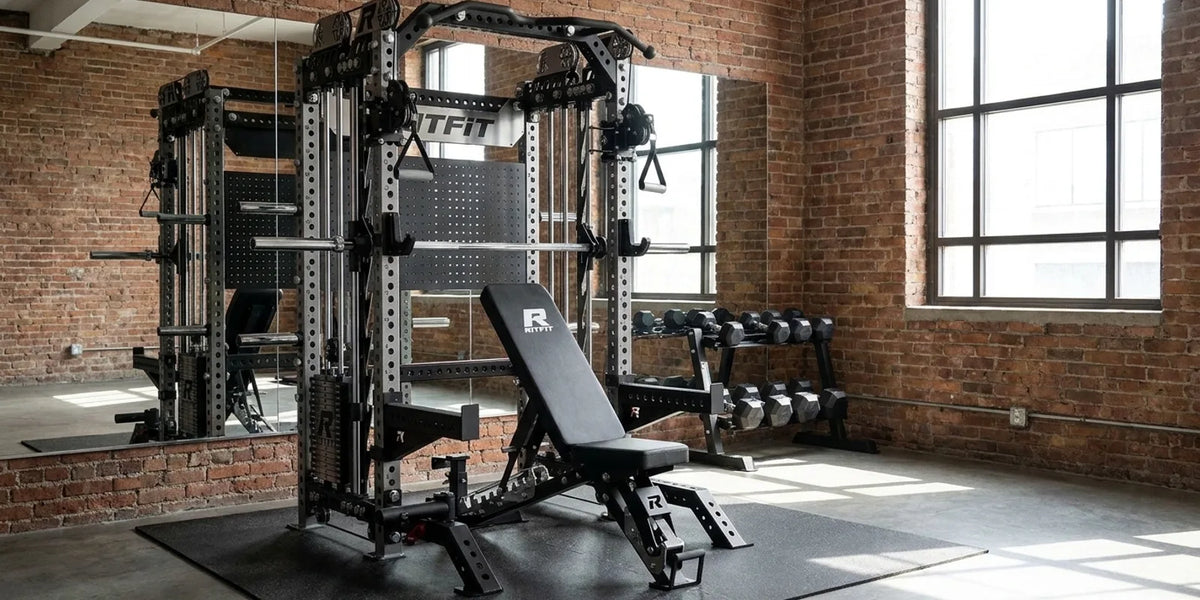
The best smith machine for advanced lifters at home is the RitFit M3 Pro, the only frame in the RitFit lineup that pairs a 2,500 lb capacity with uniform 3x3 inch 11-gauge steel and still lands on a 21.5 sqft footprint.
This guide is built for lifters who already move heavy loads without a spotter nearby. It covers the ratings that decide whether a home Smith machine holds up, then maps them onto the M3 Pro and the rest of the RitFit Smith machine lineup.
Quick Answer: The best smith machine for advanced lifters at home is the RitFit M3 Pro Home Gym Smith Machine with Cable Crossover, a 3x3 inch 11-gauge platform rated for 2,500 lb with a 572 lb static Smith module, 650 lb safety arms, a 360 lb built-in cable stack and a 21.5 sqft footprint.[1]
Key Takeaways
- Load headroom: RitFit rates the M3 Pro frame at 2,500 lb, the Smith module at 572 lb static and 352 lb dynamic, and each safety arm at 650 lb static, which is the category of rating advanced lifters should be shopping for.
- Uniform steel: The front, middle and rear posts are all 3x3 inch 11-gauge 3 mm A36 steel, where many all-in-one racks step down to 2x3 or 2x2 tubing at the middle and rear posts.
- Solo safety: Safety arms extend 560 mm with a 650 lb static rating, and the Smith module adds 10 quick-rack positions as a second fail-safe when nobody is spotting.
- Cable math: Each side has a 180 lb built-in stack, and the 2:1 pulley ratio means one handle delivers roughly 90 lb at full selection, not 180 lb.
- Space: The M3 Pro holds three stations in 21.5 sqft, stands 84 in tall and puts its highest upright hole at 78 in.
- Ownership: RitFit publishes a 5 year warranty on steel parts and 2 years on wearing parts, and the machine ships in one wooden crate.
What Separates a Smith Machine Built for Advanced Lifters From an Entry-Level One
Advanced lifters need a home Smith machine with published load ratings, uniform steel across every upright, a long safety arm and a bar that matches Olympic length. Price and cable count matter far less once you already move heavy loads on your own.
Five ratings do most of the work when you compare machines inside the same brand, and each one is published once you know where to look.
- Frame capacity: the number the uprights and base are rated to carry, plus the steel gauge and upright size behind it.
- Smith module rating: static and dynamic figures for the guided bar, which govern how much you can load for a working set.
- Safety arm rating and reach: a static figure plus arm length, since a short arm leaves a gap under a failed rep.
- Bar spec: diameter and length, because a shortened Smith bar changes where your hands sit on presses.
- Cable system: stack weight per side, pulley ratio and adjustment count, which together decide the real resistance at the handle.
RitFit positions the M3 Pro for advanced home gym users and heavier training needs, and describes it as workable for consistent everyday strength training too. Buyers who want a deeper look at what the heavy-duty tier involves can read the commercial grade Smith machine guide from RitFit.
Frame Capacity and Steel Gauge: Where Advanced Lifters Feel the Difference
The M3 Pro frame is rated for 2,500 lb, and RitFit builds all three upright pairs from the same 3x3 inch 11-gauge 3 mm A36 steel. That uniform spec, plus 1,093.5 lb of total frame mass, is what separates it from machines that publish a big number on lighter tubing.
Gauge is wall thickness, and the scale runs backward, so a lower number means thicker steel.[2]
- 11-gauge: about 0.120 in or 3.0 mm of wall, the thickness the M3 Pro uses on every upright.
- 12-gauge: about 0.105 in, a strong middle ground on 2.36 inch tubing in the RitFit M2 line.
- 14-gauge: about 0.075 in, the budget and mid-range tier, used on the 2x2 inch M1 Pro posts.
Why Uniform 3x3 Uprights Matter Front to Back
One power rack buyer guide explains that a 3x3 inch upright in 11-gauge steel is about as rigid as a home rack gets, and that upright size finishes the story that gauge starts. The same guide notes that many home racks run thinner tubing at the rear posts, where the rack resists the bend a walked-out or racked bar creates.
- Front to back: matching 3x3 specs on the middle and rear posts keeps stiffness even across the frame instead of only at the front pair.
- Attachment ecosystem: the same guide points out that 3x3 inch uprights are the size most heavy-duty attachments are built around, which matters when you add pieces later.
- Hole pattern: the M3 Pro runs 1 in holes on 2 in centers with 35 holes per side, so safety height and J-hook position move in 2 in steps.
What 1,093.5 lb of Frame Mass Does Under a Loaded Bar
RitFit lists the M3 Pro rack weight at 1,093.5 lb, spread across A36 steel uprights with two reinforced bottom supports. Mass on a wide base is what keeps a tall freestanding cage from walking or rocking during a heavy set.
Smith Bar Spec, Rack Positions, and Bar Path Under Heavy Loads
The M3 Pro carries a full length 2,205 mm Smith bar at 30 mm diameter with knurled grip zones rather than a shortened replica. RitFit rates the Smith module at 572 lb static and 352 lb dynamic across 10 adjustable positions.
Bar length and diameter decide where the bar sits in your hands, which is the part of a guided setup that advanced lifters notice first.
- 30 mm diameter: a standard Olympic style thickness, so your grip and hand position carry over from free weight pressing.
- 2,205 mm length: full length bar travel, so a wider or narrower grip does not run out of knurling.
- 572 lb static: the figure to read when the bar is sitting still in the hooks or on the safety arms.
- 352 lb dynamic: the figure that governs a moving rep, and the one that matters for a heavy working set.
What the 10 Quick-Rack Positions Change in a Solo Session
The Smith module offers 10 quick-rack hook positions on a stainless plate system, on top of the 35 upright holes and 29 cable trolley settings. More stopping points mean you can bail a rep at a height that matches your leverage instead of the nearest hole.
"Few pieces of equipment in the home exercise industry are as comprehensive and versatile as this all-in-one gym system. The robust system provides a natural, centered bar path for compound lifts like squats, presses, and rows, and incorporates a dual cable crossover station with a full rack of precision-engineered attachments."
Tom Eskey, CF-L1, CPT, Home Gym Equipment Reviewer, Garage Gym Revisited, RitFit M1 Multi-functional Smith Machine Review
Safety Arms and J-Hooks: What Spotter-Free Heavy Sets Require
Safety arms on the M3 Pro extend 560 mm and carry a 650 lb static and 285 lb dynamic rating, while each sandwich style J-hook is rated 650 lb static. A long arm plus a high static rating is the combination that makes solo heavy training practical.
Arm length is the spec most buyers skip, and it is the one that decides whether the bar lands on steel or on you.
Reading the Safety Arm Numbers Correctly
The published figures are 650 lb static with 285 lb dynamic on the safety arms, so a dropped bar rests well inside the rating while a guided rep stays under the dynamic ceiling. The 560 mm or 22 in arm reach on the M3 Pro is longer than the short spotter arms common on lighter all-in-one racks.
- Static means parked: use the higher figure for a bar resting on the arms or in the hooks.
- Dynamic means moving: use the lower figure for anything you are actively pressing or squatting.
- Reach means coverage: a longer arm catches the bar at a wider range of body positions, which matters most on incline and decline work.
One buyer guide also points out that properly anchoring a rack changes how it behaves under load, and that laser-cut holes let attachments seat squarely instead of rocking in oversized openings. RitFit built the M3 Pro with laser-cut numbering on the uprights so left and right positions are easy to match.
The home gym safety and assembly guide walks through the full inspection routine before your first heavy session.
Cable System Math: What a 2:1 Ratio Really Delivers
Each side of the M3 Pro carries a 180 lb stack through a 2:1 pulley ratio, so one handle delivers roughly 90 lb at full selection. The machine uses 16 aluminum pulleys and 29 single-hand trolley positions across two independent stacks.
The gearing is a trade, not a downgrade, and it is the single most misread spec in all-in-one machines.
- Stack total: 180 lb per side across two sides, which RitFit lists as 360 lb combined.
- Pulley count: 16 aluminum pulleys, which buyers describe in reviews as smooth through the full range with no catching between sessions.
- Adjustment: 29 cable positions, set with one hand, so switching between a high fly and a low row takes seconds.
How Much Resistance Each Cable Handle Delivers
The stack holds 18 plates at about 10 lb each, which is where the published 180 lb per side figure comes from. With a 2:1 ratio the handle travels about twice as far as the stack moves, and the load at the handle lands near half the selected weight.
- One handle, full stack: 180 lb selected divided by the 2:1 ratio gives roughly 90 lb at the grip, with a longer range of motion in exchange.
- Both handles, one movement: a two arm press or fly pulls on both stacks at once, so the combined load works out to roughly 180 lb.
- Top plate and selector: RitFit notes a smaller top plate and four balance screws to keep the stack running evenly, and that plate assembly is part of the stack rather than extra resistance.
- What it means for training: cable work on this machine is built for volume and joint friendly accessory sets, while the Smith bar and rack uprights carry the heavy compound loads.
Footprint, Ceiling Height, and Delivery for a Real Room
The M3 Pro footprint is 21.5 sqft, it stands 84 in tall with the pull-up bar installed, and its highest upright hole sits at 78 in. RitFit suggests the machine for users from 4 ft 9 in to 6 ft 5 in tall.
Those three numbers, not the marketing photo, decide whether the machine belongs in your room.
- Floor space: 21.5 sqft total, which is roughly the floor a parked car takes up in part of a one-car garage.
- Depth: 86.5 in long including the Smith bar, so account for bar travel in front of and behind the frame.
- Width: 60.4 in across, plus room to move around the cable stations on both sides.
- Lowest hole: 3.1 in from the floor, which sets how low a safety arm or J-hook can be placed.
Does the RitFit M3 Pro Smith Machine with Cable Crossover Fit a Basement Gym
A basement gym works if the ceiling clears 84 in at the rack position and the delivery route clears the crate, since the machine arrives as one box weighing 1,231.3 lb in a package measuring 232 x 65 x 76 cm. RitFit lists the machine as shipping within 2 to 3 business days with 7 to 10 days in transit by truck.
- Measure the low point: check ceiling height directly above the rack, not at the room's high side, because most basement floors slope.
- Measure the path: a 1,231.3 lb crate has to pass the doorway, stair turn and any low ductwork before it reaches the room.
- Plan the pull-up bar: the bar sits at 83 in and the frame top reaches 84 in, so leave clearance above it for a full hang.
"Very Solid 3x3 setup. Cables are smooth. Love that it came in pink. Great all in one piece. Hope you add more accessories and attachments for the m3 ! I use it daily!!!!"[3]
Katharine B. Verified Buyer, M3 Power Rack Cable Crossover Smith Machine
RitFit M3 Pro vs M1 Pro and M2: Specs Side by Side
The RitFit lineup scales from a 1,600 lb frame on 2x2 inch 14-gauge steel up to the 2,500 lb frame on 3x3 inch 11-gauge steel under the M3 Pro. Buyers pay the step up in steel, frame rating, cable adjustment range and built-in stack capacity, not in footprint.
| Model | Price | Frame material | Frame capacity | Footprint | Built-in stack | Cable positions |
|---|---|---|---|---|---|---|
| RitFit M1 Pro (no stack) | $1,299.99 | 2x2 in, 14-gauge | 1,600 lb | 20.9 sqft | None | 15 |
| RitFit M1 Pro (with stack) | $2,199.99 | 2x2 in, 14-gauge | 1,600 lb | 20.9 sqft | 264 lb | 15 |
| RitFit M2 | $2,199.99 | 2.36x2.36 in, 13-gauge | 2,000 lb | 22.8 sqft | None | 16 |
| RitFit M2 Pro | $2,799.99 | 2.36x2.36 in, 13-gauge | 2,000 lb | 22.8 sqft | 286 lb | 16 |
| RitFit M3 Pro | $3,099.99 | 3x3 in, 11-gauge | 2,500 lb | 21.5 sqft | 360 lb | 29 |
All figures taken from the RitFit published model comparison table on the M3 Pro product page, checked September 2026.
Advanced lifters shopping on load headroom land on the M3 Pro, because the RitFit M1 Pro Smith Machine Weight Stack Home Gym Package tops out at a 1,600 lb frame rating and the M2 line at 2,000 lb. A lifter who mainly wants cable work and a smaller cable footprint can save money on the M1 Pro and spend the difference on plates.
- Choose the M3 Pro if: you train heavy compound work alone and want the 2,500 lb frame, the 29 position cable system and 650 lb safety arms on one footprint.
- Choose the M1 Pro if: budget decides and your working loads stay inside a 1,600 lb frame rating.
- Choose the M2 line if: you want the modular platform and the 3D Smith path option on 13-gauge steel.
- The M3 Pro is not ideal for: rooms that cannot clear 84 in of ceiling, or lifters whose heaviest cable work stays under roughly 90 lb per handle.
Buyers who need a different balance of width, stack layout and price should also look at the RitFit Buffalo Wild Smith Machine with Adjustable Dual Cable System, which uses its own dual cable arrangement. The M3 Pro vs M2 vs M1 Pro comparison breaks that choice down further by installation demand and upgrade path.
"This machine is fabulously sturdy and gives the opportunity to do a complete body workout in one place!"
Charla W. Verified Buyer, M3 Power Rack Cable Crossover Smith Machine
Is a $3,099.99 Heavy-Duty Smith Machine Worth It for a Home Gym
The M3 Pro is worth 3,099.99 dollars if you train heavy on your own and want published ratings that stay well above what you load. A lifter who mostly trains moderate cable volume and light guided reps will get more per dollar from the M1 Pro or the M2.
Value here is a comparison of what the price buys rather than a claim about any other brand.
- Steel and ratings: 3x3 inch 11-gauge uprights on a 2,500 lb frame, a 650 lb safety arm and a 650 lb J-hook, all figures RitFit publishes on the product page.
- Three stations: a power rack, a 16 pulley cable system and a 10 position Smith module natively on one frame, rather than as paid add-on modules.
- Warranty: 5 years on steel parts for the frame and structural components, plus 2 years on wearing parts such as cables, pads and hardware, serviced directly by RitFit.
- Included attachments: sandwich J-hooks, a 560 mm safety arm, a carbon steel pull-up bar, four 300 mm storage rods rated 330 lb static each, a 10 hook rear pegboard, a center crossbar and a Quick Mount Landmine.
What Else to Budget Beyond the Machine
The storage rods hold Olympic plates and the rear pegboard takes accessories, so the add-ons that matter most are a bench and plates rather than more hardware. Four colors are listed at the same 3,099.99 dollar price, including the RitFit Limited Edition M3 Home Gym Smith Machine.
- Bench: a dedicated adjustable bench such as the RitFit GATOR 1600LB Adjustable Weight Bench covers the Smith press station and incline work.
- Plates: the Smith bar and the rack take 2 in plates, and RitFit Color Olympic Bumper Weight Plates are rated for the storage rods.
- Upgrade path: the 2:1 cable ratio is the ceiling on cable resistance, so any long term plan that needs more cable load beyond roughly 90 lb per handle is better served by adding free weight work than by an accessory purchase.
- Lower budget: a lifter working between 2,000 and 3,000 dollars has the Smith machine under $3,000 guide as the next read.
FAQs About Smith Machines for Advanced Lifters
What does the RitFit M3 Pro Smith machine cost in 2026?
The M3 Pro lists at 3,099.99 dollars across all four colorways, down from a 3,399.99 dollar regular price, and the price is the same for Black and Silver, Pink and Silver, Pink and Black and Limited Green. RitFit sells direct rather than through a marketplace, so the listed price is the price. That figure covers a power rack, a cable crossover and a Smith machine on one 21.5 sqft frame.
How much weight can the M3 Pro Smith machine hold?
RitFit publishes a 2,500 lb frame capacity, a 572 lb static and 352 lb dynamic rating for the Smith module, 650 lb static on each safety arm and each J-hook, and a pull-up bar rated 300 lb dynamic and 550 lb static. Those are published ratings rather than independent test results. Treat the dynamic figures as the ones governing moving reps and the static figures as the ones governing a bar sitting still.
Does the M3 Pro fit a low ceiling basement or garage?
The M3 Pro stands 84 in tall including the pull-up bar, and its highest upright hole sits at 78 in, so it clears most basement and apartment ceilings. The footprint is 21.5 sqft, the length is 86.5 in including the Smith bar and the width is 60.4 in. Measure the ceiling above the rack position before ordering, since basement floors usually slope.
How much resistance do the M3 Pro cable handles deliver?
Each side carries a 180 lb built-in stack across 18 plates of roughly 10 lb each, and the 2:1 pulley ratio halves the load reaching the handle while doubling the range of motion, so one handle delivers roughly 90 lb at full selection. Pulling both handles together in a two arm movement brings both stacks into play for roughly 180 lb combined.
What warranty does the M3 Pro come with?
RitFit publishes a 5 year warranty on steel parts covering the frame and structural components, plus a 2 year warranty on wearing parts such as cables, pads and hardware. Service runs directly through RitFit rather than a third party reseller, so warranty claims, replacement parts and assembly questions all go to the brand support team.
Is the M3 Pro suitable for a beginner?
RitFit describes the M3 Pro as built for advanced home gym users and heavier training needs while noting that its adjustment range, built-in stacks and guided Smith system keep it usable for everyday strength training. The practical limit is space and budget rather than experience. A lifter who cannot spare 21.5 sqft or 3,099.99 dollars gets more value from the M1 Pro.
Conclusion
The best smith machine for advanced lifters at home is one whose published ratings sit well above what you load, and the RitFit M3 Pro clears that bar with a 2,500 lb frame, a 572 lb static Smith module and 650 lb safety arms on uniform 3x3 inch 11-gauge steel.
Measure your ceiling and delivery route first, then decide between the M1 Pro, the M2 and the M3 Pro by the load headroom you actually need. Start with the multi function Smith machine guide to compare the whole RitFit lineup before you order.
Disclaimer
This article is a product specification and buying guide, and it is not medical, training, or safety advice. Follow the manufacturer assembly instructions, keep loads within the published ratings, and consult a qualified physician or coach before starting a heavy strength program.
References
1. RitFit. RitFit M3 Pro Home Gym Smith Machine with Cable Crossover product page, including the published specification table and model comparison table. Accessed September 2026. RitFit Sports.
2. Plate and Rack. Power Rack Steel Gauge: 11 vs 14 Gauge Explained, a buyer guide summarizing the published Manufacturers Standard Gauge for steel. Accessed September 2026.
3. RitFit. Verified buyer reviews for the M3 Power Rack Cable Crossover Smith Machine, published on the product page review feed. Accessed September 2026.