








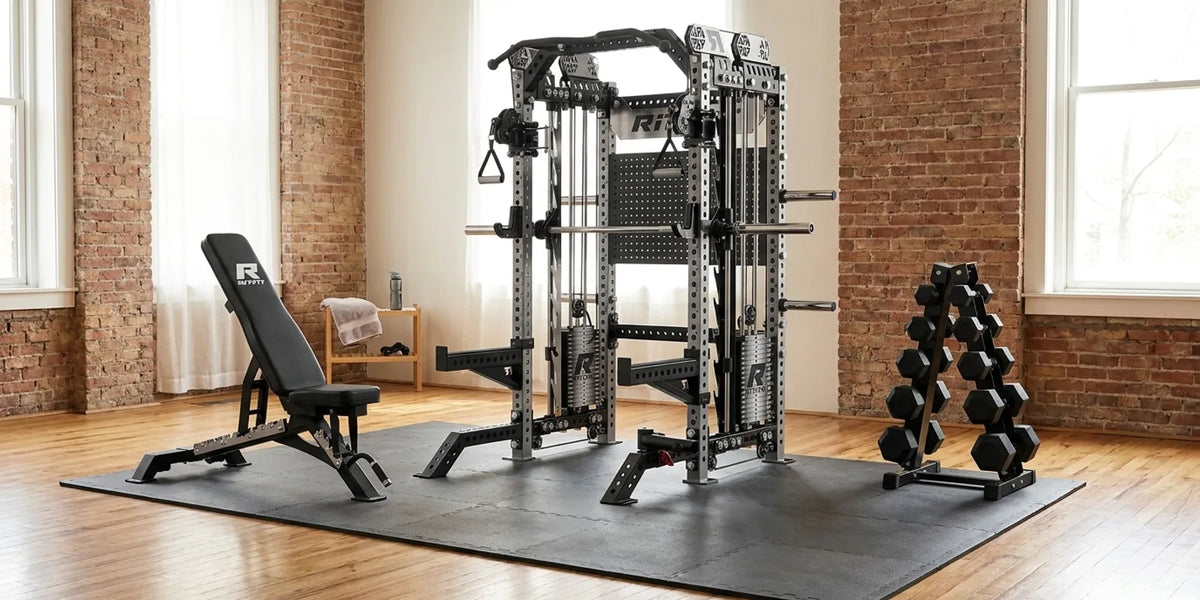
The best smith machine for personal trainers is the one that resets fastest between clients, not the one with the heaviest stack on paper. A coach who books sessions back to back needs cable heights, safety arms, and bar hooks that move in seconds without tools.
This guide explains what multi-client coaching asks of a home Smith machine, why the RitFit M3 Pro answers those demands, when the cheaper RitFit M2 or M1 PRO is the smarter buy, and what to budget for after the base machine arrives. Every model compared here comes from the RitFit line.
Quick Answer: The best smith machine for personal trainers who run several clients at home is the RitFit M3 Pro, listed at 3,099.99 dollars on the RitFit store. RitFit lists 29 single hand cable positions, a 2 to 1 pulley ratio, and 180 LB of built in stack per side, which is what lets one frame serve a shorter beginner and a taller stronger client in the same session block.
Key Takeaways
- Reset speed decides the session: The M3 Pro cable trolleys change height by hand across 29 positions, so the dead time between two clients stays short.
- One frame, many clients: RitFit lists 180 LB per side at a 2 to 1 ratio, which gives a beginner a light first set and a strong client real resistance on the same station.
- Coaching footprint: Three stations share a 21.5 square foot footprint, so one garage bay or basement corner can carry a full coaching setup.
- Model fit by coaching style: One-on-one coaching fits the M1 PRO, semi-private sessions fit the M3 Pro, and tight rooms or tight budgets point to the M2.
- Two safety layers: 560 mm extended safety arms rated 650 lb static plus a 10 position quick rack system protect a client who trains between appointments.
What Personal Trainers Need from a Home Smith Machine
A home Smith machine built for coaching has to reset quickly, adjust widely, and protect a client who is training without a spotter. In person supervision already changes outcomes, because a 10 week randomized trial with 79 trained participants recorded 88.2% adherence in the supervised group against 81.2% for app guided training and 52.2% for self guided training.[1]
- Reset speed: The gap between two clients is dead time, so every cable height, safety arm, and bar hook should move without tools.
- Adjustment range: One frame has to serve clients of very different heights in the same evening without a rebuild.
- Load spread: A beginner needs a light first set while a stronger client needs real resistance on the same station.
- Safety layers: Extended safety arms and a reliable racking system protect a client who trains alone between appointments.
- Measurable output: A coach who wants to show progress needs numbers from the lift itself, not only a training log.
Coaches still choosing a platform can compare the full RitFit Smith machine collection before committing to one frame. Budget first comparisons such as smith machine options under $3000 narrow that list by price.
Why In-Person Coaching Changes What the Machine Must Do
Once a coach stands beside the client, the machine stops being one person's equipment and becomes a shared station on a schedule, which is a different design brief.
Adjustment Range Beats Maximum Load for Multi-Client Use
A coach rarely loses a client because a stack is slightly too light, but a client notices immediately when an attachment sits at the wrong height for their frame.
Why the RitFit M3 Pro Fits a Coaching Setup
The RitFit M3 Pro fits a coaching setup because RitFit builds a power rack, a cable crossover, and a Smith machine onto one platform with hand adjustable cable heights. According to the RitFit product page, that single frame carries 29 cable positions, a 2 to 1 pulley ratio with 180 LB of built in stack per side, and a 21.5 square foot footprint.
29 Cable Height Positions for Clients of Different Heights
RitFit lists a cable trolley with single hand height adjustment across 29 positions, so a coach can drop the pulleys for a seated row with a shorter client and raise them for an overhead press with a taller one without leaving the frame. Coaches who add more cable work later can browse the RitFit cable machine collection for matching handles and attachments.
180 LB per Side at a 2 to 1 Ratio for Beginners and Strong Clients Alike
RitFit lists 180 LB of built in stack per side at a 2 to 1 cable ratio, so cable resistance arrives at roughly half the stack weight and the same station stays workable for a first session and for a strong client. Loading angle matters too, because a 10 week trial with 35 young adults found cable and barbell preacher curls produced similar biceps thickness gains, 7% against 8%, while peak torque landed at different points in the range of motion.[2]
Three Stations in a 21.5 Square Foot Footprint
RitFit lists the M3 Pro footprint at 21.5 square feet with all three stations on one platform, which is close to the space a parked car occupies, so a single garage bay or basement corner can hold a working coaching setup. The Smith station runs a true 2.2 m Olympic Smith bar with a 30 mm shaft, so clients load standard plates.
560 mm Safety Arms and the 10-Position Quick Rack Plate System
RitFit lists 560 mm extended safety arms with a 650 lb static rating plus a 10 position quick rack plate system, which gives a coach one mechanical stop for a failed rep and a second for a rushed re-rack.
"Very Solid 3x3 setup. Cables are smooth. Love that it came in pink. Great all in one piece. Hope you add more accessories and attachments for the m3 ! I use it daily!!!!"
Katharine B. Verified Buyer, M3 Power Rack Cable Crossover Smith Machine
RitFit M3 Pro vs M1 PRO vs M2 vs Buffalo: Which One Fits Your Coaching Model
One-on-one coaching usually fits the RitFit M1 PRO, while semi-private work fits the M3 Pro and tight space points to the RitFit M2. RitFit lists the M3 Pro at 3,099.99 dollars, the M1 PRO weight stack package at 2,399.99 dollars, the M2 at 2,199.99 dollars, and the RitFit BUFFALO weight stack package at 3,399.99 dollars, and those prices can change. Choose the M3 Pro if you coach two or more clients in one session, and treat the M1 PRO or the M2 as the better fit when you train one person at a time on a fixed schedule.
| Model | Listed Price on the RitFit Store | Best Coaching Fit | Coaching Detail |
|---|---|---|---|
| RitFit M2 | 2,199.99 dollars | Budget first or room limited | Lowest listed price in the RitFit all in one line, modular build for smaller rooms |
| RitFit M1 PRO | 2,399.99 dollars | One-on-one coaching | Smith machine with a weight stack package for a single client at a time |
| RitFit M3 Pro | 3,099.99 dollars | Semi-private and small group sessions | 29 cable positions, 180 LB per side at a 2 to 1 ratio, 21.5 square foot footprint, 1,980 mm uprights |
| RitFit BUFFALO | 3,399.99 dollars | Coaches who want the top frame in the line | All in one Smith machine with weight stack package at the highest listed price in the line |
Prices and specifications come from the RitFit product pages, and the manufacturer can change them at any time, so confirm current pricing and dimensions on the official page before ordering.
For One-on-One Coaching
A coach who trains a single client at a time can usually stop at the M1 PRO, which pairs a Smith machine with a weight stack package at a lower listed price than the M3 Pro. A closer lineup comparison sits in the RitFit M3 vs M2 vs M1 breakdown.
For Semi-Private and Small Group Sessions
Two or three clients rotating through one frame need the wider adjustment range and heavier stacks that the M3 Pro carries, because every semi-private training session resets the cable height and the bar height between sets. A coach who wants both a Smith bar path and cable work in the same footprint can also read how a functional trainer and Smith machine share one frame.
1,980 mm Upright Height and Basement Fit
RitFit lists the highest upright hole on the M3 Pro at 1,980 mm, which is 78 inches, so a coach working in a basement should measure ceiling height against that number before assembly. The BUFFALO weight stack package sits above the M3 Pro on listed price and suits a coach who wants the largest frame in the RitFit line.
"M1 Pro is extremely well built. Easy to install. The weight stacks are a must and enhance the performance. Very satisfied. Should have purchased much sooner."
Anthony G. Verified Buyer, RitFit M1 PRO Smith Machine Weight Stack Home Gym Package
Is the RitFit M3 Pro Worth It for a Working Trainer
The RitFit M3 Pro is worth its listed 3,099.99 dollars when a coach runs enough weekly sessions to need fast resets and a wide adjustment range. A coach who trains alone on a fixed schedule can reach the same numbers on a cheaper frame, so the verdict depends on client volume rather than on the machine itself.
What Changes Compared with the Cheaper RitFit M2
The M2 is listed at 2,199.99 dollars and the M3 Pro at 3,099.99 dollars, so the M3 Pro costs roughly 900 dollars more and answers that gap with a wider cable adjustment range, heavier built in stacks, and a larger three station platform. Nothing in the listed specs makes the M2 a compromise for a single client, but the M3 Pro is the one built for a rotating roster.
"Best Piece of equipment that I've ever owned. Very smooth!"
Jacob S. Verified Buyer, RitFit M2 Multi-Functional Modular Home Gym Smith Machine Tailored to All Fitness Levels
Break-Even Math for a Working Coach
A coach can size the decision in one step by dividing the listed price by their own session rate and comparing that session count with the clients they already book. At the listed 3,099.99 dollars the answer changes with every coach's rate, so the machine only has to hold up long enough for those sessions to be delivered.
What Coaches Add Later and What It Costs
A coach should budget for attachments, a bench, and any specialty bar before the machine arrives, because the base package does not include a full accessory set. Those extras often decide more about client programming than the frame itself, since they control which exercises a coach can hand a client.
Attachments, Benches and Specialty Bars
RitFit sells rack attachments and cable handles separately, so a coach who plans cable flys, lat pulldowns, and landmine work should price those parts into the first order through the RitFit rack attachments collection, and the smith machine attachments guide lists the upgrades that get used most. A quality adjustable bench is the other early purchase, because it unlocks incline pressing, seated work, and split squat variations for clients of any level.
When to Move to a Heavier Stack
RitFit lists 180 LB of stack per side on the M3 Pro, so a coach should track how quickly a strong client outgrows cable work at that load before planning any upgrade. Plate loaded options sit alongside stack machines in the lineup, and this weight stack and plate loaded comparison explains which setup suits high volume client work.
"Investing in a weight bench like the RitFit Gator makes a home gym space substantially more versatile. Not only can you do standard moves like bench pressing and seated shoulder pressing, but it also opens up the opportunity to do things like Bulgarian split squats and even some core exercises."
Amanda Capritto, CPT, CNC, CES, CF-L1, Editor and Certified Personal Trainer, Garage Gym Reviews, RitFit Gator Adjustable Weight Bench Review (2026) | Garage Gym Reviews
Setting Safety Rules for Clients Who Train Alone
A coach should set a stop height, a rack height, and a load ceiling for every client before leaving them to train alone. Those three settings remove most of the risk that comes with solo work, and they take less than a minute to change on a machine built for quick adjustments.
Letting the Safety Arms and Rack Plates Do the Work
RitFit lists 560 mm extended safety arms rated at 650 lb static plus a 10 position quick rack plate system on the M3 Pro, so the arms can catch a failed rep at a depth that still lets a client finish full range work. Measured output gives a coach something to review as well, and a 2024 study of Smith machine back squat exercise reported validity against a linear position transducer between r = 0.896 and 0.999 and test retest reliability of ICC 0.79 to 0.95 between sessions one week apart, which supports tracking an estimated 1RM from the machine.[3]
A Client Onboarding Checklist
- Set the stop height: Place the extended safety arms just below the client's lowest comfortable depth so a missed rep lands on the arms instead of the client.
- Measure the rack height: Use the 10 position quick rack plate system to set an unrack position the client can reach without lifting their shoulders off the bench.
- Cap the load: Start each new client at a cable setting that lets them finish every prescribed rep, and raise it only after a clean session.
- Teach the bail out: Rehearse what the client does when a rep stalls, and make the answer the same every time.
- Log the settings: Record the stop height, rack height, and working load for each client so the next session starts from the same setup.
Client instruction is the last safety layer, and a walkthrough of how to use a Smith machine at home covers the movement basics a first time client needs. Coaches who write solo plans can review safe solo training on the Smith machine before the first unattended session.
FAQs About the RitFit M3 Pro for Personal Trainers
How many cable height positions does a coach actually need?
A coach who trains clients of different heights needs enough positions to reset between sessions without tools. Twenty nine single hand adjustable positions cover seated rows, standing flys, and overhead work across most adult heights, so a coach can move from a shorter client to a taller one in seconds.
Is the RitFit M3 Pro worth it for a personal trainer?
It depends on client volume. At 3,099.99 dollars the M3 Pro costs more than the RitFit M2 at 2,199.99 dollars and the M1 PRO at 2,399.99 dollars, so a coach running four or more sessions a week across different heights and strength levels gets the most value from the wider adjustment range and heavier stacks.
How much floor space does a coaching Smith machine need?
The M3 Pro fits its power rack, cable crossover, and Smith machine into a 21.5 square foot footprint. That is close to the space a parked car takes, so a coach working with one client at a time can set this up in a single car garage bay or a basement corner.
Can clients train safely on a Smith machine without a spotter?
The M3 Pro pairs 560 mm extended safety arms rated at 650 lb static with a ten position quick rack plate system, which gives a coach two layers of protection on every rep. Clients still need a stop height that matches their own range of motion before the coach steps away.
What does a coach need to add after buying the base machine?
Budget for attachments, a bench, and specialty bars before you buy. Cable handles and benches are separate purchases, and the M3 Pro ships with 180 LB of built in weight stacks per side, so heavier cable work for strong clients may need a plate loaded plan in the first year.
How should a coach program for clients of different strength levels?
Use the 2 to 1 pulley ratio to your advantage. Cable resistance arrives at half the stack weight, so a beginner can start light on the same machine a stronger client uses at 180 LB per side, which keeps one station usable across an entire client roster.
Conclusion
The best smith machine for personal trainers is the one that keeps pace with a client roster, and the RitFit M3 Pro earns that role through fast cable resets, a 2 to 1 pulley ratio, and a compact three station footprint.
Match the model to how you actually coach, set your stop heights before the first client arrives, and price the attachments you plan to use. Coaches who want current promotions can check the RitFit discount guide first.
Disclaimer
This article offers general information about home gym equipment for coaching use and is not medical, rehabilitation, or professional training advice. Check your own space and ceiling height, follow the manufacturer's assembly and safety instructions, and consult a qualified professional before starting any new training program.
References
1. Gavanda S, Held S, Schrey S, et al. Optimizing Resistance Training Outcomes: Comparing In-Person Supervision, Online Coaching, and Self-Guided Approaches: A Randomized Controlled Trial. J Strength Cond Res. 2025;39(11):1129-1137. doi:10.1519/JSC.0000000000005216. PMCID: PMC12529976
2. Nunes JP, Jacinto JL, Ribeiro AS, et al. Placing Greater Torque at Shorter or Longer Muscle Lengths? Effects of Cable vs. Barbell Preacher Curl Training on Muscular Strength and Hypertrophy in Young Adults. Int J Environ Res Public Health. 2020;17(16). doi:10.3390/ijerph17165859. PMCID: PMC7460162
3. Qu HR, Qian DX, Xu SS, Shen YF. Validity and test-retest reliability of a resistance training device for Smith machine back squat exercise. iScience. 2024;27(1):108582. doi:10.1016/j.isci.2023.108582. PMCID: PMC10755361





