A twister arm exerciser is a compact, spring-loaded fitness bar that trains your chest, shoulders, triceps, and grip through a simple side-to-side squeezing motion, and choosing the best twister arm exerciser means matching its resistance range and safety features to your current strength level.
This guide covers how the mechanism works, exactly which muscles it trains, how to choose and size resistance safely, common mistakes to avoid, and when it makes sense to graduate to heavier cable or lever attachments instead.
Quick Answer: The best twister arm exerciser is a spring-loaded or hydraulic-resistance bar with an adjustable range of about 20 to 40 pounds for beginners, a secure safety-locking mechanism, and comfortable non-slip grips, since these features let users train chest, shoulder, tricep, and grip muscles safely before eventually upgrading to cable or lever arm attachments for continued strength gains.
Key Takeaways
- Muscles Trained: A twister arm exerciser primarily works the chest, front shoulders, and triceps through squeezing, with forearms and grip engaged isometrically.
- Beginner Resistance: Start around 20 to 40 pounds and progress only once you can complete controlled sets with good form.
- Safety First: Choose a model with a safety-locking mechanism to prevent sudden spring rebound, and keep elbows slightly bent, never locked.
- Limited Ceiling: Fixed resistance ranges make it a supplement to, not a replacement for, progressive weightlifting.
- Upgrade Path: Once you max out the highest setting, cable or lever arm attachments allow continued strength and muscle progress.
What Is a Twister Arm Exerciser and How Does It Work?
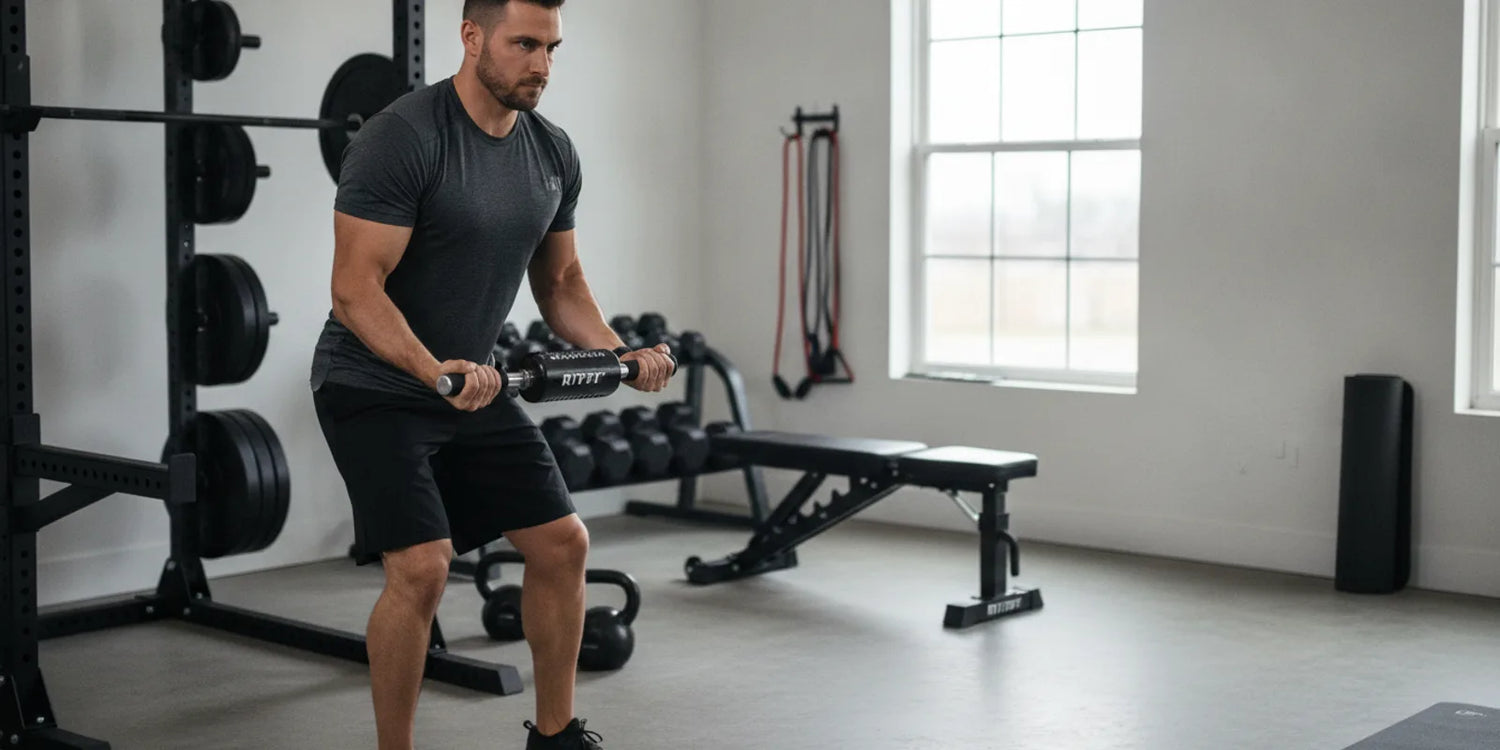
A twister arm exerciser is a handheld fitness bar with two handles connected by an internal spring, hydraulic piston, or elastic core that resists a horizontal squeezing motion. Pressing the handles together and controlling the return works the chest, shoulders, triceps, and grip in one compact, portable movement.
- Compact Design: Fits in a bag or under a desk, ideal for home gyms and travel.
- Adjustable Handles: Most models let you shift grip width to change the exercise angle.
- Two Core Mechanisms: Spring-based bars feel snappier, while hydraulic bars offer smoother, more controlled resistance.
A twister arm exerciser works well as a standalone warm-up tool or a travel companion, and pairing it with broader arm training such as an arm workout machines guide rounds out a complete upper-body routine.
Spring vs Hydraulic Resistance: Which Mechanism Is Better?
Spring-based twister arm exercisers use a coiled metal spring that snaps back quickly, while hydraulic models rely on a fluid-filled piston that resists movement smoothly in both directions. This same springy-resistance principle appeared in one pilot design-and-testing study, where researchers found it could closely mimic the assisted arm movement pattern of a passive rehabilitation device.[1]
- Spring Bars: Lighter, cheaper, and more common, but resistance can feel uneven near full compression.
- Hydraulic Bars: Heavier and pricier, but resistance stays consistent throughout the full range of motion.
- Adjustable Models: Let you swap or tighten resistance without buying a new unit.
Beginners who want predictable, joint-friendly resistance often prefer hydraulic designs, while spring bars suit those who want a lighter, more affordable option for occasional home training. If you already own a power rack, similar controlled-resistance training is also possible with jammer arms for power rack attachments.
Muscles Worked: What a Twister Arm Exerciser Really Trains
A twister arm exerciser primarily trains the pectoral muscles, front deltoids, and triceps through the horizontal squeezing motion, while the forearms and grip flexors work isometrically to hold the handles under tension. Your core also engages to keep your torso stable throughout each rep.
Chest, Shoulder and Tricep Activation
Squeezing the handles together mimics a standing chest fly, driving activation through the pectorals, front shoulders, and triceps as the arms move toward the midline of the body. This adduction pattern is what separates a twister arm exerciser from a simple pushing or pressing movement.
Grip and Forearm Engagement
Holding the handles under constant tension trains forearm and grip endurance isometrically, the same muscle groups measured by grip strength and pinch-force testing in a feasibility trial of an adjustable-resistance hand and wrist training device.[2] Clinicians also use a similar twisting-motion, eccentric wrist-extensor exercise within supervised forearm-strengthening programs, which supports general forearm and grip engagement without serving as treatment advice for any existing injury.[3]
Because grip and forearm demand is constant throughout every rep, a twister arm exerciser pairs well with dedicated arm work like the best tricep head exercises or a single-arm dumbbell row for readers who want more targeted muscle growth.
How to Choose the Best Twister Arm Exerciser for Your Goals
The best twister arm exerciser for most beginners is a hydraulic or spring model with an adjustable resistance range of at least 20 to 40 pounds, a locking safety mechanism, and cushioned, non-slip handles. Match the resistance ceiling and grip width to your current strength rather than choosing based on price alone.
- Resistance Range: Look for at least 3 to 5 adjustable levels so you can progress over time.
- Safety Lock: A locking pin or clip prevents the bar from snapping open suddenly.
- Grip Comfort: Textured, cushioned handles reduce hand fatigue during longer sets.
- Build Quality: A rigid center bar with minimal flex holds resistance more consistently.
Once you understand these buying criteria, matching resistance to your goals becomes straightforward, and if you eventually need higher, adjustable resistance for chest and shoulder work, RitFit's TAM1 Tornado Arm Attachment is a natural next step.
What Resistance Level Should You Start With?
Beginners should start a twister arm exerciser around 20 to 40 pounds of resistance, the lowest common adjustable setting on most models. Choose a level where you can complete three sets of 10 to 12 controlled squeezes with a smooth return before increasing resistance.
- Beginner: 20 to 40 lbs, focus on controlled form over speed.
- Intermediate: 40 to 100 lbs once beginner sets feel easy.
- Advanced: 100 lbs and above, typically on hydraulic or heavy-duty spring models.
Progress one resistance level at a time and only after your current setting feels controlled for every rep, and pair this progression with dedicated short head biceps exercises if bigger arms are your main goal.
Common Mistakes to Avoid When Using a Twister Arm Exerciser
The most common mistake when using a twister arm exerciser is locking the elbows completely straight, which shifts stress into the joint instead of the chest and shoulders. Letting the bar snap back uncontrolled instead of resisting the return is the second most frequent error.
- Locked Elbows: Keep a slight bend throughout the movement to protect the joint.
- Uncontrolled Return: Resist the spring or piston on the way back, not just the squeeze.
- Wrong Resistance: Too heavy a setting causes shaking and poor form, and too light limits results.
- Skipping Warm-Up: Cold shoulders and wrists are more prone to strain under sudden resistance.
Avoiding these mistakes keeps the exercise safe and effective, and readers building a complete arm routine can pair it with a broader guide to training all arm muscles for longer, bigger arms.
Is a Twister Arm Exerciser Worth It? Benefits and Limitations
A twister arm exerciser is worth it for beginners who want a compact, affordable way to build upper-body endurance, grip strength, and general chest and shoulder activation. Its fixed resistance ceiling and lack of true progressive overload make it a limited tool for anyone chasing significant muscle growth.
- Benefits: Compact, affordable, portable, and useful for warm-ups or travel workouts.
- Limitations: Fixed resistance ceiling, limited exercise variety, minimal true hypertrophy stimulus.
- Best For: Beginners, home gym starters, and those wanting a grip and endurance accessory.
For continued strength gains beyond what a twister exerciser can offer, RitFit's LAM1 Adjustable Lever Arm Attachment provides a true progressive-overload alternative.
Sample Twister Arm Exerciser Workout Routine
A simple twister arm exerciser workout routine pairs 3 sets of 10 to 12 controlled squeezes with 2 sets of 15-second isometric holds at your hardest comfortable resistance. Rest 60 to 90 seconds between sets and perform the routine 2 to 4 times per week.
- Warm-Up: 1 to 2 minutes of light squeezes at your lowest resistance setting.
- Main Sets: 3 sets of 10 to 12 controlled squeezes at your working resistance.
- Isometric Finisher: 2 sets of 15-second holds at peak compression to build grip endurance.
Following this simple structure two to four times per week builds noticeable endurance within a few weeks without requiring any additional equipment.
When to Upgrade to Heavier Resistance Training Equipment
You should upgrade from a twister arm exerciser once you can complete every set at its highest resistance setting with easy, controlled form. At that point, cable or lever arm attachments provide the adjustable, progressive resistance needed for continued chest, shoulder, and arm development.
- Signs You've Outgrown It: Highest setting feels easy, no more strength or endurance improvement.
- Next Step: Cable or lever arm attachments offer a much wider, truly progressive resistance range.
- Keep It Around: Even after upgrading, it remains useful for warm-ups or travel days.
RitFit's LAM2 Lever Arm Attachment is one practical option for readers ready to move past a twister exerciser's fixed resistance ceiling.
"For you to get complete chest development, at some point you're going to have to adduct your arms."
Jeff Cavaliere, MSPT, CSCS, Physical Therapist and Strength Coach, Founder of ATHLEAN-X, ATHLEAN-X
FAQs About Twister Arm Exercisers
What muscles does a twister arm exerciser work?
A twister arm exerciser primarily targets the chest, front shoulders, and triceps through the horizontal squeezing motion, while your forearms and grip muscles work isometrically just to hold the handles under tension. Your core also engages to stabilize your torso during each rep, making it a compact multi-muscle upper-body tool despite its small size.
How much resistance should a beginner use on a twister arm exerciser?
Most adjustable models start around 20 to 40 pounds of resistance, which is a reasonable beginner starting point. Choose a level where you can complete three sets of 10 to 12 controlled squeezes with good form, and if your elbows shake or you cannot control the return, drop down one resistance level before continuing.
Can a twister arm exerciser replace weightlifting?
A twister arm exerciser can build beginner to intermediate upper-body endurance and muscle activation, but its fixed resistance range makes it a supplement rather than a full replacement for progressive weightlifting. Once you consistently max out its highest setting, compound lifts or cable attachments are needed for continued strength and muscle growth.
Is a twister arm exerciser good for building bigger arms?
A twister arm exerciser mainly emphasizes chest, shoulder, and tricep engagement rather than direct biceps isolation, so it is not the most efficient tool for arm size alone. It can support general upper-body conditioning and grip endurance, but dedicated bicep and tricep exercises will build noticeably more arm size over time.
What is the safest way to use a twister arm exerciser?
Keep your elbows slightly bent rather than locked, control both the squeeze and the return phase, and never let the bar snap back suddenly. Stop immediately if you feel sharp wrist, elbow, or shoulder pain, and choose a hydraulic or safety-locking model if you are concerned about spring rebound injuries.
How often should I use a twister arm exerciser?
Two to four short sessions per week of 10 to 15 minutes each are enough to see endurance and activation improvements within a few weeks. Since it is a low-impact accessory tool, daily light use is generally tolerated, but allow at least one rest day if you notice forearm or wrist fatigue.
Conclusion
A twister arm exerciser is a simple, affordable way to build chest, shoulder, tricep, and grip endurance in a compact package, especially for beginners just starting a home gym routine. Choose an adjustable model with a safety lock, start around 20 to 40 pounds, and progress one level at a time.
Once you consistently max out its resistance, upgrade to real progressive-overload training. Browse RitFit's Rack Attachments Collection to find a cable or lever arm attachment that keeps your upper-body strength progressing.
Disclaimer
This article is for general fitness information only and is not a substitute for personalized medical or physical therapy advice, especially if you have an existing wrist, elbow, or shoulder condition. Consult a qualified healthcare provider or certified trainer before starting any new resistance exercise routine, particularly if you experience pain during use.
Save on your next RitFit order
Tap the button to copy your code, then paste it at checkout.
References
1. Zondervan DK, Friedman N, Chang E, et al. The Resonating Arm Exerciser: design and pilot testing of a mechanically passive rehabilitation device that mimics robotic active assistance. J Neuroeng Rehabil. 2013;10:39. PMC3654939.
2. Ríos Rincón AM, Guptill C, et al. Effectiveness of a New Device for Hand, Wrist, and Forearm Rehabilitation: Feasibility Randomized Controlled Trial. JMIR Rehabil Assist Technol. 2025;12:e62809. PMC11789689.
3. Page P. A New Exercise for Tennis Elbow That Works! N Am J Sports Phys Ther. 2010;5(3):189-193. PMC2971639.