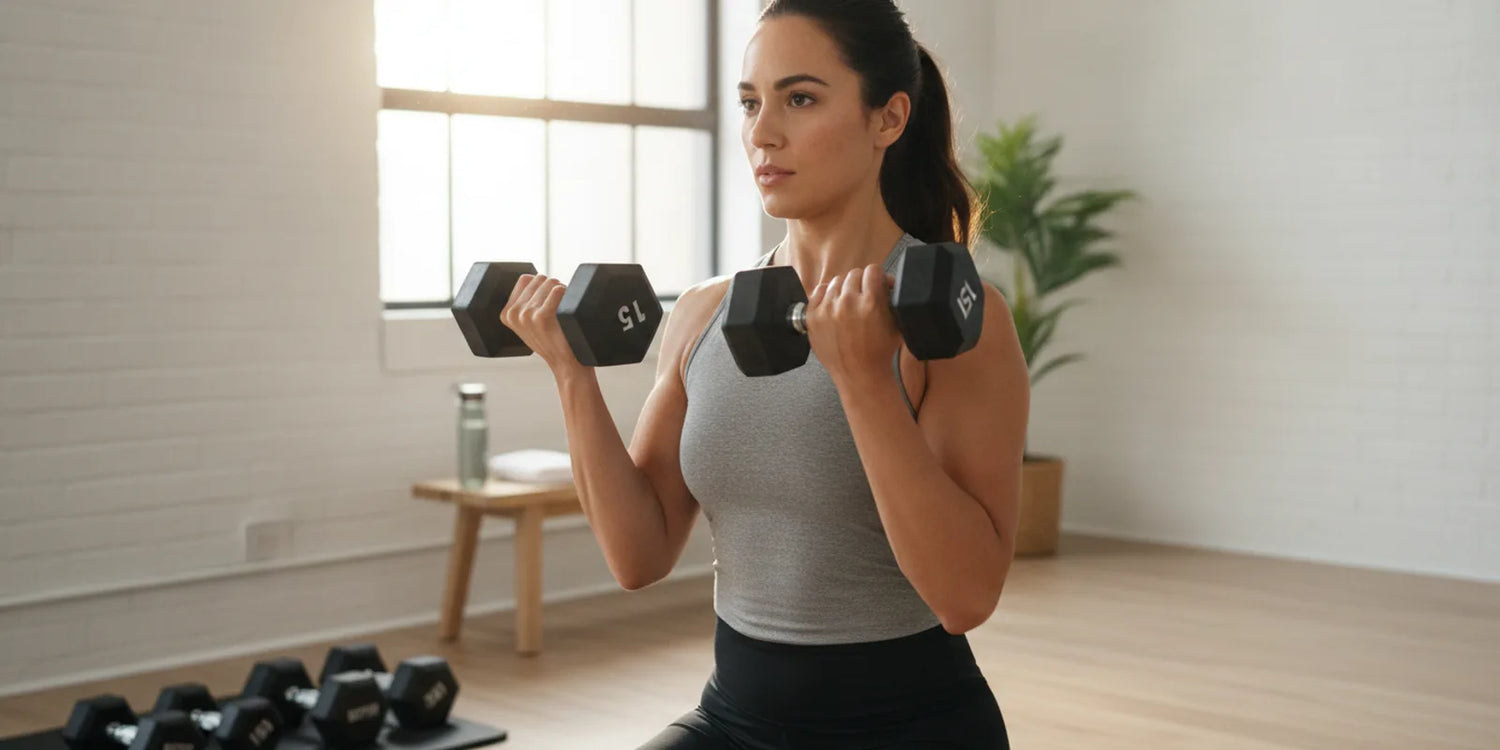
The best workout to tone arms for women comes down to two decisions most guides skip, which weight to use for each type of move and how to build a plan you will actually repeat at home.
This guide gives you a starting weight range for isolation moves and compound moves, a 3-day weekly plan you can run with one or two pairs of weights, and clear rules for when to add load.
Quick Answer: The best workout to tone arms for women uses 2 to 10 lb weights for isolation moves like curls and lateral raises, and 8 to 15 lb for compound moves like shoulder presses and rows, trained 2 to 3 times per week in 2 to 3 sets of 12 to 15 reps.
Key Takeaways
- Match the weight to the move: Use 2 to 10 lb for isolation moves and 8 to 15 lb for compound moves instead of one pair for everything.
- Effort decides the result: Definition comes from building lean muscle and lowering body fat, so the last 2 to 3 reps of every set should feel genuinely hard.
- Train arms 2 to 3 times per week: At least one rest day between sessions lets the muscle repair before the next stimulus.
- Compound moves cover more muscle: A press or a row trains several upper-body muscles at once, so a short circuit does more total work than isolation reps alone.
- Plan for at least two weights: Because isolation and compound moves need different loads, an adjustable set or two fixed pairs removes the biggest setup problem.
Why Do Light Weights Stop Working for Arm Toning?
Light weights stop working when the muscle never gets challenged hard enough to change. Toning needs two changes at the same time, a little more lean muscle to add shape and less body fat over it so that shape becomes visible.
- Muscle is the frame: Lean muscle underneath gives the arm its shape, and without enough training stimulus no number of repetitions produces visible definition.
- Fat is the cover: Body fat sits above the muscle, so consistent training and balanced nutrition are what let the muscle underneath show.
- Effort beats the number on the handle: The key variable is how hard the set feels, not a fixed weight, and the last 2 to 3 reps should feel genuinely difficult with clean form.
- Compound moves earn compound results: Presses and rows train several muscles at once, which burns more calories per session while building the arm and shoulder shape most women want.
A study of trained women found that a dumbbell program built only from compound exercises reduced biceps and triceps skinfold by roughly 5 to 6 percent and increased arm circumference by about 1.5 percent over 8 weeks.[1] That result came without a single dedicated isolation exercise, which is why the weight you start with matters less than how hard you train.
How Do You Choose the Right Weight for Each Arm Exercise?
The right weight depends on whether an exercise works one joint or several. Isolation moves tire a single muscle quickly and need lighter loads, while compound moves share the work across muscles and tolerate heavier ones.
Isolation Moves: Start Lighter at 2 to 10 lb
Isolation exercises work one joint and target a single muscle, so they fatigue quickly and use lighter weights.
- Lateral raises: 2 to 5 lb, because the long lever arm makes the shoulder work hard even at a low weight.
- Bicep curls: 5 to 10 lb, a single-joint movement that isolates the elbow flexors.
- Hammer curls: 5 to 10 lb, a neutral grip that targets the brachialis for forearm and upper arm thickness.
- Triceps kickbacks: 5 to 10 lb, which isolates the lateral head of the triceps at full extension.
- Overhead triceps extension: 5 to 10 lb, which stretches the long head of the triceps for greater activation.
Compound Moves: Go Heavier at 8 to 15 lb
Compound exercises recruit several muscle groups across more than one joint, so they allow and reward heavier loading.
- Shoulder press: 8 to 15 lb, sharing load across shoulders, triceps, and upper back.
- Single-arm row: 8 to 15 lb, because the strong back muscles allow heavier loading than pure arm exercises.
- Chest press: 8 to 15 lb, with the pectorals, triceps, and anterior deltoid all contributing.
How Do You Know the Weight Is Right?
The rep-feel method is the most practical way to choose a weight at home, and it works without any equipment beyond the weights themselves.
- Too light: You finish all 15 reps with energy to spare, so the stimulus is not enough to drive change.
- Too heavy: Your form breaks before rep 10, you swing the weight, or you cannot control the lowering phase, so drop one increment.
- Just right: The last 2 reps feel hard, your form holds, and you could not safely complete a 16th rep.
How to Choose the Best Dumbbell Set for Arm Toning at Home
Arm toning needs a light load for isolation work and a heavier one for compound work in the same session, so owning a spread of weights is more useful than a single pair.
| Exercise | Typical Beginner Range | Move Type |
|---|---|---|
| Lateral raise | 2 to 5 lb | Isolation |
| Bicep curl | 5 to 10 lb | Isolation |
| Hammer curl | 5 to 10 lb | Isolation |
| Triceps kickback | 5 to 10 lb | Isolation |
| Overhead triceps extension | 5 to 10 lb | Isolation |
| Shoulder press | 8 to 15 lb | Compound |
| Single-arm row | 8 to 15 lb | Compound |
| Chest press | 8 to 15 lb | Compound |
Starting weight ranges by exercise type for women beginning arm toning at home. Trainer consensus recommendations, evidence tier D, so treat them as a starting guideline and adjust with the rep-feel method.
- Fixed pairs: A 3 to 5 lb pair for isolation and an 8 to 12 lb pair for compound moves covers most beginners and fits on a standard dumbbell rack.
- Adjustable set: One adjustable dumbbell set replaces several fixed pairs and lets you dial the exact weight for each exercise from a single compact unit.
- When to expand: Add the next increment once both your light and medium weights feel easy across every prescribed set, instead of buying a whole new range of pairs.
"Was hesitant about adding a dumbbell set when I already had the cable-pulley system, but figured it would make a great addition to the overall gym. The weights have a great feel to them. Kind of odd that there is no 40# set, but I can live without that...may add that set later on."
Robert H. Verified Buyer, RitFit Rubber Hex Dumbbell Set with Rack
What Is the Best 3-Day Arm Toning Plan for Home?
The best 3-day arm toning plan for home alternates biceps, triceps, and shoulders across three short circuits. Each circuit takes roughly 20 to 30 minutes at the volume below.
Circuit 1: Biceps Focus
The biceps circuit uses full-range curls to maximize activation along the whole length of the muscle.
- Standard bicep curl: 2 to 3 sets of 12 to 15 reps at 5 to 10 lb, lowering slowly on a 2 second count to increase time under tension.
- Hammer curl: 2 to 3 sets of 12 to 15 reps at 5 to 10 lb, with a neutral grip that targets the brachialis for forearm and arm thickness.
- Preacher-style curl: 2 sets of 10 to 12 reps at 5 to 8 lb, using a bench or chair so the arm sits in front of the body and stretches the biceps at the start of the movement.
An 8-week trial in untrained young women found that training through the full elbow range of motion produced greater distal biceps hypertrophy and a larger strength gain than partial-range training.[2] A separate study in 38 recreationally trained women found the distal biceps region grew significantly more from a stretch-emphasis curl, with muscle thickness rising from around 2.7 cm to 2.94 cm over 9 weeks.[3]
Circuit 2: Triceps Focus
The triceps make up roughly two-thirds of the upper arm, so dedicated triceps work is the fastest route to the firm, defined look most women describe as toned arms.
- Overhead triceps extension: 2 to 3 sets of 12 to 15 reps at 5 to 10 lb, because the overhead position stretches the long head of the triceps for greater activation.
- Triceps kickback: 2 to 3 sets of 12 to 15 reps at 5 to 8 lb, focusing on full arm extension at the top for maximum contraction of the lateral head.
- Close-grip chest press: 2 sets of 10 to 12 reps at 8 to 12 lb, a compound move that loads the triceps through a longer range with a heavier weight.
Circuit 3: Shoulders
Shoulder training rounds out the routine by building the cap that frames the upper arm and makes the whole arm look more defined from every angle.
- Lateral raise: 2 to 3 sets of 12 to 15 reps at 2 to 5 lb, keeping a slight bend in the elbow and raising only to shoulder height.
- Shoulder press: 2 to 3 sets of 10 to 12 reps at 8 to 15 lb, the primary compound move of the circuit, loading several shoulder and arm muscles at once.
- Single-arm row: 2 to 3 sets of 10 to 12 reps per side at 8 to 15 lb, which trains the back and posterior shoulder while the biceps work as a secondary mover, complementing a chest and back workout.
How Many Sets and Reps Should You Do?
Use 2 to 3 sets of 12 to 15 reps per exercise with 45 to 60 seconds of rest between sets for isolation moves and 60 to 90 seconds for compound moves.
- Frequency: 2 to 3 arm sessions per week, with at least one rest day between sessions so the muscle can repair.
- Session length: Each circuit takes roughly 20 to 30 minutes at this volume, which makes it practical before or after a bench workout.
- Order: Compound moves can open or close the circuit, and starting with presses preserves energy for the heaviest loads of the session.
When Should You Move Up to a Heavier Weight?
You are ready to add weight when every prescribed rep feels controlled and the final reps feel easy. Progression is what separates a routine that keeps producing results from one that plateaus after a few weeks.
Signs You Are Ready to Increase Load
Increasing load too soon breaks form, while waiting too long stalls results, so use these signals to time the change.
- All reps feel controlled: You complete every rep of every set with clean form and no swinging or momentum.
- The last reps feel easy: The final 2 to 3 reps of the last set no longer feel hard enough to count as real effort.
- Consistent across 2 sessions: If a weight feels easy in two consecutive sessions, it is time to move up, not just one lucky day.
- Increment size: Add 1 to 2 lb at a time for isolation moves and 2 to 5 lb for compound moves, because smaller jumps preserve form and reduce injury risk.
Why Adjustable Weights Solve the Weight-Range Problem
Arm toning needs two or more weights inside one session, because lateral raises call for 2 to 5 lb while shoulder presses call for 8 to 15 lb. That range is easier to own than it sounds, since one adjustable pair replaces a row of fixed weights.
- Cost over time: A dedicated RitFit Rubber Hex Dumbbells Set with Rack or one adjustable set usually costs less than buying three or four fixed pairs one at a time as you get stronger.
- Space: One adjustable pair takes the footprint of a single dumbbell rather than a row of fixed weights, which matters in most home gym setups.
- Quick switching: Moving from a lighter isolation weight to a heavier compound weight between exercises takes seconds, which keeps rest intervals short and sessions efficient.
As Jeff Cavaliere, MSPT, CSCS, notes about choosing weights for a home setup:
"If your space is limited, a good set of adjustable dumbbells might be your better option. They will allow you to progress to heavier weight as you get stronger."
Jeff Cavaliere, MSPT, CSCS, Athlean-X
For women who want a dedicated storage solution, keeping weights on an organized women's strength training setup cuts session setup time and keeps the training area safe.
What Mistakes Keep Women From Toning Their Arms?
Most slow arm toning results trace back to a small number of fixable mistakes. Identifying the right one matters far more than adding more exercises to the plan.
Using the Same Weight for Every Exercise
Using one weight for both lateral raises and shoulder presses means the presses are far too light or the raises are dangerously heavy, because each exercise has a different mechanical demand.
- The fix: Keep at least two weight options available per session, one for isolation moves and one for compound moves, as the table in section 2 sets out.
- Why it matters: Underchallenging the larger compound muscles wastes training time, while overchallenging small isolation muscles causes form breakdown and injury risk.
Skipping Recovery Days
Training arms daily without rest days does not accelerate results and typically slows them, because muscle adaptation happens during recovery rather than during the workout itself.
- The fix: Schedule 2 to 3 arm sessions per week with at least one full rest day between them, and use the off days for lower-body or cardio work.
- Complement your arm days: Pairing arm sessions with MetCon workouts on alternate days combines a strength stimulus with the caloric burn that helps reduce the fat layer over the muscle.
- Adding extra triceps work: Bodyweight dips between arm days add volume at a low recovery cost.
Arm toning also fits naturally with how to tone your stomach, since many compound upper-body presses also train the core and contribute to overall body composition changes alongside targeted arm work.
When Should You Stop an Arm Workout?
Arm toning is low risk for most healthy women when the weights suit the movement. A few clear signals still mean you should stop the set and reassess.
- Sharp or joint pain: A burning muscular fatigue is normal, while a sharp or pinching sensation in the elbow, shoulder, or wrist is not, so stop the set immediately.
- Form collapse: If you cannot complete a rep without swinging, shrugging, or compensating with another body part, the weight is too heavy for your current strength, so drop one increment and rebuild the pattern.
- Persistent soreness beyond 72 hours: Some delayed muscle soreness after the first few sessions is normal, but soreness that lasts beyond 3 days in the same muscle suggests you raised volume or weight too quickly.
- Wrist or shoulder discomfort during kickbacks: Adjust the grip angle slightly and reduce the weight, and if discomfort continues across several sessions, substitute a band variation.
Can You Tone Arms at Home Without a Full Gym?
You can tone arms at home with a small amount of space and one or two pairs of weights. Arm toning needs less equipment than almost any other training goal.
- Minimum equipment: A light pair and a medium pair cover the whole plan, and an adjustable weights set covers both ranges in a single unit.
- Space: You need roughly one arm's length of clearance around your shoulders plus a chair or bench for curls, which most garages and apartments already have.
- Ceiling clearance: Overhead triceps extensions need room above your hands, so check that space before adding the move to a low basement setup.
- Storage: Keeping the weights on a rack or in one compact unit leaves the training area clear between sessions, which makes short sessions easier to start.
If you do want to build out a dedicated training space over time, this walkthrough of a real home gym upgrade shows how a full setup comes together.
FAQs About Best Workout to Tone Arms for Women
What size dumbbells should women use to tone arms?
Most women start with 2 to 5 lb for isolation moves like lateral raises and triceps kickbacks, and 8 to 15 lb for compound moves like shoulder presses and rows. Choose a weight where the last 2 to 3 reps feel challenging but allow clean form. Add weight once all reps feel easy.
How many times a week should women work out arms to see toning results?
Two to three sessions per week with at least one rest day between them gives muscles time to recover and grow. Recovery is critical for adaptation, so skipping rest days slows rather than accelerates results. Pair arm work with balanced nutrition for visible definition.
Can you tone arms at home using only dumbbells?
Yes. Bicep curls, triceps extensions, lateral raises, and shoulder presses cover all major arm muscles and require only dumbbells. Research on trained women showed multi-joint dumbbell exercises reduced arm skinfold by roughly 5 to 6 percent and increased arm circumference in eight weeks without any gym machines.
Will lifting heavier dumbbells make women look bulky?
No. Building bulk requires years of heavy lifting in a calorie surplus. Women have far less testosterone than men, making significant mass gain very unlikely from a standard arm-toning routine. Heavier weights within the 8 to 15 lb range for compound moves improve definition without producing unwanted size.
When should you increase dumbbell weight for arm exercises?
Increase load when you can complete all prescribed reps with clean form and the last two to three reps feel easy rather than challenging. Typically add the next weight increment every two to four weeks for isolation moves and slightly sooner for compound moves as your shoulder and back muscles adapt faster.
Are adjustable dumbbells better than fixed pairs for arm toning at home?
Adjustable dumbbells replace several fixed pairs in one compact unit, which suits arm toning because isolation moves like lateral raises need lighter loads while compound presses and rows need heavier ones. A single adjustable set saves floor space and avoids the cost of buying multiple separate pairs as you progress.
Save on your next RitFit order
Tap the button to copy your code, then paste it at checkout.
Conclusion
The best workout to tone arms for women pairs the right weight with the right exercise type, then repeats it 2 to 3 times per week. Light weights for isolation moves, heavier weights for compound moves, and a plan that adds load over time are what produce visible definition.
Start with the weight table in section 2, run the 3-circuit plan for four weeks, then move up when the final reps stop feeling hard. Browse the full RitFit dumbbells collection to pick your starting weights.
Disclaimer
The information in this article is intended for general educational purposes and does not constitute medical advice, diagnosis, or treatment for any individual condition. Consult a qualified healthcare provider or certified fitness professional before beginning any new exercise program, particularly if you have a pre-existing injury or health concern.
References
1. Gentil P, Soares S, Bottaro M. Effects of Adding Single Joint Exercises to a Resistance Training Program in Trained Women. Sports (Basel). 2019;6(4):160. doi:10.3390/sports6040160. PMCID: PMC6316221
2. Kassiano W, Costa B, Nunes JP, et al. Training in the Initial Range of Motion Promotes Greater Muscle Adaptations Than at Final in the Arm Curl. J Strength Cond Res. 2023. doi:10.1519/JSC.0000000000004464. PMCID: PMC9960616
3. Pedrosa GF, Rodrigues de Lima F, Schoenfeld BJ, et al. Regional Hypertrophy: The Effect of Exercises at Long and Short Muscle Lengths in Recreationally Trained Women. Eur J Sport Sci. 2023. doi:10.1080/17461391.2022.2137003. PMCID: PMC10407320