








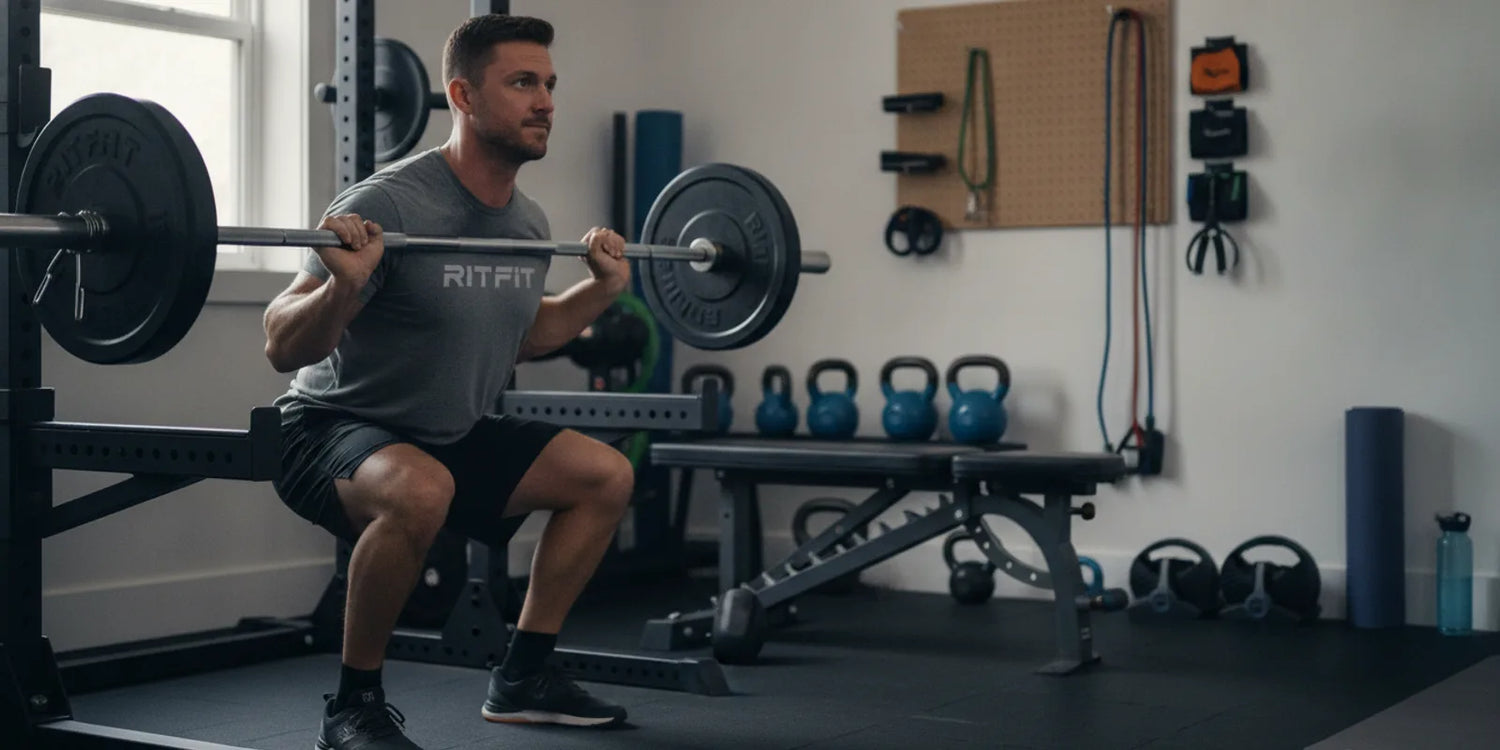
Basic barbell exercises are the fastest way for beginners to build full-body strength, and a well-chosen set of movements covers every major muscle group with a single piece of equipment.
This guide walks you through 10 foundational barbell exercises, with step-by-step form cues, starting-weight guidance, a sample 3-day workout plan, and clear signals for when to progress or stop.
Quick Answer: The most important basic barbell exercises for beginners are the back squat, deadlift, bench press, overhead press, and barbell row. These five compound movements train every major muscle group, require only a barbell and rack, and form the backbone of any effective beginner strength program.
Key Takeaways
- The Big Five First: Back squat, deadlift, bench press, overhead press, and barbell row cover every major muscle group and should be mastered before adding isolation work.
- Start with the Empty Bar: Begin every exercise with the unloaded 45-pound bar to learn movement patterns before adding plates.
- Train 3 Days Per Week: A full-body Monday-Wednesday-Friday schedule gives beginners the ideal balance of stimulus and recovery.
- Progress Only When Form Is Solid: Add 5-10 pounds only when all reps in a set feel controlled and technically consistent.
- Stop for Joint Pain, Not Muscle Burn: Sharp or shooting joint pain is a signal to stop immediately; muscle soreness and burning are normal training responses.
Why the Barbell Is the Best Training Tool for Beginners
The barbell is the most effective beginner training tool because it allows progressive overload across all major movement patterns with a single, standardized implement. A 2023 meta-analysis found that free-weight barbell training and machine-based training both improve strength, but free-weight exercises like the back squat and bench press require greater stabilizer muscle recruitment throughout the full range of motion.[1]
- Standardized loading: A standard Olympic barbell weighs 20 kg (44 lb), giving every beginner the same repeatable starting point for tracking progress.
- Compound efficiency: Each barbell lift trains multiple muscle groups simultaneously, maximizing strength gains per training hour.
- Unlimited scalability: Adding fractional plates lets beginners progress in small, manageable increments for months or years.
- Transfer to daily life: Pushing, pulling, hinging, and squatting movements mirror real-world activities, making barbell training broadly functional.
According to an ACSM overview of reviews summarizing 137 systematic reviews, resistance training improves muscle strength, hypertrophy, power, and endurance compared with no exercise, with guidelines recommending all major muscle groups be trained at high effort at least twice weekly.[2] Pairing a RitFit 7ft Olympic Barbell with a quality rack gives beginners everything needed to follow those guidelines at home.
The 10 Basic Barbell Exercises Every Beginner Should Master
The 10 basic barbell exercises below cover every major muscle group, ordered from highest priority to supporting movements, so beginners can build a complete program in stages.
1. Barbell Back Squat
The back squat is the most important lower-body exercise, training the quads, glutes, hamstrings, and core simultaneously through a full range of motion.
- Setup: Place the bar across your upper traps, feet slightly wider than shoulder-width, toes pointed 30 degrees out.
- Descent: Push hips back and down, keeping knees tracking over toes, until the hip crease drops just below the top of the kneecap.
- Drive: Push through the whole foot, driving hips straight up to return to standing.
- Starting weight: Empty bar (45 lb) for 3 sets of 5 reps until depth and knee tracking are consistent.
2. Deadlift
The deadlift trains the entire posterior chain, including the glutes, hamstrings, lower back, and traps, making it the single best exercise for building functional pulling strength from the floor.
- Setup: Bar over mid-foot, feet hip-width apart, grip just outside shins double overhand.
- Pull: Flatten the back, chest up, then drag the bar up the legs in a straight vertical path to lockout.
- Lower: Push hips back and slide the bar down the thighs, controlling the descent.
- Starting weight: 95-135 lb for men, 65-95 lb for women, depending on comfort with the hinge pattern.
3. Barbell Bench Press
The bench press is the foundational horizontal pushing movement, developing the pectorals, anterior deltoids, and triceps with a stable, measurable load.
- Setup: Lie on a flat bench, feet flat on floor, shoulder blades pinched together, slight arch in the lower back.
- Grip: Slightly wider than shoulder-width, thumbs wrapped around the bar.
- Press: Lower the bar to mid-chest with elbows at roughly 45 degrees, then press explosively back to full extension.
- Starting weight: Empty bar (45 lb) for 3 sets of 5-8 reps; add weight only when bar path is consistent.
4. Overhead Press (OHP)
The overhead press builds shoulder strength and upper-body stability through a vertical pressing pattern that also heavily involves the triceps and upper traps.
- Setup: Bar at upper chest height in the rack, grip just outside shoulder-width, elbows tucked close to the body.
- Press: Brace the core and glutes, then press the bar straight overhead to full lockout.
- Lower: Control the bar back to the starting position at the clavicle, not the chest.
- Starting weight: Empty bar for most beginners; the OHP has the lowest starting weight of the Big Five.
5. Barbell Row (Bent-Over Row)
The barbell row develops the upper back, lats, rhomboids, and rear deltoids through a horizontal pulling pattern that counterbalances pressing movements and supports posture.
- Setup: Hip-width stance, hinge to about 45 degrees, grip slightly wider than shoulder-width, palms facing down.
- Pull: Drive elbows toward the hips and pull the bar to the lower ribs, squeezing the shoulder blades at the top.
- Lower: Control the bar back to a hanging position without rounding the lower back.
- Starting weight: 65-95 lb; prioritize back angle and bar contact point over load.
Browse the full range of barbells to find the right bar for your training environment.
6. Romanian Deadlift (RDL)
The Romanian deadlift isolates the hamstrings and glutes through a hip-hinge pattern that starts standing, making it a controlled accessory to the conventional deadlift.
- Setup: Stand holding the bar at hip height, soft bend in the knees, shoulder-width grip.
- Hinge: Push hips back and lower the bar down the legs, keeping it close to the body until you feel a strong hamstring stretch.
- Drive: Squeeze the glutes and drive hips forward to return to standing.
- Starting weight: 95-115 lb; the stretch should be felt in the hamstrings, not the lower back.
7. Barbell Lunge
The barbell lunge trains unilateral leg strength, targeting the quads, glutes, and hamstrings while also challenging balance and hip stability.
- Setup: Bar across upper traps, feet shoulder-width apart, take a long step forward.
- Descent: Lower the rear knee toward the floor, keeping the front shin vertical.
- Return: Drive through the front heel to return to the starting position.
- Starting weight: Empty bar for 3 sets of 8 reps per leg until balance and control are established.
8. Barbell Curl
The barbell curl is the primary isolation exercise for the biceps, allowing heavier loading than dumbbells and a consistent supinated grip throughout the movement.
- Setup: Shoulder-width grip, palms facing up, bar resting against the thighs.
- Curl: Bring the bar to shoulder height by bending at the elbow, keeping upper arms stationary.
- Lower: Control the descent back to full arm extension.
- Starting weight: 45-65 lb; prioritize elbow isolation over load.
9. Barbell Shrug
The barbell shrug targets the upper trapezius through a direct vertical shrugging motion, supporting neck posture and strengthening the traps for heavier pulling work.
- Setup: Shoulder-width grip, arms straight, bar at hip height.
- Shrug: Elevate the shoulders straight up toward the ears as high as possible, hold briefly at the top.
- Lower: Let the shoulders drop under control; avoid rolling the shoulders forward.
- Starting weight: 95-135 lb; the traps are a strong muscle group and respond well to moderate loads.
10. Barbell Good Morning
The good morning strengthens the posterior chain through a hip-hinge pattern with the bar on the back, developing the lower back, glutes, and hamstrings for injury resilience.
- Setup: Bar across upper traps, feet shoulder-width, soft knee bend.
- Hinge: Bow forward by pushing hips back until the torso is roughly parallel to the floor.
- Return: Drive hips forward and stand tall, keeping the back flat throughout.
- Starting weight: Empty bar only; this movement requires a feel for the hip-hinge pattern before adding load.
Explore bars and plates to assemble a complete loading setup for all 10 exercises.
How to Choose Your Starting Weight
Beginners should start with the empty 45-pound bar for most exercises and add weight only when every rep in every set feels technically consistent. One study found significant individual variability in barbell velocity profiles for both the squat and bench press, indicating that load tolerance differs substantially between individuals and that self-calibration is more reliable than fixed percentage charts for new lifters.[3]
- The empty-bar rule: If you cannot complete 3 sets of 5 reps with the empty bar in good form, do not add weight.
- The "last rep" test: The final rep of your last set should feel challenging but technically identical to the first rep of your first set.
- Increment size: Add 5 lb per session on upper-body lifts (bench press, overhead press, row) and 10 lb per session on lower-body lifts (squat, deadlift) when the previous session was clean.
- Walk away rule: If form breaks on any rep, reduce the weight by 10% and rebuild from there rather than grinding through technical failure.
See the 7ft Olympic barbell specifications to understand how standard bar weight and sleeve length affect your plate loading setup.
How Often Should Beginners Train with a Barbell?
Beginners should train with a barbell 3 days per week on non-consecutive days, such as Monday, Wednesday, and Friday. According to ACSM guidelines, completing at least 2 sets per exercise at least twice weekly produces measurable strength and hypertrophy gains, with additional sets providing further benefit up to a point.[2]
- Full-body 3x per week: Hitting each major movement pattern three times per week accelerates skill acquisition and strength gains in beginners more effectively than split routines.
- 48-hour recovery minimum: Rest at least one full day between barbell sessions to allow muscle protein synthesis to complete between training stimuli.
- Session length: 45-60 minutes is sufficient for a beginner session covering 4-5 compound movements at 3 sets each.
- Deload week: After 6-8 weeks of consistent progression, reduce load by 20% for one week before resuming normal progression.
Check out weighted bar exercises for beginners for additional movement options to expand your routine after mastering the Big Five.
Sample 3-Day Full-Body Beginner Barbell Workout
The 3-day beginner barbell program below pairs foundational movements into two alternating sessions. Alternating sessions distribute fatigue and allow full-body recovery between workouts.
| Session | Exercise | Sets x Reps | Rest |
|---|---|---|---|
| Session A (Mon / Fri) | Barbell Back Squat | 3 x 5 | 3 min |
| Barbell Bench Press | 3 x 5 | 3 min | |
| Barbell Row | 3 x 5 | 3 min | |
| Barbell Curl | 2 x 10 | 90 sec | |
| Session B (Wed) | Deadlift | 1 x 5 | 5 min |
| Overhead Press | 3 x 5 | 3 min | |
| Romanian Deadlift | 3 x 8 | 2 min | |
| Barbell Shrug | 2 x 10 | 90 sec |
Deadlift is programmed for 1 top set per session to manage spinal fatigue. Add the barbell lunge and good morning after 4-6 weeks once the primary movements are established.
- Add weight each session: Add 5 lb to upper-body lifts and 10 lb to lower-body lifts when all reps of the previous session were completed with clean form.
- Warm-up sets: Do 2-3 warm-up sets at 50-70% of your working weight before the first working set of each exercise.
- Track every session: Log weight, sets, and reps in a notebook or app so you can confirm consistent progress over time.
Pair this program with a quality Olympic barbell rated for the loads you plan to reach as you progress beyond the beginner stage.
Common Mistakes Beginners Make (And How to Fix Them)
The most common barbell mistakes beginners make fall into four categories: loading too much weight too fast, skipping the warm-up, ignoring cues for lower-back rounding, and using the wrong bar for the movement.
- Ego loading: Adding plates before form is consistent is the fastest route to a stalled program. Fix: Follow the empty-bar protocol for 2-4 sessions before adding any weight.
- Lower-back rounding on deadlift: A rounded lumbar spine under load is a major injury risk. Fix: Film your lifts from the side, focus on "chest up" cues, and reduce weight until the lower back stays flat.
- Knees caving on squat: Valgus knee collapse reduces force transfer and stresses the medial knee. Fix: Actively push knees out in the same direction as your toes throughout every rep.
- Flared elbows on bench press: Elbows flaring out at 90 degrees to the torso loads the shoulder joint rather than the pecs. Fix: Tuck elbows to roughly 45 degrees and cue "protect your armpits."
- Bar path drift on overhead press: Letting the bar drift forward away from the head wastes force and compresses the lumbar spine. Fix: Press the bar in a straight vertical line by moving the head slightly back on the way up, then back through on the way down.
- Skipping barbell clips: Lifting without collars on a loaded bar is a plate-slipping hazard. Fix: Always use collars for safety, even on lighter working sets.
See the exercises with EZ curl bars guide for curl variations that reduce wrist strain if the straight barbell curl causes discomfort during the learning phase.
When to Progress to Heavier Weight
Progress to heavier weight on a given exercise when every rep of every working set looks and feels technically identical, without any form breakdown, compensatory movement, or excessive grinding on the final rep.
- Form consistency test: If a training partner or video review shows the last rep of your last set is technically identical to the first rep, you are ready to progress.
- Rate of perceived exertion: Working sets should feel like a 7-8 out of 10 effort. If the last set feels like a 6 or below, the weight is too light to stimulate adaptation.
- Session-to-session progression: Beginners can and should add weight every session during the first 3-4 months, as neural adaptations allow rapid strength gains before hypertrophy becomes the limiting factor.
- Stalling protocol: If you fail to complete all reps for two consecutive sessions at the same weight, reduce the load by 10% and rebuild for 2-3 sessions before attempting the higher weight again.
Explore the barbell accessories collection for fractional plates that allow 1.25-lb increments when 5-lb jumps become too large to complete consistently.
"The squat and bench press are the two lifts most people care about most, and they both require a rack. If you want to get strong, you need a rack."
Greg Nuckols, Strength Researcher and Coach, holder of multiple powerlifting world records, Stronger By Science, ↗
Pain vs. Soreness: When to Stop
Beginners should stop a set immediately if they experience sharp, shooting, or joint pain, but can continue through normal muscle soreness and burning sensations, which are expected responses to resistance training.
- Normal soreness (DOMS): Delayed onset muscle soreness appearing 12-48 hours after training is a normal inflammatory response. Train through it with lighter warm-up sets.
- Muscle burn during a set: A burning sensation in the working muscle during high-rep sets is a normal metabolic byproduct. Continue the set unless form breaks.
- Joint pain during a lift: Any sharp or stabbing pain in a joint during a movement is a hard stop signal. Reduce weight, check form, and if pain persists across sessions, consult a qualified professional.
- Pain that alters mechanics: If pain causes you to shift weight to one side, shorten range of motion involuntarily, or brace differently, stop the exercise for that session.
- Worsening pain across sets: If discomfort increases with each subsequent set rather than warming up and reducing, stop for the session and do not attempt to "push through."
For lower-body bar exercise variations that reduce joint stress during the learning phase, see lower body bar exercises to build glutes.
FAQs About Basic Barbell Exercises
What barbell exercises should a complete beginner start with?
Start with the five foundational movements: back squat, deadlift, bench press, overhead press, and barbell row. These compound exercises train every major muscle group and build the most strength per session. Master these before adding isolation work like curls or shrugs to your routine.
How heavy should a beginner start with a barbell?
Begin with just the empty 45-pound bar and focus on perfecting form through 3 sets of 5 to 8 reps before adding weight. Add 5 to 10 pounds only when every rep in every set feels controlled, technically consistent, and well within your ability to complete.
How many days a week should a beginner do barbell training?
Three days per week on non-consecutive days, such as Monday, Wednesday, and Friday, gives beginners the ideal balance of training stimulus and recovery. ACSM guidelines recommend training each major muscle group at least twice weekly with high effort for measurable strength and hypertrophy gains.
Do I need a squat rack to do barbell exercises?
A squat rack or power rack is essential for safety when doing back squats and overhead presses, as it allows you to set safety catches and rack the bar independently. For deadlifts and barbell rows, you can work directly from the floor without a rack.
What is the difference between a deadlift and a Romanian deadlift?
The conventional deadlift starts from the floor with knees bent, training the full posterior chain from a dead stop with significant glute and hamstring involvement. The Romanian deadlift begins standing, keeps a soft knee bend throughout, and emphasizes a controlled hamstring and glute stretch at the bottom of the movement.
When should a beginner stop a barbell workout due to pain?
Stop immediately if you feel sharp, shooting, or joint pain during any lift, as these are warning signals that should not be ignored. Pain that alters your mechanics, occurs in a joint, or worsens with each rep is a signal to stop the set, lower the weight, and reassess form before continuing.
Conclusion
Basic barbell exercises give beginners the most efficient path to full-body strength, with the squat, deadlift, bench press, overhead press, and row covering every major muscle group through proven compound movement patterns.
Start with the empty bar, train 3 days per week, and add weight only when form is consistent. Browse the barbells and weight plates collection to build out a complete home setup and start your barbell training program today.
Disclaimer
The information in this article is for general educational purposes only and does not constitute medical advice, diagnosis, or a personalized exercise prescription. Consult a qualified healthcare provider or certified strength coach before beginning any new resistance training program, especially if you have existing injuries or health concerns.
Save on your next RitFit order
Tap the button to copy your code, then paste it at checkout.
References
1. Haugen ME, et al. Effect of free-weight vs. machine-based strength training on maximal strength, hypertrophy and jump performance, a systematic review and meta-analysis. BMC Sports Sci Med Rehabil. 2023;15:103. doi:10.1186/s13102-023-00713-4. https://pmc.ncbi.nlm.nih.gov/articles/PMC10426227/
2. D'Souza AC, Fiatarone Singh MA, Lowisz CV, et al. American College of Sports Medicine Position Stand. Resistance Training Prescription for Muscle Function, Hypertrophy, and Physical Performance in Healthy Adults: An Overview of Reviews. Med Sci Sports Exerc. 2026;58(4):851-872. doi:10.1249/MSS.0000000000003897. https://pmc.ncbi.nlm.nih.gov/articles/PMC12965823/
3. Fernandez Ortega JA, Mendoza Romero D, Prieto Mondragón L. Bar Load-Velocity Profile of Full Squat and Bench Press Exercises in Young Recreational Athletes. Int J Environ Res Public Health. 2022;19(11):6756. doi:10.3390/ijerph19116756. https://pmc.ncbi.nlm.nih.gov/articles/PMC9180020/





