








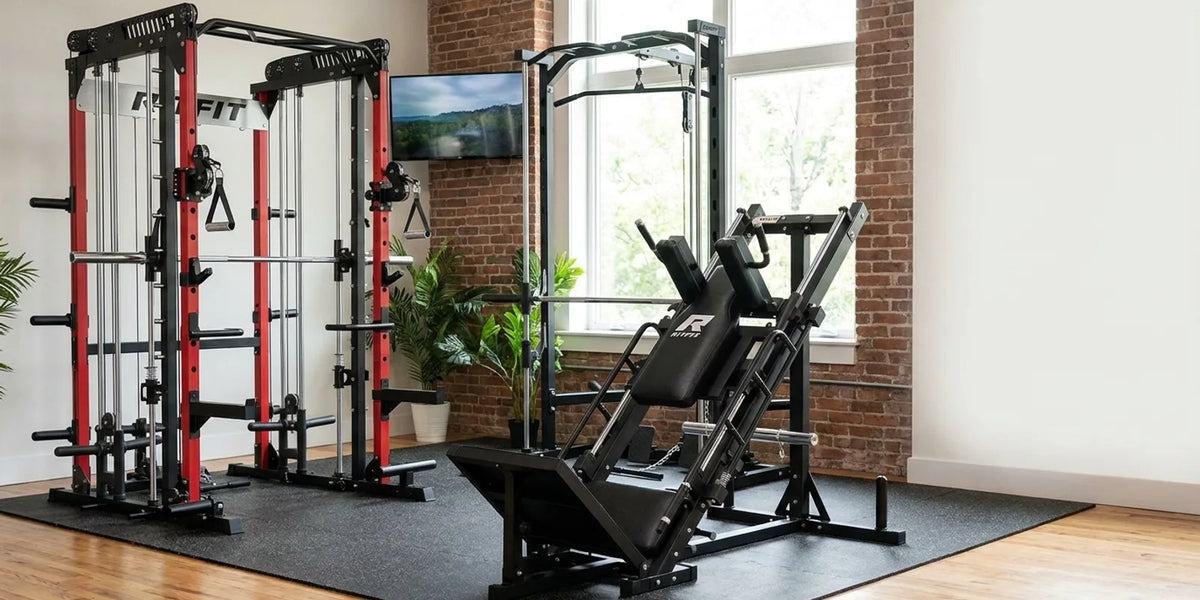
Home gym machine names rarely match across a gym floor, a product listing, and a used marketplace, which is why the same piece of equipment can appear under three different labels. This guide decodes the name of every common machine, what it trains, and whether a home version exists.
If you are shopping for a first home machine, start with the terms in the tables and entry names below, then match the machine to the muscle you actually want to train. Every entry notes the alternate names and whether a compact home version exists.
Quick Answer: Home gym machine names describe what a machine does, not the brand, and most machines travel under two or three labels. A leg press is also a hip sled, an ab crunch machine is also an ab bench, and a cable crossover is also a functional trainer.
Key Takeaways
- Name follows function: Most machines carry a floor name, a listing name, and a marketplace name that all describe the same training motion.
- Leg machines split by joint: A leg press pushes, a leg extension straightens the knee, and a leg curl bends it, so the name tells you which joint angle you train.
- Cable names flex the most: Cable crossover, functional trainer, and cable machine usually describe the same adjustable pulley station.
- The odd pieces have the oddest names: Neck harnesses and isometric trainers are the two categories buyers struggle most to name.
- One machine absorbs several names: An all in one Smith machine with a cable crossover system covers the Smith machine, cable, and rack categories at once.
Why does one gym machine have so many different names?
A gym machine collects several names because each one answers a different question. A single leg press can be labeled by its angle, its loading style, and a house nickname on the same sales page.
The names stack in three layers. The floor name is what staff use across the room, the listing name is what the manufacturer writes for search engines, and the marketplace name is whatever a reseller typed to get found.
- Floor name: Short and physical, such as the hip sled, the cables, or the smith.
- Listing name: Formal and attribute heavy, such as 45 degree plate loaded leg press or selectorized ab crunch machine.
- Marketplace name: Loose and search driven, such as leg machine, abdomen workout machine, or the home gym thing with the cables.
Machine based and free weight training produced no significant difference in hypertrophy across 13 studies with 1,016 participants, so the label on the machine matters far less than how you load it.[1]
If footprint is your real constraint, plan the floor first with this 12x12 home gym layout guide before you chase any of the names below.
"This thing is great! I have a home gym and having the capability to get so many exercises in one machine is great. The smith and cables are very smooth. Love it!"
Nikolas S. Verified Buyer, RitFit M1 PRO Multi-Functional Smith Machine with Cable Crossover System and Squat Rack for Home Gym
What is the leg machine at the gym called?
The machine you sit in and push with your legs is called a leg press. It also appears as a 45 degree leg press, a horizontal leg press, or a vertical leg press depending on the angle of the sled.
Leg machine names are the hardest to decode because the category splits by joint rather than by muscle. Browse a full leg machines category and you will see the same frame listed under several of the names below.
Leg press machine
A leg press is a machine where you sit or recline and push a weighted platform away with both feet, and the sled angle is usually the only thing the name tells you. Loads at or above roughly 60% of one rep max drive greater strength gains than lighter loads, so confirm whether the listing is plate loaded or selectorized before you compare price.[2]
Other names: 45 degree leg press, horizontal leg press, vertical leg press, hip sled, seated leg press.
Hack squat machine
A hack squat machine fixes your back against an angled pad and turns the squat into a guided push rather than a free standing lift. Listings also write it as hack squat, reverse hack squat when the back pad flips, or leg press hack squat combo when one frame carries both movements, which is exactly what the RitFit Gazelle 3 in 1 Leg Press and Hack Squat Machine does.
Leg extension machine
A leg extension machine isolates the quadriceps by straightening the knee against a padded roller, which is why the name contains the word extension. It is also listed as a knee extension machine or a seated leg extension, and almost every home version is selectorized.
Leg curl machine
A leg curl machine bends the knee against resistance and trains the hamstrings, and the name usually tells you the position, seated leg curl or lying leg curl. Prone leg curl is another name for the lying version, and some listings shorten the whole thing to hamstring curl, a naming split covered in this guide to leg extension and leg curl machines.
Hip adduction and abduction machine
A hip adduction and abduction machine moves the thighs together or apart against a pad, and the two directions are often sold as one frame under two names. Resellers call it the abductor machine, the adductor machine, or the inner and outer thigh machine, and the home footprint is large for the muscle it trains.
Angle is the last variable to check, because a compact vertical sled and a longer 45 degree sled train the same muscles in very different floor space, as this comparison of vertical vs 45 degree leg press explains.
"I love this machine. My instructions were missing 2 pages so I had to look up the final steps but other than that it's great."
Nichole S. Verified Buyer, RitFit Panther Home Hip Abductor and Adductor Machine
What are the Smith machine, cable machine, and lat pulldown machine called?
A Smith machine is a guided barbell that travels on a fixed track. The other names in this group describe either a fixed path or a cable path, and the two are easy to confuse on a listing.
These five names cause the most overlap because gyms, listings, and marketplaces use them almost interchangeably. The Smith machines category and the cable machines category both collect frames that shoppers describe with more than one of the same words.
Smith machine
A Smith machine carries a barbell on guide rods so the bar can only move up and down, which is why it is also called a smith rack, a guided barbell machine, or simply smith. Prime mover activation did not differ significantly between the Smith machine bench press and the free weight bench press at 60% 1RM in untrained men, so the guided path changes the skill demand more than the muscle hit.[3]
Other names: smith, smith rack, guided barbell machine, Smith machine with cable crossover.
Cable crossover machine
A cable crossover machine is a frame with two adjustable pulleys that can be set at almost any height, and it is also called a cable machine, a functional trainer, or just cables. When the two pulleys sit on a single upright instead of two towers, the listing often drops the word crossover altogether.
Lat pulldown machine
A lat pulldown machine pulls a bar down toward your chest against a weight stack and trains the lats, mid back, and biceps. It also appears as a pulldown, a lat pull, or a high row machine, and the name changes again when the station is built into a cable tower, as what a lat pulldown machine is explains in full.
Pec deck machine
A pec deck machine is a chest fly machine that swings your arms together on a fixed arc, and the name is often used loosely for any machine that performs a chest fly. Listings also write it as pec deck, fly machine, or chest fly machine, and these chest machines for home gyms show how the fixed arc differs from a cable path.
Seated row machine
A seated row machine pulls a handle toward your torso and trains the mid back and biceps, and it is listed as a row machine, a low row, or a cable row. The word seated is the part that matters, because a standing cable row carries the same name on some product pages.
What are the ab, back, and core machine names?
Ab and back machines are named after the movement they repeat. The word in the name is usually the exact motion you perform against the pad.
Ab crunch machine
The seated machine where you curl your chest toward your hips is an ab crunch machine, also called an abdomen workout machine, a crunch machine, an ab machine, or an ab bench. One EMG comparison found that the Ab Roller, ABslide, and FitBall produced similar or lower rectus abdominis activation than conventionally performed trunk curls, so a pad and a name do not guarantee a harder contraction.[4]
Back extension machine
A back extension machine pads your hips and lets you hinge your torso down and back up, and the same bench is called a hyperextension bench or a Roman chair. When the pad sits at an angle, listings rename it a 45 degree back extension, which is the shape these adjustable back extension machines use, including the RitFit BE01 Adjustable Back Extension Machine.
Which home gym machine names cover the odd pieces?
Two categories of equipment escape the standard machine names. Both are easier to find once you know the trade term that listings actually use.
Neck harness and neck machine
A neck harness is a head strap with a chain that you load with a plate and wear while nodding your head, which makes it the usual answer to a search for neck exercise equipment for home. A neck machine does the same work through a padded frame and a weight stack, and listings also call it a neck developer, a neck curl machine, or a 4 way neck.
Isometric exercise equipment
Isometric exercise equipment holds your body or a bar in a fixed position against resistance instead of moving through a range of motion. The category is also sold as an iso trainer or a self resistance unit, and it is usually a small frame rather than a machine with a weight stack.
Which machine names describe one all in one home gym?
One machine name can cover several categories at once. A single frame can carry a guided bar, a cable system, and a squat rack, which is why buyers search three different terms and land on one product.
The RitFit M1 Multi Functional Home Gym Smith Machine is the clearest example, because one purchase answers a Smith machine search, a cable crossover search, and an all in one home gym search. In one randomized controlled trial, community dwelling older adults with sarcopenia who followed a graded home based resistance program across 12 weeks reached 82.9% adherence.[5]
When buyers ask what the most popular gym equipment is, the practical answer is that the winner is whatever covers the most names on this page inside one footprint. A single frame also removes the cost of adding a separate cable tower later, which is the case in these reasons to add an all in one Smith machine to a home gym.
"Few pieces of equipment in the home exercise industry are as comprehensive and versatile as this all-in-one gym system. The robust system provides a natural, centered bar path for compound lifts like squats, presses, and rows, and incorporates a dual cable crossover station with a full rack of precision-engineered attachments."
Tom Eskey, CF-L1, CPT, Home Gym Equipment Reviewer at Garage Gym Revisited, in RitFit M1 Multi-functional Smith Machine Review
What should you type into a search box for each machine?
Search terms work best when they combine a category name with a loading style. A bare nickname such as the leg machine returns dozens of unrelated products.
Use the table below as a translation layer between the name you heard in the gym and the words a listing actually uses.
| Gym floor name | Also called | What it trains | Search term that works |
|---|---|---|---|
| Leg press machine | 45 degree leg press, horizontal leg press, vertical leg press, hip sled | quads, glutes, hamstrings | leg press machine |
| Hack squat machine | hack squat, reverse hack squat | quads, glutes | hack squat machine |
| Leg extension machine | leg extension, knee extension machine | quadriceps | leg extension machine |
| Leg curl machine | seated leg curl, lying leg curl, hamstring curl | hamstrings | leg curl machine |
| Hip abduction and adduction machine | abductor machine, adductor machine, inner and outer thigh machine | glutes and hip adductors | hip abduction and adduction machine |
| Smith machine | smith, smith rack, guided barbell machine | whole body | Smith machine home gym |
| Cable crossover machine | cable machine, functional trainer, crossover, cables | whole body | cable crossover machine |
| Lat pulldown machine | pulldown, lat pull, high row machine | lats, mid back, biceps | lat pulldown machine |
| Pec deck machine | pec deck, fly machine, chest fly machine | chest | pec deck machine |
| Seated row machine | row machine, low row, cable row | mid back, biceps | seated row machine |
| Ab crunch machine | ab machine, crunch machine, ab bench | rectus abdominis | ab crunch machine |
| Back extension machine | hyperextension bench, Roman chair, 45 degree back extension | lower back, glutes, hamstrings | back extension machine |
| Neck machine and neck harness | neck developer, neck curl machine, 4 way neck | neck flexors and extensors | neck harness |
| Isometric trainer | isometric exercise equipment, iso trainer | varies with the setup | isometric exercise equipment |
Alternate names reflect common gym, retail, and marketplace usage as of 2026; loading style and sled angle still vary by listing.
FAQs About Home Gym Machine Names
What is the leg machine at the gym called?
The machine you sit in and push with your legs is a leg press. It is also listed as a 45 degree leg press, a horizontal leg press, or a vertical leg press depending on the angle of the sled. Gym staff sometimes call the same machine a hip sled, and product listings may label it plate loaded or selectorized.
What is the ab machine at the gym called?
The seated machine where you crunch forward against a pad is an ab crunch machine, also sold as a crunch machine, ab machine, or ab bench. It works the rectus abdominis through trunk flexion. A rotary torso machine is a different name for the machine that twists your trunk sideways instead.
What is the difference between a pec deck and a cable crossover?
A pec deck is a chest fly machine with fixed pads or handles that travel on a set arc. A cable crossover is a cable machine with two adjustable pulleys, and it is also called a functional trainer or simply cables. Both names describe chest fly work, but only the crossover changes angles freely.
What is the most popular piece of home gym equipment?
The all in one Smith machine with a cable crossover system is the most common single purchase for a home gym because one footprint covers squats, presses, rows, and cable work. Free weights still lead for pure versatility, but one guided machine replaces several floor machines at once.
Is a machine with a weight stack called a selectorized machine?
Yes. A machine with a built in weight stack and a pin is called a selectorized machine because you select the load with a pin. A plate loaded machine uses separate weight plates instead. Listings often shorten selectorized to stack, weight stack, or pin loaded, and all three describe the same design.
What is the machine that works your lower back called?
The bench or machine you hinge over to train your lower back is a back extension machine, also called a hyperextension bench or a Roman chair. Listings sometimes call it a 45 degree back extension when the pad sits at an angle, and gym staff may simply call it the back extension.
Conclusion
Home gym machine names are a translation problem rather than a product problem, and the fastest fix is to learn the alternate names before you shop. Once you know that a hip sled is a leg press and a functional trainer is a cable crossover, listings stop reading like a different language.
Pick the category that matches the muscle you want to train, then confirm the loading style and the footprint before you compare prices. Check the current bundles and offers in the RitFit discount guide before you commit to a machine.
Disclaimer
This article explains common equipment names and general training categories, and it is not medical, rehabilitation, or safety advice for any specific condition. Consult a qualified physician or certified trainer before starting a new strength program or using any machine for a diagnosed injury.
References
1. Haugen ME, Vårvik FT, Larsen S, Haugen AS, van den Tillaar R, Bjørnsen T. Effect of free-weight vs. machine-based strength training on maximal strength, hypertrophy and jump performance - a systematic review and meta-analysis. BMC Sports Sci Med Rehabil. 2023;15(1):103. PMCID: PMC10426227
2. Lopez P, Radaelli R, Taaffe DR, et al. Resistance Training Load Effects on Muscle Hypertrophy and Strength Gain: Systematic Review and Network Meta-analysis. Med Sci Sports Exerc. 2021;53(6):1206-1216. doi:10.1249/MSS.0000000000002585. PMCID: PMC8126497
3. Wang L. A comparison of muscle activation and concomitant intermuscular coupling of antagonist muscles among bench presses with different instability degrees in untrained men. Front Physiol. 2022;13:940719. PMCID: PMC9486837
4. Hildenbrand K, Noble L. Abdominal Muscle Activity While Performing Trunk-Flexion Exercises Using the Ab Roller, ABslide, FitBall, and Conventionally Performed Trunk Curls. J Athl Train. 2004;39(1):37-43. PMCID: PMC385260
5. Liu M, Li J, Xu J, et al. Graded Progressive Home-Based Resistance Combined with Aerobic Exercise in Community-Dwelling Older Adults with Sarcopenia: A Randomized Controlled Trial. Clin Interv Aging. 2024;19:1581-1595. doi:10.2147/CIA.S473081. PMCID: PMC11444075





