








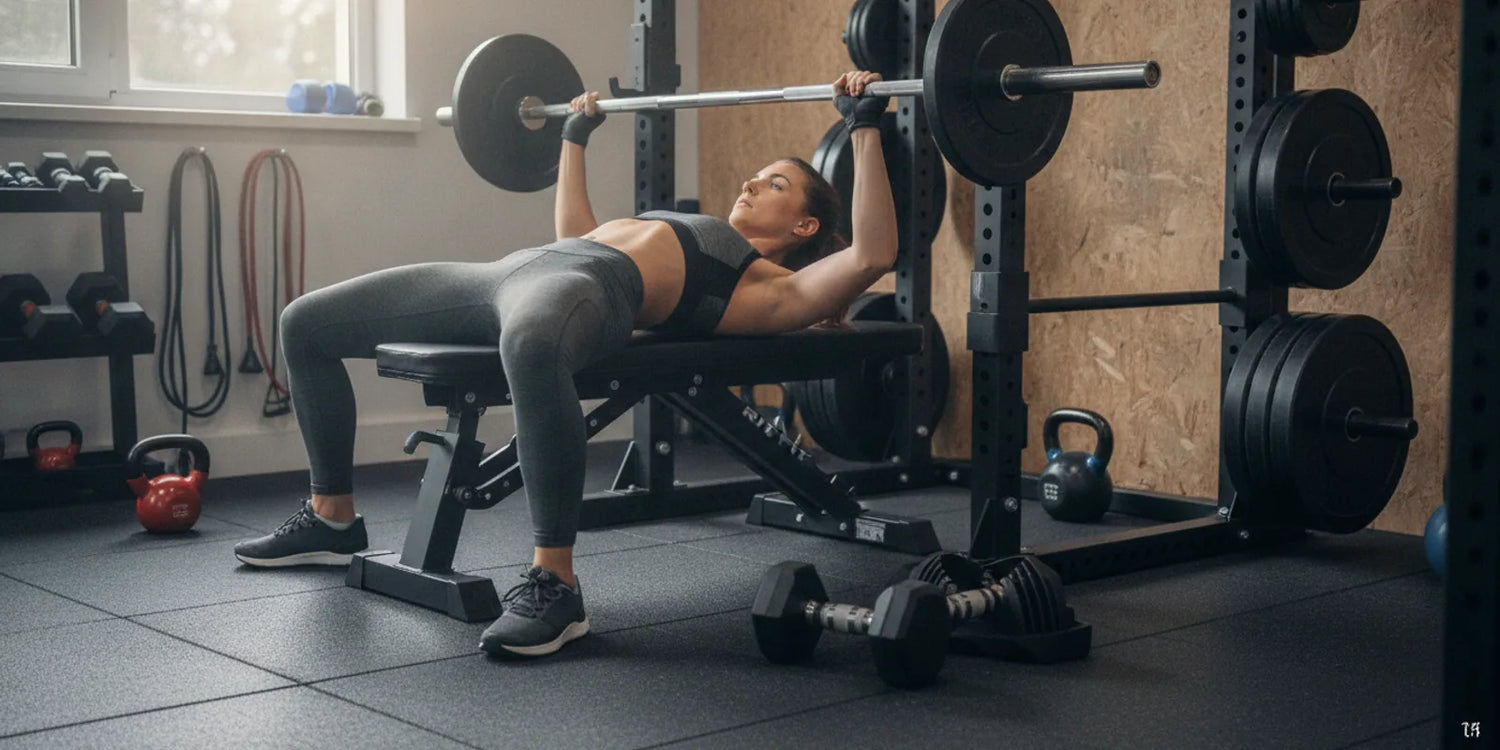
How much can the average woman bench press is one of the most common questions in the gym, and the honest answer is that it depends on your bodyweight, age, and training experience. This guide gives you realistic, women-specific numbers so you can find your own benchmark.
You will see average bench figures broken down by bodyweight and age, what counts as a good lift, and a safe path to add weight. None of this is medical advice, just practical strength context.
Key Takeaways
- It varies widely: An untrained woman near 165 pounds benches roughly 80 pounds, while an intermediate lifter reaches about 115 pounds.
- Bodyweight matters most: Heavier weight classes press more in absolute terms, so always read standards next to your own bodyweight.
- A bodyweight bench is advanced: Pressing one times your bodyweight is an advanced to elite goal that takes years for most women.
- The sex gap is real on the bench: Women press relatively less on the bench than on the squat or deadlift due to upper-body muscle distribution.
- Progress is trainable: Beginners often gain quickly at first, then advance in smaller, steadier increments with consistent practice.
How much does the average woman bench press?
The average woman benches roughly 60 to 90 pounds untrained and around 100 to 130 pounds once she reaches an intermediate level, with bodyweight being the biggest variable. A beginner who has never trained may press only the empty bar or light dumbbells, which is completely normal.
- Untrained: Often the empty bar to about 90 pounds, depending on bodyweight.
- Intermediate: Roughly 95 to 130 pounds after consistent training.
- Advanced: Approaching or exceeding her own bodyweight on a single rep.
Treat these as ranges, not targets. Your starting point says nothing about your potential, and proper proper bench press form matters more than the number on the bar early on.
What is the average female bench press by bodyweight?
The average female bench press rises with bodyweight, so a 132-pound woman and a 198-pound woman have very different benchmarks. According to ExRx and Symmetric Strength standards, a novice 132-pound woman benches around 85 pounds, while a novice 198-pound woman benches around 115 pounds.
| Bodyweight (lb) | Untrained | Novice | Intermediate | Advanced |
|---|---|---|---|---|
| 97 | 50 | 65 | 75 | 95 |
| 114 | 60 | 75 | 85 | 110 |
| 132 | 70 | 85 | 95 | 125 |
| 148 | 75 | 90 | 105 | 135 |
| 165 | 80 | 95 | 115 | 145 |
| 181 | 85 | 110 | 120 | 160 |
| 198 | 90 | 115 | 130 | 165 |
Source: ExRx and Symmetric Strength reference standards for adult women, ages 18 to 39. These are reference ranges, not survey averages.
Find the row nearest your bodyweight to locate your benchmark. For broader context you can compare these against the average bench press for men at the same bodyweights.
How does the average female bench change with age?
The average female bench tends to peak in the twenties and decline gradually with age, though training slows that decline dramatically. A useful rule of thumb places a trained woman in her twenties near her bodyweight, dropping to roughly 75 percent of bodyweight by her fifties.
- Ages 20 to 29: Around 100 percent of bodyweight for a trained lifter.
- Ages 30 to 39: Around 90 percent of bodyweight.
- Ages 40 to 49: Around 80 percent of bodyweight.
- Ages 50 to 59: Around 75 percent of bodyweight.
Age is not a hard ceiling. Consistent resistance training preserves strength for decades, and many women set personal records well into their forties and beyond.
What counts as a good bench for a woman?
A good bench for a woman is best judged relative to bodyweight rather than as a fixed number. Pressing about 0.5 times bodyweight is a solid intermediate marker, while reaching one times bodyweight sits firmly in the advanced to elite range for most women.
For perspective on the top end, a 2024 analysis of 809,986 drug-tested powerlifting entries found that female competitors aged 18 to 35 at the 90th percentile benched about 1.35 times bodyweight. These are competition data from trained athletes, not the general-population average.
If you want a sense of how heavier milestones stack up, our breakdown of whether a 100kg bench press is good and the general guide on how much you should be able to bench add useful context.
Why do women bench less than men of the same size?
Women bench less than men of the same bodyweight mainly because of upper-body muscle distribution, not effort or technique. Women carry proportionally more muscle in the lower body and less in the chest, shoulders, and arms, which limits raw pressing force.
An electromyography study of female and male athletes found the bench press muscle-activation pattern differs by sex, with women showing a smaller contribution from the triceps and shoulder girdle.[1] This is why the sex gap is wider on the bench than on the squat or deadlift, where relative strength is much closer.
- What this means for you: Compare yourself to other women, not to male lifting standards.
- Where it helps to know: Understanding the muscles the bench press works helps you target weak links.
How should a beginner woman choose her starting weight?
A beginner woman should choose a starting weight she can press for 8 to 12 controlled reps with two reps left in the tank. For many that means starting with the empty barbell or a pair of 10 to 15 pound dumbbells, then adding weight only once form is consistent.
Exercise selection matters too. A study in women found that flat and incline presses produced greater pectoralis major activation than the shoulder press, so mixing presses builds balanced strength.[2]
Many beginners progress fastest by weighing the dumbbell vs barbell bench press decision early and adding an incline bench press guide variation.
"When you lift a weight, you should consciously visualize the target muscle and feel it working throughout the complete range of motion. For example, when performing a bench press, you should focus on the muscles of your chest, e.g., pectorals, as you lift."
Brad Schoenfeld, PhD, Exercise Science Researcher at CUNY Lehman College, Diet Detective
What mistakes stall female bench progress?
The most common mistakes that stall female bench progress are training too light, skipping triceps and shoulder work, and chasing reps with sloppy form. Each one limits the upper-body strength that drives the bench.
- Lifting too light: Staying in a comfortable weight builds little strength, so push close to a challenging set within good form.
- Ignoring assistance muscles: Weak triceps and shoulders cap your press, so train them directly.
- Inconsistent setup: A shifting arch, grip, or foot position wastes force and raises injury risk.
Fixing setup first usually unlocks the fastest gains, so prioritize a stable, repeatable bench position before adding plates.
How do you keep adding to your bench safely?
You keep adding to your bench by training it 2 to 3 times per week, applying small progressive overload, and respecting recovery. Most women progress well with 3 to 4 sets of 5 to 10 reps, adding weight only when all reps feel solid.
A review of resistance training in women reports a meta-analysis showing 3 to 110 percent increases in upper-body strength across training periods of 6 weeks to 2 years.[3] Women often gain relatively more upper-body strength than men because they start from a lower base, so steady improvement is the norm.
How to break a plateau
When progress stalls for several weeks, vary your rep range, add a light extra session, or swap in dumbbell and incline work before deciding the bench has truly capped.
When to add weight
Add a small increment, often 2.5 to 5 pounds, once you complete every prescribed rep with clean form for two sessions in a row.
When pain means stop
Stop the set if you feel sharp shoulder, elbow, or wrist pain rather than normal muscular effort, then reassess your form and load before continuing.
How do you set up to bench safely at home?
You set up to bench safely at home with a sturdy adjustable bench, a barbell or dumbbells, and either safety arms or a spotter. Training without a spotter is the single biggest risk, so always have a fail-safe before you load heavy.
The video below shows how an adjustable bench supports both flat and incline pressing for a flexible home setup.
For a safe foundation, browse adjustable adjustable weight benches or start with the RitFit 1300LB adjustable weight bench, which handles flat and incline angles in a compact footprint.
FAQs About How Much the Average Woman Can Bench
How much can the average woman bench press?
It depends heavily on bodyweight and training experience. An untrained woman around 165 pounds typically benches close to 80 pounds for a single rep, rising to roughly 115 pounds at an intermediate level. Many beginners start far lighter, around the empty bar or a pair of light dumbbells, and that is perfectly normal.
Is benching your own bodyweight good for a woman?
Yes. A bodyweight bench press is a strong, advanced-level goal for most women. Strength standards place a one-times-bodyweight bench in the advanced to elite range, depending on your weight class. Reaching it usually takes consistent training over one to three years, so treat it as a long-term milestone rather than a beginner target.
Why can women bench less than men of the same weight?
Women carry a larger share of muscle in the lower body and proportionally less in the chest, shoulders, and arms. Research on muscle activation shows lower triceps and shoulder-girdle contribution in women during pressing. This is why the gap between sexes is wider on the bench press than on the squat or deadlift, where relative strength is closer.
How fast can a beginner woman increase her bench press?
Beginners often add weight every week or two at first because the nervous system adapts quickly. A review of training in women reports broad upper-body strength gains over months of consistent work. Progress slows as you advance, so expect rapid early jumps followed by smaller, steadier increases that may require changing volume or rep ranges.
Should women bench with a barbell or dumbbells?
Both work well, and many women start with dumbbells because they allow a natural range of motion and are easy to control without a spotter. A barbell lets you load heavier and track progress precisely once your form is solid. A good plan often uses dumbbells early, then adds barbell work as confidence and strength build.
Conclusion
How much the average woman can bench press depends on bodyweight, age, and experience, ranging from the empty bar for beginners to one times bodyweight for advanced lifters. Use the bodyweight chart to find your benchmark, then focus on consistent, progressive training.
Start where you are, train the bench 2 to 3 times per week, and build a safe home setup before chasing heavier numbers. Consistency, not your starting weight, decides your long-term progress.
Disclaimer
This article is for general educational purposes only and does not constitute medical, rehabilitation, or personalized training advice. Consult a qualified healthcare or fitness professional before beginning a new strength program, especially if you have any existing injury or health condition.
References
1. Gołaś A, Maszczyk A, Pietraszewski P, et al. Muscular activity patterns of female and male athletes during the flat bench press. Biology of sport. 2018;35(2):175-179.
2. Luczak J, Bosak A, Riemann BL. Shoulder Muscle Activation of Novice and Resistance Trained Women during Variations of Dumbbell Press Exercises. Journal of sports medicine. 2013;2013:612650.
3. Kraemer WJ, Fragala MS, Ratamess NA. Evolution of resistance training in women: History and mechanisms for health and performance. Sports medicine and health science. 2025;7(5):351-365.





