
Slow eccentric leg curls make the lowering phase the hardest part of the set, so the hamstring keeps working instead of dropping the pad. This guide covers the 3-second, 5-second, and count-down versions, plus load choice, weekly dosing, and the last 10 degrees that decide whether the rep counts.
In prone leg curls on a leg extension curl machine you stop and hold at one angle, while here the pad never stops moving. Read this one if your lowering is fast, sloppy, or finished by gravity.
Quick Answer: Slow eccentric leg curls work best with a 3 to 5 second lowering on a load light enough that the pad never speeds up, keeping the last 10 degrees under tension instead of releasing it. Train them twice a week for 2 to 4 sets of 5 to 8 reps, and add weight only when every rep holds the target seconds.
Key Takeaways
- Tempo range: Three to five seconds of lowering keeps the whole rep inside the 2 to 8 second window that current technique reviews recommend for hypertrophy.
- Load test: A weight is correct when you can hold the target seconds on every rep without the pad accelerating near the bottom.
- End range: The last 10 degrees before the knee straightens carry the most risk of the pad slamming back, so stop just short and keep pushing.
- Dose: Two to four sets of five to eight reps twice a week is a full hamstring tempo stimulus for most home lifters.
- Tool choice: Slow eccentrics fix control, pauses fix a sticking point, and peak squeezes add an isometric at the top.
Why the Lowering Is the Whole Rep on a Leg Curl Machine
The lowering is the whole rep because the hamstring stays loaded the entire time the pad travels, and those seconds decide how much work the muscle does. The same plate can take 1 second or 5 seconds to reach the bottom, and the slower version changes the set completely.
A paused rep stops the pad at one point and holds it there, which kills momentum at that single angle. A slow eccentric never stops, so every degree of the range gets loaded and the pad has no chance to free fall.
That difference matters on a leg curl machine because the resistance arm is short and the range is small. One fast second is enough to skip most of the useful work, while 4 controlled seconds turns a light plate into a real hamstring set.
"The leg extension/curl machine is such a great machine especially at that price point. It is another great RitFit machine for my gym!"
Westley W. Verified Buyer, RitFit PLC01 Leg Extension Curl Machine
Setting Up the Machine So the Slow Lowering Starts in the Right Place
Setup decides whether a slow lowering is possible, because the ankle pad sits just above the heels and the knee lines up with the machine pivot. Thirty seconds spent on the seat and pad saves the whole set.
- Ankle pad: Set it just above the heel, not across the Achilles, so you can push back without the pad digging in.
- Knee and pivot: Line the knee joint up with the machine pivot, then check it again after the first rep.
- Seat depth: Move the seat until the pad starts with the knee slightly bent, not locked out.
- Torso: Keep the chest against the pad and the hips down, since a rising hip is the first sign the load is too heavy.
- Feet: Keep the ankles relaxed instead of pointing the toes, which shortens the calf and shifts the work.
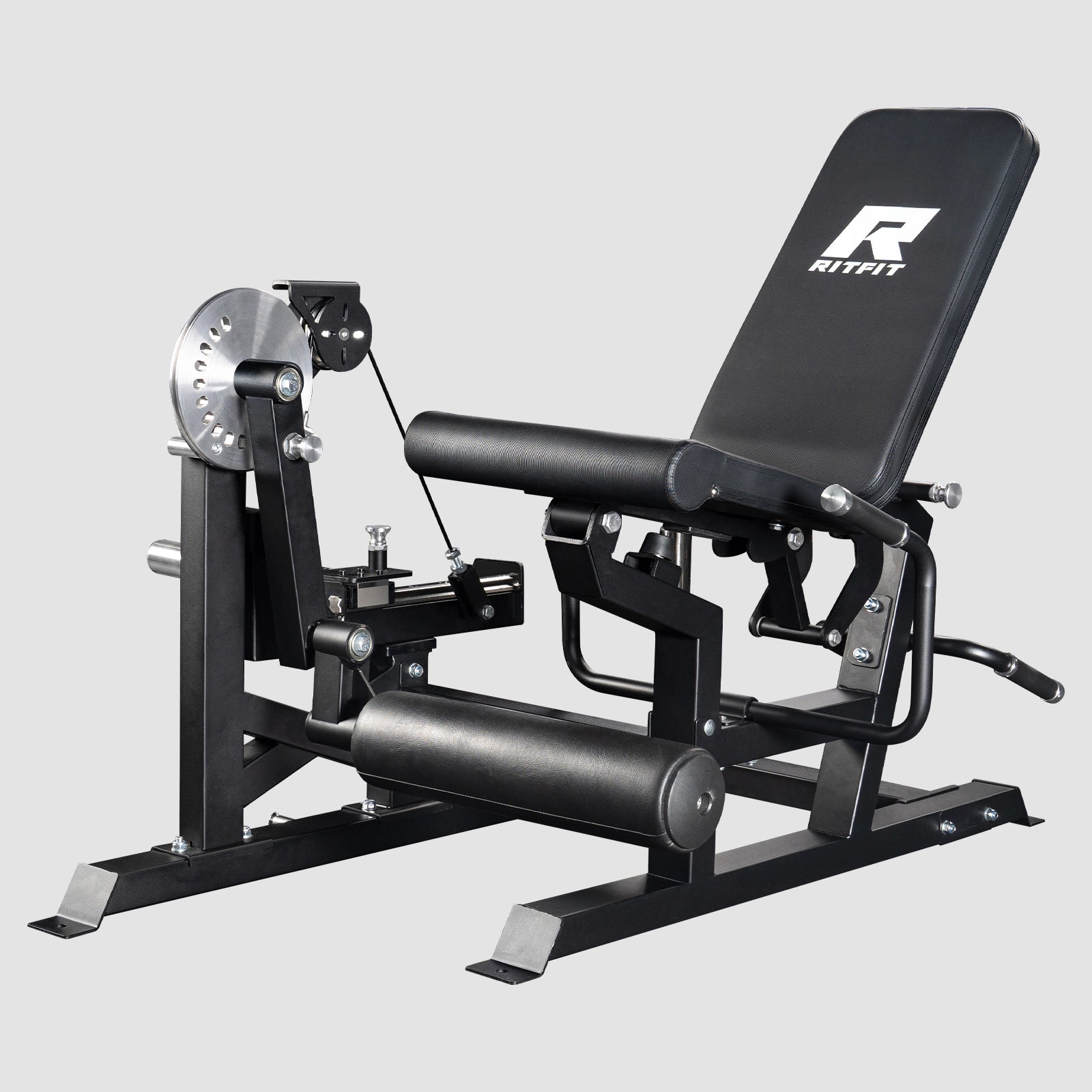
On a plate-loaded unit such as the RitFit PLC01 leg extension curl machine, the pad height and seat depth are the two adjustments that matter most. Set both before you touch the plates, then leave them alone for the rest of the block.
The 3-Second, 5-Second, and Count-Down Prescriptions
Three tempos cover almost every lifter: 3 seconds for load progression, 5 seconds for control, and a count-down for anyone who loses the bottom. Pick the one you can repeat on every rep without the pad speeding up, and stay with it for three to four weeks.
- 3-second lowering: Use this when you want to keep adding weight. The shorter count leaves enough reps in the tank to accumulate volume, and it still forces a deliberate lowering.
- 5-second lowering: Use this when the pad jumps, the hips lift, or you are coming back after a break. The extra seconds expose exactly where control disappears.
- Count-down to near extension: Count five or six seconds and finish with the knee slightly bent, still pushing the pad back. The count replaces the goal of touching bottom, so the set ends on tension instead of a drop.
A 2023 review of hypertrophy technique recommends a total repetition duration of 2 to 8 seconds while using a range of motion that reaches a fully stretched position.[1] That leaves plenty of room for a 3 to 5 second lowering and a normal lift back up.
Whichever tempo you pick, the same rep scheme works, so you can rotate the count without rewriting the program. If you also train the extension side of the machine, the leg extension and curl combo workouts show how to pair the two stations in one session.
The Last 10 Degrees: Where Hamstring Eccentrics Go Wrong
The last 10 degrees before the knee straightens are where the hamstring is longest and where the pad most often gets away, so that is the part worth protecting. Stop the lowering with a slight bend, keep pressure on the pad, and only then release.
Force in that zone is not small, since a 2023 study of elite athletes measured peak knee flexor force of 678 N in the eccentric-only Nordic hamstring exercise against 600 N when a concentric return was added.[2] The lowering is where the muscle is doing the most work, which is also why it is the easiest place to hand the job to gravity.
The fix is to treat the end of the range as a place to stay, not a place to arrive. Kicking the knees fully straight and letting the stack crash teaches nothing, while an almost-straight knee held for a beat keeps tension and protects the back of the thigh.
Range matters at the other end too. Going all the way up before the next lowering keeps the rep honest, so the curl is not a series of short pumps near the top.
"Always start from a fully extended knee and always bring the pad to touch your butt with each rep. If you can't touch the pad to your butt, it doesn't count as a rep unless you're purposefully training lengthened partials."
Dr. Mike Israetel, PhD, Co-founder, Renaissance Periodization, Complete Hamstring Training Guide
Does Slow Mean Lighter? How to Choose the Load
The load usually has to come down, but the right weight is defined by control rather than by a percentage of your normal curl. If you can hold the target seconds on every rep without the pad speeding up, the weight is right, even when it is lighter than what you usually swing.
Run this check on the first set of every session. Lower the pad while counting, and watch the final third of the range, since that is where acceleration shows up first.
- Pass: The pad moves at a steady rate for the full count and you could stop it at any point.
- Too heavy: The first half is slow and the second half runs away, or the hips lift off the seat to help brake.
- Too light: You finish the count with room to spare and feel nothing in the hamstring the next day.
- Adjustment: Move one plate at a time and re-run the check, rather than guessing a new weight from a calculator.
Starting lighter than your normal curl weight is expected, and it is not a step backward. The tempo is doing the work that extra plates used to do through momentum.
Reps, Time Under Tension, and How Many Days a Week
Two to four sets of five to eight reps, twice a week, is enough to start, and the seconds under tension matter more than the rep count. At a 5 second lowering that is roughly 25 to 40 seconds of lowering work per set, or about 2 to 4 minutes of true eccentric exposure across the week.
Volume can stay surprisingly low once the tempo is honest. A 2025 trial in resistance-trained men built eccentric hamstring strength with 48 repetitions per week for two weeks, then held those adaptations with as few as 4 repetitions per week for the next eight weeks.[3]
- Beginner: Two sets of five reps at 3 seconds, twice a week, with the load fixed for the first three weeks.
- Intermediate: Three sets of six to eight reps at 4 to 5 seconds, twice a week, adding a plate when all reps hold the count.
- Soreness the next day: Keep the same load and tempo, drop one set, and keep the range short of full extension until the soreness fades.
- Still sore after 72 hours: Cut the session to one set or skip it, and add a hinge variation instead until the hamstring settles.
If you want a second hamstring pattern in the week, use hamstring exercises for home training rather than adding more curl sets. Two quality curl sessions plus one hinge covers most home programs.
Slow Eccentric vs Paused Reps vs Peak Squeeze
Each tempo tool fixes a different problem, so the choice should start from the failure you actually see. Slow eccentrics fix control through the range, pauses fix one weak angle, and peak squeezes add a hard isometric at the top.
| Tempo tool | What it changes | Use it when |
|---|---|---|
| Slow eccentric, 3 to 5 seconds | Control through the full lowering | The pad speeds up, the hips lift, or you lose the bottom |
| Paused rep, 1 to 2 seconds | Strength at one joint angle | You collapse at the same point every set |
| Peak squeeze, 2 to 3 seconds | Isometric work at a short muscle length | The top of the curl is where you rush |
| Normal tempo, 1 to 2 seconds | Reps and load progression | Control is already clean and you need more volume |
Pick one tempo tool per training block. Stacking all three in one session turns a strength exercise into a fatigue test.
The peak squeeze is easiest to feel on the extension side, where the quad does the same job at the top. The guide to seated leg extension training explains that end range, and the same logic transfers to the curl.
Four Common Mistakes That Turn a Slow Lowering into a Drop
Slow eccentrics usually fail in four specific ways, and each one has a simple check you can run on the next set. Watch the pad rather than the clock, because the pad tells you what the count is hiding.
- Slow first two seconds, then a drop: The count starts well and the last third runs away. Fix it by counting the final degrees out loud and stopping short of lockout.
- Hips rising to help brake: The pelvis lifts off the seat so the hip extensors take over. Fix it by lowering the load and keeping the chest glued to the pad.
- Bouncing at the top: A quick rebound before the next lowering uses momentum instead of tension. Fix it by pausing half a second at the top with the pad still loaded.
- Weight so light nothing happens: The tempo is perfect but the hamstring never works hard. Fix it by adding a plate until the last two reps need real effort to slow.
All four mistakes come from the same source, which is treating the lowering as recovery time between lifts. Once the lowering becomes the lift, the mistakes disappear on their own.
When Adding Weight Beats Slowing Down
Adding weight is the better move when the tempo is already clean, the reps sit at the top of the range, and the limiting factor is load rather than control. Slowing down further in that situation mostly adds fatigue, not stimulus.
Strength and size do not respond to tempo in the same way. In a seven-week study of untrained college students doing a biceps curl, a 4 second eccentric produced a 6.0 kg gain in one-rep max against 3.30 kg with a 1 second eccentric, while muscle thickness grew about the same in both groups.[4]
- Add weight when: every rep holds the target seconds, the pad never accelerates, and you finish eight reps with two or three in reserve.
- Keep the tempo when: the pad jumps in the last third, the hips lift, or the set ends because you lost control rather than because the muscle quit.
- Swap the exercise when: the hamstring feels fine but the machine setup hurts the knee, since a hinge such as the Smith machine Romanian deadlift loads the same muscle without the knee pad.
- Stop for pain when: the discomfort is sharp, near the sit bone, or shows up on the first rep, and get it checked before loading it again.
Tempo work also has a time cost, so a short session is a fair reason to choose load over seconds. The home gym leg day setup shows where the curl fits when you only have 40 minutes.
Should You Pick the RitFit PLC01 for Slow Eccentric Curls?
The RitFit PLC01 suits slow eccentric curls because the curl station follows a fixed path and the pad can stop anywhere in the range, which is what tempo work needs. The same frame also runs leg extensions, so one machine covers both sides of a leg day.
Two details make it work for this specific job. The seat and ankle pad adjust independently, which lets you set the start position just short of lockout, and the plate-loaded resistance keeps the load constant through the bottom where a cam would change it.
The frame carries a lifetime warranty on structural welds, and parts carry a 1 year limited warranty for the original purchaser.
Compared with a bench-mounted curl attachment, a dedicated station removes the setup wobble that ruins a 5 second lowering. If you are still comparing options, the roundup of leg extension curl machines for home gyms covers the alternatives, and the Mustang Pro leg extension curl machine is the step up in the same line.
Buyers who want to see the whole category before deciding can browse leg machines and compare stations side by side.
"The family loves this machine. It is heads and shoulders above the “old” add-on leg apparatus to the end of a bench. Super easy to change positions, add or remove weight. Wish we had bought this years ago"
Robert R., Verified Buyer, RitFit PLC01 Leg Extension Curl Machine
FAQs About Slow Eccentric Leg Curls
How slow should the eccentric phase be on leg curls?
Three to five seconds is the practical range for most lifters, and it should stay slow enough that you never speed up on the way down. A 2023 review of hypertrophy technique put the useful total repetition duration at 2 to 8 seconds, so a 3 second lowering plus a controlled lift fits comfortably inside that window.
Should I use less weight for slow eccentric leg curls?
Yes, expect to drop the load at first, but the test is control rather than a number. If you can hold the target seconds on every rep without the pad accelerating near the bottom, the weight is right. If the last third of the lowering speeds up, the load is too heavy for that tempo.
How many reps and sets of slow eccentric leg curls should I do?
Two to four sets of five to eight reps is a workable start, which at a 5 second lowering gives you roughly 25 to 40 seconds of lowering work per set. Count the seconds rather than chasing a rep target, and stop the set when you can no longer slow the pad down.
How often should I train slow eccentric leg curls each week?
Twice a week suits most home lifters, with at least 48 hours between hamstring sessions. A 2025 trial in resistance-trained men found that heavy eccentric hamstring work built strength quickly and then held it with very little weekly volume, so frequency matters less than keeping the quality high.
Why does the pad slam back at the bottom of a leg curl?
The pad slams because the hamstring is weakest and most lengthened as the knee approaches extension, so the load accelerates when you stop pushing back against it. Keep a small bend at the end range and hold the last 10 degrees under tension instead of letting the stack drop.
Are slow eccentric leg curls better than paused reps?
Neither is better, and they solve different problems. Slow eccentrics build control through the whole lowering, while a pause removes momentum at one chosen point. If the pad jumps or your hips lift, use slow eccentrics first, then add pauses once the lowering is clean.
What should I change next session if my hamstrings are sore?
Keep the same load and tempo, cut one set, and shorten the range so the knee stays slightly bent. If the soreness is still sharp after 72 hours, replace the curl with a hinge pattern for a week and return to slow eccentrics once the muscle feels normal at rest.
Conclusion
Slow eccentric leg curls turn a machine most people rush through into a real hamstring exercise, provided the load is light enough to control and the last 10 degrees stay loaded. Choose 3 seconds to progress, 5 seconds to rebuild control, and a count-down when the bottom keeps getting away.
Set the seat, set the pad, then earn the next plate with clean seconds. For current offers and bundle pricing, check the RitFit discount guide before you order.
Disclaimer
This guide is general training information and does not replace assessment by a qualified coach or clinician. Stop if you feel sharp pain in the back of the thigh, and get clearance before loading a hamstring that is still recovering from a strain.
References
1. Androulakis Korakakis P, Wolf M, Coleman M, et al. Optimizing Resistance Training Technique to Maximize Muscle Hypertrophy: A Narrative Review. J Funct Morphol Kinesiol. 2023;9(1). doi:10.3390/jfmk9010009. PMCID: PMC10801605
2. Augustsson J, Andersson H. Differences in Peak Knee Flexor Force between Eccentric-Only and Combined Eccentric-Concentric Nordic Hamstring Exercise. Sports (Basel). 2023;11(2). doi:10.3390/sports11020041. PMCID: PMC9961423
3. Miura K, Miyamoto N. Effects of Reduced Training Volume of Nordic Hamstring Exercise on Eccentric Knee Flexor Strength, and Fascicle Length and Stiffness of Biceps Femoris Long Head. Scand J Med Sci Sports. 2025;35(8):e70115. doi:10.1111/sms.70115. PMCID: PMC12337809
4. Kojić F, Ranisavljev I, Ćosić D, Popović D, Stojiljković S, Ilić V. Effects of resistance training on hypertrophy, strength and tensiomyography parameters of elbow flexors: role of eccentric phase duration. Biol Sport. 2021;38(4):587-594. doi:10.5114/biolsport.2021.99323. PMCID: PMC8670796