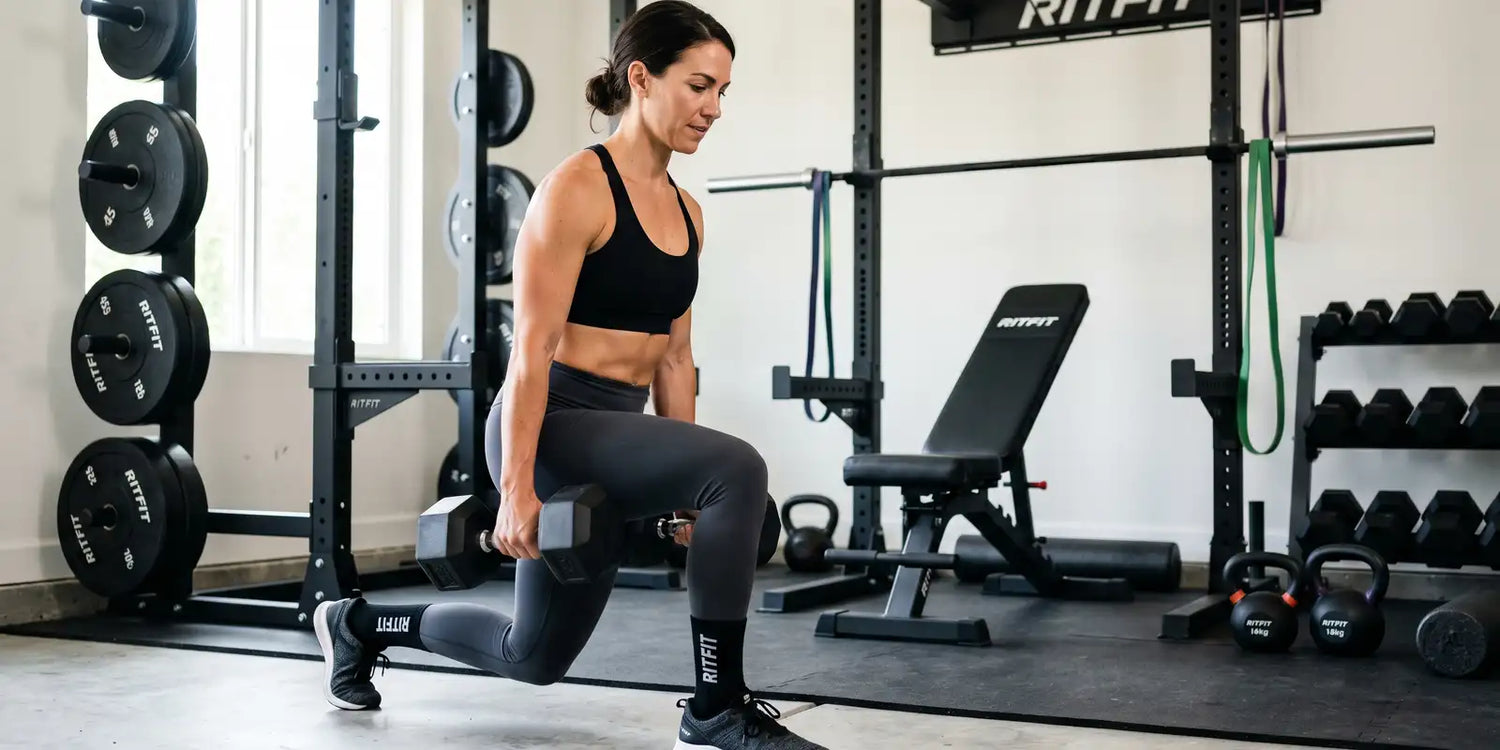
Strengthening the muscles around your knee means training the quadriceps, hamstrings, glutes, and calves that surround and support the joint. This guide shows healthy adults how to build that strength safely with simple, progressive exercises.
You will learn which muscles matter, why balance between them protects the knee, and a beginner-friendly routine you can scale from bodyweight to weights at home.
Quick Answer: To strengthen the muscles around your knee, train the quadriceps, hamstrings, glutes, and calves with bodyweight moves like quad sets, straight-leg raises, glute bridges, and wall sits two to three times per week. Progress gradually with bands or dumbbells, keep your knee aligned over your toes, and stop any exercise that causes sharp pain.
Key Takeaways
- Train the whole support system: The quadriceps, hamstrings, glutes, and calves all stabilize the knee, so a balanced routine beats isolating one muscle.
- Balance protects the joint: Keeping the hamstrings strong relative to the quadriceps supports the knee and helps reduce injury risk.
- Start with bodyweight: Quad sets, straight-leg raises, glute bridges, and wall sits build a strong base with no equipment.
- Progress gradually: Add bands, dumbbells, or step-ups once basics feel easy, training two to three times per week.
- Form first: Keep the knee tracking over your second toe and never push through sharp pain.
Why Strengthening the Muscles Around Your Knee Matters
Strong muscles take load off the knee joint itself. According to the American Academy of Orthopaedic Surgeons, strengthening the muscles that support your knee reduces stress on the joint and helps it absorb shock.
- Daily resilience: Stairs, squatting, and walking all rely on the muscles around the knee working together.
- Stability under load: Stronger quadriceps and hamstrings share the shock-absorbing role with the meniscus and cartilage.
For a wider lower-body foundation, you can also build leg muscle with compound movements that recruit these same groups.
"Strengthening the muscles around the knee is the way to go to get rid of some of this knee pain. A lot of us are probably using the wrong exercises and focusing on the wrong muscles."
Jeff Cavaliere, MSPT, CSCS, Physical Therapist & Strength Coach, former Head PT for the NY Mets, Athlean-X, "Jeff Cavaliere Shows How To Fix Knee Pain With Simple Exercises"
The Key Muscles That Support Your Knee
Four muscle groups do most of the work around the knee. The AAOS lists the quadriceps, hamstrings, hip abductors and adductors, and the glutes as the muscles to target in a knee conditioning program.
- Quadriceps: The front-of-thigh muscles straighten the knee and absorb impact when you walk downstairs or land.
- Hamstrings: The back-of-thigh muscles bend the knee and control it, stabilizing the joint during movement.
- Glutes: The gluteus maximus and medius control how the whole leg lines up from the hip, keeping the knee from caving inward.
- Calves: The gastrocnemius crosses the back of the knee and helps with shock absorption and push-off.
Because hip strength controls knee alignment, learning to strengthen your hips directly supports knee stability. For broader context, this overview of the major muscle groups shows how these pieces fit together.
The Hamstring to Quadriceps Balance
The hamstrings and quadriceps work as a team, and their balance is a cornerstone of knee stability. A systematic review reports that a hamstring to quadriceps co-activation ratio of 0.6 or greater is considered adequate for reducing stress on the ACL and lowering knee injury risk[1].
- Why balance matters: Ratios closer to 1 mean higher hamstring activation, which adds passive resistance and stability to the knee[1].
- The risk threshold: One study notes that a hamstring to quadriceps ratio below about 0.67 has been linked to greater knee injury risk, underscoring the need to train both the front and back of the thigh[2].
- A practical reference: A review describes a conventional ratio near 0.6 used as a muscle balance reference for injury prevention[3].
The practical takeaway is simple. The review found that single-leg exercises performed in roughly a 30 to 90 degree range produced more balanced co-activation than two-leg squats, so do not neglect single-leg and hamstring-focused work[1].
8 Exercises to Strengthen the Muscles Around the Knee
The eight moves below cover every muscle that supports the knee, progressing from gentle activation to loaded strength. Start with the bodyweight starters and add resistance once they feel controlled.
- Quad sets: Sit with your leg straight, tighten your thigh, and hold for 5 to 10 seconds to wake up the quadriceps.
- Straight-leg raises: Lie back, keep one leg straight, and lift it to hip height to load the quads without bending the knee.
- Glute bridges: Lie on your back and drive your hips up, squeezing the glutes that control knee alignment.
- Wall sits: Hold a seated position against a wall to build quadriceps endurance.
- Step-ups: Step onto a low platform and drive through the heel to train quads and glutes together.
- Mini-squats: Perform shallow squats while keeping the knee tracking over the second toe.
- Hamstring curls: Standing or lying, bend the knee to bring the heel toward your buttock for the back of the thigh.
- Calf raises: Rise onto the balls of your feet to strengthen the calves that cross the back of the knee.
The video below demonstrates squat foot positioning, which directly affects how your glutes and quads share the load and how your knee tracks during the movement.
No equipment yet is fine, since you can gain muscle with resistance bands by adding band tension to step-ups, curls, and abductions as you progress.
How to Program It: Frequency, Sets, and Reps
Consistency drives results more than intensity in any single session. Mass General guidance for knee-supporting muscles suggests training roughly 2 to 3 times per week with about 3 sets of 10 to 15 repetitions per exercise.
- Pick 4 to 6 moves: Cover quads, hamstrings, glutes, and calves in each session rather than hitting only one group.
- Progress slowly: Add reps first, then resistance, once a set feels controlled and pain free.
- Rest and recover: Leave a day between hard sessions so muscles adapt and rebuild.
If you want to fine-tune volume, this guide on how many reps to build muscle explains how rep ranges map to strength and size goals.
Form Mistakes That Stress the Knee
Good technique is what makes these exercises protective instead of risky. One physical-therapy guide recommends keeping the knee tracking over the second toe and not letting it collapse inward during squats, step-downs, and single-leg work.
- Knee caving inward: Inward collapse, or valgus, stresses the joint, so cue your knee to stay aligned over your toes.
- Going too deep too soon: Start with shallow ranges and earn depth as control improves.
- Pushing through pain: Stop any exercise that causes sharp pain, clicking, or grinding rather than working through it.
Quality reps with a stable knee beat heavy reps with sloppy alignment every time.
Equipment That Helps You Progress Safely
Starting with no equipment works, and you can add tools as you grow stronger. Bands and dumbbells are the simplest ways to keep challenging the muscles around the knee at home.
- Resistance bands: Light and joint-friendly, ideal for early strengthening and hip abduction work.
- Dumbbells: Add load to squats, step-ups, and bridges as bodyweight gets easy.
- Use machines with care: Mass General cautions that the knee extension machine stresses the kneecap joint and should be stopped if there is pain, clicking, or grinding.
For loading your first weighted moves, a set of dumbbells for beginners covers most of the progressions above, and you can later strengthen your knees further with structured routines.
FAQs About Strengthening the Muscles Around the Knee
What is the best exercise to strengthen the muscles around the knee?
There is no single best exercise, because the knee is supported by several muscle groups. A balanced routine works best, combining quad-focused moves like straight-leg raises and wall sits with hamstring curls, glute bridges, step-ups, and calf raises. Training the quadriceps and hamstrings together builds the stability your knee needs.
How long does it take to strengthen the muscles around your knees?
Most healthy adults notice better control and stability within a few weeks of consistent training. Meaningful strength gains generally build over roughly eight to twelve weeks when you train the knee-supporting muscles two to three times per week and gradually increase resistance. Consistency and steady progression matter far more than intensity in any single session.
Can I strengthen the muscles around my knee at home without equipment?
Yes. Bodyweight moves such as quad sets, straight-leg raises, glute bridges, wall sits, and step-ups build meaningful strength around the knee with no equipment. Once they feel easy, you can add resistance bands or light dumbbells to keep progressing and continue challenging the supporting muscles over time.
Why does balancing quadriceps and hamstring strength matter for the knee?
The quadriceps straighten the knee while the hamstrings bend and stabilize it, so they work as a team. When hamstrings are much weaker than the quadriceps, the joint can become less stable and more stressed. Training both sides of the thigh helps keep this balance and supports healthier, more resilient knee movement.
How often should I train the muscles around my knee?
General guidance suggests training the knee-supporting muscles about two to three times per week. Aim for roughly three sets of ten to fifteen repetitions per exercise, and leave a recovery day between harder sessions. Spread your work across the quadriceps, hamstrings, glutes, and calves rather than hitting only one group each time.
Conclusion
Strong, balanced muscles around the knee make daily movement easier and your joints more resilient. Build the quadriceps, hamstrings, glutes, and calves together rather than chasing one muscle.
Start with bodyweight basics, keep your knee tracking over your toes, and train two to three times per week. Add bands and dumbbells as you progress, and stop any move that causes sharp pain.
Disclaimer
This article is for general educational purposes only and is not medical advice or a treatment plan for injury, arthritis, or post-surgical knees. Consult a qualified healthcare professional before starting a new exercise program, especially if you have existing knee pain or a medical condition.
References
1. Dedinsky R, Baker L, Imbus S, Bowman M, Murray L. Exercises that facilitate optimal hamstring and quadriceps co-activation to help decrease ACL injury risk in healthy females: a systematic review of the literature. Int J Sports Phys Ther. 2017;12(1):3-15. PMCID: PMC5294945
2. Searles S, Hood J, Wood M, Bello M, Smith J, Gillen Z. Sex-based comparisons of hamstrings-to-quadriceps ratio across the velocity spectrum. Sports Health. 2025;17(6):1287-1292. PMCID: PMC11830156
3. Coombs R, Garbutt G. Developments in the use of the hamstring/quadriceps ratio for the assessment of muscle balance. J Sports Sci Med. 2002;1(3):56-62. PMCID: PMC3967430