








HYROX is a popular hybrid fitness race, and many athletes wonder how to train for HYROX at home without a full gym. The good news is that most of the event is accessible: running makes up roughly half of the race, and six of the eight stations can be approximated with bodyweight or basic equipment.
This guide covers the equipment you need, the space and weight requirements, how to replicate each station at home, and a simple weekly plan you can actually repeat. It also covers common mistakes and safe stopping conditions so you can build race readiness sustainably.
Quick Answer: Yes, you can train for HYROX at home with basic equipment and a repeatable weekly plan, since the race pairs a 1 km run with a functional station repeated across eight stations. Most stations can be simulated with bodyweight, dumbbells, kettlebells, bands, and a sandbag, leaving only the sled push and pull to need substitutes or gym access.
Key Takeaways
- Format: HYROX pairs a 1 km run with one functional station, repeated across eight stations, so running and station work matter equally.
- Feasibility: Most stations can be trained at home, but the sled push and pull are the hardest to replicate without a sled and track.
- Equipment: Dumbbells, kettlebells, a sandbag, a medicine ball, and resistance bands cover nearly every station.
- Schedule: A sustainable week combines two running sessions, one or two station sessions, and one strength session.
- Safety: Build volume gradually and stop when sharp pain, dizziness, or repeated form breakdown appears.
What Does HYROX Training Actually Ask of You?
HYROX is a hybrid race built around a simple loop: a 1 km run followed by one functional-workout station, repeated across eight different stations. One training guide describes the event as a relentless run-station cycle in which running makes up roughly half of the race, so both cardio and station strength matter equally.
- 1 km run legs: You run eight legs of 1 km at race pace, and every run after the first happens with tired legs.
- Eight stations: The functional work includes a ski erg, sled push, sled pull, burpee broad jumps, rower, farmers carry, sandbag lunges, and wall balls.
- Transitions: Moving straight from a hard run into a station is the part that defines race day.
- Divisions: Loads vary by division, but the movement patterns stay the same.
Understand this format first, because every training decision below follows from it. A home plan that trains running and station work in the same session mirrors what race day actually asks.
Can You Train for HYROX at Home?
Yes, you can complete most of a HYROX race at home, because running is fully trainable outside a gym and most stations can be approximated with basic equipment. Training guides note that sled push and sled pull are the main exception, since they really need a weighted sled and a flat track.
- Running first: Your aerobic base and race-pace intervals are the most valuable asset you can build at home. See how to improve cardiovascular endurance at home.
- Station substitutions: Bodyweight and minimal gear cover burpee broad jumps, carries, lunges, and wall-ball-style work.
- The sled gap: One equipment guide estimates that roughly three-quarters of HYROX-specific preparation can be covered at home, with sled work left for occasional gym visits.
If you are planning the room for this training, our guide to building the best gym at home helps you lay out the space around these sessions.
What Equipment Do You Need to Train for HYROX at Home?
To train for HYROX at home you need a pair of adjustable dumbbells or kettlebells, a sandbag or loaded backpack, a medicine ball, resistance bands, and running shoes. A 2021 network meta-analysis found that strength gains are greatest when you train at loads at or above roughly 60% of one-rep max, so choose weights that leave room to progress.[1]
No-Equipment Starting Point
If you have only floor space and outdoor access, you can still build a legitimate training base with bodyweight movements.
- Bodyweight moves: Burpee broad jumps, walking lunges, squats, and push-ups need no gear.
- Floor space: Clear about 6 to 8 meters for jumps and lunge drills.
Minimal Equipment (Dumbbells, Kettlebells, Bands)
Adding one kettlebell or a pair of dumbbells opens up loaded carries, lunges, and squats, while resistance bands approximate pulling work.
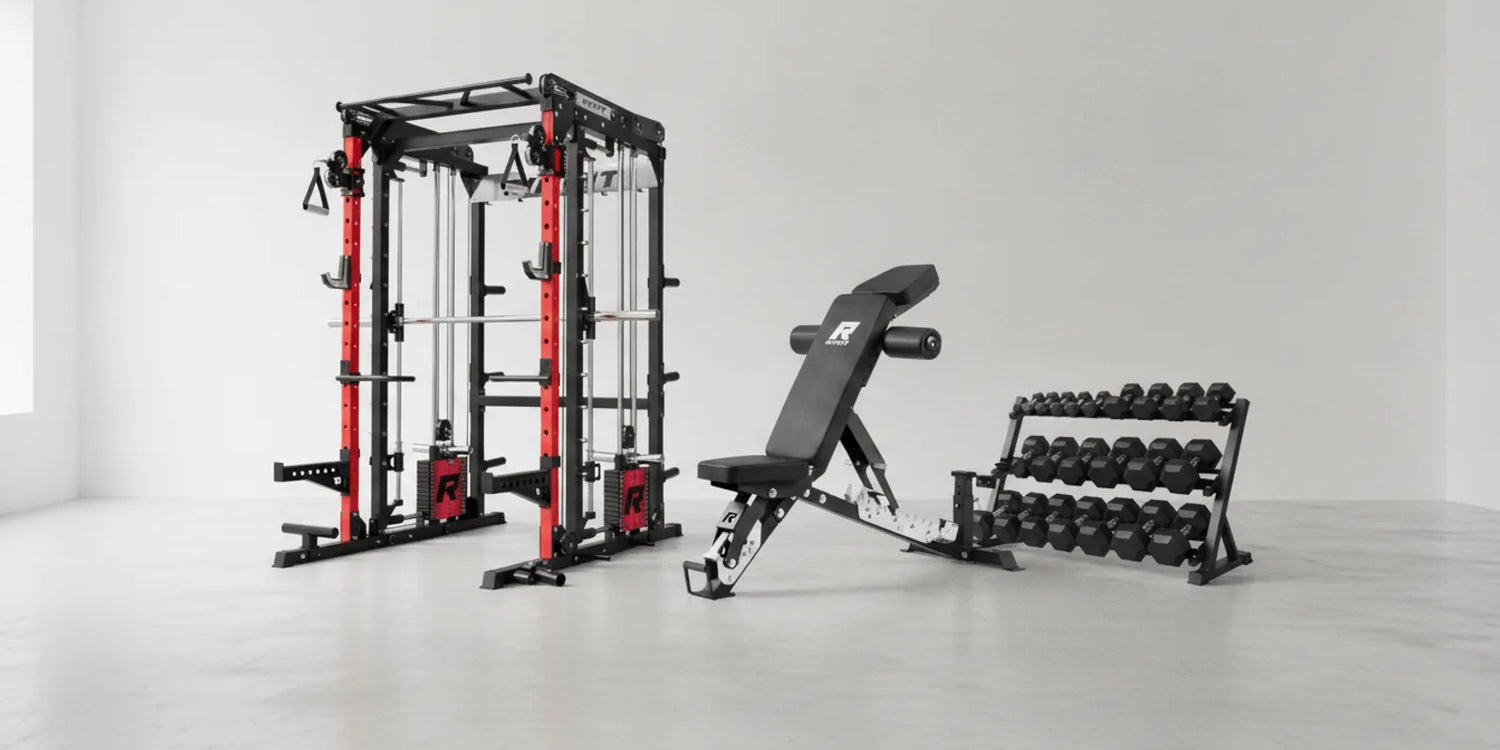
- Dumbbells or kettlebells: Cover farmer carries, goblet squats, and rows. A pair of RitFit Rubber Hex Dumbbells is a practical start.
- Resistance bands: Anchor them to a sturdy post for ski-erg and sled-pull style pulls.
- Sandbag or backpack: A loaded bag mimics the awkward load of the sandbag-lunge station.
- Medicine ball: For wall balls, thrown to a high wall or outdoor target.
Full Home Gym Upgrade
If you have the budget and space, a few upgrades cover the stations with high fidelity.
- Rowing machine or ski erg: Two machines that replicate race stations directly and fold for storage.
- Adjustable dumbbells: Adjustable dumbbells save floor space while still letting you progress the load.
- Weight bench: Supports presses, rows, and step-ups. See our weight bench exercises at home for ideas.
How Much Space and Weight Do You Need?
You need roughly 6 to 8 meters of clear floor space for burpee broad jumps, a sturdy wall with enough clearance for wall balls, and a short path or driveway for carries and lunges. A ski erg or rowing machine takes only a few square meters, while running needs only a road, park, or treadmill.
- Jump and lunge space: About 6 to 8 meters of clear, non-slip floor.
- Wall clearance: A high wall for wall-ball throws, ideally around 9 to 10 feet of target height.
- Carry path: A hallway, garden, or driveway loop for farmers carry and sandbag lunges.
- Weight range: Race loads commonly range from about 16 to 24 kg per hand for carries depending on division, but beginners should start lighter and build up.
How Do You Replicate Each HYROX Station at Home?
Every station has a workable home substitute: band pulls for the ski erg, towel pushes and wall leans for the sled, and carries, lunges, and wall balls with basic gear. Training guides suggest these substitutes build the same leg and posterior-chain endurance as the real sled, so use them with serious effort.
- Ski erg: Band pull-downs or supported rows against a heavy band.
- Sled push: Towel pushes or wall leans on a smooth floor for a heavy leg-driving effort.
- Sled pull: Hill sprints, heavy carries, and prowler-style pushes build similar leg endurance.
- Rowing: A rowing machine, or seated band rows if you have none.
- Burpee broad jumps: Pure bodyweight, just needs a clear floor. Resistance band exercises at home add variety to this conditioning.
- Farmers carry: Two heavy dumbbells or water jugs for 200 m.
- Sandbag lunges: Walking lunges with a sandbag or loaded backpack.
- Wall balls: A medicine ball thrown to a high wall or target.
What Does a Weekly HYROX Training Schedule at Home Look Like?
A sustainable home week trains four to five days, with two running sessions, one or two station sessions, and one strength session. A 2023 meta-analysis found that habit-formation interventions improve physical activity behavior, so a repeatable schedule matters more than one intense week.[2]
- Consistency wins: Research on exercise adherence shows self-efficacy is a key psychological driver of forming a lasting routine.[3]
Running Sessions
Running is the most trainable half of HYROX, and it needs only a road or treadmill.
- Long easy run: 45-75 minutes at a fully conversational pace once a week.
- Tempo run: 20-30 minutes at a comfortably hard effort once a week.
- Race-pace intervals: 4-6 x 1 km at your target race pace, with 90 seconds to 2 minutes rest.
Station Simulation Sessions
Practice the run-station loop so the transition fatigue becomes familiar.
- Run-station loops: A 1 km run followed by one station exercise, repeated 4-6 times.
- No rest transitions: Move straight from the run into the station to mimic race day.
- Pull-ups: How to train to do a pull-up at home supports the pulling strength that carries into sled work.
Strength Sessions
One to two strength sessions build the posterior chain and pulling capacity the stations demand.
- Posterior chain: Kettlebell swings, Romanian deadlifts, hip thrusts, and glute bridges.
- Unilateral work: Walking lunges, split squats, and single-arm carries. Our leg workouts at home with bench add structured lower-body options.
- Upper body pulling: Rows and band work to support the ski erg and sled pull.
What Are the Common Mistakes to Avoid in Home HYROX Training?
The most common home training mistakes are skipping running, making sled substitutes too light, ignoring transitions, and increasing volume too fast. Fix these early and you protect both race performance and recovery.
- Too little running: Running makes up roughly half the race, so it deserves a comparable share of training time.
- Light sled substitutes: If towel pushes feel easy, they are not building the leg endurance you need.
- No transition practice: Training stations in isolation misses the fatigue that decides race day.
- Too much too soon: Add volume gradually to avoid injury and burnout. Our guide to training safely on a smith machine at home applies the same principle to home strength work.
How Do You Train Safely and When Should You Stop?
Train safely by warming up, keeping your floor and ceiling clear, and raising load and volume gradually, then stop any session if you feel sharp pain, dizziness, chest discomfort, or repeated form breakdown. These stopping conditions protect you from injury and are not optional.
- Warm up: Five minutes of easy cardio plus dynamic stretches before each session.
- Check the space: Keep the jump zone clear and verify wall-ball ceiling height.
- Stop conditions: Sharp pain, dizziness, chest discomfort, or form falling apart means stop for the day.
- Rest and recovery: Schedule at least one full rest day and let your body adapt between sessions.
- Strength programming: Our best strength training for women at home guide is a useful next read for building the strength base.
"Many people underestimate the power of at-home workouts, believing that they lack the equipment or space to make meaningful progress."
Jeff Cavaliere, Physical Therapist and Strength Coach, former Head Physical Therapist for the NY Mets, at Athlean-X
FAQs About How to Train for HYROX at Home
Can you train for HYROX at home?
Yes, most of the eight HYROX stations can be approximated with bodyweight or basic home equipment, and running can be done outdoors or on a treadmill, though the sled push and pull are hard to replicate without a sled. Occasional gym visits, hill sprints, or heavy carries can cover that gap.
What equipment do you need to train for HYROX at home?
Start with a pair of adjustable dumbbells or kettlebells, a sandbag or loaded backpack, a medicine ball, and resistance bands, and add a rowing machine or ski erg as a useful station-specific upgrade. Running needs only shoes and a safe route or treadmill, so you can train every station except the sled with these basics.
How do you replicate the sled push and pull at home?
Use towel pushes or wall leans on a smooth surface for the push feel, and anchor resistance bands to a sturdy post for the pull. Hill sprints, prowler-style pushes outdoors, and heavy farmer carries build the same leg and posterior chain endurance until you reach a gym sled.
How many times a week should you train for HYROX at home?
Most home plans train four to five days a week, with two running sessions, one or two station-specific sessions, and one strength session plus a full rest day. Begin with lower volume and build gradually, because consistency matters more than intensity in the long run.
How much space do you need to train for HYROX at home?
You need roughly six to eight meters of clear floor space for burpee broad jumps, plus a sturdy wall with high clearance for wall balls, while a short path, hallway, or driveway works for carries and lunges. A ski erg or rower takes only a few square meters, and running needs only a road or treadmill.
Conclusion
Training for HYROX at home is realistic if you build the habit, cover the stations with substitutes, and progress gradually. Start with running, add one station session per week, and keep your strength work simple and repeatable.
If you are building out your space, browse the home gym equipment at RitFit to find benches, racks, and dumbbells that fit your room and budget.
Disclaimer
This article provides general fitness information and does not replace professional medical or coaching advice. Consult a qualified healthcare provider or strength coach before starting a new training program, especially if you have an injury or a medical condition.
References
1. Lopez P, Radaelli R, Taaffe DR, et al. Resistance Training Load Effects on Muscle Hypertrophy and Strength Gain: Systematic Review and Network Meta-analysis. Med Sci Sports Exerc. 2021;53(6):1206-1216. doi:10.1249/MSS.0000000000002585. PMCID: PMC8126497
2. Ma H, Wang A, Pei R, Piao M. Effects of habit formation interventions on physical activity habit strength: meta-analysis and meta-regression. Int J Behav Nutr Phys Act. 2023;20(1):109. PMCID: PMC10498635
3. Stojanovic M, Fries S, Grund A. Self-Efficacy in Habit Building: How General and Habit-Specific Self-Efficacy Influence Behavioral Automatization and Motivational Interference. Front Psychol. 2021;12:643753. PMCID: PMC8137900





