








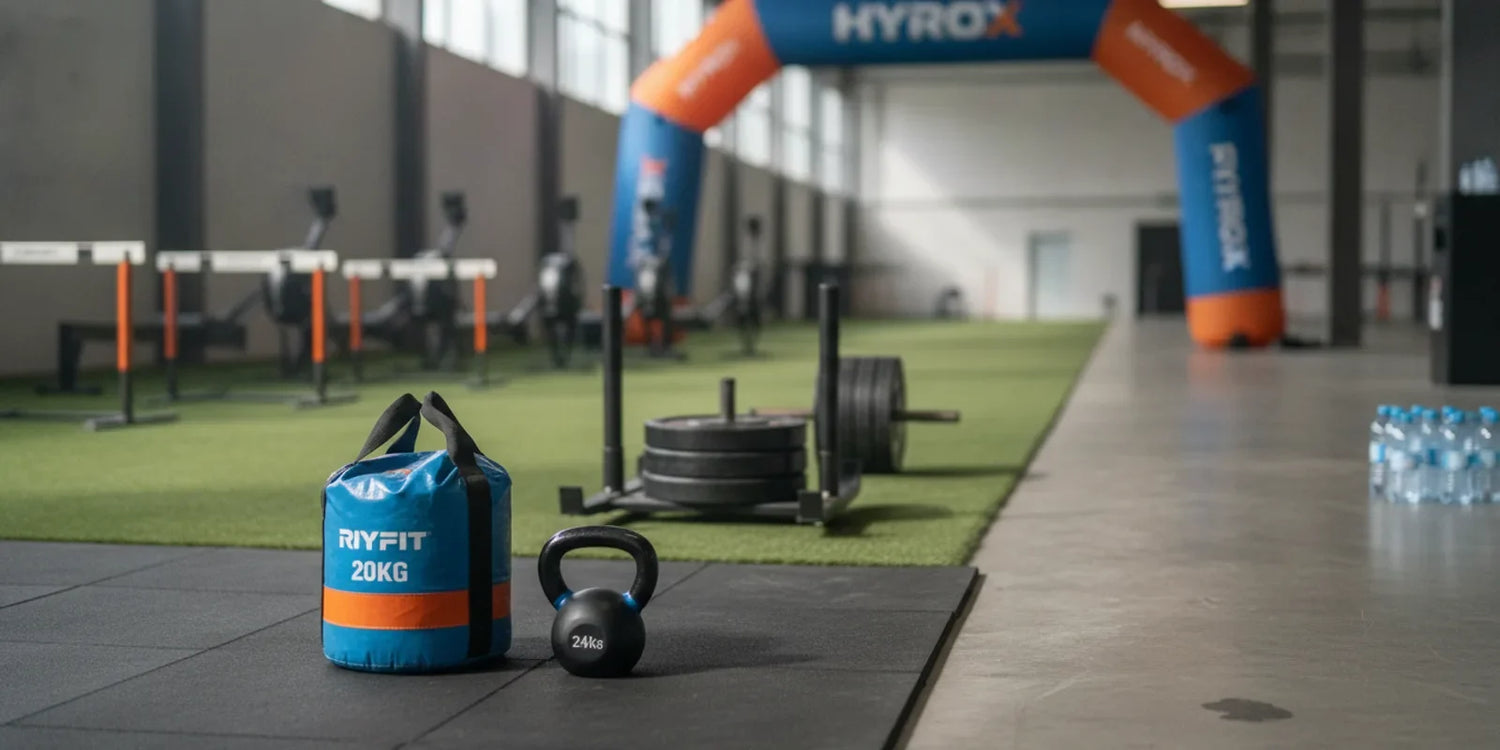
HYROX is an indoor fitness race that pairs eight 1 km running laps with eight functional workout stations. If you are wondering how hard a HYROX race really is and what fitness level you need, this guide breaks down the difficulty, the baseline requirements, and a realistic 12-16 week preparation plan.
You will learn how HYROX compares with marathons and CrossFit-style workouts, how to assess your own readiness, and what actually happens on race day. The guidance is for healthy, generally active adults preparing for a recreational race.
Quick Answer: HYROX difficulty comes from combining 8 km of running with eight loaded stations, so it demands both aerobic endurance and functional strength. A HYROX race is hard but accessible: there is no time limit, most athletes finish, and well-prepared beginners typically complete the Open division in about 80 to 105 minutes.
Key Takeaways
- Format: HYROX alternates eight 1 km runs with eight functional stations, from the SkiErg and sleds to Burpee Broad Jumps and Wall Balls.
- Difficulty: HYROX is hard because it blends running endurance with strength endurance, yet it stays accessible with no time limit and divisions for every level.
- Baseline: A practical starting point is a 5 km run in about 30 minutes, bodyweight squats for repetitions, and around 10 push-ups.
- Timeline: Plan for 12 weeks of training if you already meet the baseline and 16 weeks if you are starting from a lower base.
- Evidence: High-intensity functional training, the training style HYROX is built on, is linked to improvements in both muscular strength and endurance capacity.
What Is a HYROX Race?
A HYROX race is a standardized indoor fitness event that alternates eight 1 km running laps with eight functional workout stations, in the same order at every event worldwide. After each run you move straight into a station such as the SkiErg, Sled Push, Sled Pull, Burpee Broad Jumps, rowing, Farmers Carry, Sandbag Lunges, or Wall Balls, so running and strength work are never separated.
- Race length: 8 km of running in eight 1 km laps, with running and station work alternating throughout.
- Stations: eight stations with distances and weights that vary by division, with Wall Balls always last.
- Standardized: the same course and format at every event, which makes training specific and predictable.
- Divisions: Open, Pro, Doubles, and Relay, plus age-group waves running up to 85-89.
If the format is new to you, read our guide to What Is a HYROX Fitness Race for a station-by-station breakdown.
How Hard Is HYROX, Really?
HYROX is genuinely demanding because it blends 8 km of running with loaded station work, but it is also one of the more approachable endurance events because there is no time limit and no qualification barrier. According to HYROX, roughly 99% of registered athletes reach the finish line, and Open division has no fitness test to pass before you start.
- No time limit: you finish on your own schedule, which removes the cut-off pressure of a marathon.
- No qualification: anyone 16 or over in generally good health can register.
HYROX vs a Marathon vs CrossFit-Style Workouts
A marathon tests pure endurance, a CrossFit workout tests short bursts of power, and HYROX tests your ability to keep working after fatigue builds across 8 km.
- Marathon runner: a strong running base, but the loaded stations can erase time gains without strength endurance training.
- Strength athlete: strong on the sleds and carries, but 8 km of accumulated running exposes a missing aerobic base.
- General gym-goer: the most balanced starting point, provided a 5 km run is comfortable.
To put the difficulty in perspective, recent race data suggests most first-time Open finishers complete the race in 80-105 minutes, with the full range running from about 65 to 120-plus minutes.
What Fitness Level Do You Need?
A practical baseline for HYROX is being able to run 5 km continuously in about 30 minutes, squat your bodyweight for repetitions, and complete around 10 push-ups. One beginner guide also suggests pressing roughly 60% of your bodyweight and being comfortable on the SkiErg, rower, and sled before starting race-specific training.
The Running Baseline
The running baseline is the non-negotiable part, because the 8 km are never run on fresh legs.
- 5 km continuous: roughly 30 minutes at a comfortable jogging pace.
- Foundation first: if you cannot yet run 5 km, build that base before any HYROX-specific work.
- Pace adjustment: expect your race pace to run 20-40 seconds per kilometer slower than your comfortable 5 km pace because of station fatigue.
The Strength Endurance Baseline
The stations are loaded but modest, so raw strength matters less than strength endurance under fatigue.
- Bodyweight squat: able to squat your own weight for repetitions.
- Push-ups: around 10 clean repetitions.
- Pressing: roughly 60% of your bodyweight on a chest press.
- Grip and core: the Farmers Carry and sled work demand grip strength and core stability.
These numbers map onto the broad idea of physical fitness and the cardiac fitness engine that carries you through the running, and they are a starting point rather than a pass-fail test.
Why Is the Combination Harder Than Running or Lifting Alone?
HYROX is harder than a single-sport race because running fitness alone cannot carry you through loaded stations and raw strength alone cannot carry you through 8 km of running. The challenge sits in the transition between the two, performed while fatigue keeps building.
- Runner's trap: coaching guides note that marathon runners often gain time on the runs but give it back on the Sled Push and Sandbag Lunges.
- Lifter's trap: strength athletes find that 8 km of running reveals an aerobic base that no amount of lifting replaces.
- Burpee Broad Jumps: the only zero-load station, it is relentlessly cardiovascular and often the most disliked among first-timers, so burpee training deserves a place in your plan.
- Farmers Carry: grip and core are taxed late in the race, which is where dedicated kettlebell carry work pays off.
In short, HYROX is a hybrid event, and preparation has to be hybrid too.
Are You Ready? A Quick Self-Assessment
Being HYROX-ready means you can run 5 km comfortably, squat your bodyweight for repetitions, manage 10 push-ups, and feel steady on your feet after a hard set. Answer these questions honestly, because the answers decide whether you need 12 weeks or 16 weeks of preparation.
- Can you run 5 km without stopping? Comfortably yes means a solid base, while a real struggle means running becomes priority one.
- Can you squat your bodyweight for repetitions? This underpins the Sled Push, Sandbag Lunges, and Wall Balls.
- Can you complete 10 push-ups? Upper-body strength endurance feeds the SkiErg, rowing, and Wall Balls.
- Have you trained compromised? A heavy squat set followed by a walk shows you what a HYROX transition feels like.
- What is your goal? Finishing is a realistic first goal, while a target time adds months of work.
Multiple no answers are not a reason to panic, but they do mean 12-16 weeks of preparation is realistic before race day.
How Should You Train for HYROX: 12 or 16 Weeks?
Most beginners need about 12 weeks of targeted HYROX training if they already meet the running and strength baseline, and 16 weeks if they are starting from a lower base. The first weeks build the engine, the middle weeks add race-specific transitions, and the final weeks simulate the full event.
Weeks 1-4: Build the Engine
The first month is about volume and technique rather than intensity.
- Running volume: build toward 15-20 km per week, mostly at a comfortable zone 2 pace.
- Basic strength: squats, lunges, hinge, and push patterns cover the movements the stations need.
- Station technique: a few sessions on the SkiErg, rower, and sled make race-day movements feel familiar.
- Progressive overload: add weight or repetitions slowly so tendons adapt along with muscle, the core idea of progressive overload.
Weeks 5-8: Race-Specific Conditioning
This is where the sport-specific adaptation happens, centered on run-into-station intervals.
- Run-into-station: run 1 km at race pace, complete a station immediately, then rest.
- Compromised running: run after a hard strength session to rehearse racing on heavy legs.
- Wall Ball strategy: settle a rep scheme before race day, such as sets of 10 with short breaks.
Weeks 9-16: Simulation and Pacing
The final block rehearses the full event and refines race-day pacing.
- Full simulation: link all eight stations into one session to test transitions and nutrition.
- Pacing practice: rehearse the pace and talk test you plan to hold on race day.
- Home strength: a multi-functional home gym or functional and strength training equipment keeps station strength work consistent between gym visits.
The plan works because HYROX is a form of high-intensity functional training. In one six-month study of 45 healthy adults, regular high-intensity functional training improved multiple fitness domains, including strength and cardiorespiratory endurance.[1]
A 2020 meta-analysis linked high-intensity functional training to small-to-moderate gains in strength and endurance capacity, with endurance gains comparable to traditional endurance training.[2] In a randomized trial, eight weeks of high-intensity functional training improved fitness, and adding high-load resistance work further increased muscle mass and upper-body strength.[3]
What Happens on HYROX Race Day?
On race day you can expect a crowded venue, a bib and wristband, a guided start tunnel, and the same eight stations in the same order at every event. Arriving early, warming up properly, and knowing where each station sits removes most first-race stress.
- Arrive early: give yourself around 45 minutes to check in, warm up, and walk the venue.
- Pace yourself: choose a running pace you can hold and keep intensity in check with the talk test.
- Wall Balls last: the final station arrives when legs and lungs are already taxed, so keep something in reserve.
- Watch the format: this video walks through what a first HYROX race actually feels like.
Pacing is a skill, and using RPE is a simple way to stop early laps from destroying the later ones.
What Are the Most Common HYROX Mistakes to Avoid?
The most common first-race mistakes are starting too fast, skipping station practice, underestimating Wall Balls, and skipping a race-day nutrition plan. Each one is avoidable with a little planning.
- Starting too fast: adrenaline pushes you into an unsustainable first kilometer, so run your plan rather than the crowd's pace.
- Skipping station practice: learning SkiErg or sled technique on race morning costs time and energy.
- Underestimating Wall Balls: they come last and demand dozens of repetitions when legs and lungs are already taxed, so settle a rep scheme in training.
- No nutrition plan: a 90-minute effort needs fuel, and a gel around the halfway point can carry the later rounds.
The fix for most of these is not more volume, it is more specific application. Exercise scientist Andy Galpin captures that idea directly.
"It's not the exercise per se that determines the adaptation, it's the application."
Andy Galpin, PhD, Professor of Exercise Science and Human Performance, Parker University
Progress after your first race follows the same rule, and knowing when you have hit a fitness plateau is part of that plan.
FAQs About HYROX Difficulty and Fitness Level
How hard is a HYROX race for a beginner?
HYROX is demanding because it mixes eight 1 km runs with eight functional stations, but there is no time limit and most athletes finish. Beginners who train for 12 to 16 weeks and build a 5 km running base plus basic strength usually finish comfortably, so expect a full-body challenge rather than an impossibility.
What fitness level do you need for HYROX?
There is no official fitness test, but a useful baseline is running 5 km continuously in about 30 minutes, squatting your bodyweight for repetitions, and completing around 10 push-ups. Being comfortable on the SkiErg, rower, and sled also helps, and with this foundation about 12 weeks of targeted training is realistic.
Is HYROX harder than a marathon?
The two test different qualities, because a marathon is pure endurance while HYROX alternates running with loaded strength stations, so runners often lose time on sled pushes and lunges. Many athletes describe HYROX as harder for total-body fatigue, but the lack of a time limit makes finishing more approachable.
Can a complete beginner do HYROX?
Yes, with preparation, because complete beginners should expect 12 to 16 weeks of training starting with a running base and basic strength work before practicing the stations. Doubles and Relay formats share the workload and are gentler entry points, and if you cannot run 5 km yet, build that foundation first.
How long does it take to finish a HYROX race?
Open division finishers typically complete the race in 80 to 105 minutes, with the full range from around 65 minutes up to 120 minutes or more. There is no cut-off time so pace is personal, and well-prepared first-timers usually land in the 85 to 95 minute range.
What are the hardest HYROX stations?
New athletes often find Burpee Broad Jumps and Wall Balls the toughest because they are relentlessly cardiovascular late in the race, while Sled Push and Sled Pull demand the most raw strength. Technique matters more than sheer strength on the sleds, so practicing each station before race day makes them far more manageable.
Conclusion
HYROX difficulty is real but manageable, because the race tests hybrid fitness by pairing 8 km of running with eight functional stations. Meet the running baseline, budget 12-16 weeks, and you will finish with no time limit pressure.
Register with honest expectations and train the stations, not just the runs. For help building a home setup for station strength, visit the RitFit sales page before you book your first race.
Disclaimer
HYROX training places significant stress on the knees, hips, lower back, and shoulders, and this article provides general information rather than personalized medical advice. If you have an existing injury or health condition, consult a doctor or physical therapist before starting HYROX-specific training.
References
1. Cosgrove SJ, Crawford DA, Heinrich KM. Multiple Fitness Improvements Found after 6-Months of High Intensity Functional Training. Sports (Basel). 2019;7(9). doi:10.3390/sports7090203. PMCID: PMC6784068
2. Wilke J, Mohr L. Chronic effects of high-intensity functional training on motor function: a systematic review with multilevel meta-analysis. Sci Rep. 2020;10(1):21680. doi:10.1038/s41598-020-78615-5. PMCID: PMC7728805
3. Posnakidis G, Aphamis G, Giannaki CD, Mougios V, Bogdanis GC. The Addition of High-Load Resistance Exercises to a High-Intensity Functional Training Program Elicits Further Improvements in Body Composition and Strength: A Randomized Trial. Sports (Basel). 2022;10(12). doi:10.3390/sports10120207. PMCID: PMC9788010





