








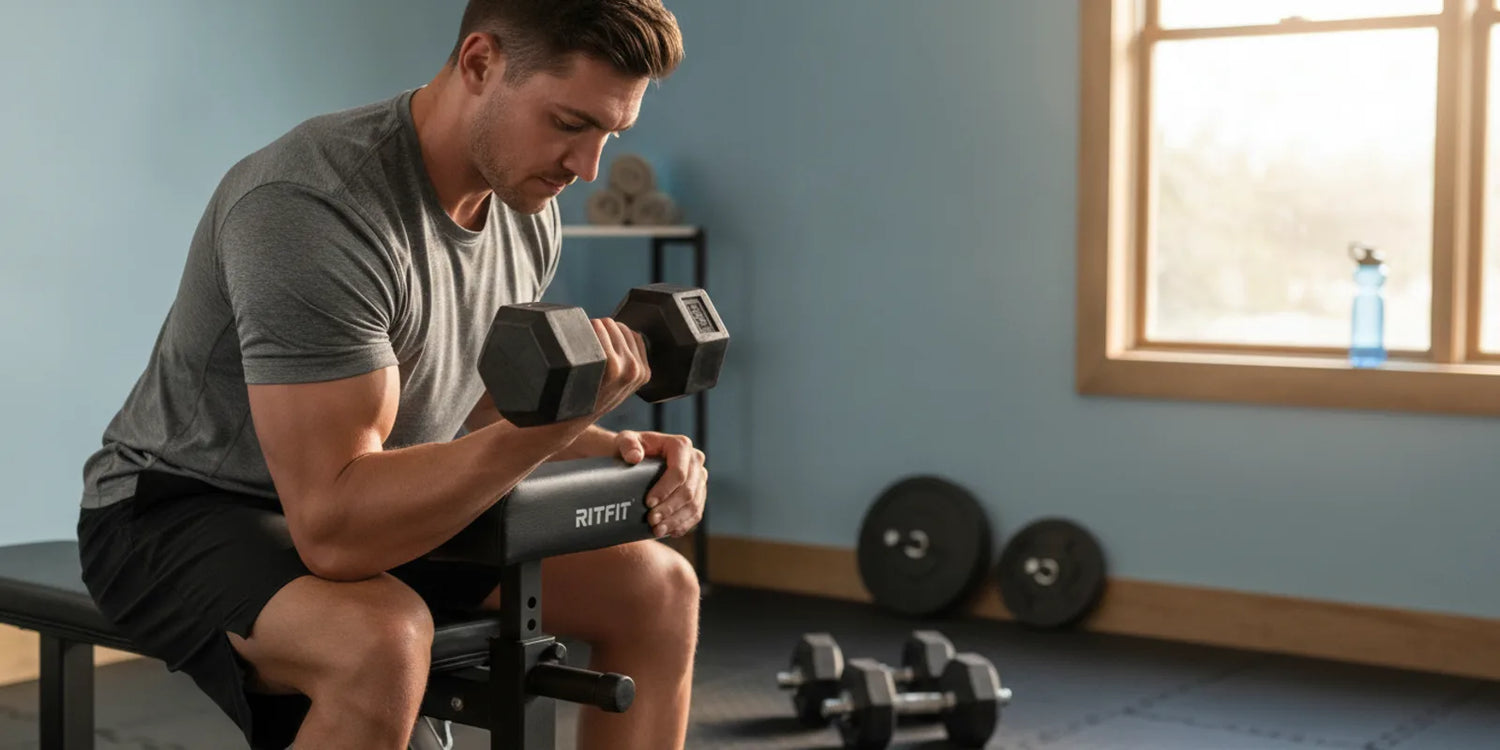
The dumbbell preacher curl at home is one of the most effective ways to isolate your biceps without a dedicated bench. By bracing your upper arm against a firm household surface, you replicate the strict mechanics of a gym preacher station.
This guide covers every substitute surface option, step-by-step form, the science behind why the bottom range of motion matters most, and how to progress safely from your first set to consistent strength gains.
Quick Answer: You can do a dumbbell preacher curl at home by resting your upper arm on a chair back, sofa armrest, stability ball, or your thigh, then curling a dumbbell through a controlled range of motion. Choose a weight you can lift for 8-12 clean reps, keep the upper arm fixed, and emphasize the slow lowering phase for maximum biceps growth.
Key Takeaways
- Surface flexibility: A chair back, sofa armrest, stability ball, or bent-knee bracing all replicate preacher curl mechanics effectively at home.
- Weight selection: Start with a load that allows 8-12 controlled reps; the fixed position eliminates momentum, so go lighter than a standing curl.
- Bottom range emphasis: An EMG study found peak biceps activation occurs near full elbow extension, making the slow lower especially important.
- Progression method: Add 2.5-5 lb only after 3 consecutive sessions at 12 clean reps; increase frequency before load if 2 sessions per week feels manageable.
- Elbow pain at the bottom: Elbow discomfort at the bottom means too much weight or hyperextension; reduce load noticeably and stop just short of full lockout.
What Is a Preacher Curl and Why Do It at Home?
The preacher curl is a biceps isolation exercise performed with the upper arm braced against a sloped support, preventing body sway and forcing the elbow to do all the work. At home, any stable inclined surface serves as the preacher pad.
Muscles Worked: Biceps Short Head, Brachialis, and Distal Growth
The preacher position places the upper arm in front of the torso, which shifts emphasis to the short head of the biceps brachii and the brachialis beneath it.
- Biceps brachii short head: Positioned with the shoulder flexed forward, the short head is in a mechanical advantage to drive elbow flexion throughout the curl.
- Brachialis: The flat muscle beneath the biceps activates strongly when the elbow is loaded in the stretched position, contributing to overall arm thickness.
- Distal biceps region: Research consistently shows the preacher curl loads the distal (lower) portion of the biceps heavily, contributing to a fuller, rounder appearance at the bottom of the muscle belly.
For home gym users focused on dumbbell bicep curls, adding the preacher variation targets the short head and brachialis in a way standard curls cannot.
What Do You Need to Do Preacher Curls at Home?
You need one dumbbell and any firm, padded surface that can support your upper arm at roughly a 45-degree angle. No specialized gym bench is required.
Best Household Substitutes for a Preacher Bench
Each surface below creates a stable brace for your upper arm and allows the forearm to move freely through the curl.
- Chair back (recommended for beginners): Straddle a sturdy chair facing the backrest. Rest your upper arm over the top edge. A padded office chair is ideal because the cushioned back mimics the feel of a preacher pad.
- Sofa armrest: Lie or kneel beside the couch with your upper arm draped over the padded armrest. The soft edge reduces elbow pressure during the eccentric phase.
- Stability ball: Kneel behind a standard exercise ball and drape your upper arms over the top. The curved surface provides a preacher-like slope, and a ball placed on a low table lets you stand for better leverage.
- Thigh or knee brace: Lean forward at the waist, hinge the hips back, and rest the back of your upper arm against your inner thigh. This requires no equipment beyond the dumbbell itself.
- Flat or incline surface edge: A low table, a step platform, or the armpad of an adjustable weight bench can all work.
If you want a purpose-built solution, the RitFit Preacher Curl Pad attaches to a flat surface or power rack and provides a proper sloped pad without a full preacher station.
Choosing the Right Dumbbell Weight
The preacher position eliminates the momentum boost you get from standing curls, so start 20-30% lighter than your usual curl weight.
- Beginner guideline: Women typically start with 8-15 lb; men with 15-25 lb. Choose a load that lets you complete 8-12 reps with strict form and no upper arm lifting off the support.
- Test before committing: Do 3 reps first. If the upper arm rises off the surface on rep 2, the weight is too heavy.
- Progression trigger: Add 2.5-5 lb only when 12 clean reps feel comfortable across 3 consecutive sessions.
Having a range of weights available makes this easier. Browse adjustable dumbbells or check the guide to the best dumbbell sets for home gym if you're still building your equipment lineup.
How Do You Do a Dumbbell Preacher Curl at Home?
The dumbbell preacher curl at home follows the same mechanics as the gym version: upper arm fixed, elbow leads, and the negative phase is controlled and deliberate.
Setup and Body Position
Position your chosen surface so the slope supports your upper arm from elbow to mid-triceps, with your elbow hanging just past the edge.
- Shoulder alignment: Keep your shoulder blade pulled down and back. Avoid shrugging or rolling the shoulder forward during the curl.
- Grip: Hold the dumbbell with a supinated (palm-up) grip. Start neutral (hammer grip) if you have wrist or elbow sensitivity.
- Elbow placement: The elbow should be just over the edge of the support, not pressed hard into it. This protects the joint and allows full range of motion.
- Core: Brace your core and keep your chest lifted. Avoid rounding the lower back to generate force.
The Curl: Concentric and Eccentric Phase
An EMG study found that the dumbbell preacher curl elicits peak biceps activation near full elbow extension, meaning the bottom of the movement is where your biceps works hardest.[1]
- Eccentric (lowering): Lower the dumbbell slowly over 3-4 seconds until the elbow is almost fully extended. Stop just short of a hard lockout to protect the biceps tendon.
- Concentric (curling up): Curl the dumbbell upward by bending the elbow, simultaneously rotating the forearm so the palm faces the front delt at the top. Take 1-2 seconds to lift.
- Top position: Squeeze the biceps briefly, but do not jerk the dumbbell. There is little resistance at peak flexion in the preacher position, so the value is in the stretch, not the lockout.
- Breathing: Exhale on the curl up, inhale on the lowering phase.
Why the Bottom Range of Motion Matters Most
A study found that training the seated dumbbell preacher curl in the initial, lengthened range of motion (0 to 68 degrees of elbow angle) produced greater distal biceps hypertrophy than training in the final range over 8 weeks.[2]
- Practical application: Allow the dumbbell to lower to near full extension on every rep. Do not cut the range short by stopping halfway down.
- Tempo prescription: A 3-second eccentric emphasis places time under tension in the lengthened position where hypertrophic stimulus is highest.
- Partial rep strategy: If you fatigue early, perform additional partial reps in only the bottom half of the range to keep the load in the most productive zone.
What Are the Best Preacher Curl Variations to Do at Home?
Home preacher curl variations differ mainly in the bracing surface and grip; each keeps the core mechanic of a fixed upper arm while adjusting difficulty or comfort.
Chair-Back Preacher Curl
Straddle the chair facing backward and drape your upper arm over the backrest. This is the most accessible version and allows unilateral or bilateral work depending on the chair width.
Stability Ball Preacher Curl
Kneel behind a stability ball and rest both upper arms over the top. The ball provides a soft, curved surface similar to a commercial preacher pad, and the slight instability engages stabilizer muscles around the shoulder.
Sofa Armrest Preacher Curl
Lie along the length of your sofa with your upper arm draped over the padded armrest. Gravity creates the same stretched load as the gym version, and the padding reduces elbow discomfort during heavy sets.
Knee-Braced Preacher Curl
Hinge at the hips with feet hip-width apart and rest the back of your upper arm against your inner thigh. This requires zero equipment and is particularly useful for travel or minimalist training.
Hammer Grip Preacher Curl
Perform the curl with a neutral (thumbs-up) grip on any of the surfaces above. The neutral position increases brachialis and brachioradialis contribution, reduces stress on the biceps tendon at the bottom, and is a good choice if supinated curling causes forearm or wrist discomfort.
For a direct comparison of cable versus dumbbell bicep training, see cable bicep curls vs dumbbell curls.
An exploratory EMG study found that the dumbbell preacher curl loads the biceps most at the lengthened position, while cable variations maintain more consistent tension through the full arc.[3] Adding a light resistance band anchored in front while holding the dumbbell can approximate that consistent tension at home.
How Many Sets and Reps of Preacher Curls Should You Do at Home?
For most home gym trainees, 3-4 sets of 8-12 reps per session done 1-2 times per week provides an effective stimulus for both strength and hypertrophy.
- Beginner: 3 sets of 10-12 reps, once per week, paired with standing dumbbell curls.
- Intermediate: 4 sets of 8-10 reps, twice per week, with 60-90 seconds rest between sets.
- Recovery rule: Allow at least 48 hours before training the same muscle again. Biceps also assist in back exercises, so account for rowing or pulling sessions.
- Progression ladder: Increase reps to 12 across all sets, then add 2.5-5 lb and return to 8 reps. Repeat.
- Deload signal: If strength drops across two consecutive sessions, reduce volume by one set for one week before resuming progression.
Pair preacher curls with a dumbbell hammer curl to complete the elbow flexor chain, or add them into a broader dumbbell home workout routine.
What Are the Most Common Dumbbell Preacher Curl Mistakes?
The most common preacher curl mistakes reduce biceps tension and increase injury risk at the elbow; most are corrected by reducing weight and slowing the eccentric phase.
- Upper arm lifting off the support: This converts the exercise into a standing curl and removes the isolation benefit. Reduce weight until the arm stays planted for all reps.
- Cutting the range short at the bottom: Stopping the descent at 90 degrees misses the most productive portion of the movement. Lower the dumbbell to near full extension on each rep.
- Bouncing out of the bottom: Using elastic rebound to initiate the curl removes tension and strains the biceps tendon. Pause for one second at the bottom before driving up.
- Locking out hard at the bottom: Forcing the elbow into full hyperextension places the biceps tendon under acute stress. Stop 5-10 degrees short of complete lockout and reduce weight if this is difficult to control.
- Using a swinging torso: Leaning back to heave the weight up means the weight is too heavy. Drop the load by one increment and maintain a vertical or slightly forward trunk.
- Rushing the concentric: A fast curl up reduces time under tension in the stretched range. Aim for a 1-2 second lift and a 3-second lower.
For a complete walkthrough of standard preacher curl technique, see the full guide on how to do preacher curls.
When Should You Stop Preacher Curls and Seek Help?
Stop the set immediately if you feel sharp pain at the front of the elbow, a sudden "pop," or a sensation of weakness or tearing in the upper arm.
- Elbow pain at the bottom: Localized pain at the front crease of the elbow at the stretch position indicates potential tendon irritation. Rest and avoid loaded elbow flexion until evaluated.
- Nerve referral: Tingling or numbness radiating into the forearm or fingers suggests possible nerve compression from improper surface positioning. Adjust elbow placement and consult a healthcare provider if it persists.
- Persistent elbow pain: Dull aching that continues 24-48 hours after training is a sign of overuse. Reduce frequency or switch to a lighter load with slower tempo before returning to normal training.
- When to see a professional: Swelling, bruising, or the muscle "bunching up" toward the shoulder (Popeye deformity) warrants immediate medical evaluation for a possible biceps tendon rupture.
"Exercises such as preacher curls and concentration curls (where the upper arm is positioned in front of the torso) work more in the short head, as do exercises such as cross cable curls on a high pulley apparatus."
Brad Schoenfeld, PhD, CSCS, CUNY Lehman College, The Science of Biceps Training ↗
For ideas on expanding your home training beyond dumbbells, explore resistance band exercises at home or the full building your home gym guide.
FAQs About Preacher Curl Dumbbell at Home
Can I do preacher curls at home without a preacher bench?
Yes. Any firm surface that supports your upper arm works, including a chair back, sofa armrest, stability ball, or your thighs bent at the waist. The key is keeping your upper arm fixed so only the elbow moves. Use a light-to-moderate dumbbell and focus on a slow, controlled lowering phase.
What weight should I start with for dumbbell preacher curls at home?
Beginners typically start with 8-15 lb (women) or 15-25 lb (men) and select a load that allows 8-12 clean reps without the upper arm lifting off the support. The preacher position eliminates momentum, so most people use slightly less weight than a standing curl. Add 2.5-5 lb when 12 reps feel easy.
Do preacher curls build bigger biceps than regular curls?
Preacher curls excel at loading the biceps in the lengthened (bottom) position, which a study in Sports (Basel) linked to greater distal biceps hypertrophy. Regular standing curls provide more consistent tension through the full range. Combining both in a program targets the biceps from different angles for optimal growth.
How many sets and reps of preacher curls should I do per week?
Three to four sets of 8-12 reps per session, one to two times per week, is a reliable starting point. Allow at least 48 hours of recovery between sessions. Increase weight only after three consecutive workouts at the top of your rep range feel manageable.
Why do my elbows hurt during preacher curls?
Elbow pain during preacher curls usually signals too much weight, gripping too tightly at the wrist, or allowing the elbow to hyperextend at the bottom. Reduce the weight noticeably, stop just short of full lockout on the way down, and flex your forearm slightly at the bottom of each rep.
Conclusion
The dumbbell preacher curl at home is a practical, science-supported way to build bicep isolation without a gym bench. A chair back, sofa armrest, or stability ball replicates the fixed-arm mechanics of a preacher station, and emphasizing the slow, stretched lowering phase delivers the hypertrophic stimulus where it counts most.
Start with a conservative weight, nail the 3-second eccentric, and progress by reps before load. When you are ready to upgrade your setup, explore back workouts at home to pair with your arm training for balanced development.
Disclaimer
The information in this article is intended for general educational purposes only and does not constitute medical or professional fitness advice. Consult a qualified healthcare provider or certified personal trainer before beginning any new exercise program, especially if you have a pre-existing injury or health condition.
Save on your next RitFit order
Tap the button to copy your code, then paste it at checkout.
References
1. Oliveira LF, Matta TT, Alves DS, Garcia MAC, Vieira TMM. Effect of the shoulder position on the biceps brachii emg in different dumbbell curls. J Sports Sci Med. 2009;8(1):24-29. https://pmc.ncbi.nlm.nih.gov/articles/PMC3737788/
2. Pedrosa GF, Simoes MG, Figueiredo MOC, Lacerda LT, Schoenfeld BJ, Lima FV, Chagas MH, Diniz RCR. Training in the Initial Range of Motion Promotes Greater Muscle Adaptations Than at Final in the Arm Curl. Sports (Basel). 2023;11(2):39. doi:10.3390/sports11020039 https://pmc.ncbi.nlm.nih.gov/articles/PMC9960616/
3. Vasiliou A, Michaelides M, Christou A, Ioannidis K, Parpa K. An Exploratory Study of Biceps Brachii Electromyographic Activity During Traditional Dumbbell Versus Bayesian Cable Curls. Muscles. 2025;4(4):45. doi:10.3390/muscles4040045 https://pmc.ncbi.nlm.nih.gov/articles/PMC12550948/





