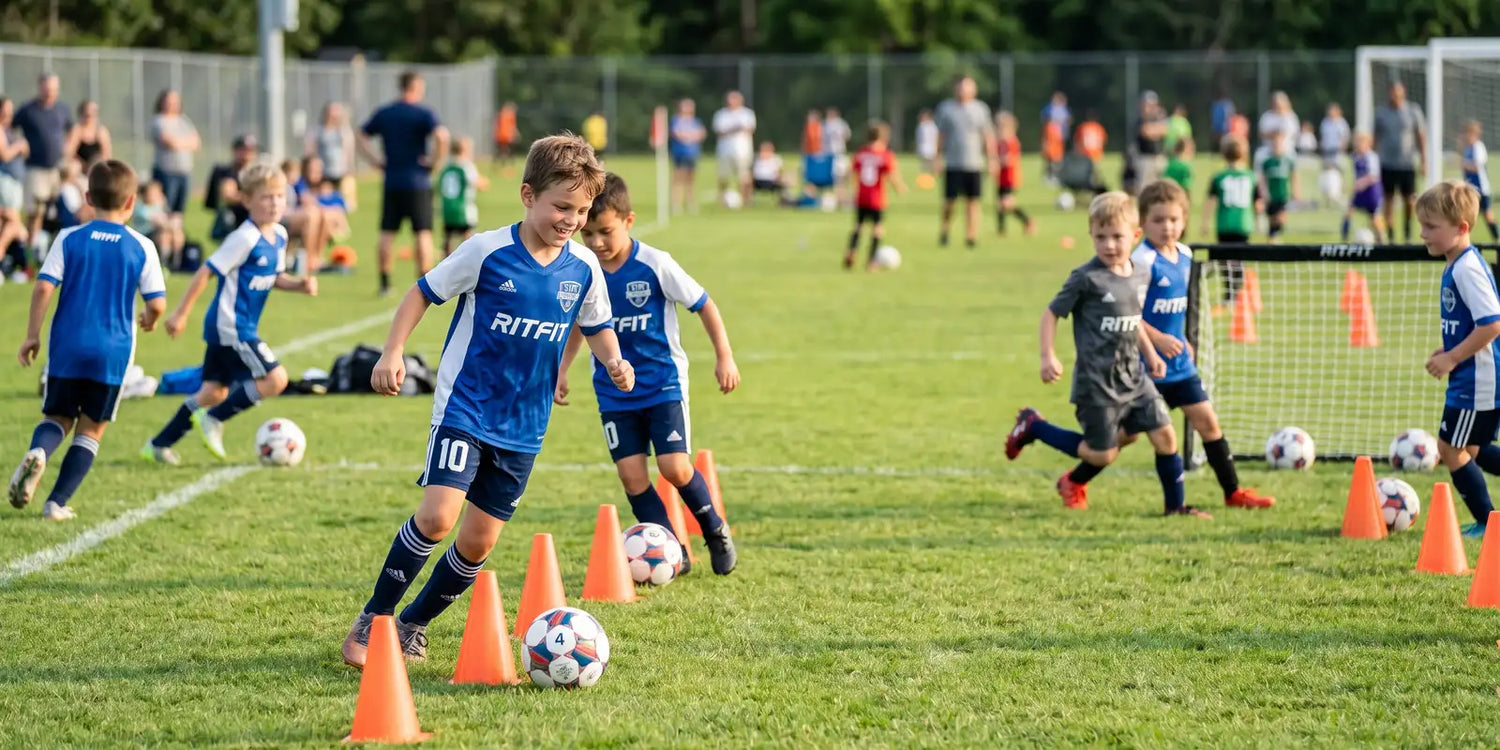
Soccer drills for 10 year olds work best when they are short, fast, and fun. At this age, kids learn through game-like play with the ball at their feet, not long tactical lectures.
This guide gives you U10 drills and a session blueprint matched to how 9 and 10 year olds actually develop their coordination, focus, and confidence.
Table of Contents
Key Takeaways
- Match the age: Ten year olds learn through fun, game-like play, so keep drills active and varied rather than turning practice into a lecture.
- Skills before tactics: U10 is about individual mastery of dribbling, first touch, and passing, not complex team formations.
- Short and focused: Sessions of about 45 to 75 minutes with 6 to 12 minute drills fit a 10 year old's attention span.
- Small sided games win: Formats from 1v1 to 4v4 give more touches and decisions per minute than full team play.
- Confidence first: Encourage both feet, reward effort, and keep kids moving so they stay engaged and want to come back.
The U10 Developmental Window: What 10 Year Olds Can and Cannot Do
Ten year olds sit in a specific learning stage, and drills should respect it. They can stabilize basic technique and follow simple instructions, but they are not ready for complex team shape.
- Individual skill stage: According to coaching guides built on the US Soccer Player Development Framework, U10 players are in a foundation stage focused on individual skill mastery rather than complex team tactics.
- Tactics come later: The ability to process complex team strategies typically does not emerge until around age 12, so formation heavy sessions work against how these kids learn.
- Growing focus: According to US Youth Soccer practice materials, the U10 player has a lengthened attention span compared to the U8 player and benefits from low stress, fun filled sessions.
The takeaway is simple, so build practice around the ball, the individual, and small groups, and save shape work for later years. If your child is brand new to the sport, our guide to the best soccer drills for beginners pairs well with this age specific plan.
How to Structure a U10 Session: Timing, Attention Span, and Touches
A good U10 session keeps kids active and the ball at their feet most of the time. Structure it around short blocks and quick transitions, not long waits in line.
- Session length: Coaching guides suggest keeping U10 sessions roughly 45 to 75 minutes, with each drill about 6 to 12 minutes, because concentration and touch quality decline after about 75 minutes.
- Read the room: If focus drops mid drill, cut it short and move to the next block. A short focused activity beats a long distracted one.
- Maximize touches: Use one ball per player and small groups so kids are active most of the session instead of standing in a line waiting for a turn.
A reliable flow is a ball based warm up, a skill block, small sided games, then a free scrimmage to finish. Keep the energy up and the explanations short.
Fun Ball Control and Dribbling Drills for 10 Year Olds
Dribbling and first touch are the heart of U10 development. Turn the reps into games so kids repeat the skill many times without getting bored.
Dribbling Gates and Shark Attack
Set up cone gates around a grid and have players dribble through as many as they can in a set time, then add a defender who plays shark to steal balls and add pressure.
Triangle Rotation Control Drill
Players work in groups of three in a triangle, receiving with an open first touch, passing to the next player, then sprinting to that spot, which builds control, coordination, and constant movement.
Encourage both feet from the start so kids do not become one footed. For more variations, our soccer dribbling drills guide adds extra options that scale up as players improve.
Passing Drills That Feel Like Games
Passing sticks better when it lives inside a game rather than a static line. Use rondos and small target games to build accuracy under light pressure.
- Numbers passing: Players jog around a grid and pass in numbered order, keeping their heads up to find the next teammate before receiving.
- Gate passing: Partners pass the ball through small cone gates to score points, rewarding accuracy and a clean first touch.
- Rondo keep away: A simple 4v1 or 4v2 circle teaches quick decisions and movement off the ball in a fun, competitive format.
Keep groups small so everyone touches the ball often. Our tips to improve soccer passing go deeper on technique for players ready for more detail.
Small Sided Games for U10 Players: The Engine of Development
Small sided games are the most valuable part of a U10 session. They create constant decisions and far more touches than full team play.
- Right formats: Coaching frameworks following US Soccer guidance recommend 1v1 through 6v6 as the core training format for U10, with 7v7 reserved for match play, because smaller formats mean more touches and decisions per minute.
- Let the game teach: In 3v3 and 4v4, players naturally learn whether to dribble, pass, or shoot without a coach explaining tactics from the sideline.
- Fitness comes free: A study of young soccer players found small sided games improved bio motor abilities such as anaerobic power, aerobic capacity, speed, and agility, with interval formats producing greater anaerobic gains than continuous ones.[1]
The video below shows ten fun small sided and skill games built specifically for this age group.
To add light conditioning inside these games, see our soccer conditioning drills for ideas that keep the work playful.
Building Coordination and Confidence Beyond Ball Work
Strong basic movement makes every soccer skill easier to learn at this age. Coordination, balance, and agility are the foundation under the ball work.
- Motor skills matter: One study of young soccer players found that fundamental motor skills strengthened the influence of physical fitness on speed dribbling, while fitness alone did not significantly drive it.[2]
- Train the brain too: In one trial of preadolescent players, both a speed agility quickness program and a small sided games program improved cognitive performance and short sprint times, suggesting youth training should develop the mind as well as the body.[3]
- Keep it confident: Reward effort and clever attempts, even imperfect ones, so kids stay willing to try new moves.
Simple agility ladders, hops, and reaction games fit naturally into a warm up. A broader strength exercises for soccer base can help older kids as they grow.
Common Mistakes to Avoid Coaching 10 Year Olds
Most U10 coaching errors come from treating kids like small adults. Avoid these traps to keep development and fun on track.
- Long lines: The fastest way to lose a 10 year old is to make them wait in line. Use small groups so players are active most of the time.
- Too much talking: Replace long explanations with game like activities, since a child who gets hundreds of touches improves faster than one who listens to formations.
- Forcing formations: Asking nine and ten year olds to hold positions for long stretches is counterproductive, so save shape work for U12 and up.
- One footed habits: Encourage both feet early so players do not become dependent on their stronger side.
When energy or focus fades, shorten the drill rather than pushing through a tired, distracted block.
Equipment and Home Practice Setup
You do not need much gear to run a great U10 session. A few simple items cover almost every drill in this guide.
- One ball per player: This single choice maximizes touches and keeps everyone busy. A properly sized RitFit soccer ball suits this age group well.
- Cones and markers: Use them to build grids, gates, and small goals for dribbling and passing games.
- Pinnies and small goals: Colored bibs split teams quickly, and pop up goals make small sided games more game realistic.
A flat, safe space and regular water breaks complete a good home or field session. As players grow into endurance work, our guide to build soccer stamina is a natural next read.
FAQs About Soccer Drills for 10 Year Olds
How long should a soccer practice be for a 10 year old?
Most U10 sessions work best at about 45 to 75 minutes, with each drill running roughly 6 to 12 minutes. Children this age lose focus when activities drag, so quick transitions and short, varied blocks keep touches sharp. If concentration drops mid drill, cut it short and move on rather than pushing a tired, distracted repetition.
What soccer skills should a 10 year old focus on?
At U10 the priority is individual skill mastery, not team tactics. Focus on ball control, dribbling with both feet, first touch, and short passing, then add simple 1v1 and 2v2 decisions. Small sided games let players make constant choices naturally, so they learn to decide whether to dribble, pass, or shoot without long sideline explanations.
Why are small sided games better than full team drills for U10 players?
Smaller formats like 1v1 through 4v4 give every child far more touches, decisions, and game realistic moments per minute than a full eleven a side setup. Ten year olds can process one to three player combinations but not complex formations yet, so small sided games match how they actually learn and keep everyone active and engaged.
How do I keep soccer drills fun for 10 year olds?
Turn skills into games. Instead of static lines, use tag style dribbling games, races, scoring, and small challenges so kids repeat a skill many times without boredom. Keep players active at least eighty percent of the time, use small groups to cut waiting, and celebrate effort and attempts so children stay confident and motivated.
What equipment do you need for a 10 year old soccer practice?
The essentials are simple. Use one ball per player to maximize touches, a set of cones or markers to build grids and gates, and a few small or pop up goals for finishing and small sided games. Pinnies or colored bibs help split teams quickly. A flat, safe space and water breaks round out a good U10 session.
Conclusion
Great soccer drills for 10 year olds are short, fun, and full of touches. Build practice around the individual and small groups, keep sessions inside a 45 to 75 minute window, and let small sided games do the teaching.
Start with the warm up and dribbling games here, add passing and small sided play, and adjust the difficulty as confidence grows. Keep it playful and the skills will follow.
Disclaimer
This article is for general youth coaching and educational purposes only and does not replace personalized guidance from a qualified coach or healthcare professional. Always consider each child's age, ability, and physical readiness, and seek professional advice before starting any new training program.
References
1. Daryanoosh F, Alishavandi H, Nemati J, et al. Effect of interval and continuous small-sided games training on the bio-motor abilities of young soccer players: a comparative study. BMC Sports Science, Medicine & Rehabilitation. 2023;15(1):51. https://pmc.ncbi.nlm.nih.gov/articles/PMC10071664/
2. Kokstejn J, Musalek M, Wolanski P, Murawska-Cialowicz E, Stastny P. Fundamental Motor Skills Mediate the Relationship Between Physical Fitness and Soccer-Specific Motor Skills in Young Soccer Players. Frontiers in Physiology. 2019;10:596. https://pmc.ncbi.nlm.nih.gov/articles/PMC6546828/
3. Trecroci A, Cavaggioni L, Rossi A, et al. Effects of speed, agility and quickness training programme on cognitive and physical performance in preadolescent soccer players. PLoS One. 2022;17(12):e0277683. https://pmc.ncbi.nlm.nih.gov/articles/PMC9714860/