








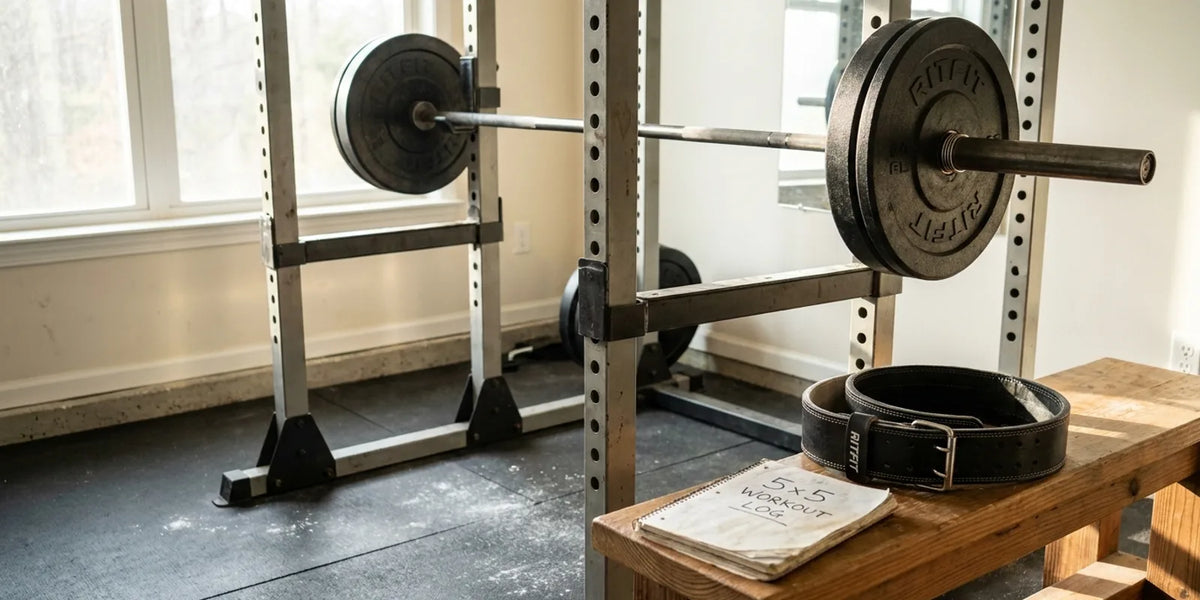
A 5x5 workout is a strength training program built on five sets of five reps of a few heavy compound barbell lifts, done as three full-body sessions each week. It is one of the simplest, most proven ways for beginners to get stronger.
This guide explains what 5x5 means, the exact lifts and structure, how to pick weights and progress safely, who it suits, and when to move on.
Table of Contents
- What Is a 5x5 Workout?
- Where Did the 5x5 Workout Come From?
- What Lifts and Structure Make Up a 5x5?
- How Does Progressive Overload Drive 5x5?
- How Often Should You Train and Rest?
- Who Is 5x5 Best For?
- How Can You Substitute or Scale the Lifts?
- What Are the Most Common 5x5 Mistakes?
- How Does 5x5 Compare to Higher-Volume Training?
- What Does a 4-Week 5x5 Starter Plan Look Like?
Key Takeaways
- The format: 5x5 means five sets of five reps of compound barbell lifts, run as three full-body workouts per week.
- The lifts: Squat, bench press, overhead press, and barbell row use 5x5, while the deadlift uses a single set of five.
- The engine: Progressive overload, adding a small amount of weight each session, is what makes the program work.
- Best for: Beginners and returning lifters who want a simple, time-efficient strength foundation.
- The limit: 5x5 is strength-focused and lower in volume, so most lifters eventually add accessory work for more size.
What Is a 5x5 Workout?
A 5x5 workout is a strength program where you perform five sets of five repetitions with the same weight on a handful of compound barbell exercises. You train the full body three times a week and add weight gradually over time.
The format keeps things simple by focusing on a few big lifts instead of many isolation exercises. This makes it easy to learn, easy to track, and time-efficient.
- Sets and reps: Five sets of five reps, often called straight sets across.
- Movement type: Heavy compound lifts that train multiple muscle groups at once.
- Goal: Build base strength and some muscle while mastering core barbell patterns.
If you want a clear starting point for barbell training, the 5x5 is a strong candidate. It rewards consistency over complexity.
Where Did the 5x5 Workout Come From?
The 5x5 workout traces back more than 65 years to early strength coaches and bodybuilders. Reg Park and later Bill Starr popularized five sets of five as a reliable way to build raw strength.
The modern version most people mean is StrongLifts 5x5, created by a coach known as Mehdi, which packaged the old method into a simple app-guided routine.
- Reg Park: An early advocate of heavy 5x5 sets for building strength and size.
- Bill Starr: Refined the 5x5 approach for athletes in his classic strength writing.
- StrongLifts: The widely used modern format that brought 5x5 to a mainstream audience.
The longevity of the method is part of its appeal. A program that has worked for decades carries a track record few newer routines can match.
What Lifts and Structure Make Up a 5x5?
A standard 5x5 uses five barbell lifts split across two alternating workouts, A and B. You rotate between them across three weekly sessions, with the squat appearing in every workout.
Workout A is squat, bench press, and barbell row, all for 5x5. Workout B is squat, overhead press, and deadlift, with the deadlift done for a single set of five.
| Workout A | Workout B |
|---|---|
| Squat 5x5 | Squat 5x5 |
| Bench Press 5x5 | Overhead Press 5x5 |
| Barbell Row 5x5 | Deadlift 1x5 |
The deadlift gets just one heavy set because it is extremely fatiguing and overlaps heavily with the squat. A safe rack and a quality bar make these heavy lifts far easier to perform.
- Equipment basics: A Olympic barbell and a sturdy power cage cover the core setup.
- Press support: An adjustable weight bench is needed for the 5x5 bench press.
- Technique first: Master the bench press workout fundamentals before loading heavy.
The video below walks through the two-workout structure and how the lifts fit together for a beginner.
How Does Progressive Overload Drive 5x5?
Progressive overload is the engine of the 5x5 program, meaning you add a small amount of weight each time you complete all your sets. This steady increase forces the body to keep adapting and getting stronger.
Most plans add around 5 pounds or 2.5 kilograms per session to each lift. An 8-week study of trained men found that heavy back squats using a low number of reps significantly improved maximal strength and power output.[1]
How Do You Choose Your Starting Weight?
Start lighter than you think, often just the empty bar or about half of your five-rep best, so you can groove the technique before the weight climbs.
- Beginners: Begin squats, bench, and overhead press with the empty bar.
- Floor lifts: Start deadlifts and rows around 65 to 135 pounds so plates clear the floor.
- Rule of thumb: Sets of five sit near 85 percent of your one-rep max once weights are heavy.
How and When Do You Add Weight?
Add weight the next session whenever you hit all five sets of five with clean form. If you miss reps, repeat the same weight until you complete it.
- Increment: Roughly 5 pounds or 2.5 kilograms per lift per successful session.
- Stall rule: Repeat a weight after a failed session rather than forcing more.
How Often Should You Train and Rest?
A 5x5 program prescribes three workouts per week with at least one rest day between each session, such as Monday, Wednesday, and Friday. Recovery days are when strength and muscle actually develop.
Because the squat appears in every workout, your legs train three times a week, while the other lifts are spaced out enough to recover. Higher frequency can help by allowing more total weekly volume across sessions.[1]
"Five hard sets, three times per week may be just as challenging as 10 sets in a single session, but it represents a 50% increase in weekly training volume. So, it seems that higher frequency independently promotes larger strength gains, and it seems likely that the benefits of higher frequencies and higher volumes would be additive."
Greg Nuckols, MA, Strength Researcher and Coach, Stronger By Science
- Schedule: Three sessions weekly with rest days between, alternating Workout A and B.
- Sleep and food: Adequate sleep and protein support recovery between heavy sessions.
Who Is 5x5 Best For?
The 5x5 workout is best for beginners and returning lifters who want a simple, effective way to build base strength. Its short exercise list and clear progression make it easy to stick with.
It suits people who value efficiency and structure over variety. Lifters chasing maximum muscle size or advanced sport-specific goals may eventually need more volume and variation.
- Great fit: New lifters learning the main barbell patterns.
- Good fit: Returning lifters rebuilding strength after a break.
- Weaker fit: Advanced lifters needing higher volume for hypertrophy.
If you fall into the beginner camp, 5x5 offers an honest, repeatable path. You can always layer in more later as your goals shift.
How Can You Substitute or Scale the Lifts?
You can scale a 5x5 by swapping barbell lifts for dumbbell or machine versions when equipment, mobility, or comfort demands it. The 5x5 structure stays the same while the movements adapt to you.
Dumbbell presses, goblet or box squats, and machine rows can stand in for the barbell versions. The goal is keeping the heavy compound pattern, not the exact tool.
- Squat options: Goblet squats or box squats when mobility is limited.
- Press options: Dumbbell bench or shoulder press, or add dips for upper-body accessory work.
- No barbell: A combo machine full-body workout or bodyweight workout options can bridge the gap.
Scaling is not cheating, it is smart programming. The right substitution keeps you training safely while you build toward heavier barbell work.
What Are the Most Common 5x5 Mistakes?
The most common 5x5 mistakes are loading too heavy too soon, skipping warm-up sets, and pushing through joint pain. Each one slows progress or invites injury.
Because weight climbs every session, ego loading catches up fast and form breaks down. Treat the early light weeks as technique practice, not wasted time.
- Ego loading: Starting too heavy leads to missed reps and soreness that derails the plan.
- Skipping warm-ups: Ramp-up sets prepare joints and groove the movement.
- Ignoring pain: Sharp or persistent joint pain is a signal to stop and reassess.
When linear progress stalls, a common fix is to deload by cutting roughly 10 percent off the bar and building back up. Pairing strength work with metcon conditioning workouts on off days can round out fitness without overloading the main lifts.
How Does 5x5 Compare to Higher-Volume Training?
5x5 favors heavy loads and lower volume for strength, while hypertrophy-focused routines use more sets and reps to maximize muscle size. Both build muscle, but they emphasize different outcomes.
A systematic review and network meta-analysis found that higher-load multiset training ranked highest for strength, while all prescriptions comparably promoted hypertrophy and multiple sets characterized the top hypertrophy approaches.[2]
- 5x5 strength focus: Heavy loads, low reps, and high frequency build base strength efficiently.
- Volume for size: More sets and accessory work drive additional muscle growth over time.
- Flexible loading: One 8-week study in elite lifters showed low-load high-rep work matched heavier loading for strength and mass.[3]
For a beginner, 5x5 builds the strength base first. Many lifters then graduate to higher-volume training, or explore time-efficient formats like a what a Tabata workout is guide, as goals evolve.
What Does a 4-Week 5x5 Starter Plan Look Like?
A 4-week 5x5 starter plan alternates Workout A and B across three sessions weekly, adding a small load each successful session. Start light and let progression do the work.
The schedule below shows how A and B rotate, with the squat trained every session and weights nudged up over the month.
| Week | Monday | Wednesday | Friday |
|---|---|---|---|
| 1 | Workout A | Workout B | Workout A |
| 2 | Workout B | Workout A | Workout B |
| 3 | Workout A | Workout B | Workout A |
| 4 | Workout B | Workout A | Workout B |
For broader full-body strength context, the principles overlap with a military-style strength training approach. A deeper bench workout routine guide helps once you progress past the starter phase.
FAQs About the 5x5 Workout
What does 5x5 mean in a workout?
5x5 means five sets of five repetitions performed with the same weight on a given exercise. In the classic StrongLifts version, you apply this scheme to compound barbell lifts like the squat, bench press, overhead press, and barbell row, while the deadlift is done for just one set of five reps because it is so fatiguing.
Is the 5x5 workout good for beginners?
Yes. 5x5 suits many beginners because it is simple, focuses on a few compound lifts, and uses three full-body sessions per week. It teaches foundational movement patterns and rewards consistency through progressive overload. Beginners should start very light, prioritize technique, and add weight gradually rather than rushing to heavy loads.
How often should you do a 5x5 workout?
Most 5x5 programs prescribe three workouts per week with at least one rest day between sessions, such as Monday, Wednesday, and Friday. You alternate between two workouts, A and B. Rest days matter because strength and muscle adaptations happen during recovery, not during the training session itself.
How much weight should you add on 5x5?
The standard guideline is to add a small amount, often 5 pounds or 2.5 kilograms, to each lift every session you complete all five sets of five reps. If you fail to hit all reps, repeat the same weight next time. This steady linear progression is the core engine that drives results on a 5x5 program.
Can you build muscle with a 5x5 workout?
Yes. You can build some muscle on 5x5, especially as a beginner, because heavy compound lifting and progressive overload stimulate growth. However, 5x5 is primarily a strength program with relatively low volume. Once progress slows, many lifters add accessory volume or switch to a higher-volume routine to maximize muscle size.
Conclusion
A 5x5 workout is a simple, proven strength program built on heavy compound lifts, three weekly sessions, and steady progressive overload. It is an excellent foundation for beginners and returning lifters.
Start light, focus on clean technique, and add weight only when you complete every set. When linear gains slow, deload or layer in more volume to keep progressing.
Disclaimer
This article is for general educational purposes only and does not replace personalized advice from a qualified coach or medical professional. Consult a healthcare provider before starting any new training program, especially if you have an injury or health condition.
References
1. Lu W, Du Z, Zhou A. Fast and Medium Tempo Resistance Training with a Low Number of Repetitions in Trained Men: Effects on Maximal Strength and Power Output. Journal of Human Kinetics. 2023;87:157-165. https://pmc.ncbi.nlm.nih.gov/articles/PMC10203832/
2. Giessing J, Eichmann B, Steele J, Fisher J. A comparison of low volume 'high-intensity-training' and high volume traditional resistance training methods on muscular performance, body composition, and subjective assessments of training. Biology of Sport. 2016;33(3):241-9. https://pmc.ncbi.nlm.nih.gov/articles/PMC4993139/
3. Yeom DC, Hwang DJ, Lee WB, Cho JY, Koo JH. Effects of Low-Load, High-Repetition Resistance Training on Maximum Muscle Strength and Muscle Damage in Elite Weightlifters: A Preliminary Study. International Journal of Molecular Sciences. 2023;24(23). https://pmc.ncbi.nlm.nih.gov/articles/PMC10707615/





