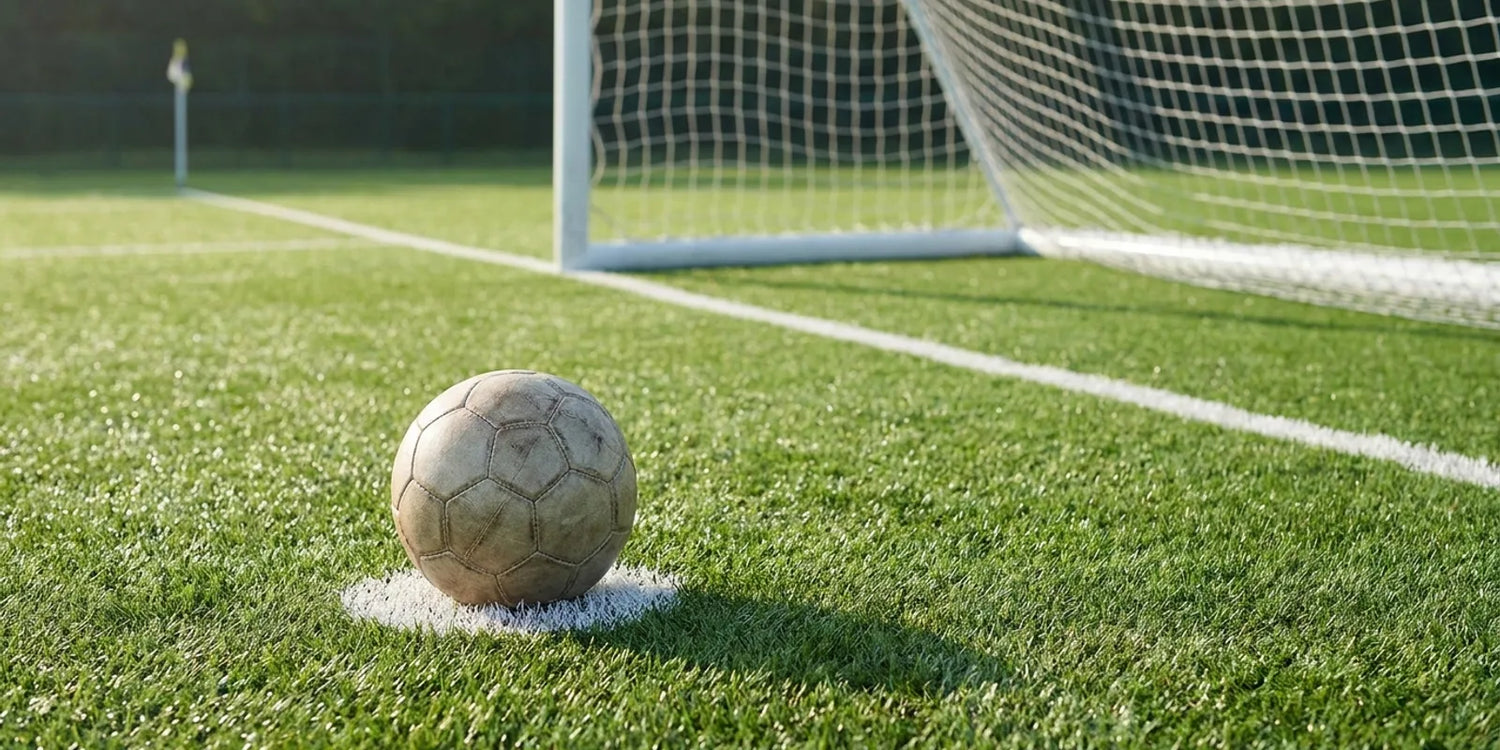
A penalty kick in soccer is taken from the penalty mark, and the penalty kick distance is 12 yards, or 36 feet, from the midpoint of the goal line. That measurement is identical in youth games, league play, and the World Cup final.
This guide gives the exact penalty distance in yards, feet, and meters, then explains when a penalty is awarded, how the procedure works, what goalkeepers may do, and how players train for the pressure.
Quick Answer: The penalty kick distance is 12 yards, or 36 feet, measured from the penalty mark to the midpoint of the goal line, which converts to 10.97 meters. IFAB Law 14 sets that mark and requires every other player to stand at least 10 yards away.
Key Takeaways
- Penalty kick distance: The penalty mark is 12 yards (36 feet, about 11 meters) from the midpoint of the goal line in every sanctioned match.
- Who is involved: Only the identified kicker and the defending goalkeeper take part, and every other player must stay outside the penalty area until the ball is in play.
- Goalkeeper limit: The goalkeeper must keep at least part of one foot on, in line with, or behind the goal line until the ball is kicked.
- After the kick: A saved or rebounding penalty stays live, but the kicker cannot touch the ball twice in a row.
How Far Is a Penalty Kick in Soccer? The Exact Distance
A penalty kick in soccer is taken from the penalty mark, which is 12 yards, 36 feet, or 10.97 meters from the midpoint of the goal line. IFAB Law 1 measures the mark from its center to the back edge of the goal line, and Law 14 sets the procedure taken from that spot. The same measurement applies in every sanctioned match, from under-8 games to the World Cup final.
A penalty kick is a direct free kick restart awarded when a defending team commits a listed offense inside its own penalty area. The kicker faces only the goalkeeper, and a goal can be scored directly from the kick.
Penalty Kick Distance in Yards, Feet, and Meters
The table below converts each penalty box measurement into the three units people look up most often.
| Field measurement | Yards | Feet | Meters |
|---|---|---|---|
| Penalty mark to goal line | 12 yd | 36 ft | 10.97 m (Laws list 11 m) |
| Penalty arc radius from the mark | 10 yd | 30 ft | 9.15 m |
| Penalty area depth | 18 yd | 54 ft | 16.5 m |
| Goal area depth | 6 yd | 18 ft | 5.5 m |
| Goal width between the posts | 8 yd | 24 ft | 7.32 m |
Source: IFAB Laws of the Game 2026/27, Law 1 (The Field of Play) and Law 14 (The Penalty Kick). Yard figures are the primary values printed in the Laws.
Penalty Area and Goal Area Measurements
Two lines drawn 18 yards (16.5 m) from the inside of each goalpost mark the penalty area, and they extend 18 yards into the field. The goal area sits inside that box at 6 yards (5.5 m) from each goalpost, and the penalty arc curves 10 yards (9.15 m) from the penalty mark.
- Goal size: The distance between the inside of the posts is 8 yards (7.32 m), and the crossbar sits 8 feet (2.44 m) above the ground.
- Why the arc exists: The arc keeps defenders a full 10 yards from the mark without letting them stand inside the penalty area.
- Closest legal position: Every player other than the kicker and goalkeeper must stand at least 10 yards (9.15 m) from the penalty mark.
When Is a Penalty Kick Awarded?
A penalty kick is awarded when a player commits a direct free kick offense inside their own penalty area while the ball is in play. The referee judges both the challenge and where it happened, because identical contact outside the area is only a free kick.
Fouls That Can Lead to a Penalty
Law 12 turns a direct free kick offense into a penalty when it happens inside the offender's own penalty area.
- Careless or reckless challenges: Charging, jumping at, kicking, pushing, striking, tackling, or tripping an opponent.
- Holding and impeding: Holding an opponent, pulling a shirt, or impeding with contact.
- Misconduct on the field: Biting, spitting at, or throwing an object at an opponent or a match official.
- Handball: Deliberate handling, or handling that makes the body unnaturally bigger.
Handball and Penalty Decisions
A deliberate handball by a defending player inside their own penalty area is always a penalty, even when it does not deny a goal-scoring chance. The referee still decides whether the arm position was a natural consequence of the player's movement.
How Is a Penalty Kick Taken?
A penalty kick is taken from the penalty mark once the referee signals, with the ball stationary on the mark. Every player other than the kicker and the goalkeeper must be at least 10 yards (9.15 m) from the mark and outside the penalty area until the ball is in play.
Step 1: Ball Placement
The ball must be stationary, with part of it touching or overhanging the center of the penalty mark. The goalposts, crossbar, and net must also be still before the kick is taken.
Step 2: Kicker Identification
The referee must be able to identify the player taking the kick before the whistle. That matters because the identified kicker is the only player allowed to strike the ball first.
Step 3: Goalkeeper Position
The defending goalkeeper stays on the goal line, facing the kicker and between the goalposts, until the ball is kicked. After contact, the goalkeeper may move in any direction.
Step 4: Other Player Positions
Every other player must stay behind the penalty mark and outside the penalty area, which is exactly why the penalty arc exists. Their roles elsewhere on the field do not change the restart, and you can see how those roles divide up in our guide to soccer positions explained.
Step 5: Referee Signal
The referee signals for the kick only after every player is in a legal position. A whistle is required, and the kick cannot start before it.
Step 6: The Kick
The kicker must kick the ball forward, and a back-heel is allowed as long as the ball still moves forward. Feinting during the run up is permitted, but feinting once the run up is complete draws a caution.
Step 7: Ball in Play
The ball is in play when it is kicked and clearly moves. From that moment any player except the kicker may play it, and the goalkeeper may handle it only inside their own penalty area.
Rules for the Kicker
The kicker must be clearly identified, must kick the ball forward, and must not touch it again until another player has touched it. Kicking the ball backward or taking a second touch changes the restart to an indirect free kick for the defending team.
- One touch only: The kicker cannot play the ball again until it has touched another player, and a goalkeeper save counts as that touch.
- No rebound double tap: If the ball comes straight back off the post or crossbar, the kicker may not play it, because no other player has touched it yet.
- Feinting: Movement and stutter steps during the run up are legal, but stopping to feint once the run up is finished is not.
- Wrong kicker: If a teammate takes the kick, the referee cautions that player and the defending team restarts with an indirect free kick.
Rules for the Goalkeeper
The goalkeeper must stay on the goal line between the goalposts when the ball is kicked. At least part of one foot must be touching, in line with, or behind the line at that moment, and the goalkeeper may move sideways or jump but cannot step forward off it early.
- Free to dive: Once the ball is kicked, the goalkeeper can dive, jump, or move in any direction.
- No unfair distraction: Delaying the kick, touching the posts, or gesturing to distract the kicker is not allowed.
- Early movement: If the goalkeeper offends and the kick is not scored, the kick is retaken, and the goalkeeper may be cautioned for repeated offenses.
- Handling the ball: The goalkeeper may handle the ball inside their own penalty area at any point, including during a shootout.
What Happens After the Kick?
The ball stays in play after a penalty kick unless it leaves the field or the referee stops play, so a save or a rebound can still be scored. The penalty is completed once the ball stops moving, goes out of play, or the referee stops play for an offense.
If a Goal Is Scored
A goal counts when the whole ball crosses the goal line between the posts and under the crossbar, provided no offense was committed first. If the kicker or a teammate encroached and the encroachment had an impact, the goal is disallowed and the defending team restarts with an indirect free kick.
If the Penalty Is Saved
A save does not end the penalty, because the ball remains in play and any player except the kicker can follow up. The goalkeeper's touch also clears the kicker to play the ball a second time.
If the Ball Hits the Post or Crossbar
The ball is still live after striking the frame, so rebounds can be scored by either team. The kicker alone is barred from a direct follow-up, because the frame is not another player.
If the Ball Goes Out of Play
If the ball leaves the field after a miss or a save, play restarts with a goal kick, a corner kick, or a throw-in depending on who touched it last. That is why a wide penalty often produces a corner rather than a goal kick.
Penalty Kick vs Penalty Shootout
A penalty kick is a restart during normal play or extra time, while a penalty shootout is a separate tiebreaker used after a knockout match ends level. Shootouts use alternating kicks, and the team that converts more of them advances.
A shootout gives each team five kicks in turn, and the tie moves to sudden death if the score is still level. Soccer psychology researcher Geir Jordet notes penalties are scored almost 80% of the time, which is exactly what makes the format so tense.
"And then there's the second component.
And that is that penalties are scored on about, or almost 80% of the time.
Which means that when you go into a penalty, their expectation is that you will score.
"
Geir Jordet, Professor of Sport Psychology, Norwegian School of Sport Sciences, in The Interview: Geir Jordet
Penalty Kick Technique
Penalty kick technique comes down to a repeatable routine: a consistent approach angle, a stable plant foot, clean contact, and one committed target zone. Power only helps once those four pieces are automatic.
Placement vs Power
A placed shot near the post beats a powerful shot down the middle, because the goalkeeper has less time to react to the corner. One study of recreational players found that the approach angle changed both penalty accuracy and kick kinematics, so the run up is part of the technique rather than a formality.[1]
The Run Up
A short, angled run up lets the kicker open the hips and strike across the ball without losing balance. The final step before contact should be longer than the others, because that plant step generates most of the speed.
Visual Focus and Targeting
A review of gaze behavior in football penalty takers shows how researchers measure where players look in the moments before contact.[2] Pick one small target inside the post and keep your eyes there through contact instead of watching the goalkeeper.
Mental Routine
A fixed pre-kick routine gives the kicker something to control when the pressure rises. One trial found that combining an external focus of attention with autonomy support changed penalty shot accuracy, which supports keeping attention on the target rather than on the body.[3]
Related Foot Skills
Penalty placement overlaps with general ball striking, so how to curve a soccer ball and improve soccer passing are both worth training alongside penalties.
How Do Goalkeepers Save Penalties?
Goalkeepers save penalties by committing to a side early, staying big through the dive, and reading the kicker's hips rather than waiting for the ball. From 12 yards the shot arrives faster than a late reaction can cover, so a planned guess beats a delayed read.
Reading the Kicker
Goalkeepers watch the plant foot and hip angle, because those two positions commit the ball's direction before contact. A laboratory study plus analyses of men's World Cup shoot-outs examined which side of the goal shooters chose and how predictable that choice was.[4]
Diving Technique
A goalkeeper who steps into the dive covers more ground than one who falls sideways. The trailing hand matters just as much, because low shots near the post are reached with the hand rather than the body.
Timing the Decision
Committing early wins against placed shots and loses against a chip, so the decision is a trade-off rather than a free win. Goalkeepers who wait too long rarely reach the corner, because the dive takes longer than the ball takes to arrive.
Training for Penalty Kick Performance
Penalty training works best when it copies match conditions: tired legs, a real goalkeeper, one attempt, and a consequence for missing. Repeating the same kick twenty times in a row builds rhythm but not the composure a shootout demands.
- Build the strength base: Our guide to strength exercises for soccer covers the hip and hamstring work behind a harder strike.
- Rehearse the routine: Our soccer drills for beginners include repeatable striking patterns you can run with a partner.
- Add fatigue first: Build soccer stamina early in the week, then take penalties at the end of a session when your legs are already heavy.
- Sharpen reactions: Our soccer conditioning drills build the repeat-sprint base that keeps kicks accurate late in a match.
Lower-body strength carries directly into a harder, more accurate strike, so home training counts. A rack and a loaded bar cover most of what a penalty session needs, and our strength machines for lower-body power are built for that kind of repeated work.
For a field session, a RitFit Limited Edition soccer ball plus a set of RitFit Limited Edition soccer towels covers repetitive placement drills in any weather.
Famous Penalty Kicks in Soccer History
The most famous penalty kicks are remembered for the decision around them as much as for the strike itself. Each one shows how a single kick from 12 yards can decide a tournament.
Antonin Panenka in 1976
Panenka chipped the ball down the middle in the 1976 European Championship final shootout and invented the finish that still carries his name. Goalkeepers now expect the chip, which is why the technique is far riskier today.
Roberto Baggio in 1994
Baggio sent the deciding kick over the crossbar in the 1994 World Cup final, and that miss defined how a great tournament can end. It also showed how much of a shootout happens before the ball is struck.
England vs Colombia in 2018
England won a World Cup shootout in 2018 after years of shootout defeats, helped by a rehearsed and pre-selected order. That planning remains the clearest modern example of a shootout treated as preparation rather than luck.
Modern VAR Era Penalties
Video review now re-checks encroachment, goalkeeper movement, and contact inside the penalty area. That scrutiny makes the 12-yard mark and the 10-yard arc around it more consequential than ever, and even the players waiting outside the area matter more, as our guide to what a forward does in soccer explains.
Common Penalty Kick Violations and Outcomes
Most penalty violations change only the restart, and the outcome depends on whether the offense helped the offending team. Encroachment is penalized only when it clearly affected play or created an advantage after the kick.
- Kicker touches the ball twice: Indirect free kick to the defending team from the position of the second touch.
- Ball kicked backward: Indirect free kick to the defending team, and a goal does not count.
- Attacker encroaches and scores: The goal is disallowed and the defending team restarts with an indirect free kick.
- Defender encroaches and the kick is missed: The penalty is retaken.
- Goalkeeper off the line early: If the kick is not scored, the penalty is retaken, and repeat offenses can draw a caution.
- Kicker feints after the run up: The kicker is cautioned, and the defending team restarts with an indirect free kick.
FAQs About Penalty Kicks
What is a penalty kick in soccer?
A penalty kick in soccer is a direct shot from the penalty mark after a defending team commits a direct free kick offense inside its own penalty area. The kicker shoots from 12 yards, only the goalkeeper defends the goal, and a goal can be scored directly.
When is a penalty kick awarded in soccer?
A penalty kick is awarded when a defending player commits a direct free kick offense inside the team's own penalty area. Common examples include tripping, pushing, holding, careless tackling, striking, or certain handball offenses, but the referee must judge the action and location.
Can a goalkeeper move during a penalty kick?
Yes. A goalkeeper can move sideways along the goal line and can jump before the kick. At the moment the ball is kicked, at least part of one foot must be touching, in line with, or behind the goal line.
Can the penalty taker touch the ball twice?
No. The penalty taker cannot touch the ball again until another player has touched it. If the ball rebounds from the post or crossbar directly back to the kicker, the kicker cannot play it, but a goalkeeper save counts as another touch.
Is a penalty kick the same as a penalty shootout?
No. A penalty kick is a restart during normal play or extra time after a penalty offense. A penalty shootout happens after a tied knockout match, when competition rules require a winner, and each team takes alternating kicks to decide the result.
What happens if players enter the penalty area too early?
Early entry is penalised when it clearly affects play or creates an advantage after the kick. If an attacker enters early and the ball scores, the kick may be retaken. If a defender enters early and the kick is missed or saved, the kick may be retaken.
How far is the penalty spot from the goal?
The penalty spot is 12 yards from the goal line, which is about 11 meters. It is centered between the two goalposts, giving the kicker a direct angle at goal while leaving enough distance for goalkeeper reaction and shot placement.
How should beginners practice penalty kick technique?
Beginners should practice one repeatable routine before adding power or deception. Start with a consistent run up, stable plant foot, clean contact, and one target zone, then add pressure by taking penalties after fitness drills or small sided games.
How far is a penalty kick in feet?
A penalty kick is taken 36 feet from the goal line, because the penalty mark sits 12 yards from the midpoint between the goalposts and 12 yards equals 36 feet. That number stays the same in every sanctioned match, from youth games to the World Cup.
How far is a penalty kick in meters?
The penalty mark is about 11 meters from the goal line, and the exact conversion of 12 yards is 10.97 meters. The IFAB Laws of the Game list the distance as 11 m (12 yds) in Law 1, while Law 14 requires every other player to stand at least 9.15 meters away.
Conclusion
The penalty kick distance is 12 yards, or 36 feet, from the midpoint of the goal line, and that figure never changes. Every rule on this page follows from that one fixed mark.
If you coach or play, set the mark and the arc at the real measurements before you rehearse, then check our discount guide for gear. Pair practice reps with lower-body strength work so your plant leg holds up.
Disclaimer
This article explains the IFAB Laws of the Game for penalty kicks and is not officiating or coaching certification. For medical, injury, or training concerns, consult a qualified professional.
References
1. Scurr J, Hall B. The effects of approach angle on penalty kicking accuracy and kick kinematics with recreational soccer players. J Sports Sci Med. 2009;8(2):230-4. PMCID: PMC3761486
2. Kurz J, Munzert J. How the Experimental Setting Influences Representativeness: A Review of Gaze Behavior in Football Penalty Takers. Front Psychol. 2018;9:682. doi:10.3389/fpsyg.2018.00682. PMCID: PMC5952262
3. Makaruk H, Porter JM, Sadowski J, et al. The effects of combining focus of attention and autonomy support on shot accuracy in the penalty kick. PLoS One. 2019;14(9):e0213487. doi:10.1371/journal.pone.0213487. PMCID: PMC6756529
4. Pereira MR, Patching GR. Goal Side Selection of Penalty Shots in Soccer: A Laboratory Study and Analyses of Men's World Cup Shoot-Outs. Percept Mot Skills. 2021;128(5):2279-2303. doi:10.1177/00315125211025412. PMCID: PMC8414810