Choosing your first workout bench comes down to one decision before any spec sheet matters, whether you need a flat, adjustable, or FID model. The right pick depends on your training goals and how much floor space you actually have.
This guide walks first-time home gym buyers through the type decision, the four specs that truly matter, and how to confirm a bench fits your room before you buy.
Quick Answer
For most first-time home gym buyers, an adjustable weight bench is the best workout bench choice because it covers flat pressing plus incline, shoulder, and dumbbell work in one footprint. Choose a flat bench only if you exclusively bench press and want maximum stability on a tight budget.
Key Takeaways
- Pick the type first: Decide flat, adjustable, or FID before comparing any specs, since type drives everything else.
- Adjustable suits most beginners: One adjustable bench covers flat, incline, and shoulder work, giving the widest exercise range per square foot.
- Four specs matter most: Weight capacity, pad height, pad width, and the seat-to-back pad gap decide comfort and safety.
- Measure at full incline: An adjustable bench is longest when raised, so check clearance behind it before buying.
- Stability over features: A rigid, non-wobbling frame matters more than extra attachments for safe, heavy pressing.
Flat vs Adjustable vs FID, Which Type Should You Pick First?
You should pick the bench type before anything else, because type determines exercise range, stability, footprint, and price. A flat bench is fixed and simple, while an adjustable bench tilts through incline angles and an FID bench adds a decline position.
- Flat bench: A single fixed surface with no moving parts, the most stable design and the cheapest, best if you only press and row.
- Adjustable bench: Tilts from flat through incline angles, covering flat press, incline press, seated shoulder press, and chest-supported rows.
- FID bench: Adds a decline setting on top of flat and incline, useful for full exercise variety but with the largest footprint.
For a one-bench home gym, the adjustable model wins on versatility, while a dedicated flat bench earns its place only for pure pressing. Browse the full lineup of RitFit weight benches to see each type side by side.
Which RitFit Bench Fits Your Training?
The right RitFit bench depends on your training goal, budget, and available space. Use the matrix below to match your priorities to a bench type inside the RitFit lineup before you shop.
| Bench Type | Best For | Stability | Footprint | Budget |
|---|---|---|---|---|
| Flat | Bench press, rows, and hip thrusts only | Highest | Smallest | Lowest |
| Adjustable | Incline press, shoulder press, chest-supported rows, dumbbell variety | High with a rigid frame | Medium, longer at full incline | Mid |
| FID | Full exercise library including decline work | High | Largest | Highest |
If you want one bench that grows with your program, an RitFit Gator adjustable bench covers the widest range, and our adjustable workout bench guide breaks down the angle settings in detail.
What Are the Four Specs That Actually Matter?
Four specs decide whether a workout bench is comfortable and safe, weight capacity, pad height, pad width, and the seat-to-back pad gap. Get these right and most other features become secondary preferences.
A stable, rigid bench matters more than gimmicks for loading heavy weight safely. One study of untrained men found that pressing on less stable surfaces raised the EMG activity of stabilizing muscles, but the practical lesson is to choose a bench that does not wobble under load.[1]
Weight Capacity and Frame Gauge
Aim for at least a 700 lb rated capacity on an adjustable bench. Quality flat benches often exceed 1,000 lb thanks to their simpler frames.
- Frame gauge: Thicker steel, such as 12-gauge or heavier, generally means a sturdier, less wobbly platform.
- Rated capacity: Count your bodyweight plus the heaviest dumbbells or loaded barbell you plan to press.
Why Pad Height Near 17 Inches Matters
A pad height of about 17 to 17.5 inches lets most lifters keep their feet flat for solid leg drive during pressing. Benches that sit too tall make it hard to plant your feet and stay stable.
Pad Width and the Seat-to-Back Gap
A pad width around 11 to 12 inches balances shoulder support with freedom for the shoulder blades to retract. Avoid a large gap between the seat and back pad, since your body can sink into it during decline or incline work.
The walkthrough above shows how capacity, pad height, and frame build come together on a heavy-duty adjustable bench.
Will an Adjustable Bench Fit Your Space?
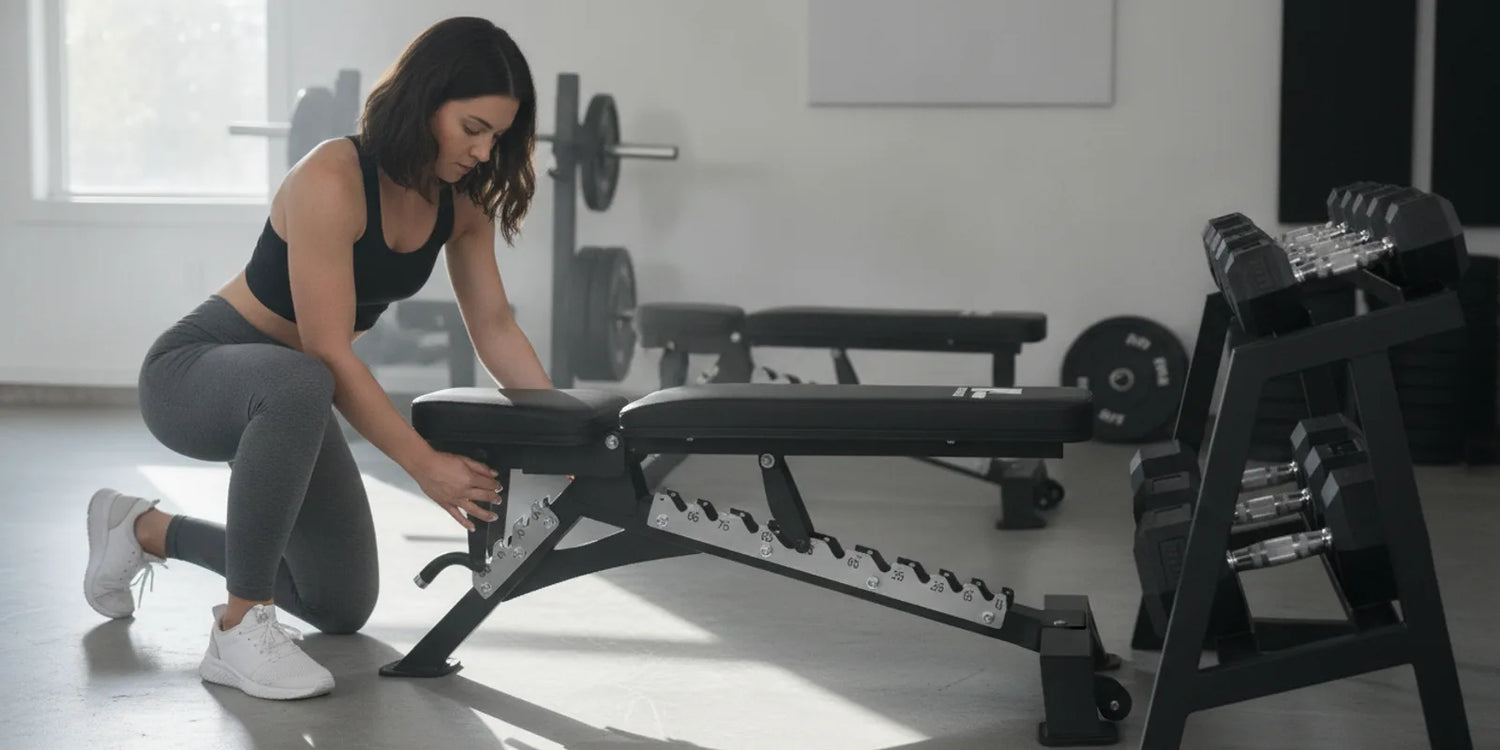
You can confirm fit by measuring the bench at its longest point when set to full incline, not just flat. The raised backrest extends the footprint, so a bench that looks compact flat may crowd a wall when angled up.
- Measure at full incline: Note the longest length with the backrest raised, then add clearance so the rear frame clears any wall.
- Plan the work zone: Leave room on both sides for dumbbells and your arms during pressing and rows.
- Look for mobility: Transport wheels and a front handle make a heavier adjustable bench easy to tuck away in a shared room.
For tight or shared spaces, a foldable model like the RitFit 1300LB adjustable bench stores upright between sessions. Pair it with the right routine from our best bench workout routines guide.
Does Bench Angle Change the Muscles You Train?
Yes, bench angle clearly changes which muscles do the most work. A study measuring EMG across five bench inclinations found that an incline around 30 degrees emphasizes the upper chest, while steeper angles shift effort toward the front deltoid.[2]
This is exactly why an adjustable bench earns its keep over a fixed flat one. You can target the mid chest at flat and the upper chest at a moderate incline without buying a second piece of equipment.
"There's a little bit of confusion around what the best angle is for the bench on an incline bench press to hit the upper chest. It's pretty conclusive. 30 degrees is a really good place for most of us. The steeper you go the more the effort gets shifted towards the front delts."
Jeff Cavaliere, MSPT, CSCS, Physical Therapist and Strength Coach, Athlean-X
To put angle work into practice, see our bench workout guide for setting up incline and flat pressing.
What Mistakes Do First-Time Bench Buyers Make?
The most common first-bench mistake is buying on weight rating alone while ignoring pad dimensions and real-world fit. A high capacity number means little if the pad is too tall, too narrow, or wobbles under load.
- Chasing capacity only: A 1,000 lb rating is meaningless if the bench rocks or the pad is uncomfortable.
- Skipping the space check: Forgetting to measure clearance at full incline leads to a bench that does not fit.
- Ignoring pad gap: A wide seat-to-back gap is annoying for flat work and unsafe on steep angles.
- Overbuying features: Leg developers and arm pads add bulk you may never use as a beginner.
Avoid these by matching the bench to your real program. If your plan centers on core and accessory moves, our bench ab workout and hamstring workouts with a home bench show what a versatile bench unlocks.
Is an Adjustable Bench Worth the Extra Cost?
For most home gym owners, an adjustable bench is worth the modest price premium over a flat bench. It does everything a flat bench does and adds incline pressing, shoulder work, and angled dumbbell movements in the same footprint.
Exercise variety also has a training rationale. A study comparing muscle activation between the barbell bench press and dumbbell flyes found different activation patterns, which supports owning a bench that enables varied pressing and angled dumbbell work.[3]
- Lower long-term cost: One adjustable bench replaces several fixed stations, so you buy less equipment overall.
- Easy upgrade path: Pair it with a rack later for a complete pressing setup without replacing the bench.
If your training is strictly flat pressing on a tight budget, a flat bench still makes sense. Otherwise, explore the adjustable options across the workout bench overview and bench workout exercises resources.
FAQs About Choosing a Workout Bench
Should a beginner buy a flat or adjustable bench?
For most beginners building a home gym, an adjustable bench is the better first purchase because it does everything a flat bench does and adds incline pressing, shoulder work, and chest-supported rows. Choose a flat bench only if you exclusively bench press and want maximum stability on a tight budget.
What weight capacity should a home workout bench have?
Look for at least a 700 lb rated capacity on an adjustable bench, which comfortably covers your bodyweight plus heavy dumbbells or a loaded barbell. Quality flat benches often exceed 1,000 lb because the simpler frame has fewer weak points. Higher gauge steel, such as 12-gauge or thicker, generally means a sturdier, less wobbly platform.
What is the ideal pad height for a workout bench?
A pad height of about 17 to 17.5 inches is ideal for bench pressing because it lets most lifters keep their feet flat for solid leg drive, while benches that sit too tall make it hard to stay stable. If you are shorter, prioritize a lower pad height so you are not reaching for the floor during your working sets.
Does the angle of an adjustable bench change which muscles work?
Yes. Research measuring EMG across several incline angles shows that around 30 degrees emphasizes the upper chest, while flat targets the mid chest and steeper angles shift effort toward the front shoulders. An adjustable bench lets you change angles to train different regions, which a fixed flat bench cannot do.
How do I know if an adjustable bench fits my space?
Measure the bench at its longest point when set to full incline, not just flat, because the backrest extends the footprint. Add clearance behind the bench so the rear frame does not hit a wall. Benches with transport wheels and a front handle are easier to tuck away in a small or shared room when you are done training.
Conclusion
Choosing your first workout bench starts with the type decision, then the four specs of capacity, pad height, pad width, and pad gap. For most beginners in limited space, an adjustable bench delivers the widest training range without crowding the room.
Measure your space at full incline, prioritize a rigid frame, then pick the model that matches your goals. A space-saving option like the RitFit Gator 1600LB adjustable bench covers most home training needs.
Disclaimer
This article is for general informational purposes only and does not replace professional fitness or medical guidance. Consult a qualified trainer or healthcare provider before starting any new training program or lifting heavy loads.
References
1. Wang L, Qiao M, Tao H, et al. A comparison of muscle activation and concomitant intermuscular coupling of antagonist muscles among bench presses with different instability degrees in untrained men. Front Physiol. 2022;13:940719. doi:10.3389/fphys.2022.940719 https://pmc.ncbi.nlm.nih.gov/articles/PMC9486837/
2. Rodriguez-Ridao D, Antequera-Vique JA, Martin-Fuentes I, Muyor JM. Effect of Five Bench Inclinations on the Electromyographic Activity of the Pectoralis Major, Anterior Deltoid, and Triceps Brachii during the Bench Press Exercise. Int J Environ Res Public Health. 2020;17(19). doi:10.3390/ijerph17197339 https://pmc.ncbi.nlm.nih.gov/articles/PMC7579505/
3. Solstad TE, Andersen V, Shaw M, Hoel EM, Vonheim A, Saeterbakken AH. A Comparison of Muscle Activation between Barbell Bench Press and Dumbbell Flyes in Resistance-Trained Males. J Sports Sci Med. 2020;19(4):645-651. https://pmc.ncbi.nlm.nih.gov/articles/PMC7675616/