








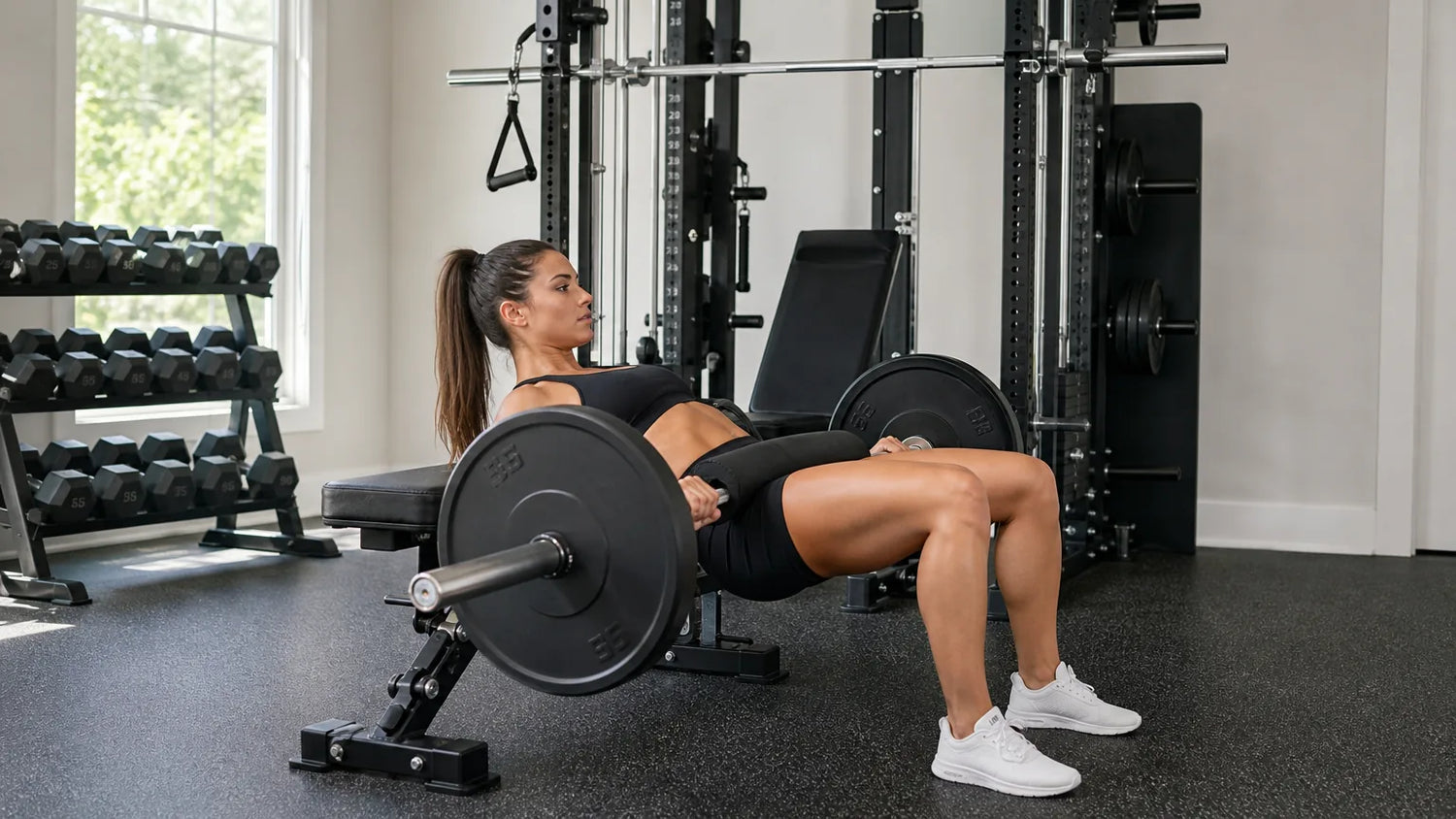
The best booty growing exercises load the gluteus maximus hard at full hip extension, where the muscle produces its greatest force, and then let you add weight over time. Hip thrusts, squats, Romanian deadlifts, step-ups, and band-resisted bridges cover the list.
This guide ranks 10 booty growing exercises and gives each one a direct verdict, compares hip thrusts, squats, and glute bridges head to head, and lists what to do instead of a back extension machine. It is written for healthy adults who train at home or in a gym and have no current injury.
Quick Answer: The best booty growing exercises are barbell hip thrusts, back squats, Romanian deadlifts, Bulgarian split squats, step-ups, and band-resisted bridges and kickbacks. Build the plan around hip thrusts for direct glute loading at full hip extension, add squats and hinges for complete development, and progress load and reps over months.
Key Takeaways
- Hip thrusts lead: The barbell hip thrust loads the glutes directly at full hip extension and is easy to overload over time.
- Squats hold their own: In one nine-week trial, hip thrusts and back squats built similar glute size, so both belong in your plan.
- Variety matters: Combine hip thrusts, squats, hinges, and single-leg work to develop all three gluteal subdivisions.
- Progress is the engine: Add reps, then load, across two to three weekly sessions to keep growth moving.
- Home works too: A bench, a barbell or dumbbells, and resistance bands can build serious glutes without a full gym.
Why does the gluteus maximus respond to hip-dominant training?
The gluteus maximus responds best to exercises that load it at full hip extension, because that is where the muscle produces peak force. Hip-dominant movements like thrusts and bridges place tension exactly where the glutes work hardest.
That does not make squats optional. In a 2023 nine-week trial, set-volume-equated hip thrust and back squat training produced similar gluteus maximus growth, while squats added more quadriceps and adductor size[2].
Three muscles make up the glutes, and each one covers a different hip action. Training all three is what separates a plan that builds size from one that only builds a pump.
- Gluteus maximus: The largest of the three, it drives hip extension and does most of the work in thrusts, squats, and hinges.
- Gluteus medius: It sits on the upper outer hip and handles abduction, so banded lateral work and single-leg movements reach it.
- Gluteus minimus: It lies beneath the medius and stabilizes the hip during single-leg stance and during walking.
- Full hip extension: Thrusts and bridges peak tension at lockout, directly targeting the glutes.
- Deep hip flexion: Squats stretch and load the glutes at the bottom, complementing thrust work.
- Hip hinge: Romanian deadlifts train the glutes and hamstrings through a long eccentric.
For a balanced lower body, pair glute work with dedicated leg exercises so the quads and hamstrings keep pace. Loaded hip extension is best performed with barbells once bodyweight becomes easy.
What are the best booty growing exercises?
The best booty growing exercises fall into three roles, primary builders, secondary compounds, and accessories. A systematic review of the barbell hip thrust reported high gluteal muscle activation and strong performance carryover relative to other hip-extension exercises[1].
Every entry below states plainly whether the movement builds glutes on its own or only when you load and progress it.
Barbell Hip Thrust (primary builder)
The barbell hip thrust earns a clear yes, because it loads the glute at full hip extension and is the easiest movement on this list to overload month after month. Set your upper back on a bench, drive through the heels, and squeeze hard at the top.
A dedicated RitFit 2-in-1 hip thrust attachment makes heavy loading stable and comfortable on the hips.
Back Squat
Back squats build the glutes by loading them under deep hip flexion while also driving quad and adductor growth. Yes, they work, but only when you reach full depth and drive the hips back instead of turning the lift into a quad-dominant half squat.
Front Squat
Front squats keep the torso more upright and shift load onto the quads, so they build glutes less than back squats do. Treat them as a squat variation for quad development and as a useful swap on days when your lower back needs a break.
Romanian Deadlift
The Romanian deadlift trains the glutes and hamstrings through a long, controlled eccentric hip hinge, and it builds glutes reliably as long as you load it. Keep a soft knee bend and push the hips back until you feel a hamstring stretch.
Bulgarian Split Squat
The Bulgarian split squat loads one leg at a time, exposing and correcting side-to-side differences in glute strength, and a slight forward torso lean shifts more work onto the glutes. It is one of the strongest glute builders here for the amount of weight it takes.
Step-Up
Step-ups build glutes when you set the box at knee height and drive through the whole foot instead of pushing off the back leg. Yes, they grow glutes, and they give you a loaded hip extension option when you own dumbbells but no barbell.
Glute Bridge
Glute bridges teach the top-end squeeze that powers heavier thrusts and work well as a warm-up or high-rep finisher. They build glutes only while they stay hard, so add a band or a single-leg variation once 20 clean reps feel easy.
Band-Resisted Glute Bridge
Adding a band around the knees increases gluteus medius involvement, which makes the banded bridge a strong accessory rather than a replacement for loaded thrusts. The verdict is yes for the upper and side glutes, and no for the heavy loading the maximus needs.
Cable and Band Kickbacks
Kickbacks isolate the glutes at end range and work best after your main compound lifts rather than in place of them. They build the upper glutes with a hard squeeze, but the load is too light to drive most of your growth on its own.
Banded and Cable Hip Abduction
Hip abduction targets the upper and side portions of the glutes, the areas the big compounds cover least. Yes, it builds glutes, and it is the single best addition if your goal is a rounder upper glute shelf.
"Super easy setup! Only modification was a bigger carabiner to make my cable fit, which I had on hand from the lat pulldown attachments. So pretty!"
Jeanetria W. Verified Buyer, RitFit Panther Home Hip Abductor and Adductor Machine
How should you program sets, reps, and load?
Program glute growth around two to three weekly sessions using moderate reps and steady progression. A 2025 systematic review and meta-analysis found that resistance training reliably drives gluteus maximus hypertrophy when volume and load progress over time[3].
- Compound lifts: Perform 3 sets of 8 to 12 reps on hip thrusts, squats, and Romanian deadlifts.
- Accessories: Use 2 to 3 sets of 10 to 20 reps for bridges, kickbacks, and abduction.
- Weekly volume: Aim for roughly 10 to 20 hard sets per week for the glutes, split across sessions.
- Load selection: Choose a weight that leaves 1 to 2 reps in reserve on your last working set.
A six-week block is the simplest way to organize that progression without changing exercises. Run weeks one and two at 3 sets of 10 reps, weeks three and four at 3 sets of 12, and weeks five and six at 4 sets of 8 to 10 with a small load increase.
Rest at least a day between heavy hip thrust or squat days so the muscle can recover. Consistency over months matters far more than any single perfect workout.
Can you grow your glutes at home with bands and a bench?
Yes, you can grow your glutes at home with a sturdy bench, a barbell or dumbbells, and resistance bands. These tools cover hip thrusts, bridges, split squats, and banded kickbacks, which is enough for full development.
- Bench work: Set up barbell or dumbbell hip thrusts and single-leg variations on a stable weight bench.
- Band work: Use resistance bands for kickbacks, lateral walks, and knee-banded bridges.
- Progression at home: Add reps, then slow the tempo, then add external load as movements get easy.
Effort and steady overload drive growth far more than the equipment itself. Core stability also helps under heavy loads, so include simple core exercises in your week.
If bands are all you own, three variations still load the glutes hard enough to progress. Pair them with the setups in this resistance band exercise guide when you want more options.
- Banded frog pumps: Lie on your back with the soles of the feet together and drive the hips up against a band looped above the knees.
- Lateral band walks: Keep constant tension on the band with short side steps to train the gluteus medius.
- Band hip thrust: Loop a band over the hips and anchor it under the feet when no barbell is available.
"In general, I feel that the hip thrust is the best glute exercise in existence. However, there are occasional lifters who don't seem to get as much tension in the glutes as others during the hip thrust. While I feel that this can be overcome in time with deliberate practice, it's always good to employ a variety of glute exercises to ensure full activation of the array of fibers for all three gluteus maximus subdivisions."
Bret Contreras, PhD, PhD in Sports Science known as The Glute Guy, Contreras Strength Institute
What common mistakes stall glute growth?
The most common mistake that stalls glute growth is never adding load or reps, so the muscle has no reason to adapt. Sloppy form and too little glute-specific work follow close behind.
- No progression: Using the same weight for months removes the stimulus for growth.
- Half range of motion: Cutting the hip thrust or squat short skips the most productive part of the lift.
- Quad-only squatting: Failing to drive the hips back and squeeze at the top leaves the glutes underworked.
- Only isolation: Relying on kickbacks alone without heavy compounds limits total growth.
Fix these by filming your sets, focusing on a full lockout squeeze, and logging your loads. Complementary pulling work such as back exercises with dumbbells supports a strong, balanced posterior chain.
When should you add weight and when should you stop?
Add weight when you can complete all planned reps with clean form and 1 to 2 reps still in reserve on your top set. Stop or lighten the load the moment you feel sharp joint pain rather than muscular effort.
- Add load when: You hit the top of your rep range for two sessions in a row with solid technique.
- Increment size: Jump by small amounts, often 5 to 10 pounds on compound lifts, to protect form.
- Stop when: You feel pinching in the lower back or knees, or form breaks down under fatigue.
Muscular burn and general fatigue are normal, sharp or localized joint pain is not. For extra core support during heavy work, add ab roller exercises and gentle exercise ball exercises.
Hip thrusts vs squats vs glute bridges: which builds more glutes?
Hip thrusts and back squats build glutes about equally well, so both belong in your plan. Glute bridges are a lighter version of the hip thrust rather than a separate competitor.
| Matchup | Verdict for glutes | Why |
|---|---|---|
| Hip thrusts vs glute bridges | Hip thrusts | Both peak at lockout, but only the hip thrust lets you load hundreds of pounds through the hips with a stable setup. |
| Hip thrusts vs back squats | Tie | Equated-volume training produced similar gluteus maximus growth in a nine-week trial, while squats added more quad and adductor size. |
| Step-ups vs Bulgarian split squats | Bulgarian split squats | The split squat holds a longer stretch under load, which makes it easier to progress with dumbbells. |
| Hip thrusts vs Romanian deadlifts | Both | Thrusts load the shortened position at lockout, while the Romanian deadlift loads the lengthened position at the bottom. |
| Glute bridges vs banded bridges | Banded bridges for the upper glutes | The band adds abduction, which recruits the gluteus medius, but it does not replace heavy loading for the maximus. |
Verdicts describe where each movement loads the glutes and how easily it can be progressed, not a measured head-to-head study for every pairing.
Run hip thrusts first when glute growth is the priority, then squat later in the week when the goal is total lower-body strength. Single-leg work such as the Bulgarian split squat fits either day as a finisher.
Which other exercises actually build glutes?
Lunges, split squats, and leg press build glutes when you load them, while wall sits, fire hydrants, and clamshells train endurance more than size. The table below gives a direct verdict for the movements people ask about most.
| Movement | Does it build glutes? | What it actually does |
|---|---|---|
| Walking lunges and reverse lunges | Yes | They load hip extension one leg at a time, and the reverse lunge keeps more tension on the glutes than the forward version. |
| Split squats | Yes | Same single-leg loading pattern as the Bulgarian split squat, with less balance demand when the rear foot stays on the floor. |
| Kettlebell swings | Partially | The hip snap trains glute power, but the light load and short range make it a conditioning tool, not a growth driver. |
| Wall sits | Barely | An isometric quad hold with the hips flexed, so the glutes stay close to their shortest and weakest position. |
| Fire hydrants | Partially | Hip abduction against bodyweight or a band, which reaches the medius but rarely loads the maximus enough to grow it. |
| B-stance Romanian deadlifts | Yes | A hip hinge with most of the load on one leg, useful for correcting a side that lags behind. |
| Leg press | Partially | Feet placed high on the platform add hip extension, but the glutes stay shortened, so it supports rather than drives growth. |
| Hack squat | Partially | A machine squat that loads the quads hardest, with the glutes contributing at depth. |
| Leg curl machine | No | Knee flexion trains the hamstrings, a different joint action from hip extension, so it does not build the glutes directly. |
| Stairmaster and stair climbing | Partially | Hundreds of low-resistance steps train glute endurance, which supports growth without driving it. |
| Incline walking and walking uphill | Partially | The same story as stairs at a lower intensity, useful for conditioning and easy on the joints. |
| Cycling | No | It builds quad and cardiovascular fitness, and the glutes contribute too little at typical resistance to change size. |
Verdicts reflect the joint action and loading position of each movement rather than a single measured trial.
Machine work earns a place when you train alone, since a leg machine lets you push close to failure without a spotter. Keep squats, hinges, and thrusts as the main glute builders and use machines and cardio as accessories.
What can you do instead of back extensions or hip thrusts?
Romanian deadlifts, cable pull-throughs, and reverse hyperextensions replace back extensions for glute training, while single-leg bridges and banded hip thrusts stand in for barbell hip thrusts. Any of them works as long as you can add load over time.
If you do not have a back extension bench
A 45-degree back extension is a hip hinge with a fixed torso, so a Romanian deadlift or a cable pull-through trains the same hip extension pattern without the machine.
If you do not have a way to load hip thrusts
Single-leg glute bridges, a banded hip thrust, and a dumbbell hip thrust all keep the same joint action at home, with the single-leg version replacing load with leverage.
If the hip thrust hurts your hips or lower back
Swap to a glute bridge with the feet slightly further from the body, and keep the ribs down so the lower back does not take over the movement.
A machine squat such as a RitFit 3-in-1 leg press and hack squat machine is another substitute when free-weight hip thrusts or squats are not an option, since the back stays supported through the whole rep.
FAQs About Booty Growing Exercises
What is the single best exercise for growing glutes?
The barbell hip thrust is widely regarded as the top glute builder because it loads the muscle hard at full hip extension, where the gluteus maximus works hardest, and it is easy to overload progressively. Pairing it with squats, Romanian deadlifts, and band work gives the fullest development across all three gluteal subdivisions.
Are squats or hip thrusts better for building glutes?
In a 2023 nine-week trial, hip thrusts and back squats produced similar gluteus maximus growth, so both are effective, though squats also drove more quadriceps and adductor growth. For the best results, include both in your program rather than choosing only one.
How often should I train glutes to grow them?
Most people grow well training glutes two to three times per week, spreading roughly ten to twenty hard sets across the week with at least a day between heavy hip thrust or squat sessions. Consistency and gradually adding load over months matter more than any single session.
Can I grow my glutes at home without a gym?
Yes. A sturdy bench, a barbell or dumbbells, and a set of resistance bands are enough to run hip thrusts, glute bridges, split squats, and banded kickbacks at home, and you progress by adding reps, slowing the tempo, then adding external load over time.
How long does it take to see glute growth?
Visible glute growth usually takes several months of consistent, progressive training rather than weeks, since early strength gains come fast but new muscle size develops gradually. Focus on adding load and reps across two to three weekly sessions, eat enough protein, and stay patient.
Can you grow glutes without hip thrusts?
Yes, you can grow glutes without hip thrusts. Romanian deadlifts, Bulgarian split squats, step-ups, and banded bridges all load hip extension hard enough to drive growth when you add reps and weight over time. Hip thrusts simply make that loading easier to progress because the setup lets you use the heaviest weight.
Does the stairmaster, walking, or cycling build glutes?
Stairmaster climbing, incline walking, and cycling build glutes only as a supporting stimulus. They load hip extension through hundreds of low-resistance steps, which trains endurance more than size. Use them for conditioning and keep squats, hinges, and thrusts as the main drivers of glute growth.
What can I use instead of a back extension machine?
Yes, several options replace a back extension machine. A Romanian deadlift and a cable pull-through train the same hip hinge with free weights, a reverse hyperextension targets the glutes and lower back directly, and a glute bridge works when you have nothing but floor space.
How many hip thrusts should I do to grow glutes?
Use a load that leaves one or two reps in reserve and run three to four sets of 8 to 12 reps, two or three times per week. The exact number matters less than adding reps or weight in the following weeks, so a set of 10 that becomes a set of 14 next month is real progress.
Conclusion
The best booty growing exercises combine hip thrusts for direct loading, squats and Romanian deadlifts for full development, and band accessories for end-range work. Train the glutes two to three times weekly and add load steadily as your form allows.
Start with movements you can control, log your progress, and progress patiently over months. For more physique-focused training, explore our guide to exercises for your waistline, and check the RitFit discount guide before you order anything for your home setup.
Disclaimer
This article is for general educational purposes only and does not replace personalized coaching or medical advice. Consult a qualified professional before starting a new training program, especially if you have any existing injury or health condition.
Save on your next RitFit order
Tap the button to copy your code, then paste it at checkout.
References
1. Neto WK, Vieira TL, Gama EF. Barbell hip thrust, muscular activation and performance: a systematic review. J Sports Sci Med. 2019;18(2):198-206. PMC6544005.
2. Plotkin DL, Rodas MA, Vigotsky AD, et al. Hip thrust and back squat training elicit similar gluteus muscle hypertrophy and transfer similarly to the deadlift. Front Physiol. 2023;14:1279170. doi:10.3389/fphys.2023.1279170. PMC10593473.
3. Krause Neto W, Krause TLV, Gama EF. The impact of resistance training on gluteus maximus hypertrophy: a systematic review and meta-analysis. Front Physiol. 2025;16:1542334. doi:10.3389/fphys.2025.1542334. PMC12018462.





