








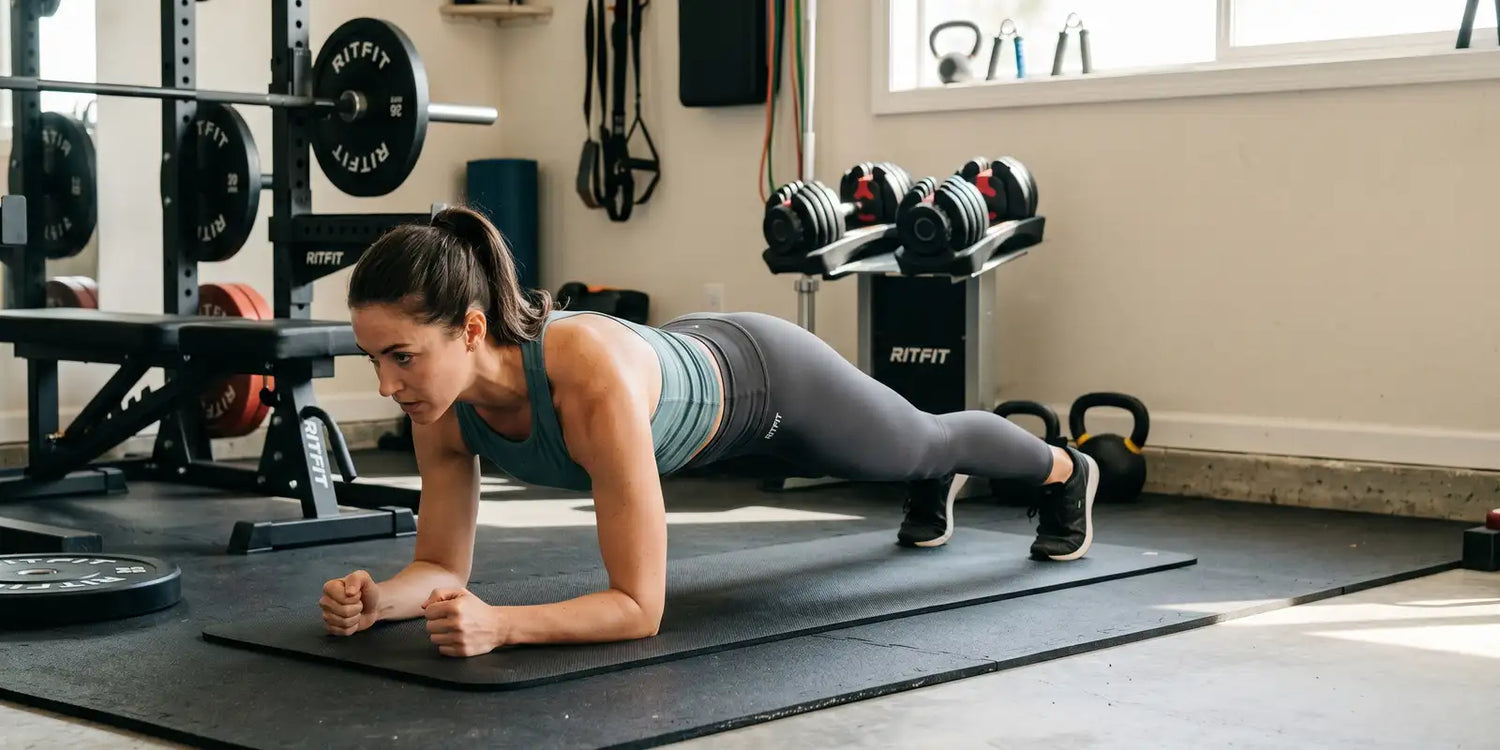
Your stomach muscles protect your lower back, steady your posture, and make everyday movement feel lighter. This guide covers the best exercises for your stomach you can do at home with no equipment.
You will learn which moves train the rectus abdominis, obliques, and deep transverse abdominis, and why exercise alone cannot flatten your belly. These are general fitness tips for healthy adults, so check with your healthcare provider first if you are pregnant or recovering from an injury.
Quick Answer: The best exercises for your stomach combine plank variations, bicycle crunches, dead bugs, and leg raises so you train the rectus abdominis, obliques, and deep transverse abdominis together. Do these moves two to three times per week with good form, and pair them with a balanced diet for visible results.
Key Takeaways
- Train all three layers: Effective stomach training works the rectus abdominis, obliques, and deep transverse abdominis, not just the surface six-pack muscle.
- Spot reduction is a myth: Exercise builds and tones abdominal muscle, but belly fat loss depends on overall calorie balance and total activity.
- Planks outperform crunches alone: Isometric moves like planks build endurance and protect your lower back better than crunches on their own.
- Frequency beats daily volume: Two to three weekly sessions with rest days let your core recover and adapt.
- Form over speed: Bracing your core and moving with control prevent neck strain and hip flexor dominance.
What Muscles Make Up Your Stomach?
Your stomach is built from three main layers, the rectus abdominis, the obliques, and the deep transverse abdominis. Each layer controls a different job, from bending you forward to stabilizing your spine and organs.
- Rectus abdominis: The vertical six-pack muscle that bends your torso forward and toward your hips.
- External and internal obliques: The diagonal muscles on your sides that handle rotation and side bending.
- Transverse abdominis: The deepest layer that wraps around your torso like a corset and stabilizes your spine during movement.
Training all three layers is what separates a strong core from a flat set of crunches. If you want to slim and shape the whole midsection, pair this guide with our exercises for your waistline and our complete guide on how to tone your stomach.
Can Exercises Alone Flatten Your Stomach?
No, exercises alone cannot flatten your stomach because you cannot spot reduce fat from one area of your body. Ab exercises strengthen and build the muscle underneath, but a visibly flat stomach also depends on total calorie balance, sleep, and stress.
- Muscle versus fat: Core work makes the abdominal muscles firmer, and they become more visible once overall body fat drops.
- The energy balance factor: A sustained calorie deficit from food and total activity is what drives belly fat loss.
- What actually works: Combine consistent core training with a balanced diet and regular full-body movement.
The same principle applies to the whole midsection. See our breakdown of the best exercise to flatten your stomach and how to target stubborn best exercises for love handles.
"While you can't spot reduce love handle fat, doing obliques exercises will help you tone the sides of your abs so that once you've reduced fat in that area, the oblique muscles will show."
Jeff Cavaliere, MSPT, CSCS, Physical Therapist and Strength Coach, former Head Physical Therapist for the NY Mets, How To Get Rid of Love Handles, Athlean-X
What Are the 8 Best Exercises for Your Stomach?
The best exercises for your stomach are the plank, bicycle crunch, dead bug, leg raise, side plank, bird dog, mountain climber, and abdominal roll-out. These moves train every core layer while protecting your lower back, and a peer-reviewed EMG comparison found that prone and side position exercises produce greater abdominal activity than crunches and bent-knee sit-ups [1].
- Plank: Hold 20-60 seconds. Keep your body in a straight line from head to heels with your core braced.
- Bicycle crunch: Do 3 sets of 10-15 per side. Rotate your opposite elbow to your knee while extending the other leg.
- Dead bug: Do 3 sets of 8-10 per side. Press your lower back into the floor as you lower your opposite arm and leg.
- Leg raise: Do 3 sets of 10-15. Keep your lower back pinned down as you raise and lower straight legs.
- Side plank: Hold 20-40 seconds per side. Stack your feet and hips while lifting your hips off the floor.
- Bird dog: Do 3 sets of 8-10 per side. Extend your opposite arm and leg while keeping your hips level.
- Mountain climber: Do 3 sets of 30 seconds. Drive your knees toward your chest from a plank position.
- Abdominal roll-out: Do 3 sets of 8-12. Roll forward with your ab wheel while keeping your core braced and your back flat. One EMG comparison found the ab roller produces activation similar to conventional trunk curls [2].
For more on this move, read our ab roller exercises guide. To progress these moves with added resistance, use an adjustable bench for weighted crunches on the RitFit 1300LB Adjustable Weight Bench, or set up cable crunches on a cable machine.
What Is a Good Beginner Stomach Workout at Home?
A simple beginner stomach workout at home combines one plank, one rotation move, and one deep core move performed in a circuit. Run the circuit below two to three times a week with rest days between sessions.
- Warm-up: Do 5 minutes of light marching or arm swings to raise your heart rate.
- Circuit, 2 rounds: 30-second plank, 12 bicycle crunches per side, 10 dead bugs per side, 12 leg raises, and a 30-second side plank on each side.
- Rest and cool-down: Rest 45-60 seconds between rounds, then finish with a 2-minute gentle stretch.
This routine works for most healthy adults and can be scaled down to seated or modified versions when needed, similar to our exercises for elderly guide. For a longer guided session, follow along with the 10-minute beginner workout below.
How Do You Engage Your Core Correctly?
Engage your core by bracing your abdominal muscles as if preparing for a light cough, not by sucking your stomach in. Keep breathing normally and stack your ribs over your hips so the target muscles do the work, and one study found this bracing technique produces high activation in the deep internal oblique [3].
- Brace, don't hollow: Squeeze gently as if bracing for a light cough, and keep your spine neutral.
- Keep breathing: A common mistake is holding your breath, so inhale and exhale naturally through each rep.
- Protect your lower back: Press your lower back toward the floor in floor moves and keep your pelvis neutral in planks.
How Many Sets, Reps, and Days Should You Train?
Train your stomach two to three times per week with 2-3 sets of 10-15 reps for most moves and planks held 20-60 seconds. This volume builds strength while giving your core enough recovery, and research on resistance-based core training found that adding load increases abdominal muscle activity [4].
- Frequency: Do 2-3 sessions weekly, and skip daily intense ab work because it slows recovery.
- Sets and reps: Aim for 2-3 sets of 10-15 reps for dynamic moves and 20-60 second holds for planks.
- Rest between sessions: Take at least one rest day between hard core sessions so the muscles can adapt.
- Progress over time: Add resistance or slow the tempo once you can finish every rep with clean form.
If you want to keep building strength across your whole body, our leg exercises guide pairs well with a balanced core routine.
What Common Mistakes Slow Down Stomach Training?
The most common mistakes are pulling on your neck, letting your hip flexors take over, and rushing reps with momentum. These habits reduce core activation and can strain your lower back.
- Neck strain: Avoid yanking your head forward during crunches, and keep your chin tucked with your hands loose.
- Hip flexor dominance: If your lower back arches during leg raises, bend your knees until your abs can hold your pelvis steady.
- Momentum and speed: Slow, controlled reps activate the core more than fast, swinging reps.
- Skipping the deep core: Many people train only the front rectus abdominis and ignore the obliques and transverse abdominis.
Fix these patterns early and results come faster. For related midline work, see our wobble board exercises for balance training.
FAQs About Exercises for Your Stomach
What are the best exercises for your stomach?
Some of the best exercises for your stomach include planks, dead bugs, bicycle crunches, leg raises, and side planks. These moves train the rectus abdominis, obliques, and deep transverse abdominis together. For best results, combine front, side, and deep core movements rather than relying on crunches alone, and progress slowly with good form.
Can exercises alone give me a flat stomach?
Exercises strengthen, build, and tone your abdominal muscles, but they cannot spot reduce fat from your belly. A visibly flatter stomach also depends on overall body composition, which is influenced by total calorie balance, sleep, and stress. Combine consistent core training with a balanced diet and regular activity for the most noticeable changes.
How often should I do stomach exercises?
For most beginners, training the stomach two to three times per week is enough to build strength while allowing the muscles to recover. Research on core programs commonly uses two to three sessions weekly over six to eight weeks. Daily intense ab work is unnecessary, and rest days actually help your core muscles adapt and grow stronger.
How do I properly engage my core during exercises?
Engage your core by gently bracing your abdominal muscles as if preparing for a light cough, rather than sucking your stomach in. Keep breathing normally and stack your ribs over your hips to protect your lower back. This bracing keeps the spine stable and ensures the target muscles, not your neck or hip flexors, do the work.
Are crunches enough for a strong stomach?
Crunches mainly target the upper rectus abdominis and are a useful starting move, but they are not enough on their own. A strong, stable stomach needs planks for full core endurance, side planks for the obliques, and exercises like dead bugs and bird dogs for the deep stabilizing muscles. Variety builds balanced core strength and better posture.
Conclusion
The best exercises for your stomach are simple to learn and easy to do at home, and moves like planks, bicycle crunches, dead bugs, and leg raises train every layer of your core. Train two to three times per week with proper bracing and stay patient, because visible results come from consistent effort and a balanced diet.
Start with the beginner workout above, add resistance as you get stronger, and track your progress across a few weeks. For more guidance, explore our fitness guides or browse our latest equipment offers.
Disclaimer
This article provides general fitness information and is not a substitute for professional medical advice, diagnosis, or treatment. Always consult a qualified healthcare provider before starting a new exercise program, especially if you are pregnant, have a medical condition, or are recovering from an injury.
References
1. Escamilla RF, Lewis C, Pecson A, Imamura R, Andrews JR. Muscle Activation Among Supine, Prone, and Side Position Exercises With and Without a Swiss Ball. Sports Health. 2016;8(4):372-9. PMCID: PMC4922527
2. Hildenbrand K, Noble L. Abdominal Muscle Activity While Performing Trunk-Flexion Exercises Using the Ab Roller, ABslide, FitBall, and Conventionally Performed Trunk Curls. J Athl Train. 2004;39(1):37-43. PMCID: PMC385260
3. Maeo S, Takahashi T, Takai Y, Kanehisa H. Trunk muscle activities during abdominal bracing: comparison among muscles and exercises. J Sports Sci Med. 2013;12(3):467-74. PMCID: PMC3772590
4. Kim HJ, Sung JH, Ryu JK, Jung HC, Wang J. Effect of Reformer Spring Resistance Modifications on Core Muscle Activity During Basic Core Muscle Exercises. Healthcare (Basel). 2024;12(23). PMCID: PMC11641042





