








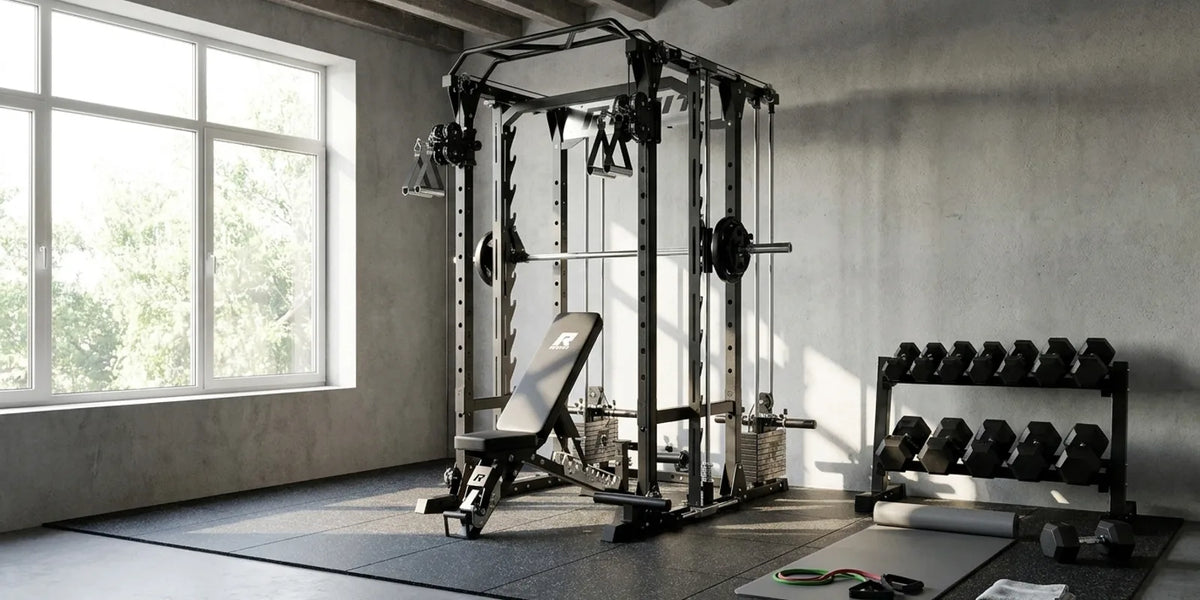
The best power rack for CrossFit athletes at home is the one frame that can take barbell work, pull-ups and accessory volume without a coach or a spotter standing over you. In 2026, the RitFit P9 is built to cover all three jobs on a single footprint.
This guide breaks down what CrossFit style programming asks of a home rack, which movements the P9 handles, how it compares with the cheaper RitFit P3 and the M2, and the floor space and ceiling clearance to check before you order.
Quick Answer: The best power rack for CrossFit athletes at home keeps the interior open, adds adjustable safety arms and lets you control the bar path. The RitFit P9 adds a 3D Smith bar with 20.7 inches of horizontal travel, a 198 lb integrated stack and switchable cable ratios, so one frame covers squats, presses, pull-ups and cable work.
Key Takeaways
- Space comes first: RitFit publishes a 19.8 sq ft footprint and over 100 cubic feet of in-rack training room for the P9, so measure your floor and ceiling before you order.
- One frame, four jobs: The 3D Smith bar adds 20.7 inches of horizontal travel and six locking positions, while the cable system runs at 1:1 or 2:1 depending on the movement.
- Budget split: The RitFit P3 covers barbell strength and cable accessory work at $689.99, while the P9 adds the 3D Smith bar and a 198 lb integrated stack at $1999.99.
- Solo training changes the list: With no spotter at home, safety arms and a bar path you can control matter more than they do in a coached box.
- Upgrade on the same frame: J-hooks, a pulley set and a hip thrust attachment all mount to the rack, so the build can grow as your programming changes.
What CrossFit Athletes Actually Need From a Home Rack
Home CrossFit training needs one frame that can take barbell work, pull-ups and accessory volume without a coach or a spotter nearby. Regular CrossFit training raises VO2max, strength and endurance and improves body composition such as lean body mass, and the injury profile sits alongside Olympic weightlifting, powerlifting and gymnastics rather than contact sports, with shoulder and spine injuries the most common and well educated coaching linked to a lower injury rate.[1]
- An open interior: Plates and limbs need room to travel, and a missed rep needs somewhere safe to go.
- Adjustable safety arms: Solo sessions need a catch height set for the lift you are doing, not for the lift before it.
- A bar path you control: Movements where your body travels, such as lunges and hip thrusts, fight a bar that only moves straight up and down.
- Pull-up capacity: Strict pull-ups, kipping sets and hanging holds all live on the same frame as your squats.
- Cable accessory volume: Face pulls, lat pulldowns and single arm rows keep shoulder and back work in the program when the barbell is already loaded.
The training evidence behind the sport is still thin, which is worth knowing before you spend on equipment for a discipline whose studies are catching up. A 2018 systematic review and meta-analysis of 31 articles found that only two reviewed studies reached a high level of evidence at low risk of bias and reported no significant meta-analytic result for any variable.[2]
Uncertain evidence is an argument for flexibility at home rather than one locked path. If you are still sorting out the vocabulary, this explanation of power cage vs power rack settles it, and this walkthrough of how to do CrossFit workouts at home covers the training side.
Why the RitFit P9 Fits CrossFit Training at Home
The RitFit P9 fits CrossFit training at home because its 3D Smith bar moves in two directions instead of locking you into one fixed path. That freedom keeps more of the movement menu available on a single frame.
The 3D Smith Bar Adds Horizontal Travel Instead of Locking You In
A fixed Smith machine only travels vertically, which is why lunges and hip thrusts feel wrong on it. RitFit lists 20.7 inches of horizontal travel and a 13 inch starting height for the P9 bar, along with six locking positions when you want the bar to stay put.
Switching Between 1:1 and 2:1 Cable Ratios Inside a Workout
The cable ratio decides how heavy the stack feels and how far the handle travels, so 1:1 suits heavy low rows while 2:1 suits long range, faster accessory work. Per RitFit's published specifications, the P9 moves between 1:1 and 2:1 without a rebuild.
Aluminum Pulleys and Linear Bearings Under High Rep Fatigue
Aluminum pulleys and precision linear bearings are the parts that decide whether the carriage still runs clean late in a conditioning piece. RitFit lists both on the P9, and verified buyers describe how the cable system feels in daily training.
Shoulder and spine positions are the usual trouble spots in this style of training, which is one reason to keep free weight positions open instead of running every lift on a fixed path. The RitFit P9 Multi-Functional Modular Power Cage keeps a 198 lb steel stack, nine plates per side, safety arms and a pull-up station on one 19.8 sq ft frame.
"really love this power cage with smith machine attachment. The installation is straightforward actually it is part of the fun. The bar, the grip are solid, smith machine part moves very smooth. The cage is pretty sturdy for the price paid. Highly recommend for home gym!"
Xin F. Verified Buyer, RitFit 1000lbs Power Cage
"You only need a power rack, barbell, bench and (ideally) some dumbbells to run this program. You could replace the bench work in this program with dips, dumbbell press, smith-machine press or machine chest press."
Jeff Nippard, Science-Based Natural Bodybuilder and Powerlifter, JeffNippard.com, Powerbuilding Phase 2.0
CrossFit Movements You Can Run on One P9 Frame
One P9 frame covers barbell strength work, gymnastics movements and cable accessory work once the right attachments are mounted. Third party reviewers at Garage Gym Reviews reported that the carriage on the RitFit power cage they tested starts at 2 pounds per side, which suits light rehab and prehab work.
- Back squat and front squat: Set the safety arms just below your bottom position so a missed rep lands on steel rather than on you.
- Bench press and overhead press: The same arms double as uprights for pressing inside the frame.
- Barbell rows and pulling work: Pairs with a bar you can load from the floor, and this guide to the best CrossFit barbell for a home gym covers which bar suits which lifts.
- Pull-ups and hanging work: The integrated pull-up station carries strict sets, kipping sets and hanging holds.
- Cable face pulls and lat pulldowns: The 198 lb stack covers shoulder health work and lat volume without loading a bar.
- Hip thrusts and accessory isolation: The RitFit 2-in-1 Hip Thrust and Bicep Curl Attachment adds a dedicated station for both.
- Bar height changes between sets: The RitFit Upgraded J-Hook Attachment resets the bar position without a wrench.
"Power cage The cage makes working out alone safer. The cable system for pull downs and rows works very well. Plus the built in pull up bars, that is an excellent feature. All in all this system is very much worth the money. Product exceeds the price in my book"
John, Verified Buyer, RitFit 1000lbs Power Cage
P3 vs P9 vs M2: Which RitFit Frame Fits Your Home CrossFit Setup
The RitFit P3, P9 and M2 all replace several machines with one footprint. The P3 suits athletes whose training is mostly barbell strength and who already own a cable solution, while the P9 covers barbell, cable and pull-up work on one frame and the M2 adds cable crossover arms and a configurable carriage.
| RitFit model | Listed price | What you get | Best for |
|---|---|---|---|
| RitFit P3 Power Cage 1200lbs | $689.99 | 2 x 2 inch 14 gauge steel, 1200 lb static load, 21 aluminum pulleys, 2:1 cable ratio, multi grip pull-up bar, 17.5 sq ft footprint | Barbell first garage builds |
| RitFit P9 Power Cage | $1999.99 | 3D Smith bar with 20.7 inches of horizontal travel and a 13 inch start height, six locking positions, 198 lb steel stack, aluminum pulleys and linear bearings, 19.8 sq ft footprint | One frame for every modality |
| RitFit M2 Multi-Functional Home Gym | $2199.99 | Configurable carriage, 3D Smith work, weight stack options, 16 height options, cable crossover and pull-up station | Home boxes that want crossover work |
Prices and specifications as listed on RitFit product pages in 2026.
Budget First Garage Builds
The RitFit P3 Power Cage 1200lbs with Smooth Cable System is the right call when barbell strength is the whole program and cable work is a bonus. It carries a 1200 lb static load rating and a 2:1 cable ratio at a fraction of the P9 price, and the RitFit P3 Power Cage 1200lbs Home Gym Package adds the plates and bar in one order.
Full Modality Home Boxes
The RitFit M2 Multi-Functional Modular Home Gym Smith Machine trades the P9 cable stack for a configurable carriage with 16 height options and cable crossover arms. Pick the P9 when switchable cable ratios and one integrated stack matter most, and the M2 when crossover angles and carriage travel matter most.
If you are weighing the two power cages, this RitFit P3 vs P9 home gym comparison works through the same specifications line by line, and the full RitFit power rack packages range shows what ships in each bundle.
"Absolutely love my RitFit M2 PRO 3D SERIES Multi-Functional Modular Home Gym Package. It's an all-in-one setup and allows a full-body workout experience in the comfort of your home."
Ethan J. Verified Buyer, RitFit M2 SERIES Multi-Functional Modular Home Gym Package
Is the RitFit P9 Worth It for a Home CrossFit Gym?
The RitFit P9 is worth the price if you would otherwise buy two or three separate pieces to cover barbell, cable and pull-up work. A 2023 systematic review of 12 studies reports CrossFit sessions lasting 30 to 60 minutes with cardiovascular load rising toward maximal effort, so the equipment you buy has to hold up to heavy strength sets and long conditioning blocks in the same week.[3]
- Buy the P9 if: you want squats, presses, pull-ups and cable work on one 19.8 sq ft footprint and would otherwise add a separate cable machine.
- Buy the P3 if: your training is mostly barbell strength, you already own a cable solution, and $689.99 fits the budget better than $1999.99.
- Buy the P9 package if: you want the same frame plus the bundled configuration in a single order at $2199.99.
- Skip both if: you do barbell work at a commercial gym and only need a bench and dumbbells at home.
As listed on RitFit product pages, the P9 is $1999.99, the P9 Power Cage Package is $2199.99, and the P3 is $689.99, so the gap is worth measuring against how many machines you would otherwise buy. If budget decides it, this roundup of the best power cage under $2000 shows what the next tier down still delivers.
"Fair price, fast shipping, easy to assemble, all parts in perfect condition. Very happy with my home gym."
David P. Verified Buyer, RitFit 1000lbs Power Cage
Will a RitFit P9 Fit Your Garage and Ceiling Height?
The RitFit P9 asks for a published 19.8 square foot footprint and a ceiling high enough to press overhead inside the frame. Measure both before you order, because the published figure covers the rack itself rather than your lifting zone.
- Measure the floor: RitFit publishes a 19.8 square foot footprint for the frame alone, so add clearance on both sides for loading plates.
- Measure the ceiling: Check the height you need for an overhead press inside the rack plus the bar, and account for a garage door track or a light fixture in the way.
- Use the volume, not just the footprint: RitFit lists over 100 cubic feet of in-rack training room, so the frame gives you room to move rather than just room to stand.
- Check the floor loading: A loaded bar, a 198 lb steel stack and your own body weight all land on the same few square feet of concrete.
Garage and basement builds benefit most from the switchable cable ratios, because a low ceiling rules out overhead barbell work on some days while cable movements still fit the same space. Verified buyers report the frame fits small spaces well, and the measurement pass above is what keeps that true in your gym.
"Awesome setup here. Love the attachments and ease of moving between exercises. Heavy duty and easy to put together. Fits in small spaces well"
Tony M. Verified Buyer, RitFit 1000lbs Power Cage
What It Costs to Build Out and Upgrade Later
A P9 build can start at the base rack and grow over time, and upgrading costs far less than replacing the frame. The RitFit P9 Power Cage Package bundles the frame with the matching configuration at $2199.99, which is the simplest way to get the full setup in one order.
- Year one: Rack, bar, plates and bench. The P9 already covers squats, presses, pull-ups and cable work without a second machine.
- Add cable capacity: The RitFit Rack Attachment Aluminum Pulley Set extends cable work on a RitFit rack frame.
- Add accessory stations: A J-hook set and a hip thrust pad mount to the same uprights, so nothing you buy early gets retired later.
- Add the training side: This guide to the best CrossFit home gym equipment covers what else belongs in the room, and these CrossFit home gym packages with barbell and bumper plates frame the starting order.
Spread the spend across two years if the full build is a stretch, because the frame is the only piece that has to fit the room and every attachment above mounts to it later.
FAQs About Power Racks for CrossFit at Home
What is the best power rack for CrossFit athletes at home
Look for an open interior, adjustable safety arms and a bar path you can control. The RitFit P9 adds a multi-directional 3D Smith bar with 20.7 inches of horizontal travel, six locking positions and a 198 pound integrated stack, so one frame covers squats, presses, pull-ups and cable accessory work.
Can you do CrossFit workouts with just a power rack at home
A rack, a barbell, plates and a bench cover most barbell-forward programming, which is why many athletes start there. Adding a cable system extends the same frame to face pulls, lat pulldowns and single-arm rows, so you are not buying a second machine for accessory volume later.
Is a Smith machine good for CrossFit training
A fixed vertical bar path fights movements like lunges and hip thrusts, because the bar cannot travel with you. A multi-directional model such as the P9's 3D Smith bar moves both vertically and horizontally and lets you drop back to free-weight movement, which keeps more CrossFit patterns available on one frame.
How much space does the RitFit P9 need
RitFit publishes a 19.8 square foot footprint and over 100 cubic feet of in-rack training room. Measure your ceiling and your bar clearance before ordering, and leave working room on both sides for loading plates, because the published figure covers the frame itself rather than your lifting zone.
Is the RitFit P9 worth the price for a home gym
It is worth it if you want squat, press, pull-up and cable work on one footprint and would otherwise buy two or three separate pieces. If your training is mostly barbell strength and you already own a cable solution, the cheaper RitFit P3 covers those lifts for a fraction of the cost.
What is the difference between the RitFit P3 and the P9
The P3 is a 1200 pound rated power cage with a dual-pulley cable system and a multi-grip pull-up bar, listed at 689.99 dollars. The P9 adds the 3D Smith bar, an integrated steel weight stack and switchable cable ratios, and is listed at 1999.99 dollars for the base configuration.
Conclusion
The best power rack for CrossFit athletes at home is the one that keeps barbell, gymnastics and cable work in one place, and the RitFit P9 covers all three on a 19.8 sq ft footprint. If your training is barbell first and you already own a cable solution, the cheaper RitFit P3 is the smarter buy.
Measure your floor and ceiling first, then check the RitFit discount guide before you order so the right frame lands in your garage the first time.
Disclaimer
RitFit publishes the specifications and prices cited in this article, and both can change without notice. This content is general fitness information rather than medical advice, so speak with a qualified professional before starting a new training program.
References
1. Claudino JG, Gabbett TJ, Bourgeois F, et al. CrossFit Overview: Systematic Review and Meta-analysis. Sports Med Open. 2018;4(1):11. doi:10.1186/s40798-018-0124-5. PMCID: PMC5826907
2. Wagener S, Hoppe MW, Hotfiel T, et al. CrossFit® - Development, Benefits and Risks. Sportorthopädie-Sporttraumatologie. 2020;36(3):241-9. doi:10.1016/j.orthtr.2020.07.001. PMCID: PMC7473349
3. Meier N, Schlie J, Schmidt A. Physiological effects of regular CrossFit(®) training and the impact of the COVID-19 pandemic-A systematic review. Front Physiol. 2023;14:1146718. doi:10.3389/fphys.2023.1146718. PMCID: PMC10113564





