Eccentric leg extensions are the lowering half of a leg extension performed on purpose, with the quadriceps resisting the pad for three to five seconds instead of letting it drop. That half is the only part of the rep where the machine pulls instead of you, which makes it the easiest part to waste.
This guide covers the setup, the count, the load rule, the weekly dose, the soreness timeline, and how to get out of a failing rep when nobody is standing next to you. It assumes a home gym and a lifter who trains alone most weeks.
Quick Answer: Eccentric leg extensions are done by lifting the pad with both legs, pausing at the top without letting the knees collapse, then lowering for three to five seconds under control. Keep the same load as your normal set until four second lowers are clean on every rep, then add one small plate pair.
Key Takeaways
- Tempo first: A leg extension counts as eccentric work only when the lowering takes three to five seconds on every rep, not just the first one.
- Three versions: Controlled lowering, slow eccentrics, and accentuated eccentrics use the same movement with different loads and different risk.
- Load rule: Earn a heavier lowering by holding four second lowers at your current weight for two sessions, then add one small plate pair.
- Dose: Two to four sets of four to six reps, once or twice a week, after the main squat or leg press work.
- Soreness: Quads can stay sore for a day or two at first, and a repeated session of the same work causes much less damage.
Why the Lowering Half Decides Whether a Leg Extension Counts
The lowering half of a leg extension is where the quadriceps lengthen while the machine pulls the shin down. It is the only part of the rep a lifter can lose without noticing, and eccentric contractions can produce more than 20% greater force than concentric or isometric ones at a lower metabolic cost.[1]
That force reserve is why a weight that feels light on the way up can still be a real stimulus on the way down. It is also why a set can look finished at the top and still have several useful seconds left in it.
Most lifters treat the top as the end of the rep and let the pad fall, which ends the set while the quadriceps still have work available. The benefits of leg extensions depend on how much of that return you actually control.
Three Different Things People Mean by an Eccentric Leg Extension
Three versions get called eccentric work on this machine, and they differ in load, tempo, and risk: controlled lowering, slow eccentrics, and accentuated eccentrics. Only the third one adds weight to the lowering phase, which is where most of the confusion starts.
| Version | What changes | Load | Best use | Main risk |
|---|---|---|---|---|
| Controlled lowering | Two second return, same weight both directions | Your normal working weight | Every set, every level | None beyond ordinary fatigue |
| Slow eccentric | Three to five second return with a one second pause at the top | Same weight, or slightly lighter at first | Learning tempo and building a tolerance for time under tension | Long sets, so form fades near the end |
| Accentuated eccentric | Heavier on the way down, lift assisted by both legs or by hand | One increment above your concentric working weight | Experienced lifters with a written plan | Highest, because the pad can outrun you |
Version names are coaching terms, not lab categories. Load is always relative to your own working weight on the machine.
Contraction type also shapes the adaptation, not just the effort. Reviews of eccentric training report that eccentric-only work tends to favor fascicle length adaptations, while changes in muscle size look similar when load or work is matched.[2]
The hamstring side of the same machine has its own setup and its own tempo rules, which is why prone leg curls on the same machine are worth learning as a separate skill.
Setting the Machine Up So the Lowering Has Somewhere to Go
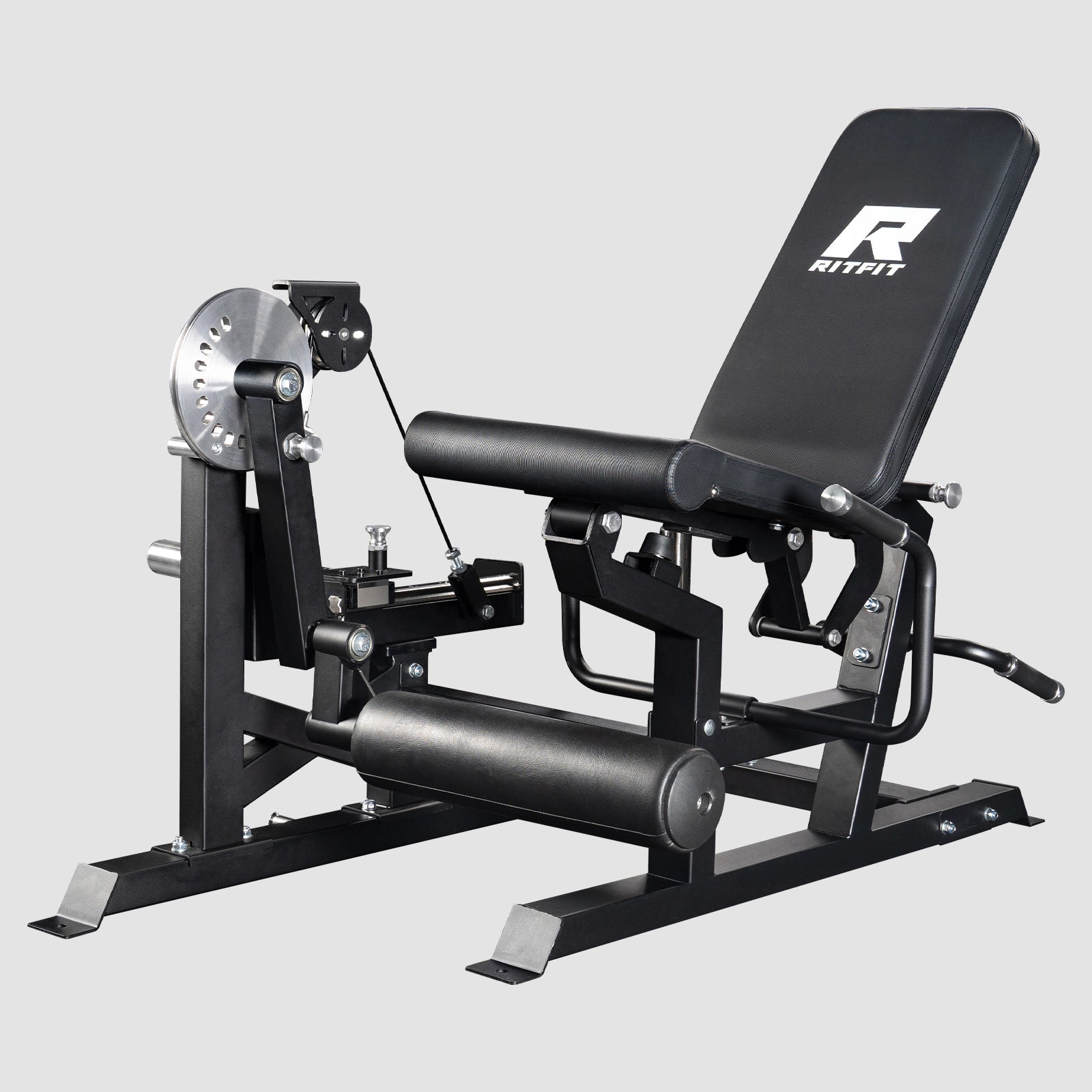
Set the seat so the knee lines up with the machine pivot, then move the shin pad until it sits just above the ankle. A pad that rides high on the shin shortens the lever and pushes the load into the knee instead of the quad.
Keep the hips and lower back against the pad through the whole return. RitFit lists the PLC01 at 109 lb with a 375 lb overall capacity, a 325 lb maximum user weight, and a 15.37 sq ft footprint, so there is a hard ceiling before technique becomes the limiting factor.
If you are still choosing a machine, the setup range is the spec that matters most, and this leg extension curl machine for beginners breakdown covers the adjustment points to check before delivery.
How to Do an Eccentric Leg Extension One Rep at a Time
An eccentric leg extension is one rep with two jobs: the legs lift the pad, and one controlled quad lowers it on a count of three to five. The count is the exercise, so a rep that ends early is a rep that was not eccentric.
- Set the shin pad above the ankle and the knee at the pivot, then sit back with hips and lower back against the pad.
- Lift the pad to near full extension and keep a soft knee at the top instead of locking out hard.
- Hold the top for one second with the quad tight, without letting the pad sink.
- Lower for three to five seconds, counting out loud if the room allows it.
- At the bottom, reverse straight into the next rep or end the set. Do not rest on the pad.
- Stop the set when the count shortens, even if the lift still feels easy.
The bottom position is a stretch, not a seat. Resting there unloads the quad and turns the next rep into a fresh start, which is the opposite of what a slow eccentric is for.
Keep the hands light on the handles and the head against the pad. Pulling with the arms is the clearest sign that the weight is above what the tempo can support, and the plain seated leg extension is the version to master first if that keeps happening.
How Much Heavier the Lowering Can Be Than the Lift
The lowering can be heavier than the lift, but only after the same weight is controlled for a full four seconds on every rep of two sessions. Eccentric strength improves faster than concentric strength, with one meta-analysis reporting a 27% gain in eccentric strength versus 10% for concentric-only training.[3]
That finding describes trained strength, not a load you can safely jump to on a plate loaded machine. The practical ladder is short: same weight both ways, then one plate pair, then assisted lifting with a single leg return.
Step one is two sets of six at your normal weight with a four second lower. Step two adds the smallest plate pair you own, which is often 2.5 or 5 lb per side, and the leg extension machine weight increments guide explains why small jumps matter more here than on a barbell.
Step three is the version most home lifters actually need: both legs lift the pad, one leg lowers it. That gives a heavier eccentric without adding a single plate, and it keeps the total under the 375 lb machine rating on the PLC01.
One increment at a time is the rule. If the count shortens on rep three, the jump was too big, and the answer is to go back a step rather than to grind out the set.
Sets, Reps, Placement, and Weekly Frequency for Eccentric Leg Extensions
Two to four working sets of four to six reps, once or twice a week, is enough for most lifters because every rep carries a long lowering phase. Place the work after your main squat, leg press, or hack squat sets, when the quads are warm but not so fatigued that the count collapses.
For a two day split, three sets on the first leg day and two on the second keeps the weekly dose near five hard sets. A single leg day works too, as long as the eccentric block is the last quad movement rather than a warm up.
Frequency matters less than spacing. Forty eight to seventy two hours between hard quad sessions gives the muscle time to recover before the next eccentric exposure, and that spacing is what makes a twice weekly plan realistic for a home gym.
If the machine is one station in a longer circuit, the lower body machine workout order is a useful template for where the slow work belongs.
What to Do Two Days Later When the Quads Are Sore
Soreness that arrives a day or two after the session is expected in the first weeks and should be easing before the next hard quad day. Soreness from unaccustomed eccentric work usually builds over several hours and peaks between 24 and 72 hours after the session.[1]
The good news is that the same work gets cheaper. A second bout of the same eccentric exercise about a week later produces much less damage, which is the adaptation known as the repeated bout effect.[4]
When the quads are sore but the count still holds, train as planned and keep the load the same. When the count shortens on the first set, cut one set and keep the weight, because adding load to a sore muscle usually just shortens the tempo further.
Do not chase soreness as proof of a good session. A week where soreness climbs every session means the volume or the load is ahead of recovery, and the fix is fewer sets, not more grit.
How to Get Out of a Rep That Is Already Failing
When the lowering starts to run, put both feet into the pad, push the sled back up with both legs, and end the set. A leg extension curl machine has no safety arms, so the leg stop at the bottom and your other leg are the only catch you get.
Set the range stop before the first rep so the pad halts before the knee is fully flexed. That stop turns a runaway return into a bump instead of a joint decision, and it takes ten seconds to set once per session.
If the pad is already falling and the working leg cannot reverse it, let it reach the stop and then unload the top plate before the next set. Fighting a falling pad with the hips is how lifters end up under a load they cannot brake.
Two rules cover the rest.
Keep both hands on the handles until the set is over, and never add a plate mid set to make the lowering harder.
Load changes belong between sets, with the machine at rest.
Four Ways the Lowering Stops Being Eccentric, and What to Avoid
A lowering stops being eccentric the moment the pad outruns the count, and that happens in four predictable ways. Each one looks like a small technique detail and each one removes the training effect the set was for.
- Letting go at the top: The pad free falls from full extension, so the quad is unloaded for the whole return and the set ends where the work should start.
- Collapsing at the top first: The knee buckles before the count begins, which dumps the load into the joint and leaves nothing to lower under control.
- Lifting the hips to brake: The hips come off the seat and the movement turns into a hip hinge, so the resistance angle moves away from the quad.
- Turning the eccentric into a pause: Stopping mid range and resting on the pad unloads the muscle, and a hold is a different stimulus from a controlled lengthening.
All four show up on video within one set. Filming a single set from the side is the fastest way to catch a hip lift or a collapsed top, and the best quad exercises only pay off when the rep is actually the rep you planned.
Who Should Skip Loaded Eccentrics for Now
Anyone with current knee pain, a patella problem, or a recent knee procedure should get clearance before adding loaded eccentrics, and beginners should stay with plain controlled lowering. The movement is legitimate, but the load ceiling is individual.
"Leg extensions create hypertrophy in the quads and can be overloaded. However, there are some potential safety issues for people with tendonitis or knee issues, as it places a lot of force and tension on the patella. It's a good exercise for some, definitely not all."
Jeff Cavaliere, MSPT, CSCS, Physical Therapist and Strength Coach, ATHLEAN-X, Quad Exercises Ranked
Skip accentuated eccentrics, not the exercise, when you train alone without a bail out plan or when the plates are already near the machine rating. A controlled lowering at a moderate weight still trains the phase that matters, and the home gym equipment for legs guide covers the rest of a solo leg station.
Should You Pick the PLC01 for Eccentric Leg Extensions
The PLC01 suits eccentric leg extensions because it is plate loaded, so load moves in small physical steps and comes off quickly when a set turns. A selectorized stack is faster to adjust, but a plate loaded machine lets you match the jump to the tempo instead of the pin.
Its 15.37 sq ft footprint and 42.7 inch height fit most spare rooms, and the 375 lb capacity leaves room for assisted lifting with a single leg return. The trade off is that every load change is manual, and there are no safety arms, so the leg stop and your setup do the work a spotter would do.
For a broader look at the category, the leg extension curl machines for home gyms comparison and the full leg machines collection put this model next to the rest of the line.
"The family loves this machine. It is heads and shoulders above the "old" add-on leg apparatus to the end of a bench. Super easy to change positions, add or remove weight. Wish we had bought this years ago"
Robert R. Verified Buyer, RitFit PLC01 Leg Extension Curl Machine
FAQs About Eccentric Leg Extensions
How slow should the eccentric phase of a leg extension be?
Aim for three to five seconds on the way down and count it out loud or in your head. If the pad reaches the bottom before you finish the count, the weight is too heavy for that tempo. Start at three seconds with a load you control, then work toward five seconds before adding any plate.
Should the eccentric phase be heavier than the concentric phase on a leg extension?
Not at first. Use the same weight in both directions until you can hold a four second lower on every rep of two full sessions. After that, add the smallest plate pair you own, lift with both legs if needed, and lower with one leg to keep the tempo honest.
How many sets and reps of eccentric leg extensions should you do in a workout?
Two to four working sets of four to six reps is enough for most lifters, because each rep carries a long lowering phase. Stop the set when the lowering speed starts to run away from you, not when you cannot lift the weight, since the lift can still feel easy after the quads stop braking well.
Can you do eccentric leg extensions every day?
No. Treat the eccentric block like any hard quad session and leave about forty eight to seventy two hours before training the same muscle hard again. Two sessions a week fits most home gym schedules, and a third only makes sense if soreness has cleared and the lowering tempo still holds on every rep.
Is soreness after eccentric leg extensions normal?
Some soreness is common in the first few weeks, and it usually builds over the next day and peaks between twenty four and seventy two hours after the session. It should fade before the next hard quad day. Soreness that keeps climbing week after week means the load or the number of sets is ahead of your recovery.
Do eccentric leg extensions build more quad muscle than normal reps?
The evidence does not support a large growth advantage when load and work are matched, so treat eccentrics as a way to train the lowering phase well rather than a shortcut to size. The clearer finding is strength specific to the eccentric phase, which is why tempo and load rules matter more than the label.
Conclusion
Eccentric leg extensions are a tempo exercise, not a heavier exercise, and the lowering count is what separates a real eccentric rep from a slow drop. Set the knee at the pivot, hold the top without collapsing, lower for three to five seconds, and add one small plate pair only after four second lowers stay clean.
Start with two sets at your normal weight this week, film one set from the side, and keep the load there until the count holds on every rep. When you are ready to shop, check the RitFit discount guide before ordering.
Disclaimer
This article is general training information and is not medical advice or a diagnosis. Consult a qualified professional before starting eccentric leg extensions if you have knee pain, a previous knee injury, or any condition that affects how you load the joint.
References
1. Nosaka K. Eccentric exercise: Muscle damage to the new normal. J Sport Health Sci. 2026;15:101126. doi:10.1016/j.jshs.2026.101126. PMCID: PMC13068641
2. Hody S, Croisier JL, Bury T, Rogister B, Leprince P. Eccentric Muscle Contractions: Risks and Benefits. Front Physiol. 2019;10:536. doi:10.3389/fphys.2019.00536. PMCID: PMC6510035
3. Spudić D, Nosaka K. Eccentric-Only Versus Concentric-Only Isokinetic Strength Training Effects on Maximal Voluntary Eccentric, Concentric and Isometric Contraction Strength: A Systematic Review and Meta-analysis. Sports Med Open. 2025;11(1):95. doi:10.1186/s40798-025-00887-w. PMCID: PMC12370621
4. Proske U, Morgan DL. Muscle damage from eccentric exercise: mechanism, mechanical signs, adaptation and clinical applications. J Physiol. 2001;537(Pt 2):333-45. doi:10.1111/j.1469-7793.2001.00333.x. PMCID: PMC2278966