A Smith machine overhead triceps extension is possible with nothing more than an adjustable bench and the bar already sitting in your rack. You set the bench inside the uprights, lie back with your head pointing away from the machine, and lower the bar behind your head with your elbows tucked.
This guide covers the bench direction, grip, and elbow path, explains why the overhead position is the one that stretches the triceps long head, and gives weight and programming rules so you can train triceps hard without a spotter.
Quick Answer: Yes, a Smith machine overhead triceps extension works, and the setup is simple. Put an adjustable bench inside the rack facing away from the uprights, press the bar overhead, then lower it behind your head with the elbows tucked, so the fixed vertical bar path matches the movement and the overhead position loads the triceps long head.
Key Takeaways
- Setup: Place an adjustable bench inside the Smith machine facing away from the uprights so the bar can travel clear behind your head.
- Bar path: The Smith bar moves straight up and down on fixed rails, which matches the vertical arc of an overhead extension.
- Muscles: The overhead arm position is the elbow extension angle that puts the triceps long head under a long stretch.
- Weight: Use a load you can control for 10 to 15 reps and keep the elbows tucked rather than flared.
- Programming: Run 2 to 4 sets two to three times per week and add small plate increments once every set is clean.
Can You Do Overhead Triceps Extensions on a Smith Machine?
An overhead triceps extension on a Smith machine is a legitimate exercise that needs only an adjustable bench and the guided bar. The Smith bar is locked to a vertical track, and the overhead extension also travels in a near-vertical line, so the fixed path matches the movement instead of fighting it. That match is why the lift stays stable enough to push close to failure on your own.
The doubt comes from the bench, not the bar.
People picture a flat bench pinned under the bar and assume the frame blocks the path behind the head.
Rotating the bench so your head points out of the rack removes that problem entirely.
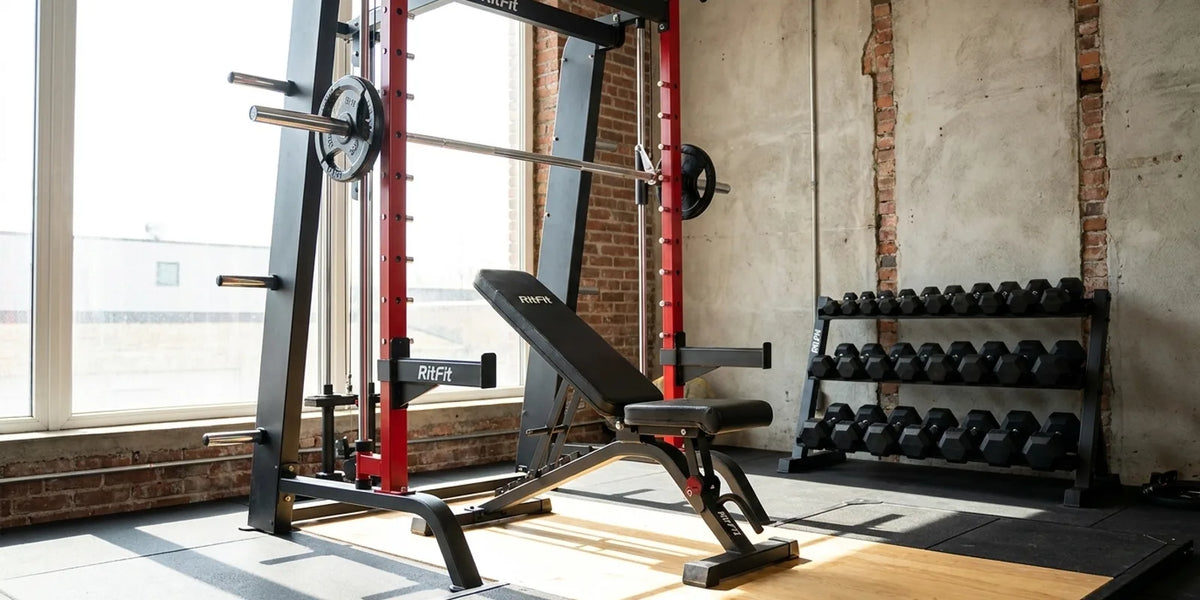
- You need: One adjustable bench, an empty or lightly loaded Smith bar, and about six feet of clear floor inside the rack.
- You do not need: A spotter, a training partner, or a second rack position for a handoff.
- Best fit: Lifters training alone at home who want triceps isolation on guided equipment, including beginners learning elbow extension.
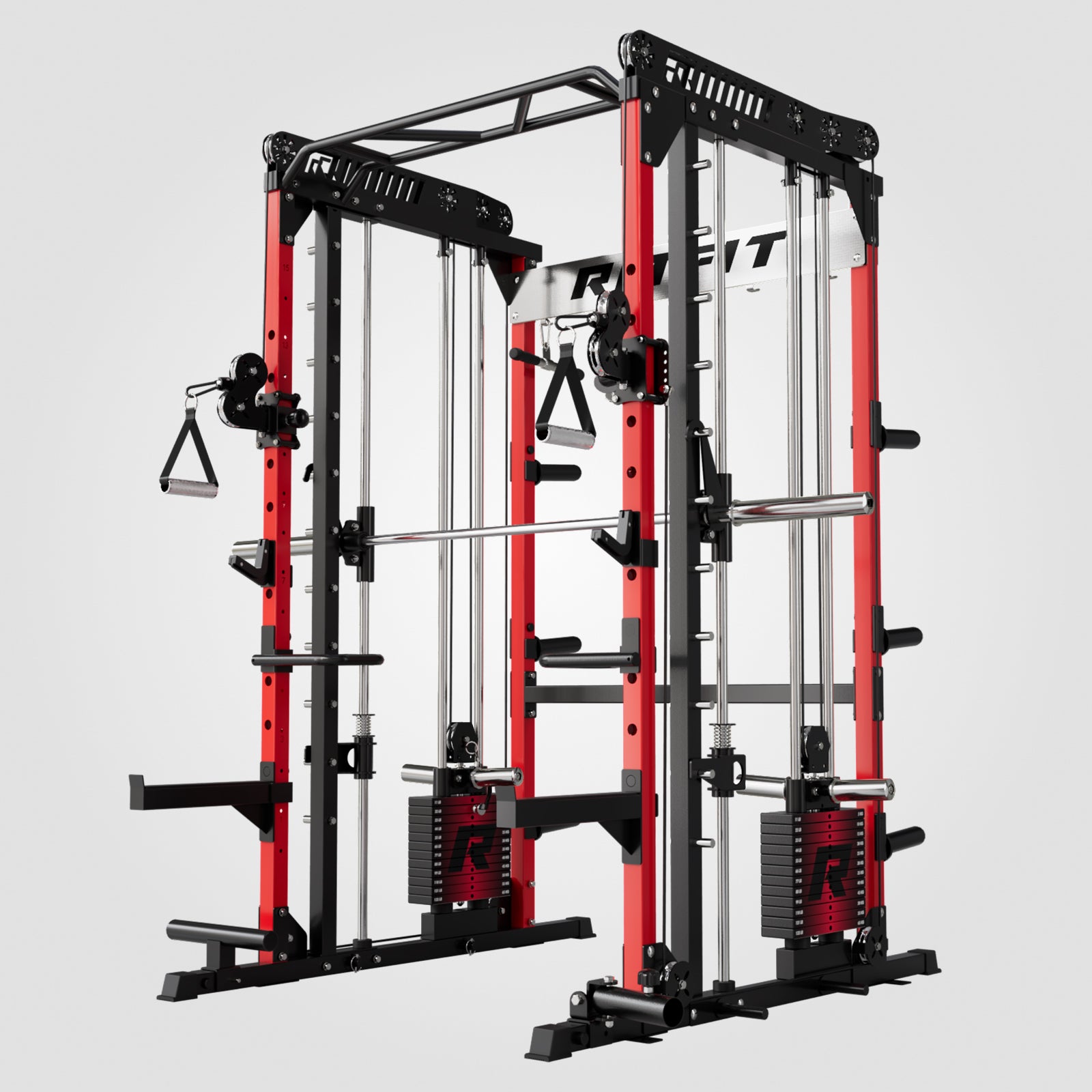
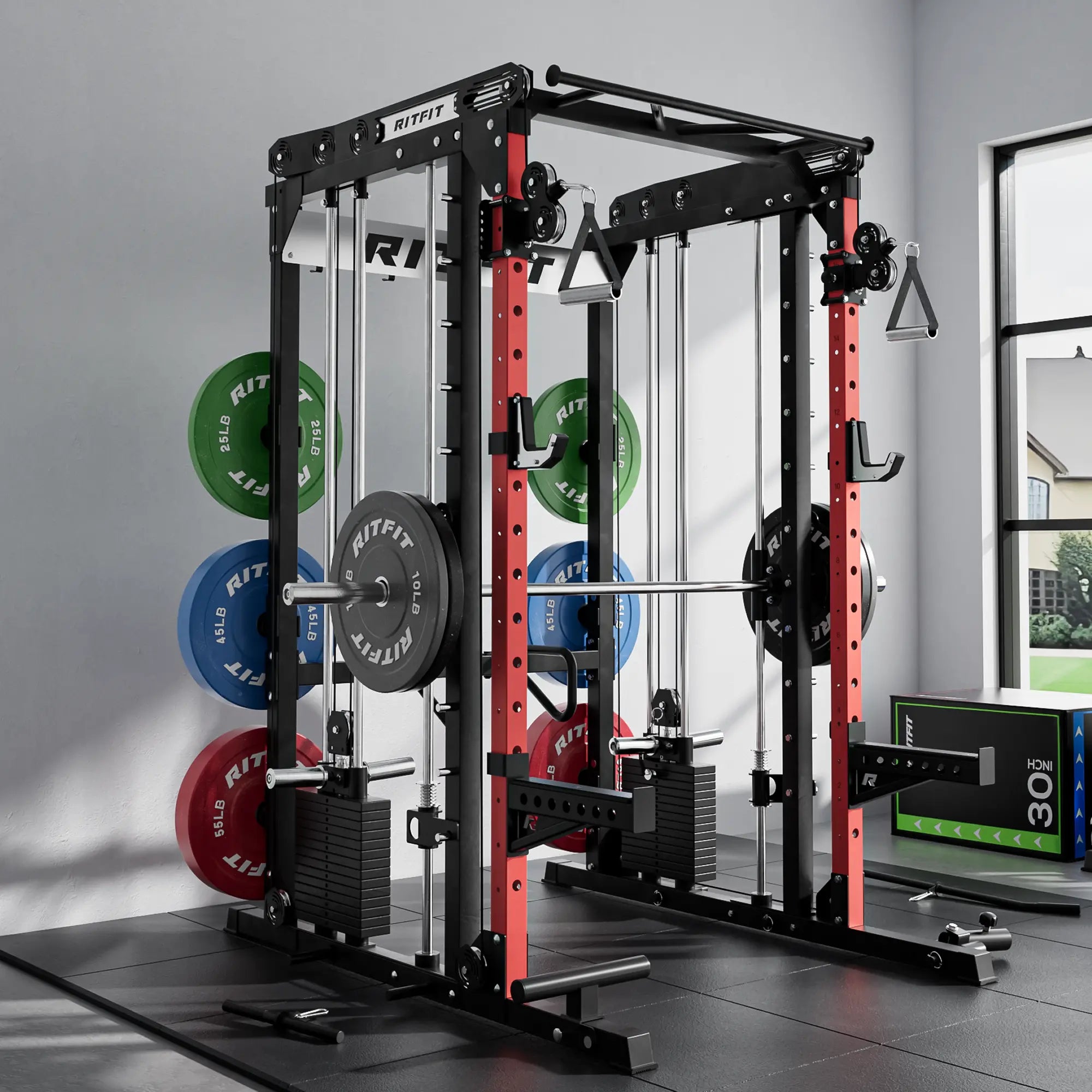
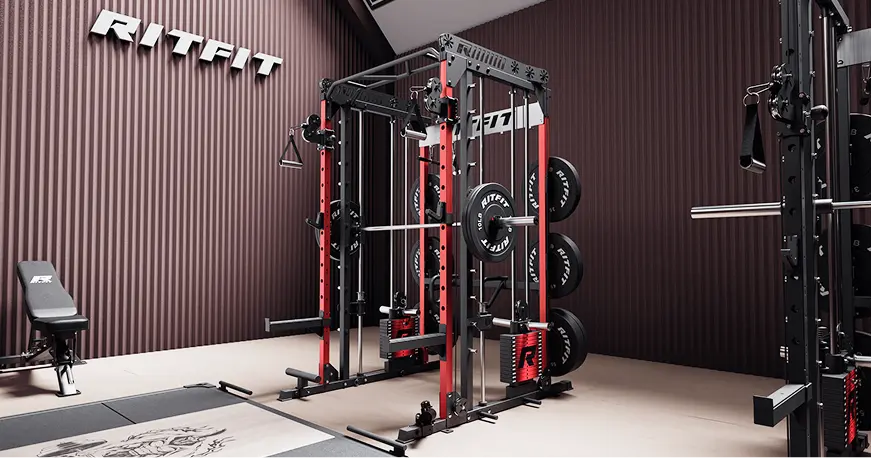
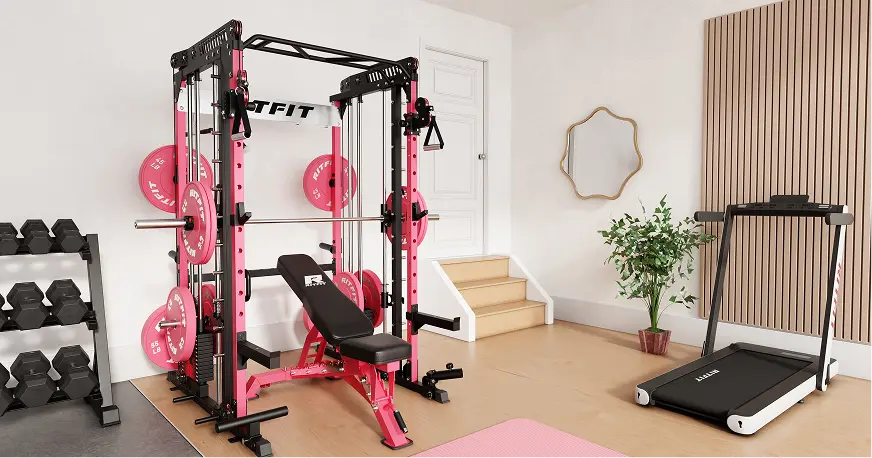
Compact all-in-one racks such as the RitFit M1 Multi-Functional Smith Machine keep the same guided bar path in a smaller footprint, so the setup transfers directly.
"The Smith machine is a great tool for hypertrophy training because it allows you to safely push to failure without a spotter. At medium intensities typically employed in hypertrophy training, the counterweighted Smith machine design offers the best choice in terms of high-force development and total external work performed."
Dr. Mike Israetel, PhD, PhD in Sport Physiology and Co-founder, Renaissance Periodization, Smith Machine Research
How to Set Up a Smith Machine Overhead Triceps Extension
Setting up a Smith machine overhead triceps extension comes down to four choices: bench direction, bench position, bar height, and grip. Each one is adjustable on your first session, and all four should feel settled before you add any real load.
Step 1, face the bench away from the machine: Point the head of the bench out of the rack so your head and hands move into open space behind the uprights.
Step 2, slide the bench under the bar line: Move the bench until your shoulders sit just under the bar and your feet are planted near the front uprights.
Step 3, set the bar height: Unrack and re-rack with arms extended, then confirm the bar clears your chest and your elbows have room below it.
Step 4, take a moderate grip: Use a grip slightly narrower than shoulder width with the thumbs wrapped, and let the elbows point forward rather than out to the sides.
Bar height is the setting people rush. Spend an extra minute here, because a bar that sits too low forces your shoulders into an awkward reach and a bar that sits too high shortens the stretch.
Racks with finer upright hole spacing make this adjustment easier, and that is one reason a dedicated machine like the Smith machine lineup at RitFit is built around 1-inch hole positions.
How to Perform the Overhead Triceps Extension Rep
The overhead triceps extension rep has two halves, a press to lockout and a controlled lower behind the head. Treat the lower as the working half, because that is where the triceps sit under the longest stretch.
- Start position: Arms extended overhead with the elbows tucked and the bar directly over your shoulders.
- Lower: Bend the elbows and let the bar travel behind your head until you feel a stretch, keeping the upper arms still.
- Bottom range: Stop at the point where the elbows are deeply bent and the forearms sit behind the head, not where the shoulders start to roll forward.
- Extend: Press the bar back to lockout by straightening the elbows, without letting them drift outward.
- Tempo: Lower over about two seconds and press up with intent, which keeps the set honest at moderate loads.
Because the bar is captive on the rails, you can pause at the bottom stretch without worrying about the weight drifting toward your face. That control is the main reason this version suits solo training.
Why the Overhead Position Targets the Triceps Long Head
The triceps long head is the only triceps head that crosses the shoulder joint, which is why the overhead arm position changes how it is loaded. Raising the upper arms overhead adds shoulder flexion on top of elbow flexion, so the long head starts every rep from a longer length.
The three heads also have different jobs during the same movement. A study found that the heads of the triceps do not contribute equally to elbow extension, so the position of the upper arm shifts which head carries more of the work[2].
Joint angle matters for the same reason. A study found that the relationship between triceps activity and the force produced shifts as the elbow angle changes, which is why a stretched overhead position feels different from a mid-range press[3].
Whether that longer starting length translates into more growth is still an active question. A systematic review examined whether resistance training at longer muscle lengths produces greater longitudinal growth in humans, and the answer continues to be refined[1].
- Long head: Crosses the shoulder, so it lengthens when the upper arm goes overhead and shortens when the upper arm stays by your side.
- Lateral and medial heads: Originate on the humerus and do not cross the shoulder, so their position barely changes with arm elevation.
- Practical read: Overhead extensions bias the long head, while the tricep head exercises you pair with presses cover the rest.
If you want the full picture of all three heads, the guide to training all three triceps heads breaks down which angle hits which region.
How Much Weight Should You Use on a Smith Machine Overhead Extension?
A good starting load for a Smith machine overhead extension is weight you can lower under control for 10 to 15 reps.
On the counterweighted Smith bar your hands move less weight than the plate total, so most lifters start around 25 to 40 lb of plate load on the first session.
- Sets and reps: Two to four sets of 10 to 15 reps for size, or five to 10 reps if you are chasing pressing strength.
- Rest: Keep rest between 45 and 90 seconds so the triceps recover between sets without the set going cold.
- Frequency: Train triceps two to three times per week in total, counting overhead presses and close-grip work toward that volume.
- When to add weight: Add the smallest available plate only after you complete every set at the top of your rep range with the elbows tucked.
Range of motion is not something you have to sacrifice for load. A study found that lengthened partial repetitions produced similar muscular adaptations to full range of motion repetitions in trained individuals, so a controlled stretch beats a heavy partial rep[4].
For a broader progression plan, the guide on how to grow triceps shows how to sequence this isolation work around your main presses.
Common Smith Machine Overhead Extension Mistakes to Avoid
Most Smith machine overhead extension mistakes come from elbow flare, too much weight, and a bench that faces the wrong way. Each one shows up early, so a single check at the bottom of the first rep catches all three.
- Bench facing the machine: Your hands then travel toward the uprights, so the bar path is blocked and the elbows hit the frame.
- Elbows flaring wide: The upper arms rotate outward and the load shifts off the long head, which also stresses the shoulder.
- Loading too heavy: The bar drifts toward the forehead or the elbows buckle, a sign the load is ahead of your control.
- Cutting the stretch: Stopping the bar at forehead level turns a long-head exercise into a short-range press.
- Chasing reps through pain: Sharp elbow pain is a stop signal, not a target, so end the set and reduce the load or range.
Safety stops are simple here. Stop the set if the elbows ache, if your shoulders roll forward at the bottom, or if you cannot control the lowering tempo.
If you are mapping the exercise into a full plan, the Smith machine exercises for muscle building guide shows where an isolation move fits around the bigger lifts.
Smith Machine Overhead Extension vs Skull Crushers and JM Press
Overhead extensions, skull crushers, and the JM press all train the triceps, but they place the shoulder and upper arm in different positions. That difference, not the equipment, is what separates them.
| Exercise | Upper arm position | Movement type | Best for |
|---|---|---|---|
| Smith machine overhead extension | Overhead with the long head lengthened | Pure elbow extension isolation | Stretched long-head work |
| Lying triceps extensions | Neutral, beside the torso | Elbow extension isolation | Lifters who cannot go overhead |
| JM press on a Smith machine | Overhead but closer to the body | Hybrid of a press and an extension | Heavier hybrid loading |
Comparison is based on joint position and movement pattern, not on measured muscle activation.
A Smith machine overhead press trains the shoulders as a compound push, so it is not a triceps isolation and cannot replace this exercise. The JM press is a press and extension hybrid, while the overhead extension is pure elbow extension with the upper arm held still.
Does the RitFit BUFFALO Smith Machine Work for Overhead Triceps Extensions?
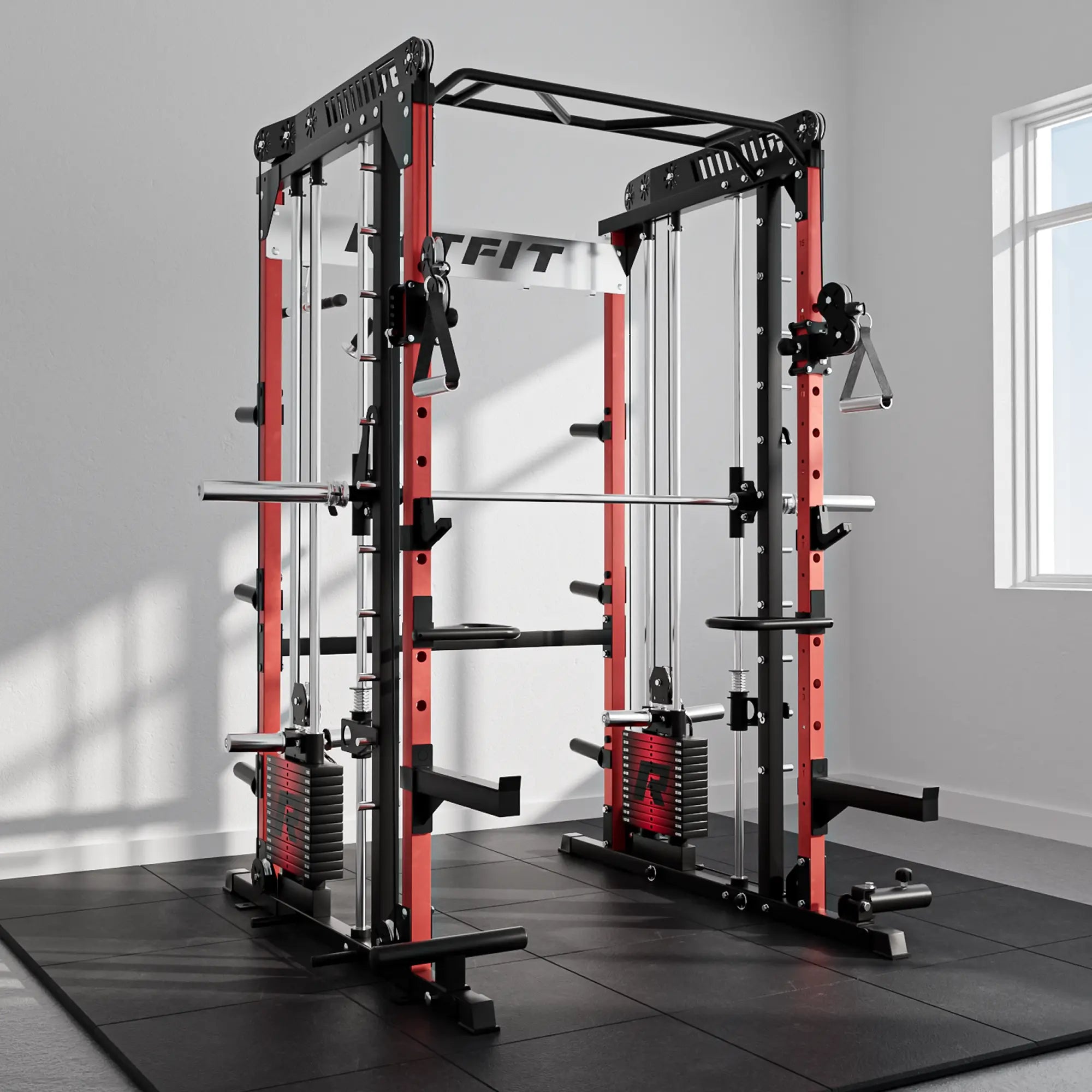
The RitFit BUFFALO Multifunctional Smith Machine supports overhead triceps extensions, because its Smith bar runs on fixed rails inside a rack wide enough for a bench. You roll the bench into the rack, face it away from the uprights, and set the bar height on the 1-inch hole spacing.
- Rack space: The BUFFALO stands 83 inches tall on a 38.1 square foot footprint, which leaves room for an adjustable bench between the uprights.
- Frame: It is built on 2 by 3 inch 13-gauge steel uprights and weighs 478 lb, so the frame stays planted when you press from a bench.
- Capacity: Published specs list an 1,800 lb maximum capacity and a 352 lb Smith bar capacity, far above the load this isolation move needs.
- Bar height control: The 1-inch upright holes let you match the bar to your bench angle instead of fighting a fixed start point.
- Cable work: A 2 to 1 pulley ratio on the lat pulldown and cable crossover lets you pair the overhead extension with cable triceps work in the same station.
Put the bench in the rack, face it away from the uprights, and start with a light plate load. The RitFit BUFFALO Multifunctional Smith Machine keeps the bar captive above you the whole time, so you can pause at the stretch without a spotter.
"The build quality of the RitFit BUFFALO is exceptional. The robust steel construction feels incredibly sturdy and secure, providing the confidence needed for intense workouts. The attention to detail in its design and finish is evident, rivaling the best commercial gym equipment I've ever used."
Tyrone C. Verified Buyer, RitFit BUFFALO Multifunctional Smith Machine with Lat Pull Down and Cable Crossover for Versatile Strength Training
Variations and Alternatives for Overhead Triceps Extensions
If the Smith machine is busy or unavailable, several overhead triceps extension alternatives train the same long head. Pick the one that matches the equipment you already own.
- Seated variation: Set the bench upright inside the rack and press from a seated position, which reduces lower-back arching.
- Dumbbell overhead extension: Hold one dumbbell in both hands and lower it behind the head when no rack is free.
- Cable overhead extension: Face away from a low pulley and extend the rope overhead for constant tension through the stretch.
- Single-arm version: Train one arm at a time to even out a side-to-side strength gap.
- Resistance band version: Anchor a band behind you for the lightest option on a home setup.
For a wider set of options on the same machine, the guide to Smith machine triceps exercises collects the pressing and isolation variations side by side.
FAQs About Overhead Triceps Extensions on a Smith Machine
Can you do overhead triceps extensions on a Smith machine?
Yes. Set an adjustable bench inside the rack and lie back with your head facing away from the uprights. Press the bar up on the fixed rails, then lower it behind your head by bending the elbows. The bar can only travel straight up and down, and that vertical path matches the overhead extension, so the lift works without a spotter.
Which way should the bench face on a Smith machine?
Face the bench away from the machine so your head points out of the rack and your feet point in. Your shoulders sit under the bar and your hands can travel behind your head into open space. If you face the machine, the uprights block the bar path and your elbows hit the frame.
Do overhead triceps extensions work the long head?
Yes. The long head is the only triceps head that crosses the shoulder joint. Raising the arms overhead puts that head under a long stretch before you extend the elbows, which is why the overhead position is treated as the long-head builder. Lying and pressing positions keep the shoulder neutral and shorten the long head.
How much weight should you use for Smith machine overhead triceps extensions?
Start around 25 to 40 lb of plate load if you are new to the movement and add small increments. Use a weight you can lower under control for 10 to 15 reps while keeping the elbows tucked. If the bar drifts toward your face or your elbows flare, drop the load before adding reps.
Are Smith machine overhead extensions better than skull crushers?
Neither is strictly better, because they load the triceps from different shoulder angles. Overhead extensions put the long head in a stretched position, while skull crushers keep the upper arm closer to neutral. Many lifters run both, using the Smith machine for one of them so the bar path stays predictable.
How many sets and reps should you do?
Two to four sets of 10 to 15 reps works for most lifters building size, with 45 to 90 seconds of rest. Train triceps two to three times per week in total and count pressing work toward that volume. Add a rep or a small plate increment when you finish all sets with clean form.
What should you do if your elbows hurt during overhead triceps extensions?
Stop the set and reduce the load or range, because sharp elbow pain is a signal rather than a target. Try a lighter load, a shorter range at first, and a neutral grip if the bar forces your wrists to twist. If the discomfort continues, swap to a cable variation and have a professional assess it.
Conclusion
The Smith machine overhead triceps extension earns its place in a home program because the fixed bar path and the bench-first setup remove the two barriers that usually block the lift, balance and a spotter.
Set the bench away from the uprights, keep the elbows tucked, and train the stretch instead of chasing load.
Start light, progress by small increments, and let the overhead position do the work on the long head.
Ready to build the setup at home? Compare the current RitFit discount guide before you order a rack and an adjustable bench.
Disclaimer
This article is educational and is not medical advice. Anyone with an existing elbow, shoulder, or wrist condition should consult a qualified professional before starting overhead triceps extensions.
References
1. Wolf M, Korakakis PA, Roberts MD, et al. Does longer-muscle length resistance training cause greater longitudinal growth in humans? A systematic review. Sports Med Health Sci. 2026;8(1):34-42. doi:10.1016/j.smhs.2025.03.001. PMCID: PMC12869050
2. Kholinne E, Zulkarnain RF, Sun YC, Lim S, Chun JM, Jeon IH. The different role of each head of the triceps brachii muscle in elbow extension. Acta Orthop Traumatol Turc. 2018;52(3):201-205. doi:10.1016/j.aott.2018.02.005. PMCID: PMC6136322
3. Akima H, Maeda H, Koike T, Ishida K. Effect of elbow joint angles on electromyographic activity versus force relationships of synergistic muscles of the triceps brachii. PLoS One. 2021;16(6):e0252644. doi:10.1371/journal.pone.0252644. PMCID: PMC8174684
4. Wolf M, Androulakis Korakakis P, Pinero A, et al. Lengthened partial repetitions elicit similar muscular adaptations as full range of motion repetitions during resistance training in trained individuals. PeerJ. 2025;13:e18904. doi:10.7717/peerj.18904. PMCID: PMC11829627