Yes, you can do pistol squats on a Smith machine. The pistol squat Smith machine version is more learnable than the free-standing movement because the guided bar takes balance out of the equation.
This guide covers both setups, the bar height and foot position that control difficulty, and a progression ladder from a high assisted bar to a loaded pistol. It also shows how the move differs from bodyweight pistols and other Smith machine single-leg exercises.
Quick Answer: Yes, pistol squats work well on a Smith machine because the guided bar acts as an adjustable balance aid and a loadable bar. Higher bar settings make the rep easier, lower settings and added weight make it harder, and the rails remove the balance problem that limits free-standing pistol squats.
Key Takeaways
- Two builds, one movement: Hands lightly on the bar give you an adjustable balance aid, while the bar across your shoulders turns the pistol into a loaded strength lift.
- Bar height sets the difficulty: Higher hooks make the rep easier and lower hooks make it harder, so progression is a simple one-notch-at-a-time ladder.
- The rails delete the balance bottleneck: A guided bar path removes the wobble that ends most free-standing pistol attempts, so the working leg does the real work.
- This is its own variation: The straight free leg demands more hip and ankle mobility than split squats, step-ups, sissy squats, or Anderson squats.
- Progress on clean reps: Move the hook down a notch or add plates only after five controlled reps per leg, and stop any set where the knee caves or the heel lifts.
Can You Do Pistol Squats on a Smith Machine?
Pistol squats work on a Smith machine in two builds, a hands-on-bar assisted version and a bar-on-shoulders loaded version. The fixed bar path removes the balance demand that usually ends free-standing attempts early, and the adjustable hooks let you dial the exact difficulty. The deep single-leg position stays the same as in the free version.
- Assisted build: Hold the bar lightly at chest height with one or both hands while you squat on one leg, using the bar only to steady yourself.
- Loaded build: Rest the bar across your shoulders and squat on one leg with the free leg extended forward, which loads the pattern like any other Smith machine squat.
- Why the machine fits: The guided bar travels a fixed vertical path, so you manage depth and knee tracking instead of a bar drifting sideways.
This is unilateral training at its most demanding, and both builds share the same foot position and the same target depth, so the skill transfers between them as you get stronger. The next sections cover setup, progression, and how this variation differs from every other single-leg squat option.
How Does a Smith Machine Change the Pistol Squat?
The Smith machine changes the pistol squat by fixing the bar path and giving your hands an adjustable balance point, which removes the hardest part of the free version. Balance, not leg strength, is what fails first on a free-standing pistol squat. With the rails guiding the bar, the working leg absorbs the full demand and every rep ends on your terms.
The single-leg squat is not one fixed pattern. In a motion-capture comparison of 16 participants, a study found that moving the free leg through front, middle, and back positions produced distinct trunk, pelvic, hip, knee, and ankle mechanics, so the pistol with its straight forward free leg behaves like its own exercise.[1]
The straight free leg also demands real hip flexion range of motion and ankle dorsiflexion, which is why depth comes easier for some lifters than others. The bar does not change those demands, it simply stops balance from hiding them.
"I love Smith machine front squats. I do them with a medium stance and my toes pointed outward. By doing so, I'm really trying to focus on the outer sweep. I do these very deep, as deep as I can go. The Smith machine allows you to position yourself underneath and take the glutes and hips out of it and really focus on your quads without worrying about balancing."
Jay Cutler, Four-time Mr. Olympia, Cutler Nutrition. Jay Cutler Answers 10 Questions About His Quad Training (SimplyShredded)
How to Do a Pistol Squat on a Smith Machine
The setup starts with the bar at hip to chest height and your working foot just ahead of the bar line. From there the rep runs through five steps, and the bar height decides how much the machine helps you. Small setup choices control the difficulty more than raw strength does.
- Step 1, set the bar height: Higher hooks make the assisted version easier because your hands can share more load, and lower hooks make it harder.
- Step 2, unrack with two feet: Grip the bar at chest height or rest it across your shoulders, rotate the hooks clear, and let the guided bar support your balance.
- Step 3, place your feet: Plant the working foot about 12 inches in front of the bar line and extend the free leg straight out in front, holding it off the ground.
- Step 4, descend with control: Bend the working knee and hip with eccentric control until the thigh reaches at least parallel, keeping the heel planted and the knee tracking over the toes.
- Step 5, drive up through the heel: Pause briefly at the bottom, then extend the knee and hip to stand while the free leg stays forward and off the floor.
Foot angle matters more than foot distance. In a single-limb squat study, joint moments measured at 60 degrees of knee flexion shifted toward the knee as the surface angle under the foot steepened and away from the ankle, so a small change in foot placement changes which joint does the work.[2]
For the assisted build your hands should only steady the bar, so the working leg carries the rep. For the loaded build, start with the empty 33 lb Smith bar and add small plates only after the pattern feels stable.
If the single-leg position feels too advanced right now, master the Smith machine squat form guide first and come back to this progression once the bilateral pattern is solid.
How to Progress to a Loaded Smith Machine Pistol Squat
Progression runs on one rule, own five clean reps at one bar height before you move the hook one notch lower. The ladder starts with high-bar assisted reps and ends with the loaded bar across your shoulders, and most lifters spend several weeks on each rung. Frequency stays modest while the skill is new.
- Rung 1, high bar with both hands: Set the bar around chest height, hold it lightly, and build full depth for five reps per leg.
- Rung 2, high bar with one hand: One light fingertip contact forces more balance work while the guided path keeps the bar steady.
- Rung 3, low bar assisted: Drop the hooks toward hip height and use less hand support every session until the hand barely touches.
- Rung 4, hands off: Run full sets beside the bar without touching it to prove the balance is yours, not the machine's.
- Rung 5, bar on shoulders: Unrack the empty 33 lb bar across your shoulders and work the loaded pistol, adding the smallest plates over time.
Move down a notch only after five controlled reps per leg with the heel planted and the knee tracking straight. When you reach the lowest useful setting, switch to the loaded build and apply progressive overload with the smallest plates available, because one leg takes the full load of every pound you add.
Two focused sessions per week with at least two rest days between them suit most people learning the pattern. Treat assisted reps as skill work for three to five sets of five to eight reps per leg.
Does the RitFit M1 PRO All-in-One Smith Machine Work for Pistol Squats?
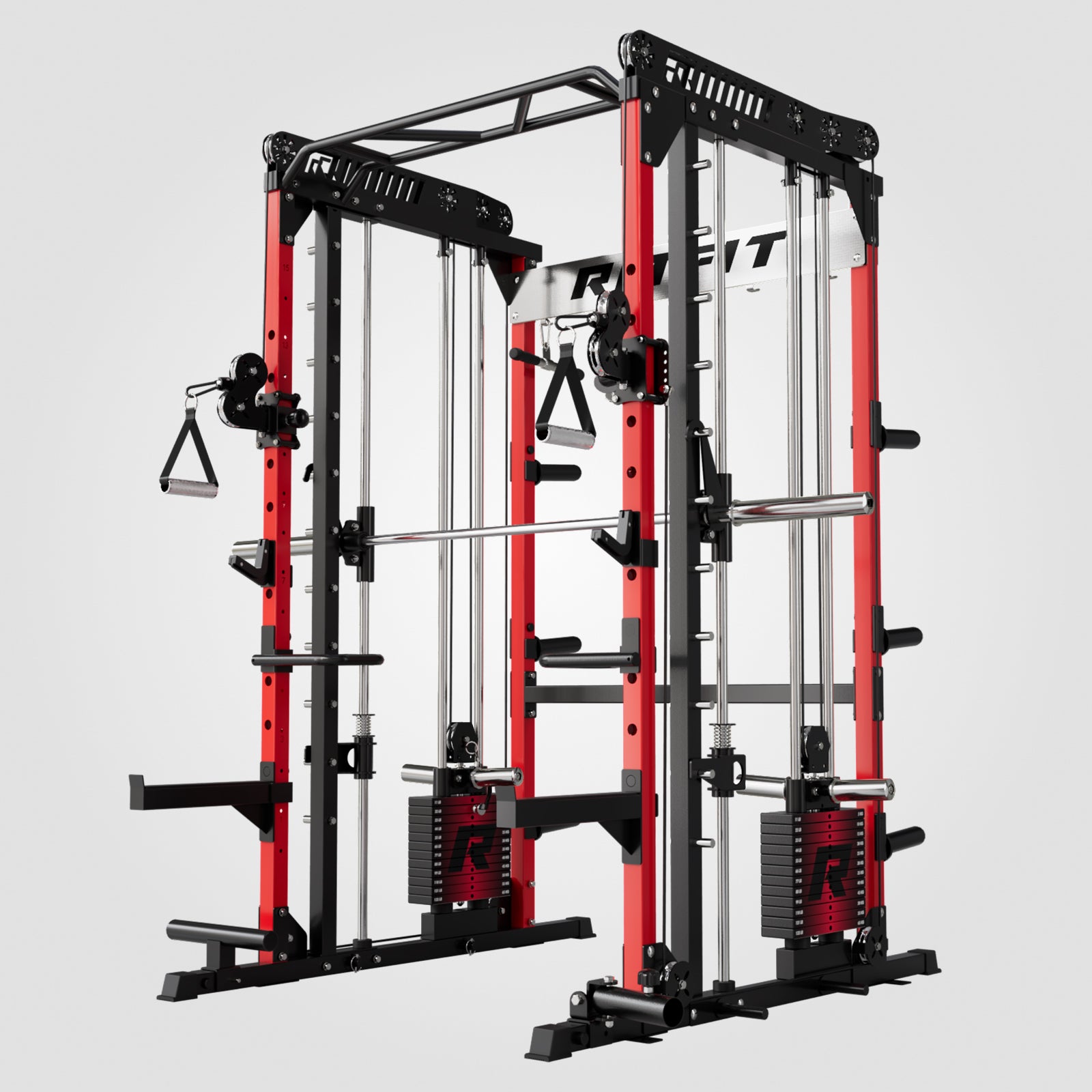
The RitFit M1 PRO All-in-One Smith Machine handles both pistol squat builds well because its guided bar offers 11 height settings on a linear-bearing system. The Smith bar is rated to 352 lb and weighs 33 lb, so the loaded version has headroom for years of progression. Full configuration details live on the RitFit M1 PRO Smith Machine listing.
- Height ladder built in: The 11 height settings turn every rung of the assisted progression into a real hook position instead of a guess, which matters when you want the bar at one exact height for one exact difficulty.
- Solo safety margin: The Smith system uses linear bearings and spring-back protection, so a flick of the wrists racks the bar at any point of the rep and gives solo garage lifters a built-in safety net.
- Capacity for the long run: With a 1,600 lb frame rating and safety arms rated to 575 lb, the loaded pistol can progress far beyond bodyweight before the frame becomes the limit.
If you are still shopping for a machine, the Smith machine collection covers the full range of hook layouts and capacities. The listing linked above shows the current configuration options for the exact unit used in this guide.
"Few pieces of equipment in the home exercise industry are as comprehensive and versatile as this all-in-one gym system. The robust system provides a natural, centered bar path for compound lifts like squats, presses, and rows, and incorporates a dual cable crossover station with a full rack of precision-engineered attachments."
Tom Eskey, CF-L1, CPT, Home Gym Equipment Reviewer at Garage Gym Revisited. RitFit M1 Multi-functional Smith Machine: Our Review
"The M1 Pro has re-energized my workout regimen. The smith machine has been really helpful allowing my rehabilitated shoulders to rebuild strength and range of motion. The landmine is an added bonus; I love the many movements it has made possible."
Joseph C. Verified Buyer, RitFit M1 PRO Multi-Functional Smith Machine with Cable Crossover System and Squat Rack for Home Gym
How Is a Smith Machine Pistol Squat Different from Other Single-Leg Squats?
The pistol keeps the free leg straight out in front, which makes it the most mobility-demanding single-leg squat pattern you can do on a Smith machine. Other variations move the free leg or the working feet into positions that trade that mobility demand for different balance or load demands. Each one trains the legs hard, but they are not interchangeable.
| Variation | Free leg and foot position | Main demand | Fits when |
|---|---|---|---|
| Smith machine pistol squat | Free leg straight forward and off the floor | Hip flexion, ankle dorsiflexion, single-leg strength | You want the strictest single-leg squat on the machine |
| Bodyweight pistol squat | Same, with no bar | Balance plus mobility | You can already hold the balance and want to test it |
| Smith machine Bulgarian split squat | Rear foot elevated on a bench behind you | Split-stance strength with less mobility demand | Hip or ankle mobility limits your pistol depth |
| Smith machine step-up | Working foot on a box, rear leg free | Drive from the bottom with easier balance | You want single-leg work without the deep fold |
| Smith machine sissy squat | Both feet down, torso leaning back | Quad isolation with forward knee travel | You want quad work without single-leg balance |
| Smith machine Anderson squat | Two feet, bar starting at pin height | Bottom-range strength and overload | You want to load the pattern instead of testing it |
Movement classifications based on setup and coaching practice, not lab comparisons.
The free-standing version is the closest cousin. Our bodyweight pistol squat guide covers the balance-first progressions, while this article assumes the machine's guided path is doing the balancing for you.
The other Smith machine variations solve different problems. Smith machine Bulgarian split squats keep both feet sharing the work and cut the mobility demand, Smith machine step-ups trade depth for a simple box height dial, and the sissy squat on a Smith machine leans the torso back to load the quads without single-leg balance work.
The Anderson squats on a Smith machine are the least comparable, because the bar starts from pins at a set height instead of descending through a full single-leg range. If your hips or ankles will not let you hit depth yet, a dedicated leg machine like the 3-in-1 leg press and hack squat machine builds the same muscles while your mobility improves.
Common Mistakes and When to Stop
Three setup errors cause most failed Smith machine pistol squats. They are a bar set too low too soon, a working heel that lifts off the floor, and a knee that caves inward at depth. The knee cave deserves the most attention, because a kinematics study tracked knee valgus and knee flexion angles through single-leg squat performance, the same inward-knee markers a coach watches during a pistol rep.[3]
- Bar too low, too soon: A low hook removes hand support before your single-leg strength is ready, so descend the ladder one notch at a time.
- Heel lift: When the working heel rises the load shifts forward and the rep stops being a clean pistol squat, so widen the stance or raise the bar.
- Knee cave: When the knee drifts inward, end the set and rebuild with a higher bar, because grinding valgus reps teaches the wrong pattern.
- Free leg cheating: Touching the free foot down mid-rep resets the balance problem you were avoiding, so cut the set instead of finishing sloppy reps.
Sharp pain in the knee, hip, or ankle ends the session immediately, and soreness that changes your walking stride means the next session waits. Return with a higher bar setting and fewer reps, because rebuilding the pattern is faster than training through it.
FAQs About Smith Machine Pistol Squats
Are Smith machine pistol squats easier than regular pistol squats?
Yes. The Smith machine pistol squat removes most of the balance demand that makes the free-standing pistol squat so hard, so you can focus on single-leg strength and depth. The difficulty still scales with bar height, and the loaded version stays challenging for advanced lifters.
How is a Smith machine pistol squat different from other single-leg squats?
A pistol squat keeps the free leg straight out in front, which demands the most hip and ankle mobility of any single-leg squat variation. Split squats and step-ups keep both feet working, the sissy squat leans the torso back instead, and the Anderson squat starts from pins rather than a full single-leg descent.
What muscles do Smith machine pistol squats work?
Smith machine pistol squats mainly train the quadriceps of the working leg, with heavy involvement from the glutes and adductors through the bottom range. The hamstrings, calves, and core work as stabilizers, and the loaded version placed across your shoulders increases the demand on the whole lower body.
How often should I train Smith machine pistol squats?
Two focused sessions per week fit most lifters, with at least two rest days between them while the movement is new. Treat the assisted version as skill work for three to five sets of five to eight reps per leg, and stop the set when your form breaks down rather than chasing fatigue.
How low should I go on a Smith machine pistol squat?
Descend until your thigh reaches at least parallel to the floor while your working heel stays planted, then pause briefly and stand up. Deeper reps depend on your hip and ankle mobility, and the straight free leg naturally limits depth, so stop where your lower back stays neutral.
Can beginners start with Smith machine pistol squats?
Yes. Beginners can start with the highest bar setting and both hands lightly holding the bar, which turns the exercise into an assisted single-leg squat with a large margin for balance. Progress by lowering the bar one notch at a time only after five clean reps per leg feel controlled.
When should I stop Smith machine pistol squat training?
Stop the set immediately if you feel sharp knee, hip, or ankle pain, or if your working heel lifts and the knee caves inward without correction. Cut the session if soreness changes your walking stride, and resume with a higher bar setting after full recovery.
What is the difference between hands on the bar and the bar on your shoulders for pistol squats?
Hands on the bar gives you an adjustable balance aid, so the working leg does the movement with help on demand. The bar on your shoulders turns the same pattern into a loaded lift, and both setups use the same foot position and depth. Pick the assisted build to learn, and the loaded build to get stronger.
How do bar height and foot position change the difficulty of a Smith machine pistol squat?
Higher hooks make the rep easier and lower hooks make it harder, so bar height is the main difficulty dial on a Smith machine pistol squat. Foot position and depth control the rest, since a planted heel and a controlled descent keep the knee and ankle demands honest.
Conclusion
Pistol squats on a Smith machine work, and the reason is simple, the guided bar turns the hardest part of the movement into an adjustable dial. Start with a high bar and light hands, own five clean reps per rung, and let the ladder do the progressing.
When you are ready to outfit the space, check the RitFit discount guide for current offers before you order.
Disclaimer
This article is general fitness information and is not medical advice or a rehabilitation program. Consult a qualified professional before starting any new exercise, especially if you have a history of knee, hip, or ankle problems.
References
1. Khuu A, Foch E, Lewis CL. NOT ALL SINGLE LEG SQUATS ARE EQUAL: A BIOMECHANICAL COMPARISON OF THREE VARIATIONS. Int J Sports Phys Ther. 2016;11(2):201-11. PMCID: PMC4827363
2. Richards J, Thewlis D, Selfe J, Cunningham A, Hayes C. A biomechanical investigation of a single-limb squat: implications for lower extremity rehabilitation exercise. J Athl Train. 2008;43(5):477-82. doi:10.4085/1062-6050-43.5.477. PMCID: PMC2547867
3. Yokoyama S, Fukuda W, Ikeno Y, Kataoka Y, Horan SA. Lower limb kinematics of single-leg squat performance in patients with anterior cruciate ligament deficiency. J Phys Ther Sci. 2021;33(5):429-433. doi:10.1589/jpts.33.429. PMCID: PMC8165361