








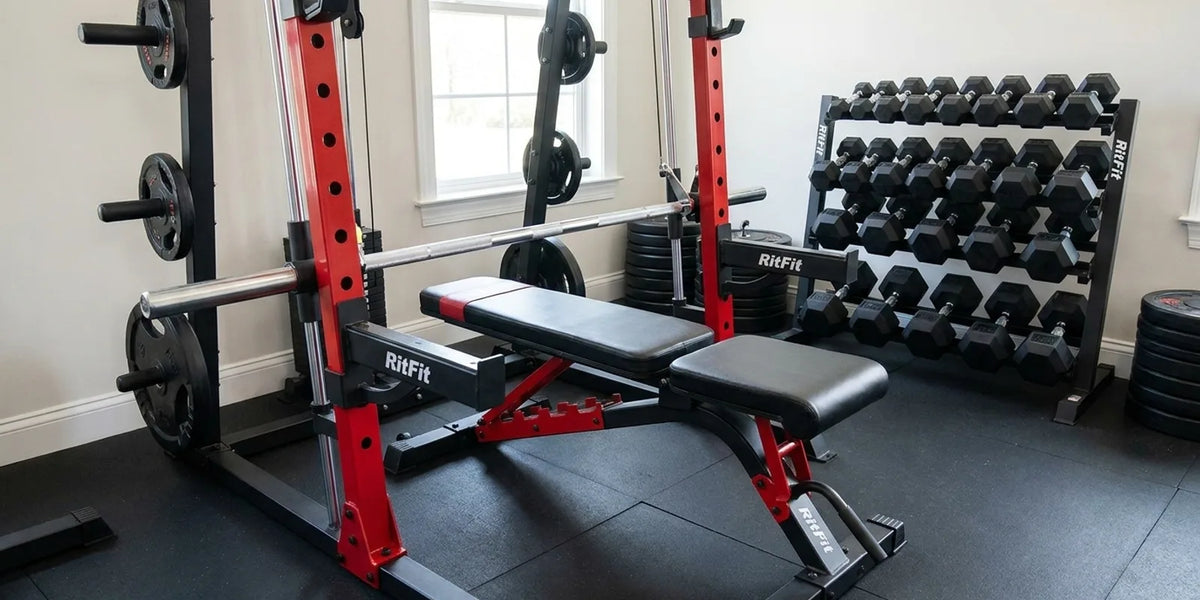
Yes, you can do a Spoto press on a Smith machine, and the fixed vertical bar path makes the hovering pause repeatable every rep. You will learn the exact pause height, the pause timing, and how to load it.
The lift suits intermediate and advanced lifters pressing at home without a spotter. Stop any set that hurts your shoulders or elbows.
Quick Answer: The Spoto press works well on a Smith machine because the guided bar keeps a fixed vertical bar path, so you can hover at the same height every repetition. Lower the bar to about 2 to 3 inches above your chest, hold it motionless for about 2 seconds, then press to full lockout without bouncing.
Key Takeaways
- Form: Hover the bar 2 to 3 inches above your chest, pause about 2 seconds, then press to lockout.
- Why the Smith machine: The fixed vertical bar path makes the same pause height repeatable on every rep.
- Spoto vs pin press: A Spoto hover keeps tension on the muscles, while a pin press rests the bar on the safeties and unloads it.
- Load: Start about 10 percent lighter than your touch-and-go bench and add weight only when every pause is clean.
- Programming: Run it 1 or 2 times per week for sets of 2 to 8 reps, and stop sets that cause joint pain.
What Is the Spoto Press?
The Spoto press is a bench press variation that pauses with the bar hovering about 2 to 3 inches above your chest before you press it back up. According to Generation Iron, the lift is named after Eric Spoto, a powerlifter best known for a 722 lbs raw bench press world record lift. The hover prevents the throw and the stretch reflex that touch-and-go reps borrow from the rebound.
Coaches at Barbell Logic make the same point, since many lifters overrely on the rebound off the chest and lose honest strength at the bottom. The pause also raises time under tension and trains the sticking point, where the chest hands the bar off to the triceps.
- Pause height: The bar hovers 2 to 3 inches above the chest and never touches it.
- Pause length: Hold the bar motionless for about 2 seconds before pressing.
- Bar path: The lift stays on one vertical line from the hover to the lockout.
In one trial measuring muscle activity in the flat bench press, prime-mover activation rose as intensity climbed from 70% to 100% of 1RM, and the ascent phase showed greater activation than the descent.[1] The rebound in touch-and-go benching comes from the stretch-shortening cycle, which the hovering pause switches off.
Can You Do a Spoto Press on a Smith Machine?
Yes, the Spoto press works on a Smith machine because the bar travels on fixed vertical rails that match the straight up and down line of a bench press. The guided path lets you hover at the same height every repetition and rack the bar safely without a spotter. Free-bar lifters drift forward or backward mid-rep, which pushes the hover height around.
The fixed rail is the whole argument for this setup, because a repeatable height is the point of a pause drill. With an even hover and a true stop each rep, the muscles keep working through the full range of motion instead of stealing force from a bounce.
- Repeatable hover: The rails keep the bar on one vertical line, so the pause lands at the same height every rep.
- Solo-friendly racking: Turn the bar into the hooks at any point if a rep goes bad.
- Strict form feedback: Any forward or backward drift shows up immediately against the guide rods.
Any machine in the Smith machine collection with room for a flat bench handles this lift, and the same rail logic covers other paused pressing.
"Few pieces of equipment in the home exercise industry are as comprehensive and versatile as this all-in-one gym system. The robust system provides a natural, centered bar path for compound lifts like squats, presses, and rows, and incorporates a dual cable crossover station with a full rack of precision-engineered attachments."
Tom Eskey, CF-L1, CPT, Garage Gym Revisited, RitFit M1 Multi-functional Smith Machine: Our Review
How to Do the Spoto Press on a Smith Machine
A proper Spoto press rep lowers the bar to about 2 to 3 inches above your chest, holds it motionless for about 2 seconds, then presses to lockout. Run the five setup and execution steps below with a load you can control.
- Step 1: Set the bench and hooks. Park a flat adjustable bench like the RitFit 1300 lb adjustable weight bench so the bar lines up over your mid chest, and set the hooks at easy reach height.
- Step 2: Unrack and brace. Unrack with straight elbows, squeeze your shoulder blades together, take a big breath, and hold it through the hardest part of the rep.
- Step 3: Lower to the hover. Lower the bar slowly until it stops about 2 to 3 inches above your chest without touching it.
- Step 4: Hold for 2 seconds. Count a steady one thousand one, one thousand two while the bar stays motionless above the chest.
- Step 5: Press to lockout. Drive the bar up the same vertical line to full lockout and repeat without bouncing.
How to Set the Pause Height and Pause Duration
A side mirror lets you eyeball the same gap every rep, and a small piece of tape on the upright marks the height once you find it. Lock in that reference point before the working sets so the pause returns to the same spot each rep.
Spoto Press vs Pin Press on a Smith Machine
The Spoto press and the pin press are different lifts, even though both get called paused benching. A Spoto press hovers 2 to 3 inches above your chest under full muscle tension, while a pin press rests the bar on the safety pins until it stops and the load unloads.
| What changes | Spoto Press | Pin Press | Touch-and-Go Bench Press |
|---|---|---|---|
| Where the bar stops | Hovering 2 to 3 inches above the chest | Resting on the safety pins | Lightly touching the chest |
| Tension at the bottom | Stays on chest, shoulders, and triceps | Drops while the pins hold the bar | Brief, then the rebound kicks in |
| Start of each rep | From a motionless hover | Dead stop from the pins | Bounced off the chest |
| What it trains | Sticking point and time under tension | Starting strength from a dead stop | Overall pressing strength |
Comparison of pause mechanics based on Barbell Logic coaching guidance and standard Smith machine setups.
The Spoto press never touches a support, so the muscles stay responsible for the bar through the whole pause. The pin press parks the bar on the safeties, which lets the rack take the load and turns every rep into a dead stop from the pins, as covered in our guide to the pin press on a Smith machine.
Touch-and-go reps on a Smith machine bench press tap the chest and rebound upward, and the Spoto hover removes that bottom bounce with its stretch reflex help. Choose the Spoto press for a stricter pause, and choose the pin press when you want to overload a dead stop.
How Much Weight Should You Use for a Spoto Press?
A good starting load is about 10 percent below your touch-and-go Smith machine bench press weight for the same number of repetitions. The pause removes the rebound, so the honest load should feel heavy at the hover and still move smoothly after the 2 second hold.
In trained men, bench press protocols at 50% and 70% of 1RM were compared, and the zero point method at the lighter load produced more repetitions and time under tension at the same total training volume.[2] Testing in 90 men with at least one year of resistance training experience showed that slower eccentric tempos significantly decrease maximal concentric performance, so 1RM numbers are tempo specific.[3]
- Start lighter: Subtract about 10 percent from your touch-and-go working weight and own the pause first.
- Track it separately: Treat your Spoto load as its own number instead of chasing your touch-and-go bench personal record.
- Keep the bar honest: Drop the weight if the hover height or the pause length shrinks inside a set.
Paused work trades load for control, so plate jumps stay small and progress comes from cleaner reps before heavier ones. That keeps the pause meaningful instead of turning the set into a bounce contest.
How Often Should You Program the Spoto Press?
The Spoto press fits best 1 or 2 times per week as a bench press accessory, for sets of 2 to 8 reps after your main pressing work. Coaches at Barbell Logic recommend that rep range and suggest only intermediate or advanced lifters add the lift.
How Many Sets and Reps to Run
Two to four sets of 2 to 8 reps covers most lifters, with a full pause held on every rep and rest kept to normal strength training intervals.
When to Add Weight
Add weight only after every planned rep pauses cleanly at the same height across all sets. Move up by the smallest plate jump available once the pause and the bar path survive the full session.
6 Best Spoto Press Variations and Alternatives
Spoto press variations change the grip or bench angle while keeping the 2 to 3 inch hover, and alternatives train the same pressing muscles with different loading. Pick the option that matches the weak point you want to attack.
- Close-grip Spoto press: Shifts work toward the triceps and follows the setup of the close-grip Smith machine bench press.
- Wide-grip Spoto press: Extends the range at the top for chest-focused work, modeled on the wide-grip Smith machine bench press.
- Decline Spoto press: Change the bench angle as in the decline Smith machine bench press and hold the same hover rule.
- Pin press: The dead-stop alternative covered above for lifters who need starting strength off a standstill.
- Machine pressing: The RitFit Gorilla chest and shoulder press machine gives a fixed path for heavy pressing without a bar.
- Paused floor press: A barbell or dumbbell option when you want a hard bottom stop without pins.
Spoto Press Common Mistakes and When to Stop
The most common Spoto press mistakes are drifting the hover height, cutting the pause short, and losing tightness at the bottom. Sharp shoulder, elbow, or wrist pain is the signal to stop the set immediately.
- Dribbling the pause: The bar dips and grazes the chest every rep instead of holding a true hover.
- Moving the target: The hover lands at a new height every rep instead of the mirror and tape reference.
- Rushing the count: One second gets treated as two, so the pause quietly disappears.
- Ego loading: Too much weight makes the bar drift and the pause shrink inside the set.
End the set when the bar path wanders or the pause shortens, because form drift under the hover is what puts shoulders and elbows at risk. Do not train through sharp pain, and check in with a qualified professional before loading the lift again.
Does the RitFit M3 PRO Smith Machine Work for Spoto Presses?
Yes, the RitFit M3 Pro Smith machine works for Spoto presses because its guided bar travels on a fixed vertical path that repeats the same hover height on every repetition. Adjustable hooks let a solo lifter unrack and rack at lockout height without a spotter.
The guided path matters most for pause work, where a drifting bar quietly changes the height you train. Paired with a flat bench, the setup covers the progression from touch-and-go pressing to strict Spoto reps in one home gym footprint.
- Versatility: The cable crossover station covers rows, pulldowns, and accessory work on days between pressing sessions.
- Solo training: The hooks and guided bar mean a failed rep can be racked with a twist of the wrists.
- Room to grow: The RitFit M1 multi-functional home gym Smith machine is another guided-path option in the same lineup.
"This machine is fabulously sturdy and gives the opportunity to do a complete body workout in one place!"
Charla W. Verified Buyer, M3 Power Rack Cable Crossover Smith Machine
FAQs About Spoto Presses on a Smith Machine
Can you do a Spoto press on a Smith machine?
Yes. The Spoto press fits the Smith machine perfectly because the guided bar travels on a fixed vertical path, so you can hover at the same height every rep. Set the bar two to three inches above your chest, hold it motionless for about two seconds, then press to lockout.
What is the difference between a Spoto press and a pin press?
The Spoto press pauses with the bar hovering above your chest, so your muscles stay under tension for the whole repetition. A pin press sets the bar down on the safety pins until it stops completely, which unloads the weight and starts each rep from a dead stop on the pins.
How do you set the pause height and pause duration on a Spoto press?
Set the hover about two to three inches above your chest and hold the bar motionless for about two seconds per repetition. Use a side mirror and a tape mark on the upright so the height stays identical, and count a steady one thousand one, one thousand two.
How much weight should you use for a Spoto press?
Start with about ten percent less than your touch and go Smith machine bench press weight for the same reps. The paused start removes the rebound, so honest load selection beats ego loading, and add weight only after every repetition pauses cleanly at the same height.
Is the Spoto press harder than a regular Smith machine bench press?
Yes, at the same load. Touch and go reps borrow momentum from the rebound off your chest, while the Spoto press holds the bar still and removes that stretch reflex help, so the bottom half of the lift works harder and your pressing power improves.
What muscles does the Spoto press work?
The Spoto press trains the same pressing muscles as the bench press, mainly the pectoralis major, the front deltoids, and the triceps. The hovering pause also keeps stabilizing muscles working through the sticking point, where the chest hands the bar off to the triceps.
How often should you do Spoto presses?
Program the Spoto press one or two times per week as a bench press accessory, for sets of roughly two to eight reps after your main pressing work. Treat it as a technique and strength builder for intermediate and advanced lifters rather than a daily max test.
Conclusion
The Spoto press works on a Smith machine, and the guided bar path makes the 2 to 3 inch hover repeatable every rep. Pick a load you can pause honestly, keep the count at 2 seconds, and progress only clean reps.
Start with the technique steps and one lighter set if paused pressing is new to you. When you are ready to outfit a home gym, check the RitFit discount guide before you buy.
Disclaimer
Nothing in this article is medical advice or a substitute for professional care. Consult a qualified healthcare professional before starting a new training program, especially with a history of shoulder or elbow issues.
References
1. Krol H, Golas A. Effect of Barbell Weight on the Structure of the Flat Bench Press. J Strength Cond Res. 2017;31(5):1321-1337. PMCID: PMC5400411
2. Trindade TB, Alves RC, Sousa NMF, et al. Acute Effect of the "Zero Point" Method on Muscle Thickness and Muscle Damage in Trained Men. Sports (Basel). 2023;12(1). doi:10.3390/sports12010006. PMCID: PMC10819921
3. Wilk M, Golas A, Zmijewski P, et al. The Effects of the Movement Tempo on the One-Repetition Maximum Bench Press Results. J Hum Kinet. 2020;72:151-159. doi:10.2478/hukin-2020-0001. PMCID: PMC7126254





