








The triceps rope pushdown is a cable-based isolation exercise that locks your elbows in place and extends them to load all three heads of the triceps brachii. This guide covers the muscles worked, step-by-step form, common mistakes, weight and rep choices, and the best alternatives for building bigger arms at home or in the gym.
Anyone who can set up a high cable pulley can use this movement, from beginners learning isolation to experienced lifters adding arm accessories. The advice follows standard strength-training practice and published anatomy research, with simple safety boundaries for healthy elbows and shoulders.
Quick Answer: The triceps rope pushdown is a cable-based isolation exercise that targets the long, lateral, and medial heads of the triceps by extending the elbow. Use a high pulley with a rope handle, pin your elbows to your sides, and press the rope down and slightly apart with control. Do 2-4 sets of 8-15 reps.
Key Takeaways
- Muscles worked: The rope pushdown isolates the triceps brachii, the three-headed extensor on the back of the upper arm.
- Form first: Pin your elbows to your sides, use a full range of motion, and split the rope only slightly at the bottom.
- Programming: Start light and do 2-4 sets of 8-15 reps, two to three times per week.
- Top mistake: Flaring the elbows and cutting reps short shift the load off the triceps and onto the shoulders.
- No cable? Dumbbell kickbacks, lying extensions, and close-grip bench press are strong alternatives.
Which Muscles Does the Triceps Rope Pushdown Work?
The triceps rope pushdown works the triceps brachii, the three-headed muscle on the back of the upper arm whose primary job is elbow extension. The rope handles let you keep a neutral grip and spread the load smoothly through the full range of motion.
The triceps brachii is the only muscle that lies along the posterior humerus, and elbow extension is its primary function [1]. Because it is three-headed, the movement trains more than a single region of the arm [1]:
- Long head: The largest head, crossing both the shoulder and elbow, so it contributes to elbow extension and assists shoulder extension.
- Lateral head: The power-producing head on the outside of the arm, heavily involved as you extend the elbow.
- Medial head: The deep head that becomes more fully engaged when the elbow flexes beyond roughly 90 degrees [1].
Each head responds to shoulder position differently. In a study of ten healthy participants, the long head produced the most elbow-extension force at low shoulder elevation, while the medial head took over at 90 degrees and above [2].
For a rope pushdown, keeping your upper arms at your sides puts you in the range where all three heads stay active, which is why the movement is so reliable for arm development. If you want a broader plan for the whole muscle group, our guide to The Best Tricep Head Exercises For Bigger Stronger Arms shows how to hit each head across a full session.
How Do You Do a Triceps Rope Pushdown With Proper Form?
Set a rope attachment on a high pulley, stand about a foot in front of the machine with your feet shoulder-width apart, pin your elbows to your sides, and press the rope down until your arms are straight, splitting the rope slightly at the bottom. Return with control until your forearms reach just above parallel, then repeat.
Getting the setup right matters more than the load, because the position of the cable, your grip, and your stance all change how much tension stays on the triceps. Follow these setup and execution steps:
- Cable height: Set the pulley to the top position so the rope pulls straight down rather than out toward you.
- Attachment: Use a rope handle and grip the ends with a neutral grip, palms facing each other.
- Stance: Stand roughly a foot back from the stack, feet shoulder-width, with a slight forward lean and a braced core.
- Elbow position: Pin your elbows to your sides and keep them fixed as the hinge point for the whole rep.
From there, the rep is simple: press the rope down until your arms are fully extended, squeeze and split the rope slightly at the bottom, then let the weight come up with control back to the start. Breathe out as you press down and breathe in as you return, and keep the pace slow enough to feel the triceps working rather than momentum.
A consistent technique like this is what most lifters need to feel their triceps working on every rep, as covered in our How To Grow Triceps guide.
Rope Pushdown Common Mistakes and How To Avoid Them
The most common rope pushdown mistakes are flaring the elbows, leaning into a pressing motion, cutting reps short, and over-splitting the rope at the bottom. Each of these pulls tension off the triceps and can add stress to the shoulders or elbows.
Because the pushdown is an isolation movement, small form breakdowns turn it into a chest, shoulder, or momentum exercise without any extra effort. Watch for these four problems:
- Flaring the elbows: Letting the elbows drift out changes the angle and recruits the shoulders. Keep them pinned to your sides for the whole set.
- Turning it into a press: Leaning far forward and driving the shoulders down makes it a pressing pattern. Keep a slight lean only, with the elbows as the only moving joint.
- Partial reps: Stopping before full elbow extension cuts off the hardest part of the range. Push to a full lockout and return only to just above parallel.
- Over-splitting the rope: Pulling the rope ends too far apart at the bottom strains the elbows. Split it just enough to get a strong squeeze.
If you tend to overload and turn every set into a battle, drop the weight until your elbows stay pinned and your reps stay clean. Many lifters fix pushdown issues the same way they fix machine-based triceps work in our Best Smith Machine Triceps Exercises breakdown, by slowing the tempo and checking the joints on film.
How Much Weight, Sets, and Reps Should You Use?
Use a load you can control for 8-15 reps with clean form, do 2-4 sets two to three times per week, and add weight only once you reach the top of your rep range without form breaking down.
Start lighter than you think you need. The rope pushdown is an accessory for arm size and strength, so control matters more than a heavy stack.
Consistent resistance training reliably increases triceps muscle thickness over time [3], and that growth comes from steady, well-performed work rather than chasing the heaviest pin on the stack.
- Weight selection: Choose a load that lets you complete the full range of motion with your elbows pinned. If your elbows drift or your body leans into the press, go lighter.
- Sets and reps: Do 2-4 sets of 8-15 reps. The higher rep end suits muscle endurance and control; the lower end builds strength once your form is automatic.
- Frequency: Treat the pushdown as an accessory after pressing work, two to three times per week, so the triceps recover between sessions.
- When to add weight: When you can hit the top of your rep range on your first set with clean form on every rep, add the smallest increment and rebuild your reps from there.
Progression is what turns the movement into growth. Log your top weight and reps, add a rep or a small load each week, and keep volume steady so the triceps adapt rather than burn out.
To see how pushdowns fit into a full session, try the 30 Minute Chest And Tricep Workout.
What Are the Best Rope Pushdown Alternatives?
If no cable machine is available, the best rope pushdown alternatives are free-weight and band movements that keep the elbow in a fixed position, such as triceps kickbacks, lying triceps extensions, and close-grip bench press. Cable users can also swap the rope for a straight or V-bar handle.
Every alternative below keeps the triceps under tension through a similar elbow-extension path, so you can swap them into a program without losing much. Cable-based options are the closest match to the pushdown pattern.
- Bar pushdown: Use a straight or V-bar handle on the same high pulley for a slightly different wrist angle and a more stable grip.
- Overhead rope extension: Face away from the pulley and extend the rope from behind the head to target the long head through a stretched position.
- Triceps kickback: A dumbbell movement that holds the elbow fixed behind the body, ideal when no cable is available. Full breakdowns are in our Best Tricep Dumbbell Exercises For Bigger Arms And Pressing Strength guide.
- Lying triceps extension: A lying extension that loads a long, deep range of motion with a barbell or dumbbells. See How To Do Lying Triceps Extensions for technique.
- Close-grip bench press: A compound pressing movement that still places heavy triceps work on the back of the arms. Learn the setup in How To Do Close Grip Bench Press For Big Triceps.
- Bench dips: A bodyweight option that needs only a bench or sturdy surface, with safety notes in our Triceps Bench Dips Exercise Form Guide For Home Growth Safety.
Rotate one or two of these in place of the pushdown when you want variety or when a home setup lacks a pulley. The goal is the same on every variation: full elbow extension under control with the elbows held fixed.
Can You Do Rope Pushdowns at Home?
You can do rope pushdowns at home with any cable machine, functional trainer, or all-in-one home gym that has a high pulley and a rope attachment, which is why the movement is so popular for home training. A cable column with a top pulley and a rope handle is all the equipment the exercise needs.
The versatility of a cable-based home setup is exactly what makes the pushdown practical outside a commercial gym. Physical therapist and strength coach Jeff Cavaliere puts it this way: a functional trainer "allows you to recreate nearly any movement pattern you want, from curls and tricep pushdowns to face pulls and side lateral raises".
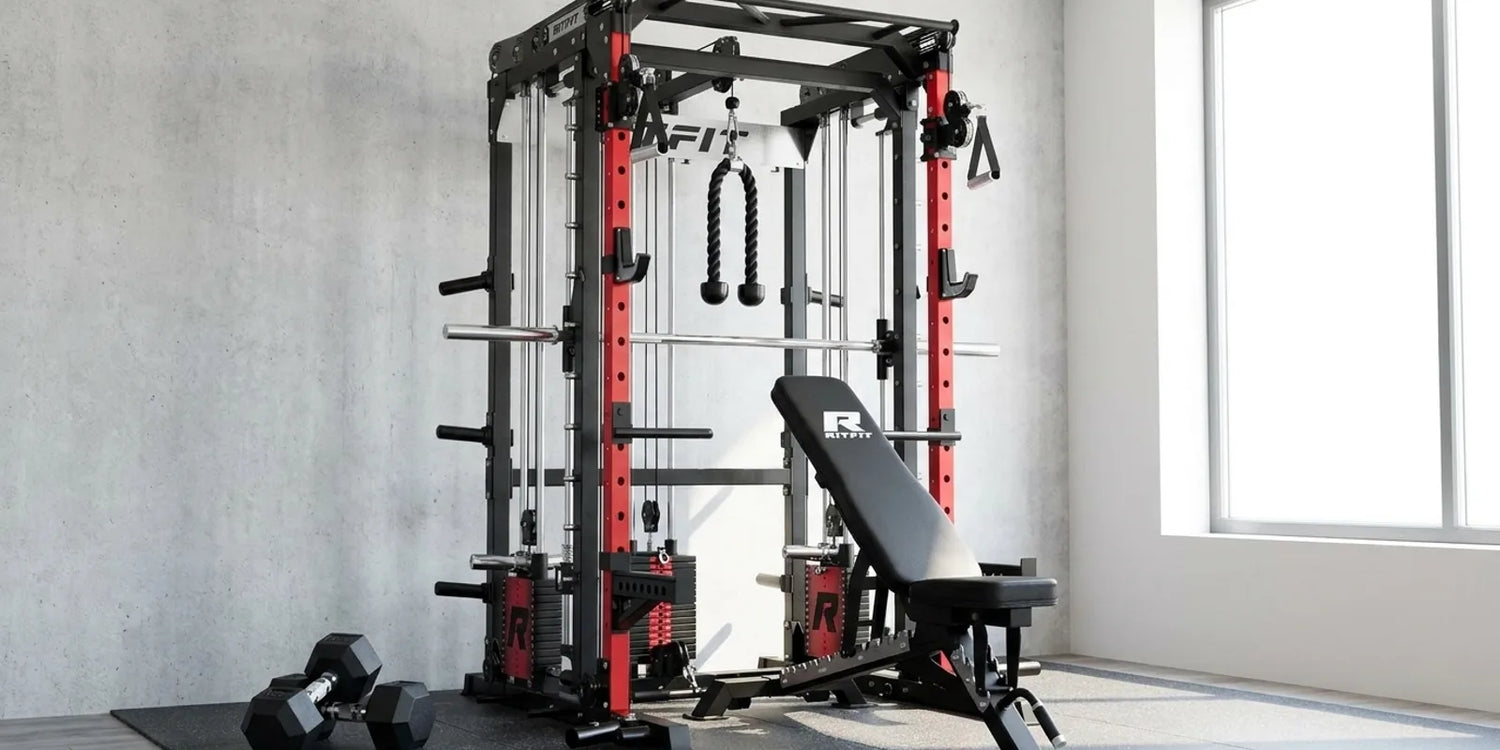
That range is what you get from a multi-functional home gym with built-in cable columns, such as the RitFit M2 Multi-Functional Modular Home Gym, which pairs a high pulley system with pressing and accessory stations.
"A functional trainer ranks high for its versatility, allowing you to recreate nearly any movement pattern you want, from curls and tricep pushdowns to face pulls and side lateral raises."
Jeff Cavaliere, MSPT, CSCS, Athlean-X
When you shop, look for a machine with a smooth high pulley, a stack that goes light enough to control, and a rope handle included or available. For a complete lineup of pulley-based options, browse the Cable Machine Collection, and pair any of them with a dedicated rope attachment so the movement feels identical to a gym cable station.
When Should You Stop a Rope Pushdown?
Stop the movement immediately if you feel sharp elbow or shoulder joint pain, and switch to a lighter load or a different exercise; a muscle burn is normal, but joint pain is not. If discomfort keeps coming back, let the joint rest and talk to a qualified professional.
The pushdown is low-risk when the elbows stay pinned and the load stays controlled, but two situations call for stopping early.
First, sharp pain in the front of the shoulder or inside the elbow means the joint is stressed, so end the set and reduce the load or the range of motion.
Second, a stinging sensation in the elbow when over-splitting the rope means you are pulling the ends too far apart, so narrow the split and slow down.
Mild muscle fatigue is expected; joint pain is the boundary you never train through.
If the pain does not settle after a few sessions, stop the movement entirely and consider an alternative like a bar pushdown or a dumbbell extension while you recover.
FAQs About the Triceps Rope Pushdown
What muscles does the rope pushdown work?
The rope pushdown primarily targets the triceps brachii, the three-headed muscle along the back of the upper arm that extends the elbow. The long head, lateral head, and medial head all contribute, with each head's share of work shifting based on shoulder position and elbow angle.
How do you set up for a rope triceps pushdown?
Attach a rope handle to a high cable pulley and set the cable to the top position.
Stand facing the machine, roughly a foot back, with feet shoulder-width apart and a slight forward lean.
Grip the rope ends with a neutral grip, then brace your core and pin your elbows to your sides.
What is the most common rope pushdown mistake?
The most common mistake is letting the elbows flare out, which shifts the load from the triceps to the shoulders and chest.
Relying on body momentum and cutting the rep short at the bottom also reduce triceps tension.
Keep the elbows pinned, control the return, and use a full range of motion.
How many rope pushdown sets and reps should I do?
Most lifters do two to four sets of eight to fifteen reps, stopping one or two shy of failure on the first set. Use the rope pushdown as an accessory after pressing work, two to three times per week, and add weight when you hit the top of your rep range with clean form.
Can I do rope pushdowns without a cable machine?
Yes.
If you do not own a cable machine, choose free-weight extensions that place the elbow in a similar fixed position, such as dumbbell kickbacks, lying triceps extensions, or close-grip bench press.
A resistance band anchored overhead can also mimic the pushdown path at home.
When should you stop a rope pushdown?
Stop immediately if you feel sharp elbow pain, joint pain, or a burning discomfort in the front of the shoulder during the movement.
A mild muscle burn is normal, but joint pain is not.
Choose a lighter load or an alternative exercise and consult a medical professional if discomfort persists.
Conclusion
The triceps rope pushdown reliably isolates the triceps brachii because pinning the elbows and extending against a cable keeps all three heads under tension. Master the setup, keep the elbows glued to your sides, split the rope only slightly at the bottom, and progress with clean sets of 8-15 reps.
Start light with a full range of motion, then add weight only when your form stays clean at the top of your rep range. At home, pick a cable-equipped machine and a rope handle, and check current deals on RitFit sales when you are ready to build your setup.
Disclaimer
This article is for general fitness education and is not medical advice. Always warm up properly, use controlled loads, and stop any exercise that causes joint pain, consulting a qualified professional if symptoms persist.
References
1. Landin D, Thompson M, Jackson M. Functions of the Triceps Brachii in Humans: A Review. J Clin Med Res. 2018;10(4):290-293. doi:10.14740/jocmr3340w. PMCID: PMC5827912
2. Kholinne E, Zulkarnain RF, Sun YC, Lim S, Chun JM, Jeon IH. The different role of each head of the triceps brachii muscle in elbow extension. Acta Orthop Traumatol Turc. 2018;52(3):201-205. doi:10.1016/j.aott.2018.02.005. PMCID: PMC6136322
3. Zaras N, Stasinaki AN, Mpampoulis T, Spiliopoulou P, Hadjicharalambous M, Terzis G. Effect of Inter-Repetition Rest Vs. Traditional Resistance Training on The Upper Body Strength Rate of Force Development and Triceps Brachii Muscle Architecture. J Hum Kinet. 2022;81:189-198. doi:10.2478/hukin-2022-0016. PMCID: PMC8884871





