








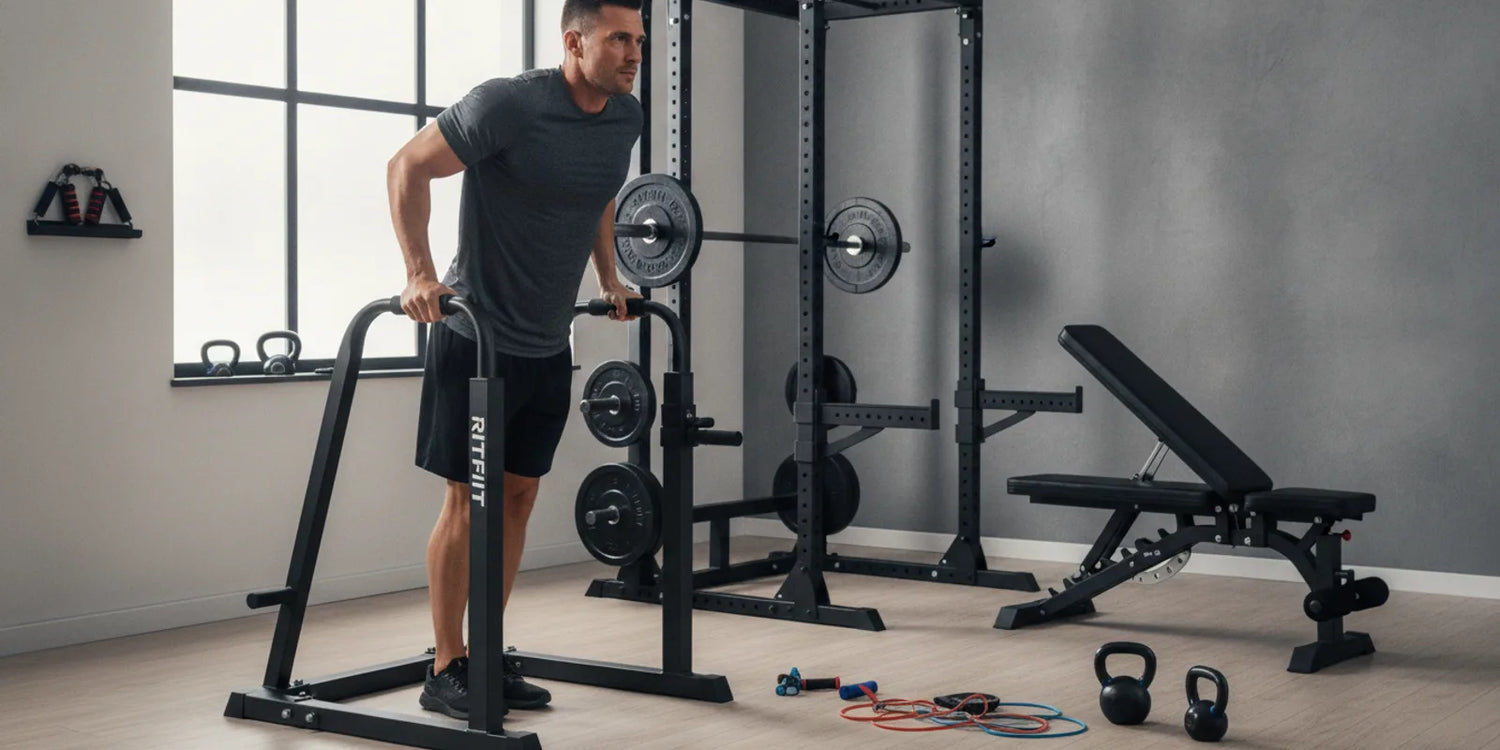
A dip station is a pair of parallel handles, standing alone, built into a power tower, or mounted to a rack, that lets you support your bodyweight to train your chest, triceps, and shoulders. The best dip station for you depends on your height, your floor space, and whether you plan to add weight.
This guide walks through the three questions to answer before buying, compares the three main equipment types, and covers safe dip form so a beginner can use a dip station without shoulder strain.
Quick Answer: The best dip station is chosen by matching bar height to your own height for leg clearance, footprint to your available floor space, and rated weight capacity to your bodyweight plus any added load, then picking a freestanding stand, power tower, or rack-mounted attachment based on those three factors.
Key Takeaways
- Bar height determines leg clearance: taller users, roughly six feet and up, need taller freestanding stands or an adjustable power tower to avoid bending their knees on every rep.
- Footprint scales with equipment type: freestanding stands need about 3x2 feet, power towers need roughly 3.5 to 4 feet in each direction, and rack-mounted attachments use almost no extra floor space.
- Weight capacity should exceed bodyweight plus added load: choose a rating at least 100 pounds above your heaviest planned dip belt or vest load, since manufacturer ratings are not lab-tested to failure.
- Torso angle controls muscle emphasis: leaning forward 25 to 35 degrees shifts work toward the chest, while an upright torso with tucked elbows emphasizes the triceps.
- Bar and ring dips out-activate bench dips: EMG research has found higher peak triceps activation on bar and ring dips than on bench dips, making a bar-style dip station a reasonable progression once bench dips feel easy.
What Does a Dip Station Actually Train?
A dip station trains your chest, triceps, and front shoulders by letting you lower and press your entire bodyweight through a deep range of motion between two parallel handles. Leaning your torso forward shifts more of that work onto your chest, while staying upright keeps the load mostly on your triceps.
- Pectoralis major: worked hardest with a forward torso lean and a deeper descent.
- Triceps brachii: the primary mover on an upright, elbows-tucked dip.
- Anterior deltoids: assist throughout the pressing motion on every dip variation.
- Core and hip flexors: stabilize your body and get extra work if you add knee raises or L-sit holds on the same station.
A 2022 study using 3D motion capture and surface EMG on experienced lifters found that peak triceps activation was higher on bar dips and ring dips than on bench dips, which supports using a bar-style dip station as a progression once bodyweight bench dips feel easy.[1] For a deeper breakdown of which muscles fire during each variation, see our guide on what muscles dips work, and pair your dip station with other pressing tools using our best chest machines for home gyms guide.
What Should You Check Before Buying a Dip Station?
Before buying a dip station, check three things: whether the bar height gives your legs enough clearance, whether the footprint fits your available floor space, and whether the rated weight capacity covers your bodyweight plus any load you plan to add. Skipping any one of these often means an uncomfortable or unsafe setup later.
- Height: measure your own height and compare it to the bar height listed by the manufacturer, since shorter stands force taller users to bend their knees on every rep.
- Space: measure the actual floor area you have free, including room to step in and out safely, not just the footprint printed in the spec sheet.
- Load plan: decide now whether you will eventually add a dip belt or weighted vest, since that decision changes which capacity rating you need.
Researchers evaluating upper-body strength in collegiate gymnasts have used bar dip one-rep max and 60-second max-rep testing to track pressing strength over a training block, which shows the bar dip is a recognized tool for measuring progress, not just a finisher exercise.[2] If you already know you want to progress into weighted dips, read are dip belts worth it before you finalize your capacity requirement.
Freestanding Stand, Power Tower, or Rack-Mounted Attachment?
The three common dip station types trade off cost, footprint, and versatility. A freestanding stand is the cheapest and smallest option but only does dips, a power tower adds pull-ups, leg raises, and push-up handles at the cost of more floor space, and a rack-mounted or wall-mounted attachment is the most space-efficient if you already own a compatible rack or a solid wall.
- Freestanding dip stand: lowest price and smallest footprint, but no pull-up bar and a fixed handle height.
- Power tower: pull-ups, dips, leg raises, and push-up handles in one unit, at the cost of the largest permanent footprint.
- Rack-mounted or wall-mounted attachment: minimal extra floor space, but only works if you already have a compatible power rack or are willing to drill into a wall.
Entry-level freestanding stands in this category commonly list around a 400 pound rated capacity in a compact footprint, while mid-price power towers typically spec 400 to 450 pounds with an adjustable backrest. If you are weighing a rack-mounted path, our best all-in-one power rack for home gym guide and best power cage with pull-up bar guide cover compatible rack options.
Which Dip Station Type Fits Your Situation?
Your best fit depends on which constraint matters most: budget and space favor a freestanding stand, exercise variety favors a power tower, and an existing rack favors an attachment. The table below breaks down each type by typical footprint, capacity, and trade-off.
| Type | Best For | Typical Footprint | Typical Capacity | Trade-Off |
|---|---|---|---|---|
| Freestanding Dip Stand | Tight space, lowest budget | About 3x2 feet | 250-400 lb | No pull-up bar, fixed height |
| Power Tower | Pull-ups, dips, and leg raises in one unit | About 3.5-4 feet | 250-450 lb | Largest permanent footprint |
| Rack or Wall-Mounted Attachment | Already own a rack or a solid wall | Minimal, uses existing structure | 300-1000+ lb, rack-dependent | Needs a compatible rack or drilling |
Footprint and capacity figures are typical ranges seen across reviewed products in each category, not lab-tested guarantees.
If you are still mapping out your overall equipment layout before deciding, our home gym guide walks through planning a full setup around whichever dip station type you choose.
Is a Higher Weight Capacity Worth the Extra Cost?
A higher weight capacity is worth the extra cost only if you actually plan to add load with a dip belt or weighted vest, since bodyweight-only training rarely approaches the rated limits of budget stands. Paying more for a 450 pound rating when you only ever do bodyweight dips buys you a safety margin, not a performance advantage.
- Bodyweight-only training: a 250 to 400 pound rated stand covers most adult users with room to spare.
- Weighted dip progression: choose a rating at least 100 pounds above your bodyweight plus your heaviest planned added load.
- Multi-user households: size the capacity to your heaviest household user, not an average.
Once your dip station's capacity comfortably covers your added load, progressive overload with a dip belt becomes the main lever for continued triceps and chest strength gains.
How Do You Adjust Dip Form for Chest vs Triceps?
Torso angle is the main lever for shifting emphasis during a dip: leaning forward 25 to 35 degrees with your elbows flared works your chest harder, while keeping your torso upright with elbows tucked close to your body emphasizes your triceps. Both variations should end in a full elbow lockout at the top.
- Chest-focused dip: lean forward 25 to 35 degrees, let elbows flare slightly, and descend until your upper arms are roughly parallel to the floor.
- Triceps-focused dip: stay upright, keep elbows close to your torso, and pause briefly at full lockout.
- Shoulder safety cue: keep your shoulder blades pulled back and down throughout the movement instead of letting them roll forward at the bottom.
Research on the bar dip found that training to fatigue increased chest and triceps muscle activation without significantly changing peak joint angles in a single set, though the same researchers note that fall risk remains a real consideration once you push multiple sets to failure.[3] The video below walks through common form mistakes on both variations.
For a closely related variation that is easier to scale for beginners, see our triceps bench dips form guide, and pair either version with our 30-minute chest and triceps workout.
What Mistakes Should You Avoid When Buying or Using a Dip Station?
The most common buying mistake is picking a stand based on price alone without checking bar height against your own height, and the most common usage mistake is leaning too far forward under heavy load, which has been linked to rare pectoral strain in case reports. Both mistakes are avoidable with a quick check before you buy or load up.
- Ignoring leg clearance: always compare bar height to your own height before buying, especially if you are over six feet tall.
- Overestimating stability on uneven floors: place a rubber mat under a freestanding stand on smooth concrete to stop rocking.
- Skipping the shoulder warm-up: cold shoulders combined with a deep dip range of motion is a common source of discomfort for beginners.
- Excessive forward lean under heavy load: keep forward lean moderate once you start adding a dip belt, since deep, heavily loaded forward-lean dips carry more shoulder and chest strain.
Once your equipment and form are dialed in, our full dips workout guide gives you a complete session to build from.
"Heavily loaded compound elbow extension exercises, such as dips, produce robust triceps hypertrophy and pressing strength gains."
Brad Schoenfeld, PhD and Jozo Grgic, PhD, Exercise Science Researchers, Strength and Conditioning Journal
FAQs About Dip Stations
What is a dip station used for?
A dip station is a pair of parallel handles, either freestanding, part of a power tower, or attached to a rack, that lets you support your bodyweight and perform dips to train the chest, triceps, and front shoulders. Many models also support knee raises, L-sits, and elevated push-ups for extra core and upper-body work.
How much space do I need for a dip station?
A standalone dip stand typically needs about a 3-foot by 2-foot footprint plus a few feet of clearance for your legs and dismount. A full power tower needs roughly 3.5 to 4 feet in each direction, while a rack-mounted or wall-mounted dip attachment needs the least floor space but requires a compatible rack or solid wall.
What weight capacity should I look for?
If you only plan bodyweight dips, a stand rated 250 to 400 pounds holds up fine for most adults. If you plan to add a dip belt or weighted vest, choose a station rated at least 100 pounds above your bodyweight plus the heaviest load you intend to add, since manufacturer ratings are not lab-tested to failure.
Should I choose a freestanding stand or a power tower?
Choose a freestanding dip stand if you already have a pull-up bar and want the smallest footprint and lowest cost. Choose a power tower if you want pull-ups, leg raises, and push-up handles in one unit and have the floor space, since it trades portability for exercise variety in a single piece of equipment.
How does bar height affect who should use a dip station?
Lower freestanding stands, often around 35 inches tall, can force taller users to bend their knees to clear the floor during dips. If you are over roughly six feet tall or want straight-leg dips, look for taller bars, an adjustable-height power tower, or a rack-mounted attachment set at a compatible height.
Do dips work the chest or the triceps more?
Torso angle decides the emphasis: leaning your torso forward about 25 to 35 degrees with elbows flared shifts more work to the chest, while staying upright with elbows tucked close to the body emphasizes the triceps. Research using EMG has found bar and ring dips produce higher peak triceps activation than bench dips.
Are dip stations safe for beginners?
Yes, when used with controlled form, keep shoulder blades pulled back and down, descend only until your upper arms are roughly parallel to the floor, and avoid excessive forward lean under heavy load, which has been linked to rare pectoral strain in case reports. Beginners should master bodyweight dips before adding a dip belt.
Conclusion
Choosing the best dip station comes down to matching bar height to your own height, footprint to your available space, and rated capacity to your load plans, not just picking the top-rated product on a list. Freestanding stands fit tight budgets and small spaces, power towers add exercise variety, and rack-mounted attachments make sense if you already own compatible equipment.
Start with bodyweight dips, master the chest and triceps torso-angle cues from this guide, then progress toward weighted dips only once your form is consistent. Browse current deals on the RitFit sales page before you buy your equipment.
Train smarter and save more
Get practical training advice, new product updates, and subscriber offers delivered directly to your inbox.
- Training guides
- Product launches
- Exclusive offers
Join the RitFit community
Enter your email below to receive the latest RitFit updates.
By signing up, you agree to receive RitFit marketing emails. You can unsubscribe at any time.
Disclaimer
This article is for general fitness and educational purposes only and does not replace personalized guidance from a qualified trainer or physician, particularly if you have an existing shoulder, elbow, or chest injury. Consult a healthcare or fitness professional before starting a new dip training program or adding significant weighted load.
Save on your next RitFit order
Tap the button to copy your code, then paste it at checkout.
References
1. McKenzie A, Crowley-McHattan Z, Meir R, Whitting J, Volschenk W. Bench, Bar, and Ring Dips: Do Kinematics and Muscle Activity Differ?. Int J Environ Res Public Health. 2022;19(20). doi:10.3390/ijerph192013211. PMCID: PMC9603242
2. Li A, Tang J, Zheng K, Chen J, Wang G, Feng D. Effects of low-load blood flow restriction vs. high-load resistance training on upper-body strength in male collegiate gymnasts: A randomized controlled trial. J Exerc Sci Fit. 2026;24(2):200456. doi:10.1016/j.jesf.2026.200456. PMCID: PMC12925195
3. McKenzie A, Crowley-McHattan Z, Meir R, Whitting J, Volschenk W. Fatigue Increases Muscle Activations but Does Not Change Maximal Joint Angles during the Bar Dip. Int J Environ Res Public Health. 2022;19(21). doi:10.3390/ijerph192114390. PMCID: PMC9659300





