








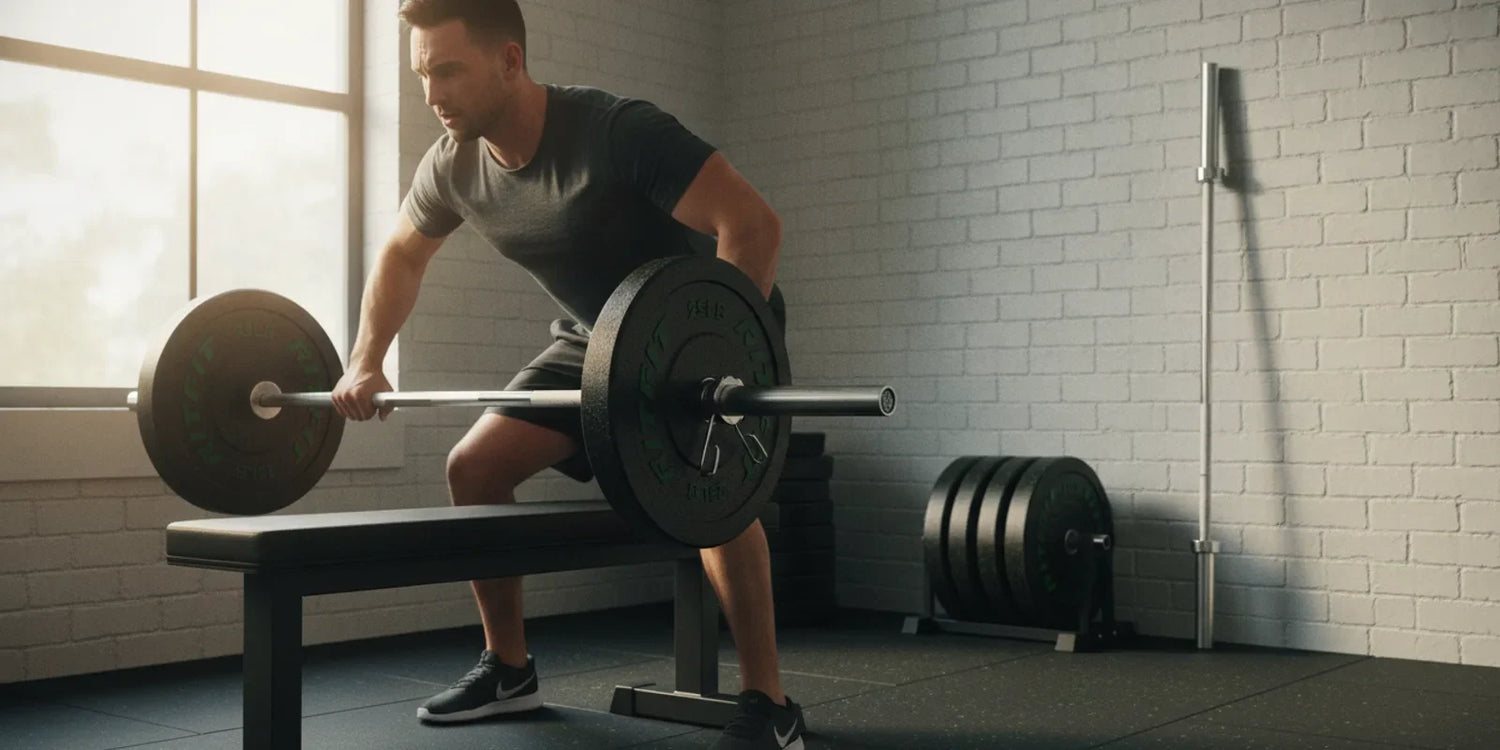
If someone says they are loading a plate and 25 on the bench, they mean 185 pounds total. That number combines the bar, the 45 pound plates, and the 25 pound plates in a specific way.
This guide decodes that shorthand, teaches the simple formula behind it, and shows you how to load and progress safely.
Quick Answer
A plate and 25 on the bench equals 185 pounds. That is a 45 pound Olympic bar plus one 45 pound plate and one 25 pound plate on each side, which adds 140 pounds of plates to the bar.
Key Takeaways
- The total is 185 pounds: A plate and 25 per side on a standard bar adds up to 185 pounds in all.
- A plate means 45 pounds per side: In gym shorthand, one plate is a single 45 pound plate loaded on each end.
- The bar always counts: A men's Olympic bar weighs 45 pounds and is part of every total you lift.
- The formula is simple: Multiply one side by two, then add the bar weight to get the true total.
- Load smart and progress gradually: Use collars, balance both sides, and add small plates to bridge to 225.
| Brand | RitFit Sports |
|---|---|
| Featured Products | Adjustable benches from the adjustable weight benches lineup |
| Key Specs | 45 lb Olympic bar, 45 lb and 25 lb plates, 70 lb per side, 185 lb total |
| Best For | Beginner and intermediate lifters decoding gym plate shorthand |
How Much Is a Plate and 25 on the Bench in Total?
A plate and 25 on the bench is 185 pounds total. That figure comes from a 45 pound bar plus a 45 pound plate and a 25 pound plate on each side.
- The bar: A standard men's Olympic barbell weighs 45 pounds.
- Each side: One 45 pound plate plus one 25 pound plate equals 70 pounds per side.
- Both sides: 70 pounds times two equals 140 pounds of plates total.
- Grand total: 140 pounds of plates plus the 45 pound bar equals 185 pounds.
This 185 pound mark sits right between the one plate milestone of 135 and the two plate milestone of 225, making it a popular working weight. To learn the next step up, see our guide on how much two plates on bench is.
What Does a Plate Actually Mean in the Gym?
A plate in gym shorthand almost always means one 45 pound plate loaded on each side of the bar. So one plate describes 135 pounds total.
The Bar Itself Counts as 45 Pounds
A standard men's Olympic bar weighs 45 pounds, and one loading guide notes this weight is always part of your total loaded weight. For a deeper breakdown, read our explainer on how much a bench press barbell weighs.
A Plate Means One 45 Pound Plate Per Side
When lifters count in plates, they count per side, not as a grand total. So a plate and 25 means a 45 plus a 25 on each end, not 45 plus 25 in total.
- Per side language: Plate talk always describes what hangs on one end of the bar.
- Symmetry assumed: Both sides carry identical plates unless stated otherwise.
- The bar is implied: The 45 pound bar is included even though nobody mentions it.
How Do You Calculate Total Bar Weight From the Plates?
You calculate total bar weight by multiplying one side by two, then adding the bar. The formula is total equals bar weight plus two times the weight loaded on one side.
Worked Example: How a Plate and 25 Hits 185 Pounds
One side holds a 45 and a 25, which is 70 pounds, so both sides add 140 pounds to the 45 pound bar. That sum is exactly 185 pounds.
- Step one: Add the plates on one side, here 45 plus 25 equals 70 pounds.
- Step two: Multiply by two for both sides, giving 140 pounds.
- Step three: Add the 45 pound bar to reach 185 pounds total.
Tracking the true total of bar plus plates matters because accurate load records underpin smart intensity planning over time.[1] The short clip below walks through the same plate math step by step.
What Are the Common Bench Weights and Plate Combinations?
The common bench weights follow predictable plate patterns built around the 45 pound bar. Knowing them lets you load any target quickly without doing fresh math each time.
| Total Weight | Per Side | Plates Per Side |
|---|---|---|
| 95 lb | 25 lb | 1 x 25 |
| 135 lb | 45 lb | 1 x 45 (one plate) |
| 185 lb | 70 lb | 1 x 45 + 1 x 25 (a plate and 25) |
| 225 lb | 90 lb | 2 x 45 (two plates) |
| 275 lb | 115 lb | 2 x 45 + 1 x 25 |
| 315 lb | 135 lb | 3 x 45 (three plates) |
If you want a benchmark for where you stand, our guide on how much you should be able to bench puts these numbers in context, and the average bench for women piece offers another reference point.
How Do You Load the Bar Safely for 185 Pounds?
You load the bar safely by placing the heaviest plates closest to the collar and securing both ends. Standard practice loads discs in descending order by weight, equally divided between the two sides.[2]
- Heaviest first: Slide the 45 pound plate on first, then the 25 pound plate outside it.
- Match both sides: Load one plate per side at a time so the bar stays balanced.
- Lock the collars: Clip a collar on each end before you unrack or lift.
- Verify the count: Walk around the bar and confirm both sides match.
A sturdy, well rated bench keeps this load stable, so consider the RitFit 1300 lb adjustable weight bench or the compact RitFit Gator adjustable weight bench for home setups. Pair either with a structured bench workout to put 185 pounds to use.
What Mistakes Throw Off Your Plate Count?
The biggest mistake is forgetting the bar, which makes lifters underestimate their real weight by a full 45 pounds. A few simple habits prevent miscounts.
- Skipping the bar: Always start your total at 45 pounds before adding any plates.
- Counting total instead of per side: Remember that a plate and 25 means each end, not the whole bar.
- Mismatched sides: An uneven load shifts balance and can compromise your press.
- Ignoring collar weight: Heavy collars add a small amount worth noting for precise tracking.
For programming context that builds on correct loading, see our bench workout guide.
When Should You Add Weight and Progress Past 185?
You should add weight when your current load feels controllable for your target reps with a rep or two left in reserve. Velocity and reps in reserve help judge when a load is right and when to progress.[3]
- Bridge the gap: Add 10 or 5 pound plates per side to move past 185 toward 225 gradually.
- Small jumps win: Climbing in steps beats jumping the full 40 pounds to two plates at once.
- Estimate your max: A rep test on a moderate weight predicts roughly where your top single sits.
That estimating approach is something exercise scientists describe plainly.
"If I did 75 pounds on my bench press and I did it eight times, you can just run an estimate to say, okay, you're probably going to be able to bench about 95 pounds for one rep max."
Andy Galpin, PhD, Professor of Exercise Science and Human Performance, Parker University
FAQs About Bench Plate Math
How much is a plate and 25 on the bench?
A plate and 25 on the bench equals 185 pounds. That is the 45 pound Olympic bar plus one 45 pound plate and one 25 pound plate on each side. Each side holds 70 pounds of plates, so two sides add 140 pounds to the 45 pound bar for a 185 pound total.
What does a plate mean in gym slang?
In gym shorthand, a plate almost always means one 45 pound plate loaded on each side of the bar. So one plate on the bench refers to 135 pounds total, which is the 45 pound bar plus two 45 pound plates. The phrase describes plates per side, not the grand total.
Does the barbell count toward the total weight?
Yes, the barbell always counts. A standard men's Olympic bar weighs 45 pounds, and that weight is part of what you are lifting. Forgetting the bar is the most common counting mistake, and it makes lifters underestimate their real working weight by a full 45 pounds.
How do you calculate total barbell weight from the plates?
Use this formula, multiply the weight on one side by two, then add the bar weight. For a plate and 25 per side, that is 70 pounds times two, which is 140 pounds, plus the 45 pound bar. The result is 185 pounds total loaded on the bench.
What is the next jump after a plate and 25?
After 185 pounds, the classic next milestone is two plates, or 225 pounds, which means two 45 pound plates per side. To bridge the gap, you can add small increments such as 10 or 5 pound plates per side, moving up gradually instead of jumping the full 40 pounds at once.
Conclusion
A plate and 25 on the bench is 185 pounds, built from a 45 pound bar plus a 45 and a 25 on each side. Once you know the formula, you can decode any plate shorthand in seconds and load with confidence.
Start tracking the bar in every total, load symmetrically, and apply the formula to your next bench session with confidence.
Disclaimer
This article is for general educational purposes only and does not replace personalized coaching or medical advice. Consult a qualified trainer or healthcare professional before starting or changing any strength training program.
Save on your next RitFit order
Tap the button to copy your code, then paste it at checkout.
References
1. Gantois P, Fonseca FS, Nakamura FY, Fortes LS, Fernandez-Fernandez J, Batista GR. Analysis of velocity- and power-load relationships of the free-weight back-squat and hexagonal bar deadlift exercises. Biol Sport. 2023;40(1):201-208. doi:10.5114/biolsport.2023.112966 https://pmc.ncbi.nlm.nih.gov/articles/PMC9806758/
2. Ferri Marini C, Shoaei V, Micheli L, et al. Barbell load distribution and lifting velocity affect bench press exercise volume and perceived exertion. PLoS One. 2022;17(12):e0278909. doi:10.1371/journal.pone.0278909 https://pmc.ncbi.nlm.nih.gov/articles/PMC9733861/
3. Jukic I, Prnjak K, Helms ER, McGuigan MR. Modeling the repetitions-in-reserve-velocity relationship: a valid method for resistance training monitoring and prescription, and fatigue management. Physiol Rep. 2024;12(5):e15955. doi:10.14814/phy2.15955 https://pmc.ncbi.nlm.nih.gov/articles/PMC10901726/





