








Disclosure: RitFit is our own brand. Links to RitFit products in this article point to the official RitFit store and our own seller pages, and we benefit from purchases made through them.
Single-leg calf raises on a Smith machine work because the guided bar carries the load while your ankle does all the moving. This guide covers setup, loading, and clear comparisons with the seated, donkey, and double-leg versions.
Expect exact bar placement, step height, sets and reps, and rules for when to add weight or stop for pain.
Quick Answer: Yes, single-leg calf raises on a Smith machine work well because the guided bar removes the balance problem and lets each calf carry a heavy load through a full range of motion. Rest the bar on the same side shoulder or grip it at hip height, stand on a plate step, pause at the top, and train the weaker leg first.
Key Takeaways
- It works: The Smith machine guided bar lets one calf carry a heavy, stable load through a full range of motion without the balance penalty of dumbbell single-leg raises.
- Fix asymmetry: Single-leg loading forces each calf to carry the full bar, closing left-right strength gaps that two-leg raises hide.
- Setup is simple: Bar at hip height or on the same side shoulder, a plate step under the working foot, and hooks set for a quick re-rack.
- Standing work grows the calf: A 12-week training comparison found far more lateral gastrocnemius growth from standing raises than seated raises.[1]
- Train calves often: Two to three sessions per week with progressive overload beat one heavy day, and tendon pain means regress rather than push.
Can You Do Single-Leg Calf Raises on a Smith Machine?
Single-leg calf raises on a Smith machine work better than the dumbbell version because the guided bar removes the balance penalty while each calf handles the full load. The rails keep the bar on a fixed vertical path, so ankle strength rather than wobble decides the set. That setup turns a balance-challenged bodyweight move into a heavy, repeatable lower-leg builder.
- Single-leg loading raises the ceiling: Two-leg raises split the load and let the stronger calf set the pace, while one leg at a time carries the whole bar and pushes past bodyweight.
- The bar handles balance for you: Rest it across the same side shoulder and let the rails hold it, or keep it at hip height and grip the bar itself.
- The guided path frees your focus: With the balance variable gone, all attention goes to driving through the ball of the foot and squeezing the top of plantar flexion.
- A plate step gives the ankle room: Standing on a bumper plate or low plyo box lets the heel drop below the toes for a full stretch and full dorsiflexion at the bottom.
Smith machine veterans rely on the same principle when their leg work gets heavy, as Jeff Nippard explains of his own training on the machine:
"Next, I do Smith machine squats for the quads and glutes. Here I get as deep as I can and explode out of the hole. Doing these on the Smith allows me to push my last set to failure without worrying about dumping the bar."
Jeff Nippard, Science-Based Natural Bodybuilder and Powerlifter, JeffNippard.com, Jeff Nippard's Science-Backed Leg Workout for Massive Quads (Men's Health UK)
Single-Leg vs Double-Leg, Seated, and Donkey Smith Machine Calf Raises
Single-leg Smith machine calf raises fix left-right strength gaps and raise the per-side load ceiling beyond the two-leg version. The seated version shifts work toward the soleus, the donkey version trains the stretched position, and the double-leg standing version remains the heavy baseline builder. Pick each variation for the job it does best.
| Variation | Muscles emphasized | Best for | Watch out for |
|---|---|---|---|
| Single-leg standing on a Smith machine | Gastrocnemius and soleus, one side at a time | Fixing uneven calves and loading each leg beyond bodyweight | Sets take longer because each leg trains separately |
| Double-leg standing on a Smith machine | Whole triceps surae | Moving the most total weight and learning the movement | The stronger leg can hide the weaker one |
| Seated on a Smith machine | Soleus emphasis with a bent knee | Adding thickness low in the calf after standing work | Less stretch on the gastrocnemius |
| Donkey on a Smith machine | Gastrocnemius in the stretched position | Training the lengthened range with hip-friendly loading | The bent-over setup takes practice |
| Bodyweight single-leg | Gastrocnemius and soleus, one side at a time | Beginners, warmups, and travel | Hard to overload beyond bodyweight |
Roles reflect standard training practice. The standing versus seated hypertrophy comparison comes from the 12-week training study cited below.
If a bigger, more visible calf is the goal, favor standing work. In a 12-week training study, standing knee-extended calf raises grew the lateral gastrocnemius 12.4% versus 1.7% for seated knee-flexed raises on the other leg, and the whole triceps surae 5.6% versus 2.1%, while soleus gains were similar at 2.1% versus 2.9%.[1]
Each version has its own full guide: bodyweight single-leg calf raises for the no-equipment version, double-leg Smith machine calf raises for the baseline builder, seated Smith machine calf raises for soleus work, and donkey calf raises on a Smith machine for the stretched position.
Set Up the Smith Machine for Single-Leg Calf Raises
The Smith machine bar sits at hip height for single-leg calf raises so you can step under it and unrack with a straight ankle. A bumper plate or low plyo box goes under the working foot so the heel can travel below the toes. Set the safety hooks one hole below your finished height so a quick quarter turn re-racks the bar without stepping off the box.
- Bar height: Hip height, close to where you set up a deadlift, with the bar clearing the step by a few inches at lockout.
- Bar on your body: Same side shoulder with one hand steadying it, or both hands gripping at hip height, whichever keeps the stack over the working foot.
- Step height: Start with one bumper plate (around 2 inches) and move to a 6-inch step when ankle mobility allows a full stretch without the heel lifting.
- Foot position: Ball of the foot on the edge of the step, heel free, with the toes pointed straight ahead or slightly out.
Run one set with the empty bar before adding plates, and keep the floor clear so the step cannot slide mid-set.
Do the Single-Leg Calf Raise Step by Step
The single-leg Smith machine calf raise is a short, strict movement that ends with a hard pause at the top of plantar flexion. Rise as high as possible onto the ball of the foot, hold the peak contraction, then lower the heel below the step edge. Train one leg per set and match the same reps on the second side.
- Step 1: Get under the bar. Rest the bar on the same side shoulder or grip it at hip height, and stand with the ball of the working foot on the step edge.
- Step 2: Unrack and settle. Rise a quarter of the way, release the hooks, and find the balance point with the knee soft rather than locked.
- Step 3: Rise to full plantar flexion. Push through the ball of the foot until the heel is as high as it goes, then hold the peak contraction for one second.
- Step 4: Lower to a full stretch. Drop the heel below the step over two to three seconds, feel the calf lengthen, and pause briefly before the next rep.
- Step 5: Match both sides. Finish all reps on the weaker leg first, then repeat the same count on the stronger leg.
Slow lowering raises time under tension on the calf, and the brief pause at the bottom kills the bounce that shifts stress into the Achilles tendon. Keep the knee nearly straight throughout so the calf, not momentum or hip drive, does the work.
Does the RitFit PSR05 Smith Machine Work for Single-Leg Calf Raises?
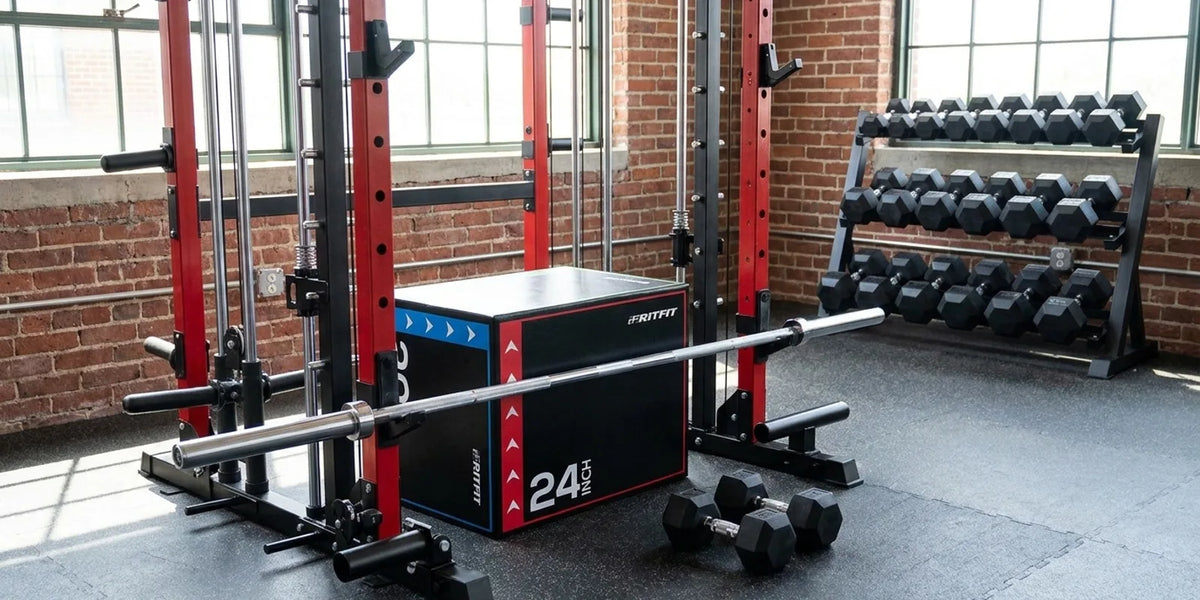
The RitFit PSR05 2.0 Multifunctional Smith Machine handles single-leg calf raises well because its guided bar and height-adjustable hooks cover both bar positions and a quick re-rack. The power rack frame anchors a plate step, and the lat pulldown system keeps calves inside a complete leg day.
For a garage gym where one rig does everything, that combination means calf work slots between squats and pulldowns without moving equipment. Lifters who want guided single-leg loading also skip buying a separate standing calf raise station.
Shoppers comparing frames and footprints can browse the Smith machine collection for the machine that fits their space.
Choose the RitFit PSR05 If You Want Calves and Leg Day on One Rig
The guided bar gives beginners a stable platform for single-leg calf raises while the same frame handles heavy squats, presses, and pulls as strength grows.
"If you're short on space, this compact Smith machine delivers everything you need for a complete strength-training experience. The machine is well designed with a small footprint, making it ideal for my home gym. Very happy with this purchase."
Maria del Carmen S. Verified Buyer, RitFit PSR05 2.0 Smith Machine Home Gym Package
Choose Load, Reps, and Progression for Single-Leg Calf Raises
Start single-leg Smith machine calf raises with the empty bar plus one small plate per side and build toward three to four sets of eight to twelve reps per leg. Add load only when every rep includes a full stretch, a one second peak contraction, and no pain. Calves tolerate frequent work, so plan two to three sessions per week.
- Starting load: Empty bar first, then the smallest plates available, because ankle strength lags behind quad and glute strength.
- Rep range: Eight to twelve reps per leg for three to four sets, finishing each set one or two reps shy of failure.
- Tempo: One second pause at the top, two to three seconds down, brief pause at the bottom, and no bouncing.
- When to add weight: Move up a plate after two sessions where you clear the top of the rep range with perfect range of motion.
- Finishers: After failure, continue with partial reps in the stretched position, which adds training volume without extra equipment.
Unilateral training produces real growth when it stays consistent. In a 10-week study, men who trained one leg at a time added about 8% gastrocnemius thickness, and sets extended with partial reps in the stretched position produced greater gains per set, 0.16% versus 0.08%.[2]
Adaptation is not only size. Eight weeks of simple home calf raises raised rapid plantar flexor force production 21% versus control in a study of healthy men in their seventies.[3]
For context, the standing versus seated comparison used 70% of one-repetition maximum for 10-rep sets, 5 sets per session, 2 sessions per week across 12 weeks. That dose scales up or down with your training age.
Weekly volume questions get a full breakdown in how many calf raises to program each week.
Add Single-Leg Calf Raises to Your Smith Machine Leg Day
Place single-leg calf raises at the end of a Smith machine leg day, after squats and lunges, when the calves are warm but not yet fatigued. Two to four sets per leg finish the session without stealing performance from the big movements. Train them on a second lower-body day later in the week if calf size is the priority.
- After squats: Heavy quad and glute work first, calves last, because single-leg raises never limit your squat but heavy squats will limit your raises.
- On a second lower-body day: Pair single-leg Smith raises with hamstring or glute work for extra weekly calf volume.
- As a finisher: One all-out set per leg with slow negatives closes the session when time is short.
For a complete lower-body rotation, follow our leg day workout and slot the single-leg raise into the finisher block.
Common Mistakes and Fixes for Single-Leg Calf Raises
Most single-leg calf raise mistakes cut range of motion, bounce the stretch, or shift effort from the calf to the ankle joint. Fixing the biggest form leaks does more for growth than adding another plate. Work through the checklist below before you progress the load.
- Cutting the range: If the heel never drops below the step, the calf never lengthens and the set misses its main growth stimulus. Lower until the stretch is obvious.
- Bouncing the bottom: Momentum out of the stretch trains the Achilles tendon more than the calf. Pause briefly at the bottom instead.
- Standing on the whole foot: Keep the ball of the foot on the step edge so the ankle can travel through full dorsiflexion and full plantar flexion.
- Letting the knee bend: A soft knee is fine, but a squatting pattern shifts work away from the calf. Keep the leg nearly straight.
- Rushing the top: Without a peak contraction at full plantar flexion, the hardest part of the range never gets trained. Hold it for one second.
Record one side-view set if you train alone, because small form leaks disappear in the mirror.
Swap in Other Calf Raise Variations When You Need Them
Swap single-leg Smith machine calf raises for seated, donkey, double-leg, or leg press calf raises whenever equipment, fatigue, or ankle mobility changes what your calves need. Rotate variations across the week instead of chasing one perfect movement. Each swap keeps progressive overload moving while a different part of the calf takes the lead.
- Seated Smith machine calf raises: Choose the seated version when the soleus needs direct work or the gastrocnemius is already tired from standing sets.
- Donkey calf raises: Use the bent-over donkey position to train the stretched range when standing ankle travel feels limited.
- Double-leg Smith machine calf raises: Go back to two legs after heavy single-leg blocks to handle more total weight with less setup time.
- Leg press calf raises: Load the calf heavily on a plate-loaded machine when the Smith station is busy or the lower back needs a break. Our leg press calf raise setup covers the full form.
- Rack-based raises: Without a Smith machine, calf raises with a squat rack give a similar loaded stretch.
Browse more ideas in our Smith machine calf exercises roundup, or shop the leg machine collection if a dedicated calf machine fits your space.
When Should You Stop Doing Single-Leg Calf Raises?
Stop single-leg calf raises when sharp Achilles tendon pain, ankle pinching, or foot numbness shows up, because training through those signals can turn a small issue into a long layoff. Muscle effort and mild soreness are fine, but joint and tendon pain is a warning. Drop back to double-leg raises, shrink the step height, and reduce the load before rebuilding.
- Sharp or sudden pain: Pain at the Achilles tendon or ankle that changes how you walk ends the session immediately.
- Pain that grows set to set: Discomfort that climbs through the workout rather than fading is a reason to stop early.
- Numbness or tingling: Sensation changes in the foot mean the bar or position is compressing something, so re-rack and adjust.
- Regression ladder: Drop to double-leg raises, shorten the range, and lighten the load before rebuilding single-leg work pain free.
If pain persists beyond a few days of rest, seek a qualified evaluation before returning to loaded calf work.
FAQs About Single-Leg Calf Raises on a Smith Machine
Can you do single-leg calf raises on a Smith machine?
Yes. The guided bar holds the load in a fixed vertical path, so you can stand on one leg and push through the ball of your foot without wobbling or holding a dumbbell. Set the bar at hip height, stand on a weight plate step, and train each leg separately.
Where should the bar sit for single-leg calf raises?
Rest the bar across the shoulder of the working leg and hold it lightly, or keep it at hip height and grip it for balance. The shoulder position frees both hands and stacks the weight over the calf, while the hand supported position gives beginners more control while they learn the ankle action.
How does the single-leg version compare with seated and donkey Smith machine calf raises?
Use each variation for a different job. Standing single-leg raises fix strength imbalances and load one calf hard, seated raises shift work toward the soleus, donkey raises train the stretched position, and double-leg standing raises are the heavy baseline builder that suits most lifters first.
How much weight should you use for single-leg calf raises on a Smith machine?
Start with the empty Smith bar plus one small plate per side and master full range of motion first. Add weight in small steps only when every rep includes a one second pause at the top and a controlled stretch at the bottom without pain.
How often should you train single-leg calf raises?
Train calves two to three times per week with at least one day between sessions. Calves recover quickly, so steady frequency plus progressive overload beats one heavy day, and you can rotate single-leg Smith raises with seated or donkey variations across the week.
Do single-leg calf raises fix uneven calves?
Yes. Single-leg training is the standard fix for left-right calf imbalances because the weaker leg cannot hide behind the stronger one. Start each set with the weaker leg and match the same reps on the stronger side until the size and strength gap closes.
When should you stop doing single-leg calf raises?
Stop the set if you feel sharp pain at the Achilles tendon, pinching in the ankle, or numbness in the foot. Muscle effort and mild soreness are fine, but joint or tendon pain is a warning, so regress to double-leg raises and lighter loads before rebuilding.
Conclusion
Single-leg calf raises on a Smith machine give you what bodyweight raises cannot: heavy, stable loading for each calf through a full range of motion. Set the bar at hip height or on the same side shoulder, stand on a plate step, pause at the top, and train the weaker leg first.
Start with three to four sets of eight to twelve reps per leg, twice a week, and add a plate when the reps feel clean. Check our RitFit discount guide before you add equipment.
Disclaimer
This article is general training information, not medical diagnosis or treatment advice. Stop exercising and consult a qualified healthcare professional before continuing if you have calf, Achilles tendon, or ankle pain or a history of lower-leg injury.
References
1. Kinoshita M, Maeo S, Kobayashi Y, et al. Triceps surae muscle hypertrophy is greater after standing versus seated calf-raise training. Front Physiol. 2023;14:1272106. doi:10.3389/fphys.2023.1272106. PMCID: PMC10753835
2. Goli A, Attarieh P, Nunes JP, et al. Does Performing Partial Repetitions Beyond Momentary Failure Enhance Muscle Hypertrophy in Volume-Load-Equated Calf-Raise Resistance Training?. Int J Exerc Sci. 2026;19(4):4003. doi:10.70252/IJES2026403. PMCID: PMC13075556
3. Ema R, Ohki S, Takayama H, Kobayashi Y, Akagi R. Effect of calf-raise training on rapid force production and balance ability in elderly men. J Appl Physiol (1985). 2017;123(2):424-433. doi:10.1152/japplphysiol.00539.2016. PMCID: PMC5583613





