








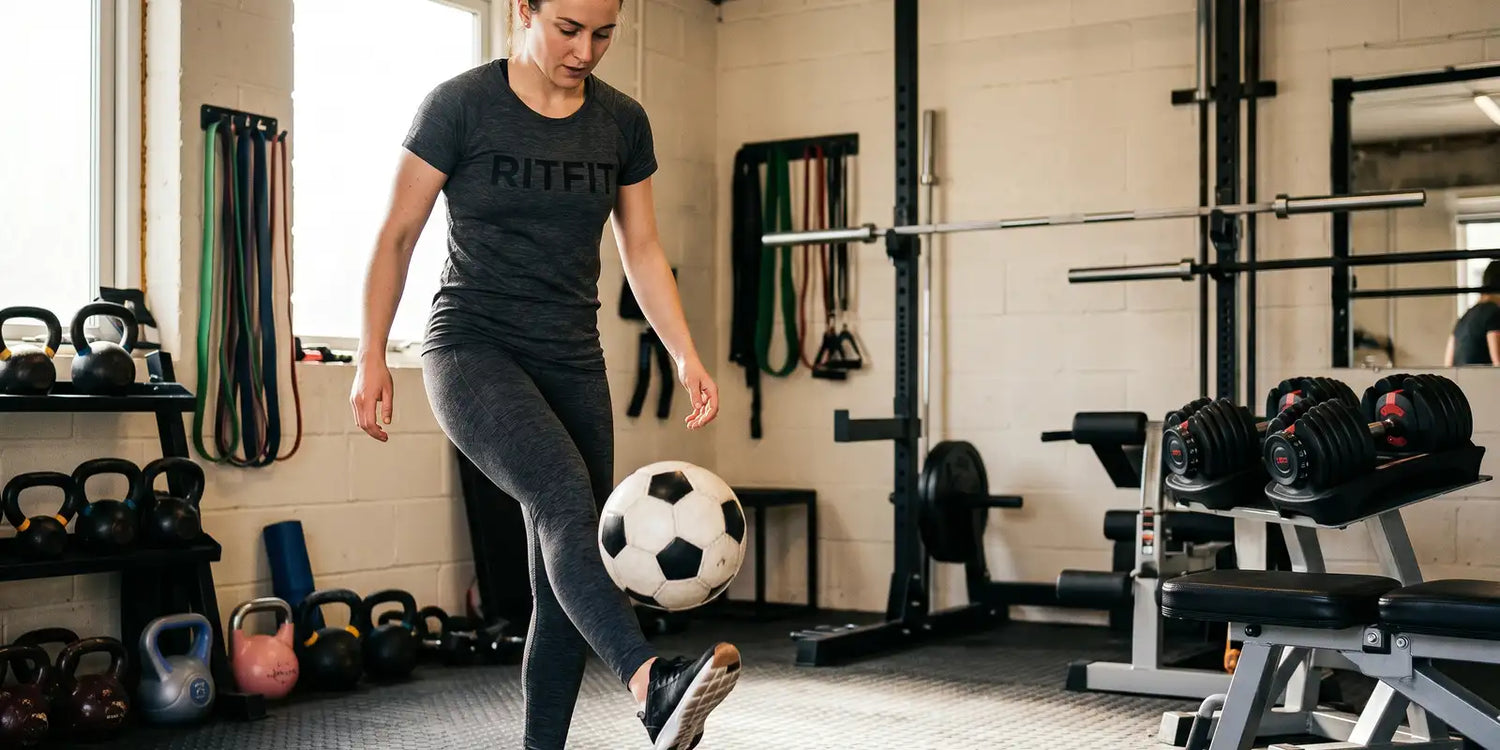
Juggling a soccer ball is the fastest way to build a soft first touch, ball control, and confidence on the field. This guide walks you through correct setup, a clear five level progression, the technique cues that matter, and the common mistakes to fix.
It suits beginners, parents coaching kids, and adult recreational players. You will also learn how off the ball balance and single leg strength make every touch steadier.
Table of Contents
- How should you set up before your first touch?
- What is the five level juggling progression?
- Which technique cues actually matter?
- What are the most common juggling mistakes?
- How should you structure daily practice?
- Does balance and strength training help your juggling?
- Why does juggling pay off in real games?
Key Takeaways
- Start with setup: Lock your ankle, stay light on your toes, and aim each touch straight up to about waist height.
- Use backspin: Contact the lower center of the ball with your laces to create backspin that pulls it back toward you.
- Follow a progression: Move from self drops to two touches, alternating feet, no bounce, then thighs toward 100 juggles.
- Practice daily: Short sessions of 10 to 15 minutes every day beat one long weekly session for steady improvement.
- Train the body behind the touch: Single leg balance, core, and coordination work make your standing leg steadier and your touches cleaner.
How should you set up before your first touch?
Set up by standing relaxed with knees slightly bent, feet about shoulder width apart, and your weight light on your toes. Hold the ball at waist height in both hands so you can drop it cleanly onto your dominant foot.
- Body position: Keep your head over the ball, shoulders loose, and stay ready to take a small step in any direction.
- Ball choice: Use a properly inflated, correctly sized ball so it bounces predictably, and check our guide on what size soccer ball do I need first.
- Surface: Begin on flat, even ground with space around you so a stray touch never sends you chasing the ball into a hazard.
A calm, balanced stance gives you time to react. If you want a fuller primer, read our walkthrough on how to juggle a soccer ball for beginners.
What is the five level juggling progression?
The five level progression takes you from zero to 100 plus juggles by adding one challenge at a time. Each level builds a specific skill, so you only advance once the current level feels controlled and repeatable.
- Level 1, self drop: Drop the ball, kick it back to your hands with your laces, and catch it. Aim for 20 clean catches in a row.
- Level 2, two touches: Kick up, let it bounce once, kick up again, then catch. The bounce gives you time to reset your position.
- Level 3, alternating feet: Kick with the right, let it bounce, kick with the left, repeat. This is how continuous juggling eventually works.
- Level 4, remove the bounces: String 3 touches, then 5, then 10 without letting the ball land. Stay light and keep touches soft.
- Level 5, add thighs: When the ball rises too high, use your thigh to reset, building toward 100 touches with feet and thighs.
The video below from Progressive Soccer demonstrates this build up from a handful of juggles toward hundreds, with the same backspin and rhythm cues used here.
Which technique cues actually matter?
The cues that matter most are a locked ankle, backspin, and controlled touch height. Together they keep the ball close and predictable so each juggle sets up the next one cleanly.
- Lock your ankle: A firm, stable ankle gives you consistent contact, while a loose ankle lets the ball bounce away unpredictably.
- Create backspin: Strike the lower center of the ball with a small scooping motion so it spins back toward you rather than away.
- Keep it waist high: Aim straight up to about waist height, since smaller, controlled touches give you far more time and control.
- Stay light on your toes: A relaxed upper body and quick feet let you adjust under the ball instead of reaching for it.
These cues carry over to other skills too, including how to head a soccer ball for beginners once your air control improves.
What are the most common juggling mistakes?
The most common juggling mistakes are kicking the ball too high, using a loose ankle, and tensing up. Each one breaks your rhythm and sends the ball away from your control zone.
- Kicking too high: Tall kicks are hard to track and recover. Fix it by aiming for waist height with smaller, softer touches.
- Loose ankle: A floppy ankle gives inconsistent contact. Fix it by locking the ankle and pointing your toe slightly upward.
- Hitting too early: Rushing the touch causes mishits. Fix it by letting the ball drop toward knee height before you strike.
- Tensing up: A stiff body kills feel. Fix it by relaxing your shoulders and staying light, since soft touches come from a relaxed body.
Working these fixes early prevents bad habits from carrying into match play, where touch and composure decide outcomes.
How should you structure daily practice?
Structure daily practice as short, focused sessions of 10 to 15 minutes that target one progression level at a time. Consistency matters more than session length, so frequent practice builds the touch faster than occasional long sessions.
A systematic review of skill acquisition in soccer found that how practice is designed and how coaches give feedback shapes how well skills are learned[1].
- Warm up: Spend two minutes on self drops and single touches to find your rhythm before pushing for streaks.
- Work both feet: Juggle several times with your dominant foot, then add touches with your weaker foot to stay balanced.
- Set a milestone: Chase a clear target such as 5, then 10, then 20 touches, and log your best streak each day.
Once you can rally consistently, layer in our best soccer drills for beginners to apply that touch in movement.
Does balance and strength training help your juggling?
Yes, balance and strength training help your juggling because juggling depends on staying stable on one leg while the other manipulates the ball. Stronger single leg control and core stability translate directly into steadier, cleaner touches.
Research on young players suggests training should mainly involve coordination and balance work to improve dynamic postural control rather than heavy strength loading[2].
"One of the hardest exercises you can do for your lower body is the pistol squat. This one legged exercise requires a combination of balance, enormous glute strength and the ability to reverse momentum at the drop of a hat and go from a controlled descent into an explosive ascent."
Jeff Cavaliere, MSPT, CSCS, Physical Therapist and former Head Physical Therapist for the NY Mets, ATHLEAN-X
- Balance work: Single leg holds and balance trainer drills build the standing leg stability juggling relies on. Browse our balance and stability gear and our balance trainer guide.
- Loading guidance: Start single leg moves with body weight only, then add light load such as a single dumbbell once your form stays steady.
- When to progress: Add load or remove support only after you can hold a controlled single leg stance for 30 seconds per side.
- When to stop: Stop any drill if you feel joint pain, since juggling and its accessory work are skill builders, not exercises to push through pain.
For a fuller plan, see our roundup of the best strength exercises for soccer, and practice with a quality ball like the RitFit limited edition soccer ball.
Why does juggling pay off in real games?
Juggling pays off in real games because it sharpens your first touch, coordination, and feel for the ball under pressure. Those touches transfer to controlling passes, settling loose balls, and reacting faster in tight spaces.
In one randomized controlled trial, 111 participants aged 17 to 19 did 70 sessions of football juggling and showed greater gains in inhibition and shifting plus increased frontal, temporal, and cerebellar brain connectivity than a control group[3].
- Better first touch: Soft, repeatable contact under the ball makes trapping a pass feel natural in a match.
- Sharper coordination: Alternating feet and body parts trains the timing your game relies on.
Once your control is solid, add finishing skills with our guides on how to shoot a soccer ball for beginners and how to curve a soccer ball for beginners.
FAQs About Juggling a Soccer Ball
How long does it take to learn to juggle a soccer ball?
Most beginners can string together a handful of touches within a week of short daily sessions, and reach 20 to 50 consecutive juggles within a few weeks. Progress depends on consistency rather than long sessions, so practicing 10 to 15 minutes every day beats one long weekly session. Be patient through the early plateaus.
Where should you make contact on the ball and on your foot?
Strike the bottom center of the ball with your laces, the firm flat part on top of your foot near the shoelaces. Lock your ankle and point your toe slightly upward so the surface stays stable. Aim straight up to about waist height, which keeps the ball close and gives you time to reset between touches.
Why does the ball keep spinning away from you?
The ball drifts when you hit it with a loose ankle or strike it off center. Lock your ankle, contact the lower center of the ball, and use a small scooping motion to create gentle backspin. Backspin pulls the ball back toward you instead of away, making each touch easier to control and recover.
Should you practice with your weak foot from the start?
Yes, introduce your weaker foot early even if it feels clumsy. Start by juggling several times with your dominant foot, then add a single touch with your weaker foot before catching. Building both feet from the beginning develops balance and coordination on both sides and prevents the lopsided control that slows many players down later.
Does strength and balance training help your juggling?
Yes, juggling relies on standing stability while one foot manipulates the ball, so single leg balance, core, and coordination work transfer directly. Research on young players highlights coordination and balance training for better dynamic postural control. Add simple single leg holds, balance trainer drills, and core work a few times a week to support steadier juggling.
Conclusion
Juggling improves fastest when you stack small wins. Lock your ankle, use backspin, keep touches waist high, and climb the five level progression one milestone at a time.
Practice 10 to 15 minutes daily, work both feet, and add single leg balance and core training to steady your touch. Start today and track your best streak each session.
Disclaimer
This article is for general skill development and educational purposes only and does not replace coaching or medical advice. Consult a qualified coach or healthcare professional before starting new training if you have any injury or health concern.
References
1. Bergmann F, Gray R, Wachsmuth S, Honer O. Perceptual-Motor and Perceptual-Cognitive Skill Acquisition in Soccer: A Systematic Review on the Influence of Practice Design and Coaching Behavior. Frontiers in Psychology. 2021;12:772201. https://pmc.ncbi.nlm.nih.gov/articles/PMC8675907/
2. Lee UY, Joo CH. The effects of proprioceptive exercise training on physical fitness and performance of soccer skills in young soccer players. Journal of Exercise Rehabilitation. 2024;20(1):34-41. https://pmc.ncbi.nlm.nih.gov/articles/PMC10902691/
3. Dong X, Gui X, Klich S, et al. The effects of football juggling learning on executive function and brain functional connectivity. Frontiers in Human Neuroscience. 2024;18:1362418. https://pmc.ncbi.nlm.nih.gov/articles/PMC10954781/





